Public Charge Rule Florida Immigrants: Crucial 2026 Updates
Navigating the public charge rule can be complex for Florida immigrants in 2026. This rule assesses if non-citizens are likely to rely on specific government benefits, potentially impacting green card eligibility. Our comprehensive guide explains which benefits are considered, who is exempt, and the step-by-step process for assessment. We cover essential documents, processing timelines, and cost factors. Learn to avoid common mistakes and understand when legal counsel is crucial. Florida Immigration Lawyers offers expert guidance for your immigration journey. Contact us for a free consultation to protect your future in Florida.
The public charge rule determines if non-citizens are inadmissible to the U.S. or ineligible for a green card because they are likely to rely primarily on specific government benefits. For Florida immigrants, understanding this rule in 2026 is critical to avoid inadmissibility grounds and protect your immigration future.
- The rule focuses on a prospective assessment of self-sufficiency.
- It primarily considers cash assistance and long-term institutional care.
- Most non-cash benefits like Medicaid (excluding long-term care), food stamps, and housing assistance are generally NOT considered.
- Certain immigrant categories are exempt from the public charge rule.
- Consult an experienced immigration attorney for personalized guidance.
Navigating the complexities of U.S. immigration law can feel overwhelming, especially when rules like the public charge rule impact your future in Florida. You might be wondering how receiving certain government assistance could affect your ability to get a green card or adjust your status. This rule is a critical aspect of federal public charge policy that directly influences many Florida immigrants seeking to build a life here.
This comprehensive guide will demystify the public charge rule for you, covering its background, current applications in 2026, and how it specifically affects individuals in Florida, including Miami. We will walk you through the assessment process, required documents, timelines, and common pitfalls to avoid. Understanding these nuances is vital for your green card application and overall immigration journey.
Do not risk your immigration future by navigating this complex rule alone. Call Florida Immigration Lawyers at 1-844-967-3536 for a free consultation. Our experienced team is here to provide the clarity and support you need.
Understanding the Public Charge Rule for Florida Immigrants
The public charge rule is a long-standing principle in U.S. immigration law, codified in the Immigration and Nationality Act (INA). It states that non-citizens who are likely to become a "public charge" are inadmissible to the United States. This means they may be denied a visa or adjustment of status, including a green card. The rule's interpretation and application have evolved over time, making it crucial for Florida immigrants to stay informed about current guidelines in 2026.
Historically, the rule aimed to ensure immigrants could be self-sufficient and not primarily dependent on the government for support. The current policy, largely reverting to the 1999 interim field guidance, provides clearer definitions of what constitutes a "public charge." It emphasizes a holistic review of an individual's circumstances, rather than simply focusing on benefit use.
For residents of Florida, particularly in diverse cities like Miami, understanding the specifics of this immigration rule is paramount. Many families may rely on certain benefits for their children or for temporary support. It is important to distinguish between benefits that are considered and those that are not. The rule primarily looks at long-term cash assistance and institutionalization for long-term care at government expense.
What Benefits Are Considered and Which Are Not?
Under the current federal public charge policy, only a narrow set of public benefits are considered in the public charge determination. These include Supplemental Security Income (SSI), Temporary Assistance for Needy Families (TANF), state or local cash assistance programs for income maintenance, and long-term institutionalization at government expense. This is a critical distinction for Florida immigrants concerned about their eligibility.
Crucially, many common non-cash benefits are generally NOT considered. These include Medicaid (except for long-term institutional care), the Supplemental Nutrition Assistance Program (SNAP, or food stamps), housing assistance, Children's Health Insurance Program (CHIP), and disaster relief. Receiving these benefits typically does not make you a public charge. Utilizing these immigration benefits for your family in Florida should not be a cause for alarm under the current rule.
Who is Exempt from the Public Charge Rule?
Not all immigrants are subject to the public charge rule. Several categories of individuals are exempt from this ground of inadmissibility. These exemptions are vital for many vulnerable populations seeking protection in the U.S.
Common exemptions include refugees, asylees, certain trafficking victims (T visa applicants), victims of qualifying criminal activity (U visa applicants), and VAWA self-petitioners. Additionally, certain special immigrant juveniles and individuals applying under the Cuban Adjustment Act are often exempt. If you fall into one of these categories, the public charge rule Florida immigrants typically face will not apply to your case. For comprehensive details on exemptions, you can refer to the USCIS Policy Manual.
Navigating the Public Charge Assessment: A Step-by-Step Guide for Florida Immigrants
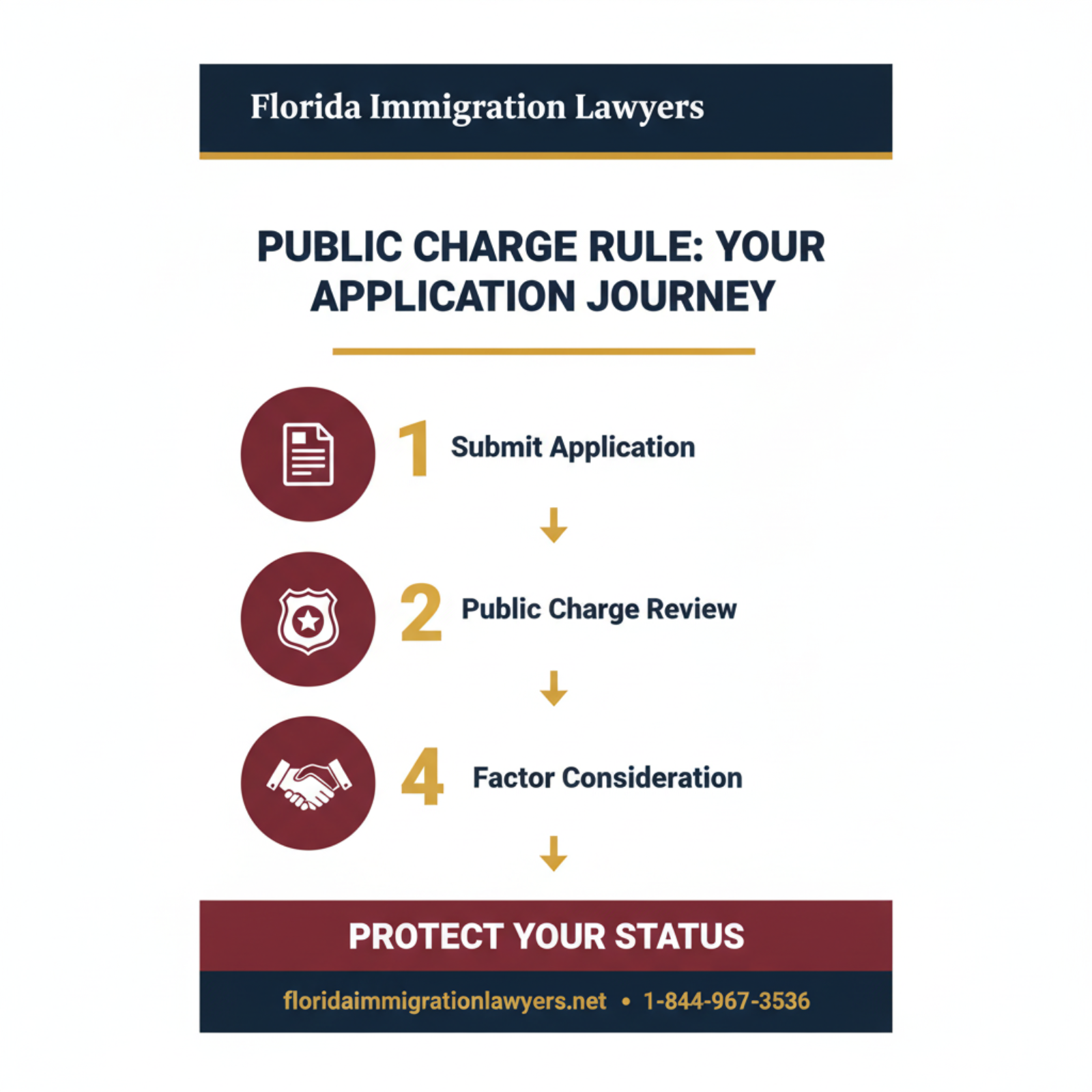
The public charge assessment is a prospective determination. Immigration officials evaluate whether an applicant is likely to become a public charge in the future. This is not about past benefit use, unless it indicates a future likelihood of primary reliance. The process involves a holistic review of various factors.
- Understand the Applicability: First, determine if the public charge rule applies to your specific immigration case. As discussed, certain visa categories and statuses are exempt. Consulting with an attorney is the best way to confirm your situation.
- Gather Financial Documentation: Prepare extensive documentation demonstrating your financial stability and ability to be self-sufficient. This includes income, assets, and resources. For Florida immigrants in Miami, this could involve proof of employment from local businesses or property ownership in the region.
- Submit Form I-864, Affidavit of Support (if applicable): If you are applying for a family-based green card, a U.S. citizen or lawful permanent resident sponsor must typically file Form I-864. This affidavit legally binds the sponsor to support you, demonstrating that you will not become a public charge. The sponsor must meet specific income requirements.
- Prepare Evidence of Other Positive Factors: USCIS considers a range of factors beyond just income. These include your age, health, family status, education, skills, and prospective employment opportunities. Highlighting strong English language skills or a degree from a Florida university, for example, can be beneficial.
- Attend Your Interview: During your adjustment of status interview at a USCIS field office in Florida (e.g., Miami Field Office), or your consular interview abroad, be prepared to discuss your financial situation and ability to support yourself. An immigration officer will ask questions related to your self-sufficiency.
- Address Any Concerns: If the immigration officer has concerns about your public charge potential, you may be given an opportunity to provide additional evidence or submit a Form I-945, Public Charge Bond. This bond acts as a financial guarantee that you will not become a public charge. However, the use of this bond is rare under current policy.
Essential Documents for Public Charge Assessment
A thorough preparation of your documentation is paramount for a successful green card application and to address the public charge rule Florida immigrants face. Organizing these documents meticulously can significantly streamline your case and demonstrate your self-sufficiency.
- Proof of Income: Federal tax returns (for the last 3 years), W-2 forms, pay stubs, letters from employers verifying employment and salary.
- Proof of Assets: Bank statements, property deeds (e.g., Florida real estate), investment portfolios, retirement accounts.
- Affidavit of Support (Form I-864): Completed and signed by your financial sponsor, along with their supporting financial documents.
- Health Insurance Information: Proof of health insurance coverage or ability to obtain it.
- Education and Skills: Diplomas, degrees, vocational training certificates, professional licenses, employment history demonstrating skills.
- Proof of Family Status: Birth certificates, marriage certificates, divorce decrees, demonstrating dependents or family support.
- Any Other Relevant Evidence: Letters from community organizations, volunteer work, or any other documentation that demonstrates your ability and willingness to be self-sufficient.
Public Charge Processing Times and Expectations
The timeline for a public charge determination is integrated into the overall processing time for your immigration application, such as a green card application or visa petition. There isn't a separate, distinct processing time solely for the public charge assessment. However, delays can occur if officials require additional evidence or have concerns.
For Florida immigrants, processing times can vary significantly depending on the specific USCIS field office (e.g., Miami, Orlando) or the U.S. consulate abroad. You can check the USCIS website for current processing times for various forms. Be prepared for the possibility of requests for evidence (RFEs) if your initial submission is deemed incomplete or raises questions regarding your potential to become a public charge. Responding promptly and thoroughly to RFEs is crucial to avoid further delays.
Factors Influencing Processing Speed
Several factors can influence how quickly your public charge rule Florida immigrants case is processed. These include the completeness of your initial application, the accuracy of your financial documentation, the caseload at the processing center, and any unforeseen policy changes. Proactive preparation and legal guidance can help minimize potential delays.
Understanding Costs and Fees in Public Charge Cases
While there isn't a specific "public charge fee," the assessment is part of a larger immigration application process that involves various costs. These can include filing fees for forms like the I-485 (Application to Register Permanent Residence or Adjust Status) or the I-130 (Petition for Alien Relative). USCIS fees are subject to change, so always check the official USCIS website for the most current amounts.
Beyond government filing fees, Florida immigrants should also budget for other potential expenses. These may include fees for medical examinations, translation services for foreign documents, and obtaining certified copies of records. Perhaps the most significant "cost" that provides immense value is legal representation. An experienced immigration attorney can help you navigate the complexities of the federal public charge policy, prepare compelling documentation, and represent you effectively.
Do not navigate this complex and critical process alone. The stakes for your future in Florida are too high. Contact Florida Immigration Lawyers today at 1-844-967-3536 for expert legal guidance and a free consultation. We are here to protect your interests.
Common Mistakes to Avoid for Florida Immigrants Under the Public Charge Rule
Avoiding common pitfalls is crucial when dealing with the public charge rule Florida immigrants face. A single error or oversight could lead to significant delays or even a denial of your immigration application. Be meticulous and seek professional help.
- Misunderstanding Which Benefits Are Counted: Many applicants mistakenly believe all government assistance makes them a public charge. This often leads to unnecessary fear or avoiding benefits they are eligible for and that are not counted, such as SNAP or most Medicaid. Consequences: Unnecessary stress, missed eligible benefits.
- Incomplete Financial Documentation: Failing to provide thorough and consistent evidence of income, assets, and resources. USCIS needs a clear picture of your financial stability. Consequences: Requests for Evidence (RFEs), significant delays, potential denial.
- Not Filing a Robust Affidavit of Support (Form I-864): For family-based petitions, the I-864 is critical. If the sponsor's income is insufficient or the form is incomplete, it can jeopardize the entire green card application. Consequences: RFE, interview difficulties, denial.
- Ignoring Positive Factors: Overlooking or failing to highlight strong positive factors like education, job skills, and health insurance coverage. These factors can significantly strengthen your case. Consequences: Weaker application, increased scrutiny.
- Providing Inconsistent Information: Discrepancies between your application forms, supporting documents, and interview statements can raise red flags. Ensure all information is accurate and consistent. Consequences: Credibility issues, potential accusations of misrepresentation.
- Failing to Disclose Past Benefit Use (if applicable and relevant): While most non-cash benefits are not considered, intentionally concealing any information can be detrimental. Always be truthful and transparent, even if you believe a benefit is irrelevant. Consequences: Accusations of fraud, denial, potential bars to future immigration.
- Delaying Response to Requests for Evidence (RFEs): USCIS provides a specific deadline for responding to RFEs. Failing to meet this deadline or providing an inadequate response can lead to denial. Consequences: Application denial, restart the process.
- Not Seeking Legal Counsel: Attempting to navigate the complex federal public charge policy without expert legal advice. This rule is nuanced and constantly evolving. Consequences: Mistakes, delays, denial, missed opportunities.
- Assuming Exemptions Apply Without Confirmation: Believing you are exempt from the rule without verifying your specific category with a legal expert. Consequences: Unpreparedness, application denial.
- Ignoring Florida-Specific Context: Not considering local job markets, community resources, or specific USCIS office expectations in Florida, especially in areas like Miami. Consequences: Less tailored preparation, potential for missteps.
When to Call a Lawyer for Public Charge Concerns
The public charge rule can be one of the most confusing aspects of immigration law, and its implications are severe. You should consider calling an experienced immigration lawyer, like those at Florida Immigration Lawyers, at several key points in your journey. We are here to help Florida immigrants navigate these challenges.
- Before Filing Any Application: If you have concerns about your eligibility or past benefit use, or if you simply want to ensure your application is as strong as possible from the start.
- If You Have Received Public Benefits: Even if you believe they are not counted, an attorney can review your history and advise on potential impacts.
- If You Are Exempt from the Rule: An attorney can confirm your exemption status and help you gather the necessary documentation to prove it.
- If You Receive a Request for Evidence (RFE): This indicates USCIS has concerns. An attorney can help you formulate a comprehensive and persuasive response.
- If Your Case Involves Complex Financial Situations: Such as business ownership, multiple income sources, or unusual asset structures.
- If You Are Concerned About an Interview: An attorney can prepare you for public charge-related questions and, in some cases, represent you at the interview.
- If You Are Applying for a Green Card Through a Family Member: The Affidavit of Support (Form I-864) is critical, and an attorney can ensure it is correctly prepared and supported.
- If You Are Seeking Asylum or Other Humanitarian Relief: While often exempt, understanding your full legal protections is crucial. Learn more about our asylum services.
- If You Are Facing Deportation Proceedings: The public charge rule can sometimes be a factor in deportation defense, and an attorney is indispensable.
- For General Immigration and Citizenship Questions: Our firm handles a wide range of immigration law matters, including citizenship applications.
Our attorneys at Florida Immigration Lawyers possess in-depth knowledge of federal public charge policy and local Florida immigrants contexts, including the Miami area. We can assess your unique situation, identify potential challenges, and develop a robust strategy to protect your interests. Do not risk your future; contact us for peace of mind.
Can ICE ask for immigration status in public?
This is a common concern among Florida immigrants. While law enforcement officers, including ICE agents, generally have the authority to ask about immigration status, individuals are not typically required to answer. You have the right to remain silent. It's important to remember that immigration enforcement often occurs in public places. Knowing your rights is essential, and an attorney can provide guidance on how to respond if approached.
Can cops ask for immigration status in Florida?
Similar to ICE, local law enforcement officers in Florida can ask about immigration status. However, your rights generally remain the same: you are not obligated to answer questions about your citizenship or immigration status. It's advisable to politely decline to answer such questions and to state that you wish to speak with an attorney. For more information on your rights, consider consulting an attorney or reliable immigrant rights organizations.
About Florida Immigration Lawyers
Florida Immigration Lawyers is a leading immigration law firm dedicated to serving individuals and families across all of Florida, including Miami, Orlando, and Tampa. Our mission is to provide compassionate, effective, and results-driven legal representation for all your immigration needs. We understand the profound impact immigration matters have on your life, and we are committed to guiding you through every step of the process.
Our team of experienced attorneys specializes in a comprehensive range of immigration services. Whether you are pursuing a green card application through family immigration, seeking a visa for business immigration, or navigating complex issues like the public charge rule Florida immigrants face, we are equipped to assist. We pride ourselves on offering personalized strategies tailored to your unique circumstances, ensuring you receive the highest caliber of legal support.
At Florida Immigration Lawyers, we believe in accessible legal help. That's why we offer free consultations and are available 24/7 to address your urgent questions and concerns. With a deep understanding of federal public charge policy and Florida's specific legal landscape, we are your trusted partners in achieving your immigration goals. Call us today at 1-844-967-3536 or visit our website at https://www.floridaimmigrationlawyers.net to schedule your free consultation. Se Habla Español.
Sources and References
- U.S. Citizenship and Immigration Services (USCIS) Policy Manual, Volume 8, Part G, Chapter 3 - Public Charge
- U.S. Citizenship and Immigration Services (USCIS) - Public Charge Fact Sheet
- Executive Office for Immigration Review (EOIR)
- 8 U.S.C. § 1182(a)(4) - Immigration and Nationality Act (INA) - Inadmissible Aliens - Public Charge
- 8 CFR § 212.22 - Public Charge - Definitions and Factors
This article provides general legal information and is not intended as legal advice. Every case is unique, and outcomes depend on specific facts and circumstances. Contact an attorney for advice about your particular situation.
Your immigration journey is too important to navigate without expert guidance. If you are a Florida immigrant concerned about the public charge rule or any other immigration matter, do not hesitate. Call Florida Immigration Lawyers now at 1-844-967-3536 for a free, confidential consultation. Let us put our expertise to work for you. Se Habla Español - Estamos aquí para ayudarle.
Need help with Immigration?
Our Florida immigration attorneys offer free consultations. Call today or schedule online.
Frequently Asked Questions
Florida Immigration Lawyers
Legal Team
Our experienced attorneys at Florida Immigration Lawyers have been serving clients across Florida for over 20 years. We specialize in immigration, personal injury, criminal defense, workers compensation, and family law.