H-1B Visa Fee Increase Florida: Navigating New Costs in Kissimmee
The H-1B visa fee increase in Florida, effective in 2026, significantly impacts employers and skilled foreign workers, including those in Kissimmee. These changes involve higher filing fees, a new Asylum Program Fee, and adjusted premium processing costs. Understanding these updated financial requirements and procedural shifts is crucial for a successful application. This guide provides a comprehensive breakdown of the new fee structure, application steps, document checklist, and common mistakes to avoid. Learn how Florida Immigration Lawyers can help you navigate these complexities and ensure compliance. Don't face these changes alone; contact us for expert legal guidance.
The H-1B visa fee increase in Florida, effective in 2026, significantly impacts employers and skilled foreign workers, including those in Kissimmee. These changes involve higher filing fees, a new Asylum Program Fee, and adjusted premium processing costs. Understanding these updated financial requirements and procedural shifts is crucial for a successful application. Navigating these complexities often requires expert legal guidance to ensure compliance and avoid costly delays.
- New USCIS fees and surcharges are effective in 2026.
- Employers bear the primary responsibility for most H-1B fees.
- Premium processing fees have also seen an adjustment.
- Consulting an immigration lawyer is vital for compliance.
- Proper preparation can mitigate potential delays.
H-1B Visa Fee Increase Florida: Navigating New Costs in Kissimmee
Are you an employer in Kissimmee, Florida, relying on skilled foreign talent, or a professional seeking an H-1B visa to work in the Sunshine State? If so, you are likely aware of the recent H-1B visa fee increase in Florida, which became effective in 2026. These changes represent a significant shift in the financial landscape for H-1B petitions, impacting businesses and individuals alike across Florida.
The U.S. Citizenship and Immigration Services (USCIS) regularly adjusts its fees to cover operational costs and fund various immigration programs. The latest adjustments, particularly the new Asylum Program Fee, add layers of complexity and expense to the H-1B process. Understanding these updated requirements is essential for anyone involved in H-1B immigration.
This comprehensive guide will break down the new H-1B visa fee increase in Florida, explain who is affected, and provide a clear roadmap for navigating the updated process. We will cover everything from the application steps and necessary documents to timelines, cost factors, and common pitfalls to avoid. Call Florida Immigration Lawyers at 1-844-967-3536 for a free consultation to discuss your specific H-1B visa situation.
Understanding the H-1B Visa Fee Structure in 2026
The H-1B visa program is crucial for U.S. employers to hire foreign workers in specialty occupations. These roles typically require a bachelor's degree or higher in a specific field. The recent fee adjustments by USCIS have redefined the financial obligations associated with this vital visa category, affecting petitions filed in Florida and nationwide.
As of 2026, the H-1B visa fee increase includes several components. These components range from the base filing fee to specific surcharges that apply under various circumstances. It is important for petitioners to understand each fee to accurately calculate the total cost of an H-1B application.
Key Components of the New H-1B Visa Fees
The updated fee structure involves several distinct charges. These include the base filing fee for Form I-129, Petition for a Nonimmigrant Worker, and additional fees that depend on the employer's size and other factors. Understanding each fee is critical for budgeting and compliance.
- Base Filing Fee (Form I-129): This is the fundamental fee for filing the H-1B petition. Its amount has seen an increase to reflect current processing costs.
- American Competitiveness and Workforce Improvement Act (ACWIA) Fee: This fee supports U.S. worker training and education programs. It applies to most employers, with different rates for small employers (25 or fewer full-time equivalent employees) and larger employers.
- Fraud Prevention and Detection Fee: This fee is mandated for initial H-1B petitions and for petitions involving a change of employer. It helps fund anti-fraud initiatives.
- Public Law 114-113 Fee (H-1B and L-1 Visa Fraud Prevention and Detection Fee): This specific fee applies to employers with 50 or more employees, where more than 50% of their U.S. workforce holds H-1B or L-1 nonimmigrant status. This fee can be substantial.
- Asylum Program Fee: This is a significant new addition to the fee structure, designed to fund asylum processing. It applies to most employment-based petitions, including H-1B.
- Premium Processing Fee: For those seeking expedited processing, this optional fee guarantees a decision within a specific timeframe, typically 15 calendar days. This fee has also increased.
Step-by-Step Guide to the H-1B Application Process with New Fees
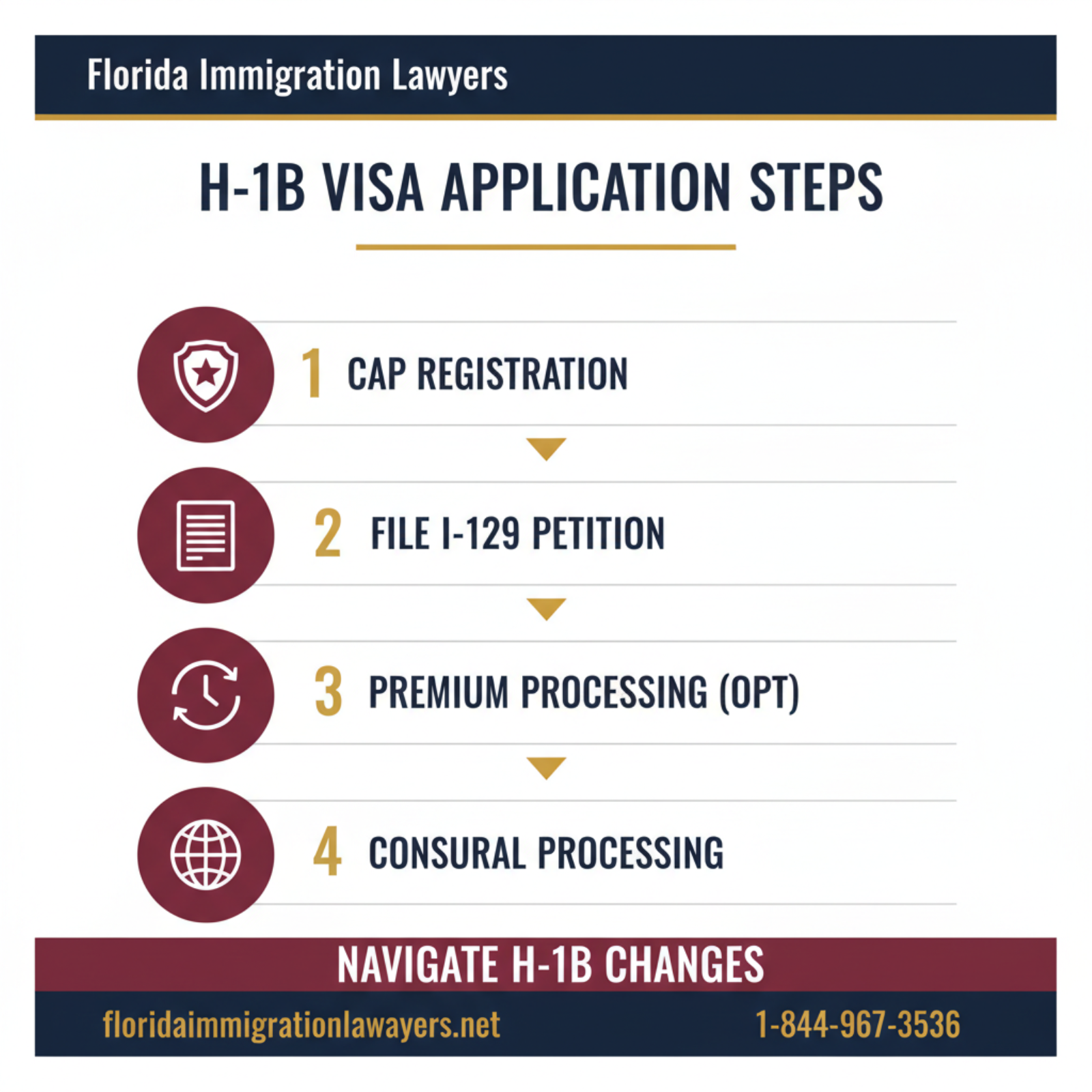
Navigating the H-1B application process, especially with the H-1B visa fee increase in Florida, requires careful attention to detail. This step-by-step guide outlines the typical journey, emphasizing the points where new fees come into play. Employers and beneficiaries in Kissimmee and throughout Florida should familiarize themselves with each stage.
- Employer Determines Eligibility and Job Offer: The employer must have a specialty occupation position available that requires at least a bachelor's degree. They must also offer a prevailing wage for the position, as determined by the U.S. Department of Labor (DOL). This step is crucial before any filing begins.
- Labor Condition Application (LCA) Filing: The employer files Form ETA-9035, Labor Condition Application, with the DOL. This form attests to compliance with H-1B wage and working condition requirements. The LCA must be certified by the DOL before the H-1B petition can be filed with USCIS.
- H-1B Lottery Registration (if applicable): For cap-subject H-1B petitions, employers must first register electronically during the designated registration period. If selected in the lottery, they receive a registration selection notice. This step involves a non-refundable H-1B registration fee per beneficiary, which has also been subject to recent adjustments.
- Petition Filing (Form I-129): Once an LCA is certified and, if applicable, a lottery selection is received, the employer files Form I-129, Petition for a Nonimmigrant Worker, with USCIS. This is where the bulk of the H-1B visa fee increase in Florida comes into play, including the base filing fee, ACWIA fee, fraud prevention fee, and the new Asylum Program Fee. All required fees must be paid accurately.
- USCIS Processing and Adjudication: USCIS reviews the petition and supporting documents. This stage can take several months, or it can be expedited through premium processing for an additional fee. USCIS may issue a Request for Evidence (RFE) if more information is needed.
- Visa Interview (for beneficiaries outside the U.S.): If the petition is approved, beneficiaries outside the U.S. must attend a visa interview at a U.S. embassy or consulate in their home country. This involves paying a separate visa application fee (MRV fee) to the Department of State.
- Entry into the U.S. or Change of Status: Upon successful interview, the visa is issued, allowing entry into the U.S. For beneficiaries already in the U.S., approval of Form I-129 typically grants a change of status to H-1B.
Essential Document Checklist for H-1B Petitions
A well-prepared H-1B petition requires a comprehensive set of documents. Ensuring all necessary paperwork is correctly compiled and submitted can prevent delays or requests for evidence. The following list outlines the typical documents required for an H-1B visa application, especially important given the H-1B visa fee increase in Florida and the need for a complete submission.
- Certified Labor Condition Application (LCA) Form ETA-9035.
- Form I-129, Petition for a Nonimmigrant Worker, with all required supplements.
- Employer's letter of support detailing the job offer, duties, and necessity for the H-1B worker.
- Beneficiary's educational credentials (degrees, transcripts, evaluations if foreign degrees).
- Beneficiary's resume or curriculum vitae.
- Copies of beneficiary's passport, visa, and I-94 (if applicable).
- Evidence of employer's ability to pay the proffered wage (e.g., financial statements, tax returns).
- Company's organizational chart and details about the specialty occupation.
- Job description outlining the specialized duties and required qualifications.
- Any previous USCIS approval notices (I-797) for the beneficiary.
- Copy of H-1B lottery registration selection notice (if applicable).
- Checks or money orders for all applicable USCIS fees, including the H-1B visa fee increase components.
Timeline and Processing Expectations for H-1B Visas
The timeline for H-1B visa processing can vary significantly based on several factors, including USCIS workload, the time of year, and whether premium processing is utilized. With the recent H-1B visa fee increase in Florida, it's also important to factor in potential administrative adjustments by USCIS. Planning ahead is crucial for both employers and beneficiaries.
For cap-subject H-1B petitions, the process typically begins with the electronic registration period in March. If selected, petitions can be filed starting April 1st for an October 1st start date. Regular processing can take anywhere from 6 to 12 months or even longer. For those in Kissimmee or other parts of Florida with urgent needs, premium processing offers a faster, albeit more expensive, option.
Factors Affecting H-1B Processing Times
- Cap-Subject vs. Cap-Exempt: Cap-subject petitions are limited by an annual quota and are subject to the lottery. Cap-exempt petitions (e.g., for non-profit research organizations, universities) can be filed at any time.
- USCIS Service Center: Processing times can vary between the different USCIS service centers that handle H-1B petitions.
- Completeness of Petition: Incomplete petitions or those requiring a Request for Evidence (RFE) will naturally experience longer processing times.
- Premium Processing: This service guarantees adjudication within 15 calendar days for an additional fee, making it a popular choice despite the H-1B visa fee increase.
Cost Factors and Fee Breakdown for H-1B Petitions
The H-1B visa fee increase in Florida, effective in 2026, has significantly altered the financial landscape for petitioners. Understanding each cost component is vital for employers in Kissimmee and throughout Florida to budget appropriately. These fees are generally paid by the employer, though some specific exceptions may apply for certain costs.
It is important to remember that fee amounts are subject to change by USCIS. The figures discussed here reflect the changes implemented around 2026. Always verify the latest fees directly on the USCIS website.
Detailed Breakdown of H-1B Visa Fees (Approximate as of 2026)
- H-1B Registration Fee: A small, non-refundable fee for each lottery entry. This fee has seen a notable increase to discourage frivolous registrations.
- Form I-129 Base Filing Fee: This is the primary fee for the petition itself. It has increased across various visa categories, including H-1B.
- ACWIA Fee (Public Law 105-277):
- Employers with 25 or fewer full-time equivalent employees: This fee is lower.
- Employers with 26 or more full-time equivalent employees: This fee is significantly higher.
- Fraud Prevention and Detection Fee (Public Law 108-447): This fee applies to initial H-1B petitions and change of employer petitions.
- Public Law 114-113 Fee: This additional fee applies to employers with 50 or more employees, where more than 50% are H-1B or L-1 nonimmigrants. This can add a substantial amount to the total cost.
- Asylum Program Fee: This new fee applies to Form I-129 and other employment-based petitions. It is a per-petitioner fee, not per beneficiary.
- Premium Processing Fee (Form I-907): An optional fee for expedited processing within 15 calendar days. This fee has also increased to reflect inflation and service demands.
- Attorney Fees: While not a USCIS fee, legal fees for an experienced immigration lawyer are a crucial part of the overall cost. Florida Immigration Lawyers offers transparent fee structures.
- Department of State Visa Application Fee (MRV Fee): Paid by the beneficiary for the visa interview at a U.S. embassy or consulate, if applicable.
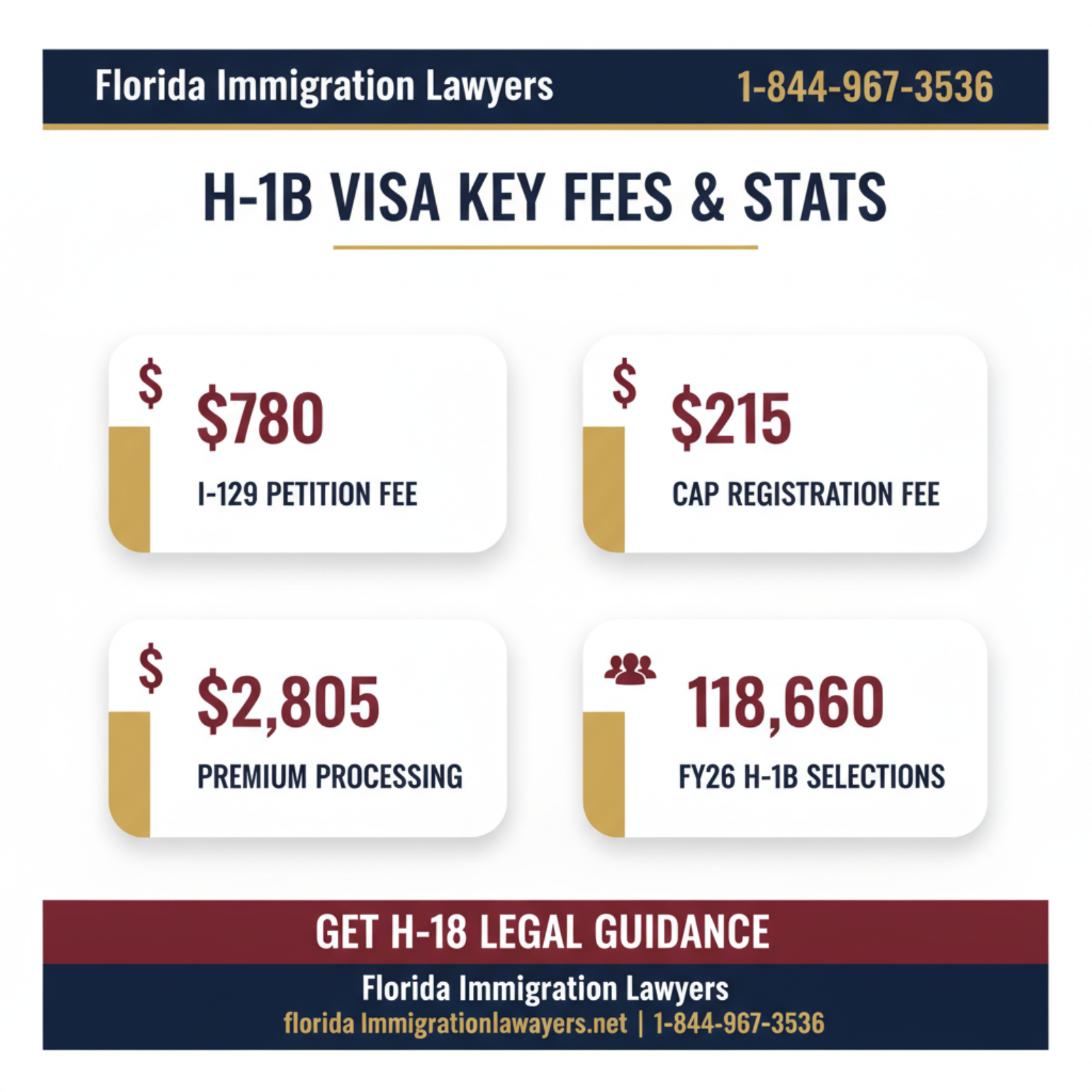
The total cost of an H-1B petition can range significantly depending on the employer's size, whether premium processing is used, and if the Public Law 114-113 fee applies. Employers in Kissimmee should carefully calculate these costs, considering the H-1B visa fee increase in Florida.
Do not navigate this process alone. Contact Florida Immigration Lawyers today for expert guidance on your H-1B visa petition and to understand the full financial implications.
Common Questions About H-1B Visa Fees
The H-1B visa fee increase in Florida has generated many questions. Here, we address some common inquiries, clarifying who pays which fees and debunking common misconceptions, especially concerning past proposals.
Who pays the H-1B fees?
Generally, the employer is responsible for paying most of the H-1B visa fees, including the base filing fee, ACWIA fee, fraud prevention and detection fee, Public Law 114-113 fee, and the new Asylum Program Fee. This is mandated by law to prevent employers from shifting these costs to the foreign worker, which could potentially exploit the worker. The only fee typically paid by the beneficiary is the Department of State visa application (MRV) fee for the interview at a U.S. embassy or consulate, if they are applying from abroad. Premium processing fees are optional and can be paid by either the employer or the beneficiary, though it is usually covered by the employer.
What is the new H-1B visa fee?
As of 2026, the new H-1B visa fees are not a single, consolidated amount but a combination of increased existing fees and new surcharges. Key changes include higher base filing fees for Form I-129, an increase in the H-1B registration fee, and the introduction of the Asylum Program Fee. Additionally, premium processing fees have been adjusted. It's crucial to consult the official USCIS website for the most current and specific fee schedules, as they are subject to change.
Who will be affected by new H-1B visa fees?
The H-1B visa fee increase in Florida and nationwide primarily affects U.S. employers who sponsor H-1B workers. They will incur higher costs for filing petitions, potentially impacting their hiring budgets and strategies for attracting global talent. Foreign workers, while not directly paying most of the USCIS fees, may indirectly experience shifts in job availability or employer willingness to sponsor due to increased financial burdens on companies. Employers in industries prevalent in Florida, such as technology, healthcare, and hospitality, will particularly feel these effects.
Common Mistakes to Avoid in H-1B Petitions
The H-1B application process is complex, and even minor errors can lead to significant delays, denials, or costly resubmissions. Given the H-1B visa fee increase in Florida, avoiding mistakes is more critical than ever to protect your investment. Here are some common pitfalls to watch out for:
- Incorrect Fee Payment: Submitting an incorrect fee amount or using an outdated fee schedule is a frequent error. USCIS will reject petitions with incorrect fees, causing delays. Always verify the current fees on the USCIS website.
- Incomplete or Inaccurate Forms: Failing to fill out all required fields on forms, providing inconsistent information, or omitting signatures can lead to RFEs or denials. Double-check every entry.
- Insufficient Evidence of Specialty Occupation: Not adequately demonstrating that the position truly requires a bachelor's degree or higher in a specific field is a common reason for RFE. Provide detailed job descriptions and organizational charts.
- Failure to Establish Employer-Employee Relationship: For third-party placements, proving a legitimate employer-employee relationship throughout the H-1B validity period can be challenging. Submit comprehensive contracts and work orders.
- Not Meeting Prevailing Wage Requirements: Failing to pay the H-1B worker at least the prevailing wage for the occupation in the specific geographic area (e.g., Kissimmee) can lead to LCA certification issues or USCIS scrutiny.
- Lack of Timely Filing: Missing deadlines, especially for cap-subject petitions or responses to RFEs, can result in the petition being rejected or denied. Be mindful of all submission dates.
- Poorly Prepared LCA: Errors or omissions on the Labor Condition Application (LCA) can cause delays with the Department of Labor or issues later with USCIS. Ensure accuracy and proper posting.
- Inadequate Documentation of Beneficiary's Qualifications: Not providing clear evidence of the beneficiary's educational qualifications, such as official transcripts and degree evaluations, can lead to questions about eligibility.
- Ignoring Public Access File Requirements: Employers must maintain a Public Access File (PAF) for each H-1B worker. Failure to do so can result in penalties during a DOL audit.
- Assuming Prior Approvals Guarantee Future Success: Even if a beneficiary has had H-1B status before, each new petition (especially with a new employer or significant changes) is evaluated independently.
- Not Consulting an Experienced Attorney: Attempting to navigate the complex H-1B process, particularly with the H-1B visa fee increase in Florida, without legal counsel significantly increases the risk of errors and delays.
When to Call a Florida Immigration Lawyer for H-1B Assistance
Common Mistakes to Avoid in H-1B Petitions
The H-1B application process is complex, and even minor errors can lead to significant delays, denials, or costly resubmissions. Given the H-1B visa fee increase in Florida, avoiding mistakes is more critical than ever to protect your investment. Here are some common pitfalls to watch out for:
- Incorrect Fee Payment: Submitting an incorrect fee amount or using an outdated fee schedule is a frequent error. USCIS will reject petitions with incorrect fees, causing delays. Always verify the current fees on the USCIS website.
- Incomplete or Inaccurate Forms: Failing to fill out all required fields on forms, providing inconsistent information, or omitting signatures can lead to RFEs or denials. Double-check every entry.
- Insufficient Evidence of Specialty Occupation: Not adequately demonstrating that the position truly requires a bachelor's degree or higher in a specific field is a common reason for RFE. Provide detailed job descriptions and organizational charts.
- Failure to Establish Employer-Employee Relationship: For third-party placements, proving a legitimate employer-employee relationship throughout the H-1B validity period can be challenging. Submit comprehensive contracts and work orders.
- Not Meeting Prevailing Wage Requirements: Failing to pay the H-1B worker at least the prevailing wage for the occupation in the specific geographic area (e.g., Kissimmee) can lead to LCA certification issues or USCIS scrutiny.
- Lack of Timely Filing: Missing deadlines, especially for cap-subject petitions or responses to RFEs, can result in the petition being rejected or denied. Be mindful of all submission dates.
- Poorly Prepared LCA: Errors or omissions on the Labor Condition Application (LCA) can cause delays with the Department of Labor or issues later with USCIS. Ensure accuracy and proper posting.
- Inadequate Documentation of Beneficiary's Qualifications: Not providing clear evidence of the beneficiary's educational qualifications, such as official transcripts and degree evaluations, can lead to questions about eligibility.
- Ignoring Public Access File Requirements: Employers must maintain a Public Access File (PAF) for each H-1B worker. Failure to do so can result in penalties during a DOL audit.
- Assuming Prior Approvals Guarantee Future Success: Even if a beneficiary has had H-1B status before, each new petition (especially with a new employer or significant changes) is evaluated independently.
- Not Consulting an Experienced Attorney: Attempting to navigate the complex H-1B process, particularly with the H-1B visa fee increase in Florida, without legal counsel significantly increases the risk of errors and delays.
While this guide provides extensive information, the H-1B visa process, especially with the H-1B visa fee increase in Florida, is highly intricate and subject to constant change. Knowing when to seek professional legal help is crucial for success. Florida Immigration Lawyers are here to provide the expertise you need.
You should consider contacting an attorney from Florida Immigration Lawyers if you encounter any of the following scenarios:
- Complex Job Duties: If the specialty occupation is unusual or difficult to define, legal guidance can help articulate the role effectively to USCIS.
- Employer or Beneficiary Has a Prior Immigration History: Any past immigration issues, denials, or complex statuses require careful legal review to avoid future problems.
- Request for Evidence (RFE): Receiving an RFE indicates USCIS needs more information or clarification. Responding effectively requires legal expertise.
- Public Law 114-113 Fee Applies: If your company falls under the 50/50 rule, the additional fee and compliance requirements necessitate legal review.
- Navigating the H-1B Lottery: Understanding the registration process and increasing chances of selection (within legal bounds) benefits from legal strategy.
- Changing Employers or Amending Petitions: Any changes to employment, location (e.g., moving from Kissimmee to Miami), or job duties require amended petitions, which can be complex.
- Concerned About Compliance: Employers worried about meeting prevailing wage, LCA, or Public Access File requirements can benefit from an audit and guidance.
- Any Doubts or Questions: If you are unsure about any aspect of the H-1B visa fee increase in Florida or the application process, a consultation can provide clarity and peace of mind.
Florida Immigration Lawyers has extensive experience in business immigration matters, including H-1B visas. We understand the specific challenges faced by employers and workers in Kissimmee and throughout Florida. Our team can help you prepare a robust petition, respond to RFEs, and ensure compliance with all federal regulations, including those related to the H-1B visa fee increase. We also handle related practice areas such as business immigration, family immigration, and deportation defense.
About Florida Immigration Lawyers
Florida Immigration Lawyers is a leading immigration law firm dedicated to serving individuals, families, and businesses across the entire state of Florida, including Kissimmee, Orlando, Miami, and Tampa. Our team of experienced attorneys is committed to providing compassionate, effective, and results-oriented legal representation for a wide range of immigration matters.
We understand the complexities and emotional toll that immigration processes can entail. Our mission is to simplify these challenges for you, offering personalized strategies and unwavering support. We pride ourselves on our deep understanding of U.S. immigration law and our commitment to our clients' success.
Our Services Include:
- H-1B Visas and other Employment-Based Visas
- Family-Based Immigration and Green Cards
- Asylum and Refugee Status
- Deportation and Removal Defense
- Citizenship and Naturalization
- Visa Appeals and Waivers
- And many more immigration solutions.
Why Choose Florida Immigration Lawyers?
- Experienced Attorneys: Our lawyers possess extensive knowledge and experience in all facets of immigration law.
- Client-Centered Approach: Your needs and concerns are our top priority. We provide clear communication and personalized attention.
- Statewide Coverage: We serve clients in every corner of Florida, offering accessible legal assistance.
- Bilingual Services: Our team is fluent in English and Spanish, ensuring effective communication for a diverse clientele.
- Free Consultations: We offer initial free consultations to discuss your case and outline your options.
Contact us today to learn how we can assist you with your immigration journey. Call us at 1-844-967-3536 or visit our website at https://www.floridaimmigrationlawyers.net. We are available 24/7 to answer your questions and provide the legal support you deserve.
Sources and References
- U.S. Citizenship and Immigration Services (USCIS)
- USCIS Fee Schedule
- U.S. Department of Labor (DOL) - H-1B Program
- 8 U.S.C. § 1101 et seq. - Immigration and Nationality Act (INA)
- 8 CFR Part 214 - Nonimmigrant Classes
- Public Law 105-277 - American Competitiveness and Workforce Improvement Act of 1998 (ACWIA)
- Public Law 108-447 - Consolidated Appropriations Act, 2005 (Fraud Prevention and Detection Fee)
- Public Law 114-113 - Consolidated Appropriations Act, 2016 (Additional H-1B and L-1 Fee)
This article provides general legal information and is not intended as legal advice. Every case is unique, and outcomes depend on specific facts and circumstances. Contact an attorney for advice about your particular situation.
The H-1B visa fee increase in Florida presents new hurdles for employers and skilled professionals. However, with careful planning and the right legal support, these challenges can be successfully overcome. Do not let the complexities of immigration law deter you from your goals. Our dedicated team at Florida Immigration Lawyers is ready to assist you every step of the way.
Contact Florida Immigration Lawyers today for a free consultation at 1-844-967-3536. Se Habla Español - Estamos aquí para ayudarle.
Florida Immigration Lawyers
Legal Team
Our experienced attorneys at Florida Immigration Lawyers have been serving clients across Florida for over 20 years. We specialize in immigration, personal injury, criminal defense, workers compensation, and family law.