H-1B Visa Fee Increase in Florida: What You Need to Know in 2026
The H-1B visa fee increase for 2026, including a potential $100,000 additional fee for certain employers, marks a significant shift for businesses and professionals in Florida. This comprehensive guide from Florida Immigration Lawyers details the new cost structures, potential exemptions, and the intricate application process. We provide critical insights into who is affected, how to navigate the changes, and essential documents required. Understanding these updates is crucial for successful H-1B petitioning in 2026. For expert assistance and peace of mind, contact Florida Immigration Lawyers for a free consultation.
The **H-1B visa fee increase** in 2026 significantly impacts employers and foreign professionals in Florida. New regulations, including a potential $100,000 additional fee for certain petitions, demand careful planning. Understanding exemptions and the complex application process is crucial. Seeking legal guidance from experienced Florida immigration lawyers is highly recommended to navigate these changes successfully.
- The H-1B visa landscape in Florida is evolving with new fee structures in 2026.
- A substantial additional fee, potentially $100,000, may apply to specific H-1B petitions.
- Employers and applicants should identify potential exemptions to these increased costs.
- The application process remains complex, requiring meticulous documentation and adherence to deadlines.
- Consulting with a Florida immigration lawyer is essential for informed decision-making and compliance.
Are you an employer in Pembroke Pines, Florida, seeking to hire skilled foreign talent, or a professional aiming to work in the Sunshine State? The **H-1B visa fee increase** for 2026 introduces significant changes you need to understand. Navigating these new regulations can be daunting, but with the right information, you can prepare effectively.
This comprehensive guide from Florida Immigration Lawyers will break down the latest updates regarding **H1B visa fees 2026**. We will cover the new cost structures, potential exemptions, and the overall impact on employers and beneficiaries across Florida. Our goal is to empower you with the knowledge to make informed decisions about your immigration journey.
Do not let complex legal changes overwhelm your plans. For personalized guidance on the **H-1B visa fee increase** and your specific situation, call Florida Immigration Lawyers at 1-844-967-3536 for a free consultation. We are here to help you understand every aspect of the process.
Understanding the H-1B Visa in 2026: A Florida Perspective
The H-1B visa program is vital for many Florida businesses, allowing them to employ foreign workers in specialty occupations. These roles typically require a bachelor's degree or higher in a specific field. From the tech hubs in Orlando to the healthcare providers in Miami, skilled professionals on H-1B visas contribute significantly to Florida's economy. Learn more about our comprehensive business immigration services.
However, the immigration landscape is constantly shifting. Recent policy changes and proposed legislation, particularly concerning the **H-1B visa fee increase**, have created new challenges. It is crucial for both employers and prospective employees to stay informed about these evolving requirements.
What is the H-1B Visa?
The H-1B visa is a nonimmigrant visa that permits U.S. employers to temporarily employ foreign workers in specialty occupations. These positions generally require theoretical and practical application of a body of highly specialized knowledge. USCIS administers the H-1B program, which is subject to an annual cap, limiting the number of visas issued each fiscal year.
The Impact of Recent Fee Changes on Florida
The year 2026 brings significant changes to the financial burden associated with H-1B petitions. Most notably, a substantial **H-1B visa fee increase**, including a potential $100,000 additional fee, has been introduced for certain employers. This change aims to incentivize the hiring of U.S. workers and impacts companies that rely heavily on H-1B employees.
For businesses in Pembroke Pines and across Florida, this increase necessitates a reevaluation of recruitment strategies and budgets. Understanding who is affected and what exemptions exist is paramount. Florida Immigration Lawyers can help you navigate these complex regulations and determine the best course of action for your business.
Navigating the H-1B Visa Application Process
Applying for an H-1B visa is a multi-step process that requires meticulous attention to detail. Any errors or omissions can lead to delays or even denial. Here is a general outline of the steps involved, especially considering the **H-1B visa fee increase** in 2026.
- Labor Condition Application (LCA) Filing: The employer must first file a Form ETA-9035, Labor Condition Application, with the U.S. Department of Labor (DOL). This certifies the employer will pay the H-1B worker at least the prevailing wage and that working conditions will not adversely affect U.S. workers.
- H-1B Cap Registration (if applicable): If subject to the annual cap, employers register for the H-1B lottery during the designated period. This involves submitting basic information about the company and the prospective employee to USCIS.
- H-1B Petition Filing: If selected in the lottery or if the petition is cap-exempt, the employer files Form I-129, Petition for a Nonimmigrant Worker, with U.S. Citizenship and Immigration Services (USCIS). This petition includes supporting documentation about the employer, the beneficiary, and the specialty occupation.
- Paying Required Fees: This is where the **H-1B visa fee increase** comes into play. Employers must submit all applicable fees, which can include the base filing fee, ACWIA fee, fraud prevention and detection fee, and potentially the new $100,000 additional fee for certain employers.
- Premium Processing (Optional): Employers may opt for premium processing by filing Form I-907 and paying an additional fee. This ensures USCIS processes the petition within a specified timeframe, typically 15 calendar days.
- USCIS Decision: USCIS reviews the petition and supporting evidence. They may issue a Request for Evidence (RFE) if more information is needed. Upon approval, USCIS sends an I-797 Approval Notice.
- Visa Interview (for those outside the U.S.): If the beneficiary is outside the U.S., they must attend an interview at a U.S. Embassy or Consulate in their home country. They will need to present their I-797 approval notice and other required documents.
- Entry to the U.S.: Upon visa approval, the beneficiary can enter the U.S. and begin working for the petitioning employer. They must adhere to the terms and conditions of their H-1B visa.
Each step requires careful preparation and adherence to strict deadlines. Working with an experienced immigration attorney from Florida Immigration Lawyers can significantly streamline this process and prevent costly errors. Explore all our immigration services.
Essential Documents for Your H-1B Petition
A successful H-1B petition hinges on submitting a complete and accurate set of documents. Missing or incorrect paperwork can lead to Requests for Evidence (RFEs) or even denial, especially with the heightened scrutiny surrounding the **H-1B visa fee increase**. Ensure you gather all necessary items before filing.
- Certified Labor Condition Application (LCA) – Form ETA-9035.
- Form I-129, Petition for a Nonimmigrant Worker, and all applicable supplements.
- Evidence of the beneficiary's educational qualifications (degrees, transcripts, evaluations).
- Beneficiary's resume and letters of experience.
- Copy of the beneficiary's passport, visa, I-94 record, and previous I-797 approval notices (if applicable).
- Employer's Federal Employer Identification Number (FEIN).
- Company's financial statements, tax returns, and business license.
- Job offer letter detailing the specialty occupation, salary, and terms of employment.
- Detailed description of the specialty occupation duties and requirements.
- Evidence of employer-employee relationship (e.g., contracts, organizational charts).
- Photographs of the beneficiary (passport-style).
- Certified translations of any foreign language documents.
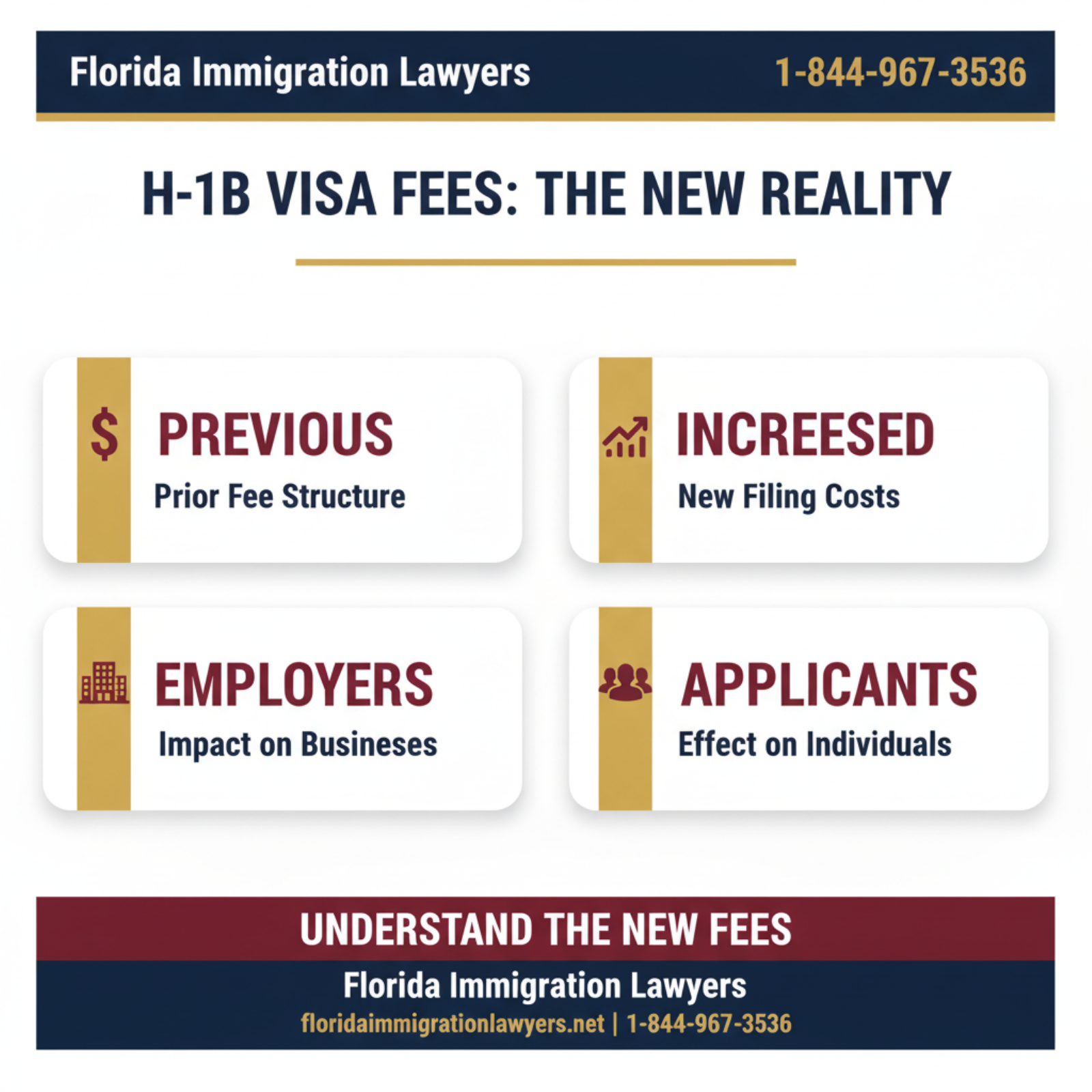
This list is not exhaustive, and specific cases may require additional documentation. Florida Immigration Lawyers can provide a tailored checklist to ensure your petition is robust and complete.
H-1B Visa Timelines and Processing Expectations for Florida Applicants
Understanding the typical timeline for H-1B visa processing is crucial for planning, especially with the new **H-1B visa fee increase** for 2026. The H-1B process can be lengthy and vary based on several factors, including the annual cap and USCIS processing loads.
- LCA Processing: Typically 7-10 business days.
- H-1B Cap Registration: Usually in March, with results announced by the end of March.
- Petition Filing Window: If selected, petitions are filed starting April 1st for an October 1st start date.
- Regular Processing: Can take anywhere from 3 to 6 months, or even longer, depending on the USCIS service center workload.
- Premium Processing: Guarantees a response within 15 calendar days for an additional fee. This option is often utilized by Florida employers needing faster processing.
- Visa Interview and Stamping: Once the petition is approved, scheduling an interview at a U.S. Consulate abroad can take several weeks to a few months.
It's important to remember that these are general estimates. Unforeseen circumstances, such as government shutdowns or Requests for Evidence (RFEs), can significantly impact processing times. Staying organized and proactive is key, and our firm can help you track your petition's progress.
H-1B Visa Fee Increase: A Detailed Breakdown for 2026
The **H-1B visa fee increase** for 2026 introduces several new financial considerations for employers. Beyond the standard fees, the potential for a $100,000 additional fee for specific companies has garnered significant attention. Understanding these costs is vital for any Florida business contemplating H-1B sponsorship.
Understanding the New $100,000 Fee
The most significant change is the introduction of a substantial additional fee, often referred to as the "$100,000 H-1B fee." This fee generally applies to employers with 50 or more employees, where 50% or more of their workforce consists of H-1B or L-1 nonimmigrant visa holders. This fee aims to discourage over-reliance on foreign workers in certain sectors.
There are important distinctions and potential **H1B visa $100K fee exemption** criteria. For instance, universities and non-profit research organizations are often exempt from this fee. It is crucial to assess if your company falls under this category. The "H1B 100k fee when to pay" question is critical; this fee is typically paid at the time of filing the Form I-129 petition. Incorrect fee payment can lead to rejection.
Other Associated H-1B Costs
Beyond the potential $100,000 fee, several other standard fees apply to H-1B petitions. These include:
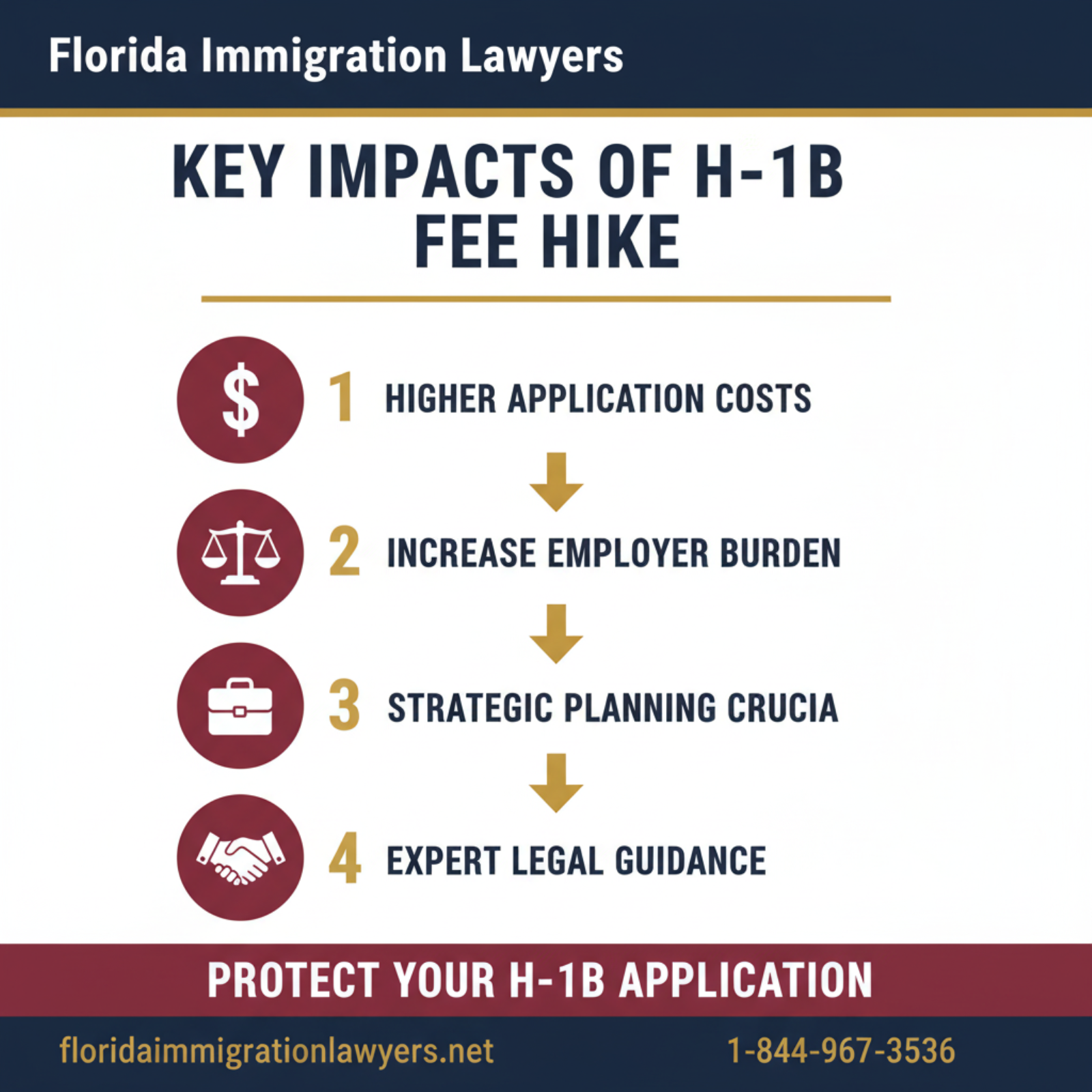
- USCIS Base Filing Fee: The standard fee for filing Form I-129.
- American Competitiveness and Workforce Improvement Act (ACWIA) Fee: Varies based on employer size.
- Fraud Prevention and Detection Fee: Mandatory for all initial H-1B petitions and new employment petitions.
- Public Law 114-113 Fee (if applicable): An additional fee for employers meeting specific H-1B/L-1 workforce composition criteria, distinct from the new $100,000 fee.
- Premium Processing Fee (Optional): For expedited processing.
- Attorney Fees: Legal fees for professional immigration services.
- Visa Application Fee (DS-160): Paid by the beneficiary for consular processing.
These fees are subject to change, and USCIS regularly updates its fee schedule. Consulting with Florida Immigration Lawyers ensures you have the most current information and accurately calculate your total costs. We understand the financial implications of the **USCIS $100k fee h1b** and other charges.
The complexities of the **H-1B visa fee increase** and the application process can be overwhelming. Do not navigate this process alone. Contact Florida Immigration Lawyers today for expert assistance and peace of mind. Our team is ready to provide the support you need.
Common Mistakes to Avoid in Your H-1B Petition
The H-1B visa process is intricate, and even minor errors can lead to significant setbacks. Being aware of common pitfalls can save you time, money, and stress, especially with the added complexities of the **H-1B visa fee increase**.
- Incorrectly Calculating or Paying Fees: With the new **H-1B visa fee increase** and potential $100,000 fee, miscalculating or submitting the wrong amount is a critical error. Consequences: Petition rejection, significant delays, or even denial.
- Failing to Meet Prevailing Wage Requirements: Employers must pay the H-1B worker at least the prevailing wage for their occupation. Consequences: DOL investigations, fines, and potential debarment from future immigration programs.
- Submitting Incomplete Documentation: Missing required forms, signatures, or supporting evidence is a frequent mistake. Consequences: Request for Evidence (RFE), which prolongs the process and adds stress, or outright denial.
- Not Establishing a Valid Employer-Employee Relationship: This is particularly relevant for third-party placements. USCIS scrutinizes whether the petitioning employer truly controls the H-1B worker. Consequences: RFE or denial, especially for IT consulting firms.
- Missing Deadlines for Cap-Subject Petitions: The H-1B cap registration and filing windows are strict. Consequences: Missed opportunity to secure a visa for the current year.
- Inadequate Proof of Specialty Occupation: The job duties must clearly demonstrate that the position requires a bachelor's degree or higher in a specific field. Consequences: RFE questioning the "specialty occupation" aspect, leading to delays or denial.
- Lack of Proper Education Credential Evaluation: Foreign degrees must be evaluated for U.S. equivalency. Consequences: RFE or denial based on insufficient educational qualifications.
- Providing Inconsistent Information: Discrepancies between the LCA, I-129 petition, and supporting documents can raise red flags. Consequences: Increased scrutiny, RFEs, or suspicion of misrepresentation.
- Assuming an Exemption from the $100,000 Fee Without Verification: Many employers might assume they are exempt from the new $100,000 fee. Each case needs careful review against current regulations. Consequences: Petition rejection due to underpayment of fees.
These mistakes can be costly. Partnering with an experienced Florida immigration lawyer is the best way to ensure your H-1B petition is prepared accurately and efficiently.
When to Call a Florida Immigration Lawyer for Your H-1B Visa
Given the complexities of the H-1B visa program, especially with the **H-1B visa fee increase** for 2026, professional legal guidance is invaluable. While some aspects might seem straightforward, specific situations warrant immediate consultation with an experienced Florida immigration lawyer.
You should consider contacting Florida Immigration Lawyers if any of the following scenarios apply to your situation:
- Uncertainty about the New Fee Structure: If you are unsure whether your company is subject to the new $100,000 H-1B fee or if you qualify for an **H1B visa $100K fee exemption**.
- Previous H-1B Denials or RFEs: If your prior H-1B petitions have been denied or received Requests for Evidence (RFEs), a lawyer can help analyze the reasons and strategize a stronger re-filing.
- Complex Employer-Employee Relationship: For staffing agencies or third-party placements, establishing a valid employer-employee relationship can be challenging.
- Changes in Employment: If an H-1B employee's job duties, location, or employer changes, an amended petition may be required. A lawyer ensures compliance.
- Immigration History Complications: Any prior visa overstays, criminal records, or other immigration violations can significantly complicate an H-1B petition.
- General Confusion and Stress: The sheer volume of paperwork, legal jargon, and evolving regulations can be overwhelming. A lawyer provides clarity and peace of mind.
At Florida Immigration Lawyers, we specialize in helping individuals and businesses in Pembroke Pines and throughout Florida navigate the H-1B visa process. Our attorneys are adept at handling the nuances of the **H-1B visa fee increase** and other policy changes. Meet our experienced legal team. We offer comprehensive services, from initial assessment to petition filing and responding to RFEs. Do not leave your immigration future to chance; let our expertise guide you.
Frequently Asked Questions About the H-1B Visa Fee Increase
Many common questions arise concerning the H-1B visa, especially with the recent fee changes. Here are answers to some of the most frequently asked questions, providing clarity on the **H-1B visa fee increase** and related topics for 2026.
1. Who pays the $100,000 H-1B fee?
The $100,000 H-1B fee is typically paid by the petitioning employer. It applies to certain employers with 50 or more employees, where 50% or more of their workforce consists of H-1B or L-1 nonimmigrant visa holders. This fee is generally not passed on to the employee, as per Department of Labor regulations, to prevent unfair practices. Exemptions apply, such as for non-profit research organizations or universities.
2. Do I have to pay $250 to enter the USA?
The $250 fee you might be referring to is likely related to the H-1B fraud prevention and detection fee, which is part of the overall H-1B petition filing fees paid by the employer. It is not a fee paid by individuals directly at the port of entry for simply entering the USA, unless in very specific circumstances unrelated to general H-1B entry. For H-1B beneficiaries, you might pay the DS-160 visa application fee at the consulate and potentially SEVIS fees if you were previously an F-1 student.
3. How much salary is required for an H-1B visa?
For an H-1B visa, the employer must pay the higher of either the actual wage paid to other employees with similar experience and qualifications, or the prevailing wage for that occupation in the area of intended employment. The U.S. Department of Labor (DOL) determines prevailing wages based on occupation and geographic location. These wages can vary significantly by state, including different regions within Florida, and are a crucial component of the Labor Condition Application (LCA) process.
4. Do current H-1B holders have to pay $100,000?
Generally, the $100,000 H-1B fee primarily applies to initial H-1B petitions or petitions for new employment filed by certain employers. It typically does not apply to extensions of status for current H-1B holders with the same employer, unless the employer's circumstances change to fall under the criteria for the fee at the time of the extension. It is imperative for employers to verify the applicability of this fee for each specific petition, as the regulations can be complex. Always consult with an immigration attorney for clarification on your specific situation.
5. What are the H1B visa fees 2026 for F1 students transitioning to H-1B?
F1 students transitioning to H-1B status will be subject to the same H1B visa fees 2026 as other H-1B applicants. The employer will pay the base filing fee, ACWIA fee, fraud prevention and detection fee, and potentially the Public Law 114-113 fee or the new $100,000 fee, if applicable to the employer. The F1 student, as the beneficiary, would typically only pay the DS-160 visa application fee if they need to travel abroad for visa stamping, and potentially a SEVIS fee. The **USCIS $100k fee h1b** is an employer-borne cost.
About Florida Immigration Lawyers
Florida Immigration Lawyers is a leading law firm dedicated to providing exceptional immigration services across the entire state of Florida. With a deep understanding of U.S. immigration law and its constant evolution, we are committed to helping individuals, families, and businesses achieve their immigration goals.
Our experienced team of attorneys specializes in a wide range of immigration matters, including family-based petitions, employment visas like the H-1B, asylum claims, deportation defense, and naturalization. We pride ourselves on offering personalized, compassionate, and effective legal representation.
Choosing Florida Immigration Lawyers means partnering with a firm that puts your needs first. We understand the challenges and anxieties associated with immigration processes, and we are here to provide clear guidance and robust advocacy. Our commitment extends to serving diverse communities, including those in Pembroke Pines and surrounding areas.
For dedicated and knowledgeable legal support, contact Florida Immigration Lawyers today. We are available 24/7, offer free consultations, and proudly serve clients throughout all of Florida. Call us at 1-844-967-3536 or visit our website at https://www.floridaimmigrationlawyers.net to learn more about how we can assist you.
Sources and References
- U.S. Citizenship and Immigration Services (USCIS)
- U.S. Department of Labor (DOL)
- U.S. Department of State (Travel.State.Gov)
- 8 U.S.C. § 1101 et seq. (Immigration and Nationality Act)
- 8 C.F.R. Part 214 (Nonimmigrant Classes)
- INA § 212(n) (Labor Condition Applications)
This article provides general legal information and is not intended as legal advice. Every case is unique, and outcomes depend on specific facts and circumstances. Contact an attorney for advice about your particular situation. Immigration laws are subject to frequent changes.
Do not face the complexities of the **H-1B visa fee increase** or any immigration challenge alone. Florida Immigration Lawyers is here to provide the expert legal guidance you deserve. Call us today at 1-844-967-3536 for a free, confidential consultation. Se Habla Español - Estamos aquí para ayudarle.
Need help with Immigration?
Our Florida immigration attorneys offer free consultations. Call today or schedule online.
Frequently Asked Questions
Florida Immigration Lawyers
Legal Team
Our experienced attorneys at Florida Immigration Lawyers have been serving clients across Florida for over 20 years. We specialize in immigration, personal injury, criminal defense, workers compensation, and family law.