Immigration Documents Checklist Florida 2026: Your Essential Guide
Preparing immigration documents in Florida for 2026 demands meticulous attention to detail. This guide provides a comprehensive checklist for Naples residents, covering essential USCIS forms, financial paperwork, and identification required for various applications. From understanding processing timelines to navigating cost factors, we simplify the complex journey. Learn how to avoid common mistakes and when to seek legal counsel for your specific immigration needs. Florida Immigration Lawyers offers free consultations and expert guidance to ensure your application is complete and accurate, helping you achieve your immigration goals with confidence.
Preparing your immigration documents in Florida for 2026 involves gathering specific identification, financial, and legal paperwork required by USCIS and other agencies. This comprehensive checklist helps ensure all necessary USCIS forms and supporting evidence are properly submitted for your application.
- Identify your specific immigration goal (e.g., green card, citizenship).
- Gather all personal identification and financial support documents.
- Complete and submit correct USCIS forms for your application type.
- Prepare for potential interviews and respond promptly to RFEs.
- Consult an experienced immigration lawyer for complex cases.
Immigration Documents Checklist Florida 2026: Your Essential Guide
Are you navigating the complex world of immigration in Florida, specifically in Naples, and feeling overwhelmed by the sheer volume of immigration documents and paperwork required? You are not alone. The process can be daunting, with ever-evolving requirements and strict deadlines.
Understanding which documents are essential for your specific immigration case in 2026 is crucial for success. This detailed guide and checklist will help Florida residents, particularly those in Naples and surrounding areas, prepare their applications with confidence.
We will cover everything from essential identification to financial proof and specific USCIS forms. For personalized guidance on your unique situation, do not hesitate to call Florida Immigration Lawyers at 1-844-967-3536 for a free consultation. We are here to help you every step of the way.
Understanding Immigration Documents in Florida for 2026
The journey to legal immigration in the United States, especially from Florida, hinges on the precise submission of your immigration documents. These documents serve as proof of your identity, eligibility, and compliance with U.S. immigration laws. Any inaccuracies or omissions can lead to significant delays or even denial of your application.
Florida, with its diverse population and proximity to international borders, has a significant immigrant community. Whether you are seeking a family-based visa in Miami or pursuing citizenship in Naples, understanding the federal and sometimes state-specific document requirements is paramount.
The Role of USCIS in Your Document Journey
U.S. Citizenship and Immigration Services (USCIS) is the primary federal agency responsible for administering immigration and naturalization benefits. They are the gatekeepers for most USCIS forms and applications, from green cards to work permits.
Every piece of paperwork you submit to USCIS must meet their stringent guidelines. This includes original documents or certified copies, proper translations, and adherence to specific formatting instructions. Ignoring these details can result in a Request for Evidence (RFE) or outright rejection.
Florida-Specific Document Considerations
While most immigration documents are federally mandated, Florida residents may encounter specific requirements related to state services. For instance, obtaining a Florida driver's license or state ID card requires presenting certain immigration proofs to the Florida Department of Highway Safety and Motor Vehicles (FLHSMV).
Documents like your I-797 approval notice, I-94 arrival/departure record, or Alien Registration Receipt Card (green card, Form I-551) are frequently requested. Understanding these state-level implications is part of a comprehensive document strategy for immigrants in Florida.
Navigating Your Immigration Journey: A Step-by-Step Guide
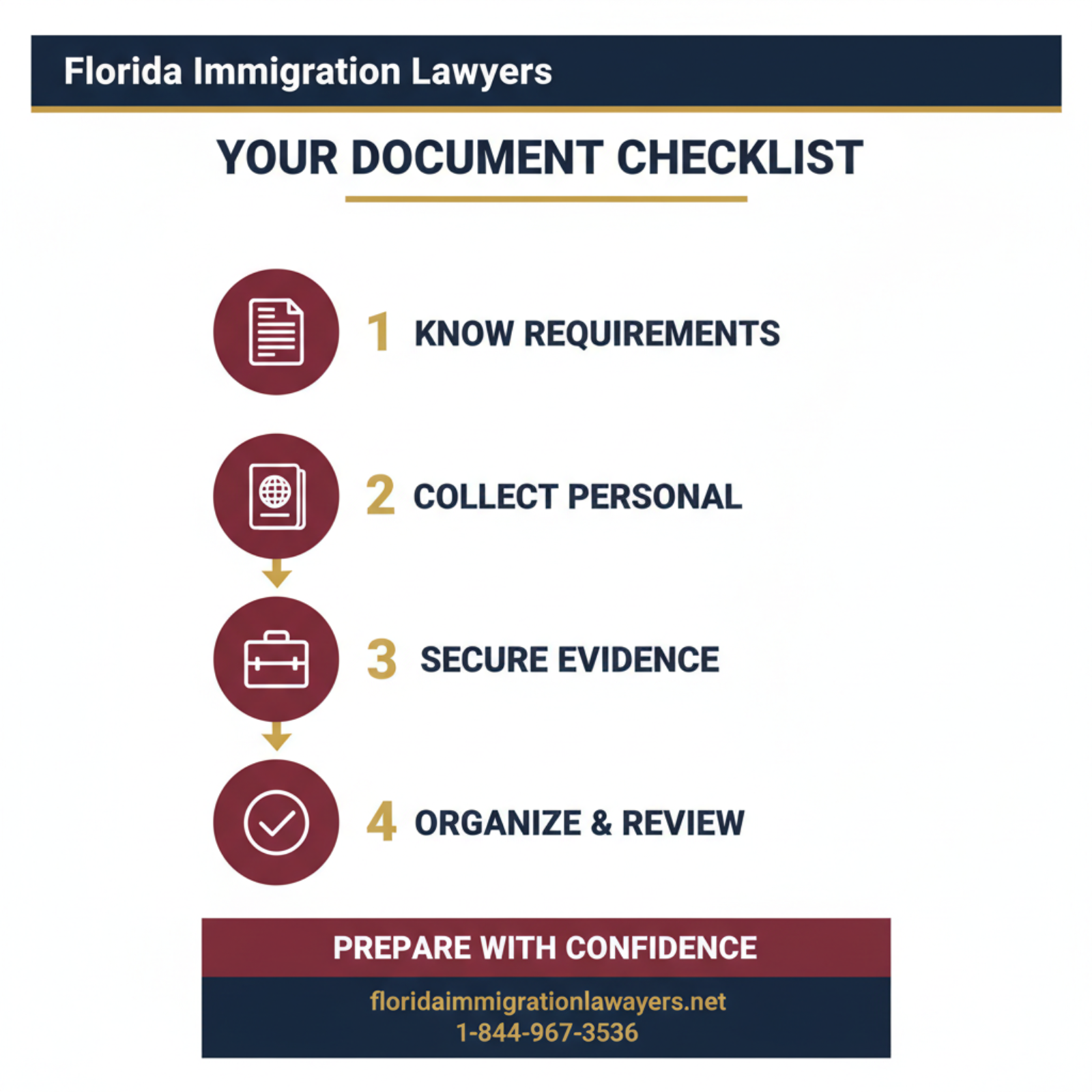
Successfully navigating the immigration process requires a methodical approach. This step-by-step guide outlines the general path you will follow when preparing your immigration documents for submission in 2026.
-
Determine Your Immigration Goal: Your first step is to clearly define what immigration benefit you are seeking. Are you applying for a family-based green card, a work visa, asylum, or naturalization? Each goal has a distinct set of required USCIS forms and supporting paperwork.
-
Identify Required USCIS Forms: Once your goal is clear, research the specific USCIS forms associated with your application. For example, a family petition often involves Form I-130, Petition for Alien Relative, and Form I-485, Application to Register Permanent Residence or Adjust Status. The USCIS website is your primary resource for current forms.
-
Gather Supporting Documents: This is often the most extensive part of the process. You will need to collect a wide array of personal, financial, and legal records. These include birth certificates, marriage certificates, passports, financial statements, and medical examination results.
-
Complete Forms Accurately and Completely: Fill out all USCIS forms with utmost care. Any missing information or inconsistencies can cause significant delays. Review every section multiple times and ensure all questions are answered truthfully and thoroughly.
-
Review and Organize Your Packet: Before submission, meticulously review your entire application packet. Ensure all required immigration documents are included, properly ordered, and correctly signed. Create an index or cover letter if necessary to help USCIS officers process your application efficiently.
-
File Your Application: Submit your completed application to the correct USCIS lockbox or service center. Always keep a complete copy of everything you send for your records. Consider sending via certified mail with a return receipt to confirm delivery.
-
Prepare for Interviews: Many immigration processes, especially for green cards and citizenship, require an interview. Be ready to discuss your application and provide original supporting paperwork. If you are in Florida, your interview might be at the USCIS Miami Field Office or another regional location.
-
Respond to RFEs and NOIDs Promptly: USCIS may send a Request for Evidence (RFE) if they need more information or a Notice of Intent to Deny (NOID) if they plan to deny your case. Respond to these notices quickly and comprehensively, providing all requested immigration documents by the deadline.
Essential Immigration Documents Checklist for Florida Residents
This comprehensive checklist details the types of immigration documents you will typically need for various applications in Florida. Remember, your specific case may require additional or fewer items.
-
Identity and Nationality Documents:
- Valid Passport from your country of origin.
- Original Birth Certificate with certified translation (if not in English).
- Form I-94, Arrival/Departure Record (print from CBP website).
- Visa pages from your passport (if applicable).
- Form I-551, Permanent Resident Card (Green Card) (if applicable).
- Employment Authorization Document (EAD, Form I-766) (if applicable).
-
Financial Support Documents:
- Form I-864, Affidavit of Support (for family-based immigration).
- Sponsor's most recent federal income tax returns and W-2s.
- Bank statements, pay stubs, and employment verification letters.
- Proof of assets (e.g., property deeds, stock certificates).
-
Personal Records and Civil Documents:
- Marriage Certificate (if applicable).
- Divorce Decrees (for all prior marriages, if applicable).
- Birth Certificates of all children (if applicable).
- Adoption Decrees (if applicable).
- Proof of name change (if applicable).
-
Medical and Health Records:
- Form I-693, Report of Medical Examination and Vaccination Record, completed by a USCIS-approved civil surgeon.
- Vaccination records.
-
Legal and Criminal History Documents:
Step-by-Step Process Guide - Police clearances from all countries and U.S. states where you have lived.
- Court records for any arrests, charges, or convictions (even if expunged).
- Proof of rehabilitation (if applicable).
-
Proof of Florida Residency (for state services):
- Utility bills (electric, water, gas) in your name.
- Lease agreement or property deed.
- Florida voter registration card.
- Mail from government agencies (e.g., FLHSMV).
- Bank statements with your Florida address.
-
Specific USCIS Forms (Examples):
- Form I-130, Petition for Alien Relative.
- Form I-485, Application to Register Permanent Residence or Adjust Status.
- Form N-400, Application for Naturalization.
- Form I-765, Application for Employment Authorization.
- Form I-140, Immigrant Petition for Alien Worker.
- Form I-129, Petition for a Nonimmigrant Worker.
- Form I-589, Application for Asylum and for Withholding of Removal.
-
Photographs:
- Two identical passport-style photographs (2x2 inches, white background) for each applicant.
Immigration Processing Timelines and Expectations for 2026
Understanding the typical timelines for processing immigration documents is vital for managing your expectations. USCIS processing times can fluctuate significantly due to various factors, including caseload volume, policy changes, and the complexity of individual cases.
For 2026, while specific predictions are challenging, it is wise to anticipate that some applications, particularly family-based petitions and naturalization, may still experience lengthy waits. USCIS aims to improve efficiency, but backlogs remain a reality for many applicants in Florida and nationwide.
USCIS Processing Times: What to Expect in Florida
USCIS provides estimated processing times online for different form types at various service centers and field offices. For residents of Naples, your application might be processed through the USCIS National Benefits Center or a specific service center, with interviews potentially scheduled at the Miami Field Office.
You can check current processing times for your specific USCIS forms on the USCIS website. These times are estimates only and can change without notice. We recommend regularly checking for updates.
Impact of RFEs and Interviews on Your Timeline
Receiving a Request for Evidence (RFE) or a Notice of Intent to Deny (NOID) will inevitably extend your processing timeline. This is why submitting a complete and accurate application with all required immigration documents from the outset is so important.
Interviews also add a stage to the process. Preparing thoroughly for your interview, including having all original paperwork ready, can help ensure a smooth experience and prevent further delays.
Understanding Immigration Costs and Fees in Florida
The financial aspect of immigration is an important consideration for many individuals and families in Florida. There are several categories of costs associated with filing immigration documents and applications.
While specific fee amounts are subject to change by USCIS and should always be verified on their official website, understanding the types of costs involved will help you budget effectively for your immigration journey in 2026.
-
USCIS Filing Fees: Almost every USCIS form comes with an associated filing fee. These fees vary significantly depending on the type of application (e.g., Form I-130, Form I-485, Form N-400). Fee waivers may be available for certain low-income applicants, but eligibility is strict.
-
Biometrics Fees: Most applicants are required to attend a biometrics appointment to have their fingerprints, photograph, and signature taken. There is typically a separate fee for this service, which is often paid along with the application filing fee.
-
Medical Examination Costs: If your application requires a medical examination (e.g., for adjustment of status), you must visit a USCIS-approved civil surgeon. The costs for this examination, including vaccinations, are paid directly to the doctor and can vary.
Key Statistics & Data -
Attorney Fees: While not mandatory, hiring an experienced immigration attorney from Florida Immigration Lawyers can be a wise investment. Our fees cover expert legal advice, preparation of all paperwork, representation, and peace of mind. We offer transparent fee structures.
-
Other Potential Costs: These can include translation services for non-English immigration documents, courier fees for secure mailing, and travel expenses for interviews or biometrics appointments. Budgeting for these miscellaneous costs is important.
Do not navigate this process alone. The complexities of gathering and submitting your immigration documents in Florida can be overwhelming. Contact Florida Immigration Lawyers today to ensure your application is accurate and complete. We are here to provide the expert legal support you need.
Common Mistakes to Avoid When Preparing Immigration Documents
Errors in your application can lead to significant setbacks. Avoiding these common mistakes is crucial when preparing your immigration documents in Florida:
-
Incomplete or Inaccurate Forms: Submitting forms with blank fields or incorrect information is a primary reason for delays or denials. Always double-check every entry.
-
Missing Supporting Documents: Failing to include all required evidence, such as birth certificates, marriage licenses, or financial statements, will trigger an RFE and extend your processing time.
-
Failure to Meet Deadlines: USCIS has strict deadlines for responding to RFEs or submitting applications. Missing these can result in your case being denied or closed.
-
Not Disclosing Criminal History: Attempting to conceal any arrests, charges, or convictions, even minor ones, can lead to serious legal consequences, including charges of misrepresentation.
-
Submitting Outdated Forms: USCIS frequently updates its forms. Always download the latest version from the USCIS website to ensure you are using the correct edition.
-
Poor Document Organization: Submitting a disorganized packet of paperwork can confuse adjudicators and slow down processing. Organize your documents logically, perhaps with labels or dividers.
-
Ignoring Requests for Evidence (RFEs): Not responding to an RFE by the deadline, or providing insufficient evidence, will almost certainly lead to a denial of your application.
-
Assuming Self-Filing is Always Best: While possible for simple cases, complex situations (e.g., prior denials, criminal history, specific visa types) greatly benefit from professional legal assistance.
-
Not Updating Your Address with USCIS: If you move, you must notify USCIS within 10 days using Form AR-11. Failure to do so can result in missed notices and critical updates regarding your case.
-
Traveling Without Advance Parole: If you have a pending adjustment of status application, leaving the U.S. without an approved Advance Parole document can be considered abandonment of your application.
When to Call a Lawyer for Your Immigration Documents in Florida
While this checklist provides a solid foundation, many situations warrant the expertise of an immigration attorney. Florida Immigration Lawyers are dedicated to helping individuals and families navigate the intricacies of U.S. immigration law.
Consider contacting us if you encounter any of the following scenarios:
-
Complex Case History: If you have previous immigration denials, a history of overstaying visas, or any criminal record, your case is inherently complex and requires professional guidance. An attorney can assess the impact of these issues on your immigration documents and strategy.
-
Deportation or Removal Proceedings: Facing deportation defense is a critical situation that demands immediate legal representation. An attorney can protect your rights and explore all available defenses in immigration court.
-
Receiving an RFE or NOID: These notices indicate a problem with your application. A lawyer can help you understand the request, gather the correct additional paperwork, and craft a compelling response to USCIS.
-
Difficulty Understanding USCIS Forms or Laws: If you find the legal language confusing or are unsure which USCIS forms apply to your situation, an attorney can clarify everything and ensure accurate submission.
-
Seeking Specific Visa Types: Applications for certain employment-based visas or investment visas often have intricate requirements that benefit greatly from legal expertise in preparing immigration documents.
-
Family Immigration Challenges: If your family petition involves unique circumstances, such as step-children, prior marriages, or issues with a sponsor's income, a lawyer can provide tailored advice for your family immigration case.
-
Peace of Mind: Even for seemingly straightforward cases, having an attorney review your immigration documents and application can provide invaluable peace of mind, knowing that everything is handled correctly.
Our attorneys at Florida Immigration Lawyers are experienced in all facets of immigration law. We serve clients across Florida, including Naples, Miami, Orlando, and Tampa. Let us put our expertise to work for you.
About Florida Immigration Lawyers
Florida Immigration Lawyers is a leading immigration law firm dedicated to serving individuals, families, and businesses across the entire state of Florida. Our team of compassionate and knowledgeable attorneys is committed to providing exceptional legal representation and guidance through every step of the immigration process.
We understand the profound impact immigration matters have on your life. Our services span a wide range of practice areas, including general immigration, family-based visas, employment immigration, naturalization, asylum, and deportation defense. We pride ourselves on offering personalized strategies tailored to your unique needs.
Why choose Florida Immigration Lawyers? We combine extensive legal expertise with a client-centered approach, ensuring you receive clear communication, dedicated advocacy, and support. Our firm is available 24/7, offering free consultations to discuss your case and outline your best path forward. We are proud to serve all of Florida, including our valued clients in Naples, Miami, Orlando, and Jacksonville. Your immigration success is our priority.
Sources and References
- U.S. Citizenship and Immigration Services (USCIS)
- U.S. Department of State (travel.state.gov)
- Executive Office for Immigration Review (EOIR - justice.gov)
- 8 U.S.C. Chapter 12 - Immigration and Nationality Act (INA)
- 8 CFR - Code of Federal Regulations, Title 8 (Aliens and Nationality)
- USCIS Policy Manual
This article provides general legal information and is not intended as legal advice. Every case is unique, and outcomes depend on specific facts and circumstances. Contact an attorney for advice about your particular situation.
Navigating your immigration journey in Florida, especially with all the required immigration documents and USCIS forms, can be complex. Do not leave your future to chance.
Contact Florida Immigration Lawyers today for a free consultation. Call us at 1-844-967-3536 to discuss your specific needs and let our experienced team guide you. Se Habla Español - Estamos aquí para ayudarle.
Florida Immigration Lawyers
Legal Team
Our experienced attorneys at Florida Immigration Lawyers have been serving clients across Florida for over 20 years. We specialize in immigration, personal injury, criminal defense, workers compensation, and family law.