E-2 Visa Florida: Launch Your Business in Naples by 2026
Unlock Florida's business potential with an E-2 investor visa. Learn how to invest in Naples, FL, and secure your future by 2026. Contact Florida Immigration Lawyers for a free consultation.

The E-2 visa allows nationals of treaty countries to enter the U.S. to develop and direct an enterprise where they have invested substantial capital. It is ideal for foreign entrepreneurs looking to establish or purchase a Florida business, such as in Naples, contributing to the local economy. This non-immigrant investor visa typically grants a stay of up to two years, renewable indefinitely, provided the business continues to meet requirements.
- The E-2 visa is for treaty country nationals investing substantially in a U.S. business.
- It's a non-immigrant visa, often renewable, allowing you to direct your enterprise.
- Investment must be "substantial" and the business must not be marginal.
- Employment creation or significant economic impact is typically expected.
- Consulting an immigration attorney is crucial for navigating the complex application process.
Are you an entrepreneur dreaming of establishing a thriving business in the sunny state of Florida? Perhaps you envision launching a new venture or acquiring an existing one in a vibrant community like Naples. The E-2 investor visa offers a unique pathway for foreign nationals from treaty countries to achieve this very goal.
This non-immigrant visa category allows individuals to enter the United States solely to develop and direct an enterprise in which they have invested a substantial amount of capital. Florida, with its robust economy, diverse population, and strategic location, presents unparalleled opportunities for international investors. The E-2 visa can be your gateway to tapping into this potential, particularly in growing markets across Southwest Florida.
This comprehensive guide will walk you through everything you need to know about securing an E-2 visa for your Florida business by 2026. We will cover eligibility, the application process, required documentation, potential costs, and common pitfalls to avoid. Our goal is to equip you with the knowledge to make informed decisions about your investment in the U.S.
For personalized guidance and to discuss your specific business immigration goals, do not hesitate to reach out. Call Florida Immigration Lawyers at 1-844-YO-PELEO for a free consultation today. Our experienced team is ready to assist you in making your entrepreneurial dreams a reality in Florida.
Understanding the E-2 Investor Visa for Florida Businesses
The E-2 investor visa is a non-immigrant visa specifically designed for treaty investors. These are individuals who come from countries that maintain a treaty of commerce and navigation with the United States. Its primary purpose is to facilitate international trade and investment between the U.S. and these treaty countries.
To qualify for an E-2 visa, your investment must be "substantial." While there is no fixed minimum dollar amount, the investment must be sufficient to ensure the successful operation of the enterprise. It must also be "at risk," meaning the funds are irrevocably committed to the business and subject to potential loss.
The business you invest in must be a real, active operating commercial enterprise. It cannot be a passive investment, nor can it be a "marginal" enterprise. A marginal enterprise generates just enough income to provide a minimal living for the investor without significant potential for growth or job creation.
The E-2 visa allows the principal investor to enter the U.S. and actively develop and direct their investment. This means you must have at least 50% ownership or operational control of the enterprise. Employees of the E-2 principal, if of the same nationality and meeting specific criteria, may also be eligible for E-2 visas.
For those looking to establish a Florida business, particularly in a vibrant city like Naples, the E-2 visa offers an excellent opportunity. Florida's pro-business environment and diverse economy make it an attractive destination for foreign investment. Our firm regularly assists clients across the state, from Miami to Naples, in navigating these complex requirements. This visa is a pathway for long-term stability, renewable indefinitely as long as the business continues to meet requirements.
The Immigration and Nationality Act (INA) Section 101(a)(15)(E)(ii) and 8 Code of Federal Regulations (CFR) 214.2(e) govern the E-2 treaty investor classification. These regulations outline the specific criteria that must be met for eligibility, emphasizing substantial investment and active business development. For more information on general immigration law, please visit our practice area page.
Who is Eligible for an E-2 Visa? Key Criteria for Treaty Investors
Eligibility for the E-2 investor visa hinges on several critical factors. Understanding these criteria is the first step toward successfully launching your Florida business. This visa is exclusively available to nationals of countries with which the United States maintains a treaty of commerce and navigation.
Treaty Country Nationality and Investment
First, you must be a national of a treaty country. This means you hold citizenship in one of the many countries that have an E-2 treaty with the U.S. A comprehensive list of these countries is maintained by the U.S. Department of State.
Second, you must have invested, or be actively in the process of investing, a substantial amount of capital in a bona fide enterprise in the United States. "Substantial" means the investment must be significant in relation to the total cost of purchasing or establishing the enterprise.
Bona Fide Enterprise and Active Management
The enterprise must be a real, active commercial or entrepreneurial undertaking. Speculative or idle investments do not qualify. Your Naples business must be actively engaged in providing goods or services.
The investment must not be marginal. The business must have the present or future capacity to generate significantly more than enough income to provide a minimal living for you and your family. It should also create jobs for U.S. workers or have a significant economic impact.
You must also be coming to the U.S. solely to develop and direct the investment enterprise. This requires that you either own at least 50% of the enterprise or possess operational control through a managerial position. Your active role is crucial for the success of the business.
Dependents and Employees
Spouses and unmarried children under 21 years of age may also be eligible for E-2 visas, regardless of their nationality. Spouses of E-2 visa holders are generally authorized to work in the U.S. without needing a separate employment authorization document. This offers flexibility for families establishing a new life in Florida.
Certain employees of an E-2 principal investor may also qualify for an E-2 visa. These employees must be of the same nationality and engaged in executive, supervisory, or highly specialized duties. Our firm can help you assess the eligibility of your key personnel for business immigration visas.
Step-by-Step Guide to Obtaining Your E-2 Visa for a Florida Business
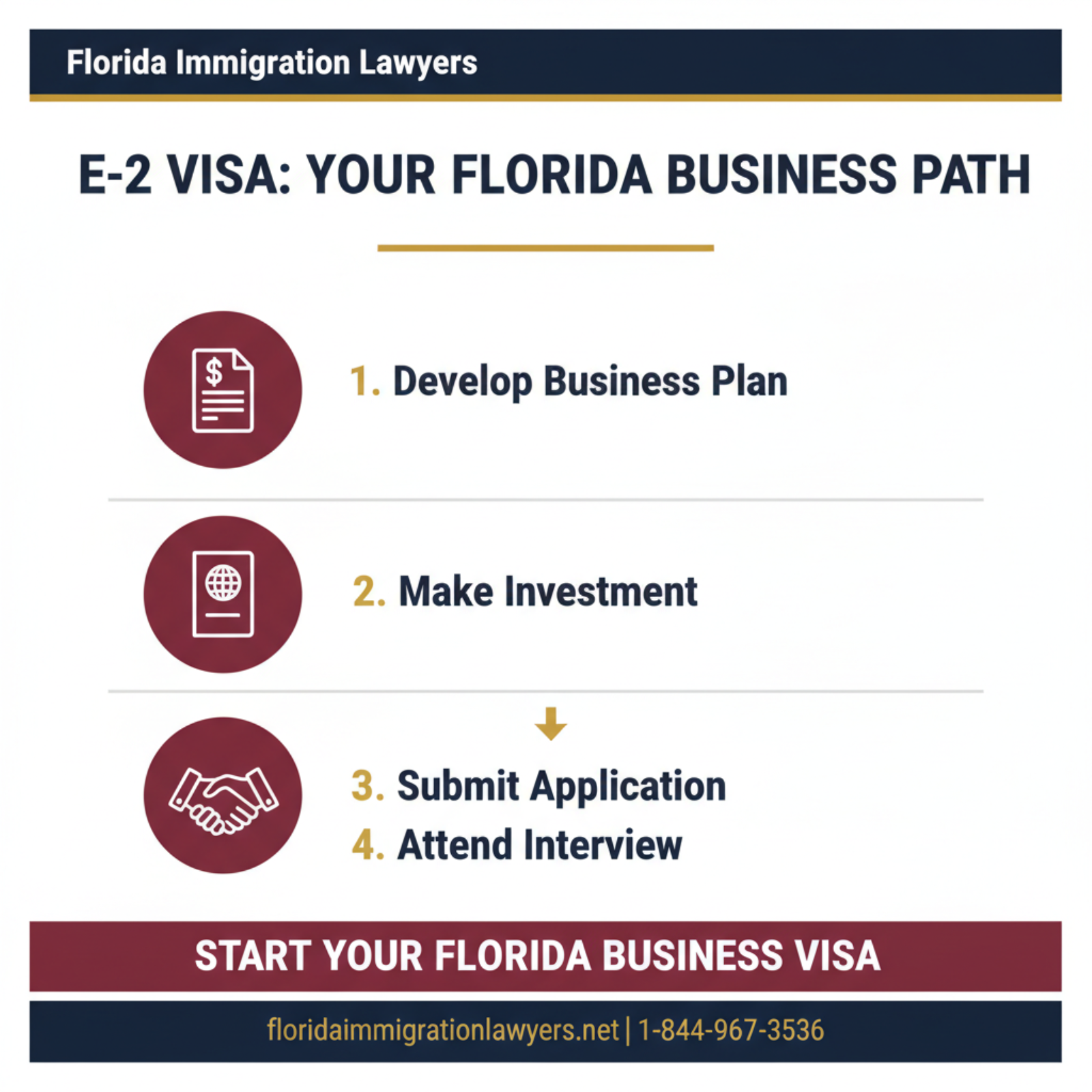
Navigating the E-2 investor visa application process can be complex, but a structured approach simplifies it. Here is a step-by-step guide to help you prepare for your investment in a Florida business, whether it's a new venture or an existing one in Naples.
-
Step 1: Confirm Treaty Country Nationality and Research Business Opportunities.
Verify that you are a national of an E-2 treaty country. Simultaneously, begin researching viable business opportunities in Florida. Consider sectors with growth potential in Naples or other promising areas. This initial research is crucial for identifying a "bona fide" enterprise.
-
Step 2: Make a Substantial and At-Risk Investment.
Identify a specific business to purchase or establish. You must invest a substantial amount of capital, ensuring the funds are irrevocably committed to the business operations. This typically involves transferring funds, purchasing assets, or signing lease agreements.
-
Step 3: Develop a Comprehensive Business Plan.
A detailed business plan is essential. It must demonstrate the viability of your Florida business, its potential for growth, job creation, and its capacity to generate more than a marginal income. Include financial projections, market analysis, and your role in managing the enterprise. This plan is a cornerstone of your E-2 application.
-
Step 4: Gather Required Documentation.
Collect all necessary supporting documents. This includes proof of your nationality, evidence of your investment funds and their lawful source, business registration documents, financial statements, and lease agreements. A thorough document checklist is provided below. Accuracy and completeness are vital for a smooth process.
-
Step 5: File Your E-2 Application.
If you are outside the U.S., you will apply through a U.S. Embassy or Consulate (Consular Processing). If you are already in the U.S., you may apply for a Change of Status with USCIS by filing Form I-129. Consular processing is generally recommended for initial applications.
Step-by-Step Process Guide -
Step 6: Attend Your Visa Interview (Consular Processing).
If applying through consular processing, you will schedule and attend an interview at the U.S. Embassy or Consulate. Be prepared to discuss your business plan, your investment, and your intentions in the U.S. An attorney can help you prepare for this critical step.
-
Step 7: Receive Visa Approval and Enter the U.S.
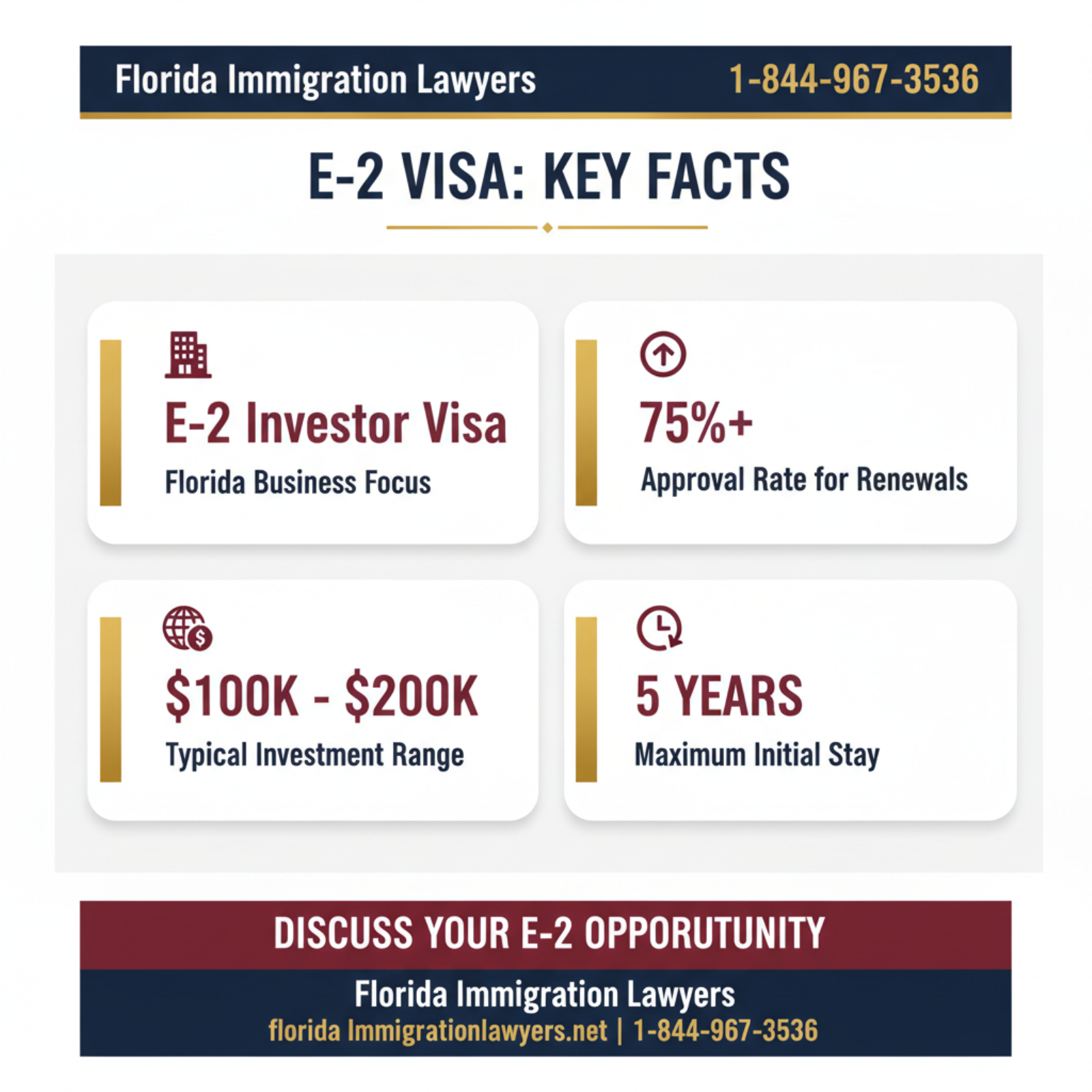
Upon approval, your E-2 visa will be stamped in your passport. You can then travel to the U.S. and begin developing your Naples business. The E-2 visa is typically issued for up to two or five years, depending on reciprocity agreements with your treaty country, and can be renewed indefinitely.
Each step requires meticulous attention to detail and a deep understanding of immigration law. Our business immigration attorneys at Florida Immigration Lawyers are adept at guiding clients through every stage of this process, ensuring all requirements are met for a strong application.
Essential Document Checklist for Your E-2 Investor Visa
A well-organized and complete set of documents is crucial for a successful E-2 visa application. Missing or incorrect documentation can lead to significant delays or even denial. This checklist outlines the typical documents required for your Florida business investment.
- Proof of Nationality: Valid passport from an E-2 treaty country for the principal applicant and any dependents.
- Visa Application Forms: Completed Form DS-160 (Online Nonimmigrant Visa Application) for consular processing, or Form I-129 (Petition for a Nonimmigrant Worker) and Form I-129 E Supplement for USCIS applications.
- Photographs: Recent passport-style photographs meeting U.S. visa requirements.
- Curriculum Vitae (CV) / Resume: Detailing your professional and educational background.
- Source of Funds Documentation: Clear evidence of the lawful source of your investment funds. This can include bank statements, tax returns, property sale documents, or business sale agreements.
- Evidence of Investment: Documents proving the funds are irrevocably committed and "at risk." Examples include bank statements showing funds transferred, purchase agreements for business assets, or lease agreements for business premises in Florida.
- Business Formation Documents: Articles of Incorporation, Operating Agreement, Federal Employer Identification Number (EIN), and business licenses for operation in Florida (e.g., in Naples).
- Business Plan: A detailed, professional business plan outlining the nature of the business, market analysis, financial projections, organizational structure, and job creation potential. This is vital for demonstrating the non-marginal nature of your Naples business.
- Proof of Ownership and Control: Stock certificates, partnership agreements, or other documents demonstrating at least 50% ownership or operational control.
- Evidence of Non-Marginality: Documents demonstrating the business's capacity to generate more than a minimal living for the investor, such as detailed financial projections, evidence of current employees, or letters of intent from potential clients.
- Dependents' Documents: Marriage certificates for spouses, birth certificates for children, and their respective passports and visa application forms.
Remember, this is a general list. Specific requirements may vary based on your individual circumstances. Always consult with an experienced E-2 visa lawyer to ensure your application package is robust and complete.
The journey to obtaining an E-2 investor visa and establishing your Florida business can be intricate. Do not navigate this process alone. Contact Florida Immigration Lawyers today to ensure your application is meticulously prepared and strategically presented. Our dedicated team is here to support your investment in the Sunshine State.
E-2 Visa Timeline and Processing Expectations for Florida Investors
Understanding the processing timeline for an E-2 visa is essential for effective business planning. The duration can vary significantly based on the application method, the specific U.S. Embassy or Consulate, and the overall caseload of USCIS. Planning for your new Florida business requires realistic expectations.
Consular Processing vs. Change of Status
For applicants outside the U.S., applying through a U.S. Embassy or Consulate (consular processing) is generally the most common route. Wait times for interviews vary, but can range from a few weeks to several months. After a successful interview, the visa stamp can be issued within days to weeks.
This means you could potentially obtain your E-2 visa and be ready to direct your Naples business within 3 to 6 months from the start of your document preparation. This assumes no significant delays. It is a more predictable path for initial applications.
If you are already in the U.S., you may file Form I-129 with USCIS for a Change of Status. USCIS processing times can fluctuate from 6 to 12 months, or longer. Premium processing is available for an additional fee, guaranteeing a response within 15 calendar days for the I-129 petition.
Factors Influencing Processing Times
Several factors can influence how long it takes to secure your E-2 investor visa. The completeness and accuracy of your application package are paramount. Missing documents or requests for additional evidence (RFEs) will inevitably cause delays.
The complexity of your business model and the size of your investment can also impact review times. Geographic location plays a role, as consulates in certain treaty countries may have higher volumes of E-2 applications. Staying informed about current processing times on the USCIS website (uscis.gov) and the Department of State website (travel.state.gov) is advisable.
While we cannot guarantee specific timelines, a well-prepared application, particularly through consular processing, offers the most predictable path. We work diligently to ensure your application for an E-2 visa for your Florida business is as strong and efficient as possible.
Cost Factors and Fee Breakdown for Your E-2 Visa Investment
Investing in a Florida business through the E-2 investor visa involves various costs beyond the initial business investment. Understanding these financial aspects is crucial for comprehensive planning. While we cannot provide specific filing fee amounts as they are subject to change, we can outline the general categories of expenses.
The Business Investment Itself
The most significant cost will be the "substantial" investment in your U.S. enterprise. This can range from tens of thousands to hundreds of thousands of dollars, depending on the nature and scale of your Naples business. This investment covers business acquisition, startup costs, inventory, equipment, real estate, and operational capital. The investment must be irrevocably committed and at risk.
Government Filing Fees
Regardless of whether you apply through consular processing or a change of status, there will be government-mandated filing fees. These typically include the DS-160 Application Fee for consular processing, or the Form I-129 Petition Fee for USCIS applications. An optional Premium Processing Fee is available for expedited I-129 petitions. These fees are non-refundable and must be paid directly to the U.S. government agencies. Always check official websites for current fee schedules.
Legal and Professional Fees
Engaging an experienced E-2 visa lawyer is a significant investment that can prevent costly mistakes and delays. Legal fees cover the attorney's time and expertise in preparing your application, developing your business plan strategy, and representing you. Our firm, Florida Immigration Lawyers, offers transparent fee structures for our comprehensive business immigration services.
Beyond legal fees, you may incur costs for business plan consultants, accountants for financial projections, and translation services. It is prudent to budget for these incidental costs to avoid unexpected financial strain. A thorough financial plan is essential for a successful E-2 visa journey.
Common Mistakes to Avoid When Applying for an E-2 Visa
The E-2 investor visa process is highly detailed, and even minor errors can lead to significant setbacks or denial. Being aware of common pitfalls can help you avoid them and strengthen your application for a Florida business investment.
- Underestimating the "Substantial" Investment Requirement: Many applicants assume a low dollar amount is sufficient. The investment must be proportional to the total cost of the business and robust enough to ensure its viability. Insufficient investment often leads to denial, indicating a lack of commitment or a marginal business.
- Failing to Prove Lawful Source of Funds: You must clearly demonstrate that your investment funds were obtained through legal means. Vague explanations or missing documentation regarding the origin of your capital can raise red flags with immigration authorities, resulting in rejection.
- Investing in a "Marginal" Business: The E-2 visa is not for businesses that only provide a minimal living for the investor. The enterprise must have the capacity to generate significant income or create jobs for U.S. workers. A business plan failing to demonstrate this will likely be denied.
- Lack of Irrevocable Commitment of Funds: Funds must be "at risk" and irrevocably committed to the enterprise. Simply having money in a U.S. bank account earmarked for the business is usually not enough; you need to show actual expenditure or contractual obligations.
- Incomplete or Poorly Prepared Business Plan: A weak or generic business plan is a major red flag. It must be detailed, realistic, and convincingly demonstrate the nature of your Naples business, market analysis, financial projections, and your active role.
- Not Demonstrating Control of the Enterprise: You must prove that you will develop and direct the business. This means showing at least 50% ownership or a clear managerial role. Passive investment without active control is typically not acceptable for the E-2 visa.
- Failing to Meet Treaty Country Nationality Requirements: This is a fundamental requirement. If you are not a national of a treaty country, you are simply not eligible for the E-2 visa. Always double-check your country's status with the U.S. Department of State.
- Misunderstanding the Non-Immigrant Nature of the E-2 Visa: The E-2 visa is temporary and does not directly lead to a Green Card. Presenting an intention to permanently reside in the U.S. during your interview can lead to denial, as it contradicts the required non-immigrant intent.
- Ignoring U.S. Tax Implications: While not a direct visa requirement, failing to understand the tax implications of operating a U.S. business can lead to future legal and financial complications. Seeking advice from a tax professional is highly recommended.
- Attempting the Application Without Legal Counsel: The complexity of immigration law and the specific requirements for the E-2 visa make professional legal assistance almost indispensable. DIY applications often miss critical details, leading to delays or denials and wasted investment.
Avoiding these common errors is crucial for a smooth application process. Engaging an experienced E-2 visa lawyer can significantly increase your chances of success and help you navigate the nuances of the law, ensuring your Florida business venture starts on solid legal ground.
When to Call a Lawyer for Your E-2 Investor Visa in Florida
While this guide provides extensive information, the E-2 investor visa process is rarely straightforward. The complexities of immigration law, coupled with the significant financial investment in a Florida business, make professional legal guidance invaluable. Knowing when to seek legal counsel can make the difference between a successful application and a costly denial.
You should strongly consider contacting Florida Immigration Lawyers if any of the following scenarios apply to you: You are just starting your research or are unsure about the "substantial" investment criteria. If you need to prove a lawful source of funds or require a robust business plan, our attorneys can assist. Complex immigration history or a desire to change status also warrant legal advice.
If you receive a Request for Evidence (RFE) or Notice of Intent to Deny (NOID), legal intervention is almost always necessary to respond effectively. Even for routine renewals, ensuring continued compliance with E-2 requirements for your Florida business is essential. Our team possesses extensive experience with E-2 visas and other investor visa categories.
Do Not Navigate This Process Alone
Our experienced immigration attorneys are ready to fight for you. Get a free, confidential case review today.
Se Habla Español
Or leave your details and we’ll call you:
Free Evaluation in 24 Hours
Or talk to us right now

AI voice assistant — available 24/7
FreeFrequently Asked Questions

William J. Vásquez
Founding Attorney · Vasquez Law Firm
U.S. Air Force veteran and immigration attorney with years of hands-on U.S. immigration experience. J.D., NCCU School of Law. AILA member. Admitted to the 4th, 5th, and 11th Circuit Courts.
Available 24/7 - Free Evaluations
Reviewed for legal accuracy by William J. Vásquez
Licensed in North Carolina; U.S. immigration is federal practice.
Related Legal Services
Our Florida immigration attorneys can help you with family immigration services, immigration lawyer cost in Florida and experienced immigration attorneys. Call today at 1-844-YO-PELEO for a free case review.
Related Links
Related Topics
Free Legal Case Review
Discuss your case with our experienced attorneys. We're available 24/7.
Se Habla Español - Estamos aquí para ayudarle.
Related Articles
EAD Advance Parole Combo Card in Florida: What You Need
An EAD advance parole combo card allows individuals with pending adjustment applications to both work and travel abroad without jeopardizing their green card application. Learn how to apply in Florida, what documents you need, and common mistakes to avoid.
PERM Labor Certification in Florida: A 2026 Guide
Learn all about the PERM labor certification process in Florida, essential for employers sponsoring green card applicants. Understand the steps, document requirements, and common mistakes to avoid in this 2026 guide.
Dual Citizenship Lawyer in Florida: What You Need to Know
For Florida residents, the concept of dual citizenship, or holding two passports, offers a compelling blend of opportunities and challenges. While the U.S. generally permits dual nationality, the path to achieving this status requires a meticulous understanding of both U.S. immigration laws and the citizenship policies of your country of origin. This guide explores the definition of dual citizenship, the detailed step-by-step process for U.S. naturalization, and the significant benefits and potential pitfalls involved. We cover essential documentation, typical timelines, and cost considerations for 2026, providing crucial insights for anyone in Orlando, Miami, or across Florida considering this important legal step. Learn about common mistakes to avoid and understand when to seek professional legal counsel to navigate this complex process successfully. Florida Immigration Lawyers is here to provide expert, bilingual support for your dual citizenship journey.
Immigration Lawyer Orlando Free Consultation in Florida
For individuals and families in Orlando, Florida, navigating the complexities of U.S. immigration law requires expert guidance. An immigration lawyer in Orlando offers crucial support for everything from visa applications and green card processes to naturalization and deportation defense. This comprehensive guide details what a free consultation covers, providing a step-by-step overview of immigration pathways, essential document checklists, and expected timelines in 2026. We also highlight common mistakes to avoid, discuss the critical role of legal counsel in deportation and asylum cases, and explain why choosing a local Orlando immigration attorney is beneficial. Florida Immigration Lawyers is dedicated to serving the diverse community of Orlando with compassionate, effective legal solutions, ensuring you receive personalized advice and robust representation for a successful immigration journey.