DACA Work Permit Florida: Your Guide to Employment Authorization in 2026
For DACA recipients in Florida, understanding the process for obtaining or renewing a work permit (EAD) is crucial for legal employment. This comprehensive guide from Florida Immigration Lawyers details DACA eligibility requirements, step-by-step application procedures, necessary documents, and expected timelines for 2026. We cover the costs involved and highlight common mistakes to avoid. Given the complexities and evolving legal landscape surrounding DACA, especially in Florida, securing expert legal assistance is highly recommended. Learn how our firm can help you navigate the USCIS DACA process to maintain your authorization and employment in Florida. Contact us for a free consultation.
The DACA work permit Florida process allows eligible Deferred Action for Childhood Arrivals recipients to legally work in the state. This involves filing Form I-821D and Form I-765 with USCIS, primarily for renewals. While initial DACA applications are generally not accepted, current recipients in Florida can maintain their employment authorization through timely renewals. Expert legal guidance is crucial for a successful application.
- DACA work permits enable legal employment in Florida.
- Renewals require filing Forms I-821D and I-765.
- Initial DACA applications remain paused for new applicants.
- Timely submission is vital to avoid employment gaps.
- Consulting an immigration lawyer is highly recommended.
Are you a DACA recipient living in Florida, perhaps in Orlando or a surrounding community, wondering about your ability to work legally? The Deferred Action for Childhood Arrivals (DACA) program provides temporary protection from deportation and, crucially, grants eligibility for a work permit. This employment authorization document (EAD) is essential for DACA recipients to build careers and contribute to Florida's economy. Many individuals rely on their DACA work permit for stability.
Understanding the specific requirements and procedures for the DACA work permit Florida process is paramount. This comprehensive guide from Florida Immigration Lawyers will walk you through everything you need to know about applying for or renewing your DACA-based work authorization in 2026. We will cover eligibility, the application steps, necessary documents, timelines, and potential costs. Our goal is to empower you with the information needed to maintain your legal employment status.
Do not navigate this critical process alone. If you have questions or need assistance with your DACA work permit application or renewal, call Florida Immigration Lawyers at 1-844-967-3536 for a free consultation. Our experienced team is ready to help you understand your options and secure your future in Florida.
Understanding DACA and Your Work Authorization in Florida
DACA, or Deferred Action for Childhood Arrivals, is a U.S. immigration policy that protects certain undocumented immigrants who came to the United States as children from deportation. It also grants them a renewable two-year work permit, officially known as an Employment Authorization Document (EAD). For thousands of young people across Florida, including those in vibrant cities like Orlando, Jacksonville, and Miami, DACA has been a lifeline. It allows them to pursue higher education, build careers, and support their families without constant fear.
The ability to obtain a DACA work permit Florida is particularly significant given the state's large immigrant population and economic opportunities. While the program's legal status has faced challenges, current DACA policy, under court orders, generally allows for renewals. This means that if you are already a DACA recipient, you can typically continue to apply for and receive your work authorization. However, initial DACA applications for new applicants have been paused due to ongoing litigation. This distinction is crucial for understanding your current options.
This section will provide a foundational understanding of DACA's purpose and how it directly impacts your ability to work legally within Florida. We recognize the unique circumstances and anxieties faced by DACA recipients, especially with evolving immigration policies. Our firm, Florida Immigration Lawyers, is dedicated to providing clear and empathetic guidance throughout your journey.
Who is Eligible for DACA Renewal in Florida?
To be eligible for DACA renewal and thus maintain your DACA work permit Florida, you must meet several key criteria. These requirements are largely consistent with the original DACA guidelines. You must have continuously resided in the U.S. since June 15, 2007, and have not departed the U.S. without advance parole on or after August 15, 2012. Furthermore, you must not have been convicted of a felony, a significant misdemeanor, or three or more other misdemeanors, and must not pose a threat to national security or public safety.
USCIS emphasizes that you must submit your renewal application before your current DACA and EAD expire. Ideally, you should file your renewal request between 120 and 150 days before the expiration date. This timeframe allows USCIS ample opportunity to process your application and prevent any lapse in your employment authorization. Failing to renew on time can lead to a gap in your ability to work legally.
It is important to remember that DACA does not provide a path to lawful permanent residency or U.S. citizenship. It offers temporary relief from deportation and employment authorization. Consulting with an attorney can help you determine if you meet all the necessary DACA eligibility requirements for renewal.
Step-by-Step Guide to the DACA Work Permit Florida Application Process
The process for securing or renewing your DACA work permit Florida involves several specific steps and requires careful attention to detail. This guide outlines the typical procedure for DACA recipients seeking to maintain their employment authorization. Remember, initial applications for DACA are generally not being accepted by USCIS at this time.
- Gather Required Documents: Before starting your application, collect all necessary supporting documents. This includes your previous DACA approval notices (Form I-797), your current EAD card, identification documents, and any new evidence related to continuous residence or education. Ensure all documents are clear and legible.
- Complete Forms I-821D and I-765: You will need to complete Form I-821D, Consideration for Deferred Action for Childhood Arrivals, and Form I-765, Application for Employment Authorization. Both forms are crucial for your DACA work permit Florida renewal. You must also complete Form I-765 Worksheet (Form I-765WS) to justify your economic need for employment. Be meticulous in filling out every section accurately and completely.
- Prepare Supporting Evidence: Along with the forms, you must include copies of all supporting documentation. This typically includes copies of your previous DACA approval notice, your most recent EAD card, passport photos, and potentially evidence of your continuous presence in the U.S. since your last DACA approval. Do not send original documents unless specifically requested by USCIS.
- Pay Filing Fees: USCIS requires specific filing fees for DACA and the EAD. These fees are subject to change, so always check the official USCIS website for the most current amounts. You can pay by money order, personal check, cashier's check, or by credit card using Form G-1450. Fee waivers are generally not available for DACA applications.
- Mail Your Application Packet: Once all forms are completed, signed, and all supporting documents and fees are prepared, assemble your packet according to USCIS instructions. Mail your application to the correct USCIS lockbox facility. The specific address depends on your state of residence, so verify the correct address on the USCIS website. For most Florida residents, this will be a specific lockbox designated for DACA applications.
- Attend Biometrics Appointment: After USCIS accepts your application, you will receive an appointment notice for biometrics (fingerprints and photos) at an Application Support Center (ASC). It is mandatory to attend this appointment. Failing to do so can result in denial of your application.
- Receive Decision: USCIS will process your application and mail you a decision. If approved, you will receive a new Form I-797, Approval Notice, for DACA and your new DACA work permit Florida (EAD card). If denied, the notice will explain the reasons.
Throughout this process, it is vital to keep copies of everything you submit and to track your application status online using the receipt number provided by USCIS.
Essential Document Checklist for Your DACA Work Permit Application
Preparing a complete and accurate set of documents is critical for a successful DACA work permit Florida application or renewal. Missing or incorrect documents can lead to delays or even denial. Use this checklist as a guide to ensure you have everything in order.
- Completed and signed Form I-821D, Consideration for Deferred Action for Childhood Arrivals.
- Completed and signed Form I-765, Application for Employment Authorization.
- Completed Form I-765 Worksheet (I-765WS), demonstrating economic need.
- Two identical passport-style photographs (taken within 30 days of filing).
- Copy of your most recent DACA approval notice (Form I-797).
- Copy of your current Employment Authorization Document (EAD card), front and back.
- Copy of your birth certificate with a certified translation if not in English.
- Copy of your passport identity page, or other government-issued photo identification.
- Copy of your Form I-94, Arrival/Departure Record (if applicable).
- Proof of continuous residence in the U.S. since your last DACA approval (e.g., utility bills, school records, employment records, medical records).
- Proof of having met educational requirements (e.g., high school diploma, GED certificate, school transcripts, or proof of enrollment in school/GED program).
- Evidence of any prior criminal history (if applicable, including disposition records).
- Check or money order for the correct filing fees, payable to the "U.S. Department of Homeland Security."
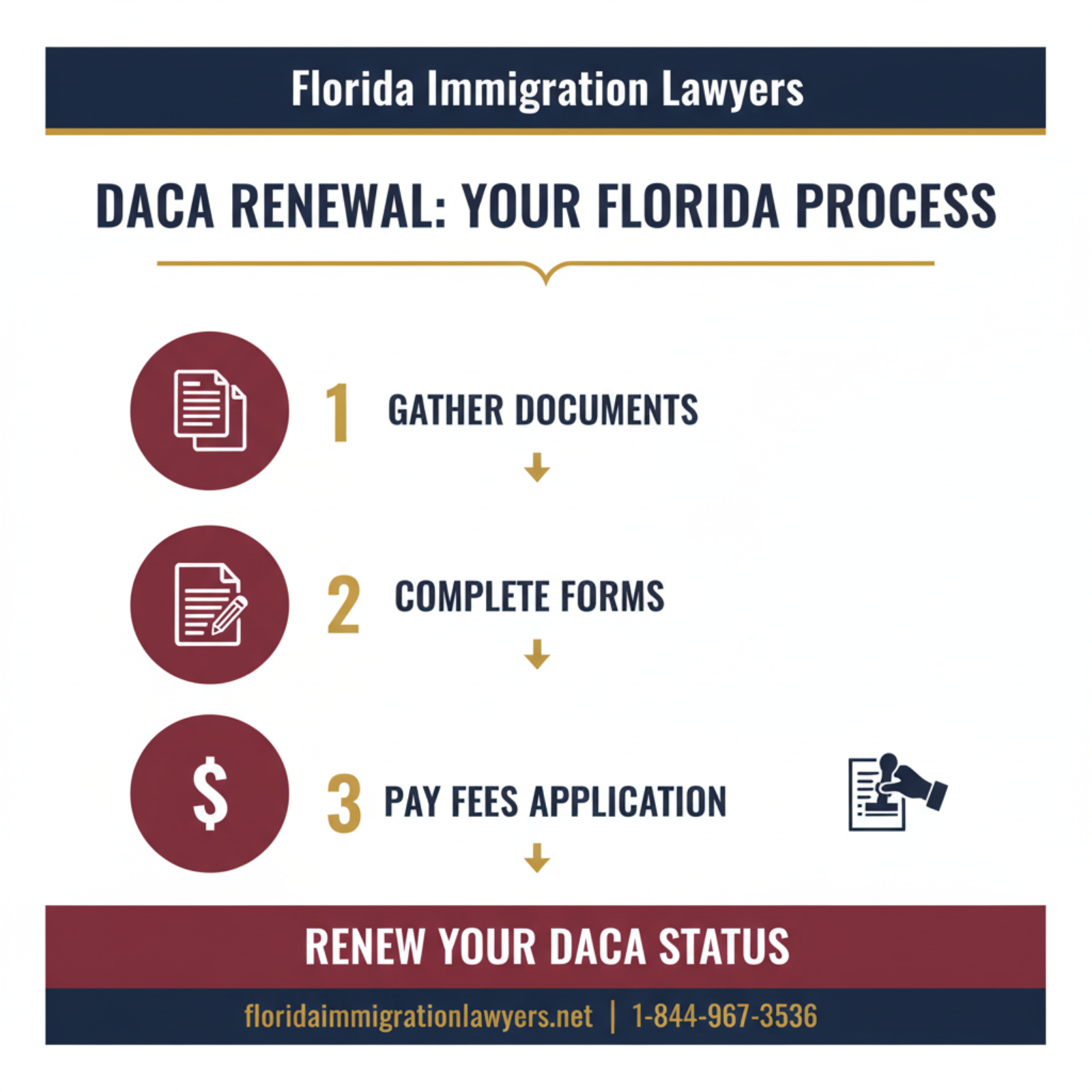
Organizing these documents systematically will greatly assist in the efficient processing of your DACA work permit Florida application. Always double-check the USCIS website for any updates to required documents before filing.
DACA Work Permit Florida: Timeline and Processing Expectations
Many DACA recipients in Florida often ask, "How long does it take to get a DACA work permit?" The processing time for a DACA work permit Florida renewal can vary significantly. USCIS processing times are subject to factors such as caseload volume, government shutdowns, and policy changes. Generally, it is advisable to submit your renewal application well in advance of your current EAD's expiration date.
- Recommended Filing Window: USCIS recommends filing your DACA renewal request between 120 and 150 days before your current DACA and EAD expire. This timeframe aims to prevent any lapse in your employment authorization.
- Initial Receipt Notice: After mailing your application, you should receive a Form I-797C, Notice of Action, confirming receipt of your application within 2-4 weeks. This notice will include your receipt number, which you can use to track your case online.
- Biometrics Appointment: Typically, within 4-8 weeks of receiving your receipt notice, you will get an appointment letter for biometrics at a local Application Support Center (ASC). For those in Orlando, this might be the Orlando ASC.
- Case Review and Decision: After your biometrics appointment, USCIS reviews your application. The review period can range from 3 to 7 months, or sometimes longer. You can check current processing times on the USCIS website by selecting Form I-821D and the service center.
- EAD Card Delivery: If approved, your new DACA approval notice and EAD card will be mailed to you. This usually arrives within 1-2 weeks after the approval decision.
It is crucial to monitor your application status regularly and respond promptly to any Requests for Evidence (RFEs) from USCIS. Delays are common, so planning ahead is key to maintaining uninterrupted employment authorization.
Cost Factors and Fee Breakdown for DACA Applications
Understanding the financial commitment involved is a vital part of preparing for your DACA work permit Florida application. There are specific fees associated with filing DACA and EAD forms with USCIS. These fees are mandated by law and are subject to change, so always verify the current amounts directly on the USCIS website.
- Form I-821D Filing Fee: There is currently no separate fee for Form I-821D itself.
- Form I-765 Filing Fee: The fee for Form I-765, Application for Employment Authorization, is typically a set amount. This fee covers the cost of processing your work permit application.
- Biometrics Services Fee: A separate biometrics fee is charged to cover the cost of collecting your fingerprints, photograph, and signature. This fee is generally paid along with the I-765 fee.
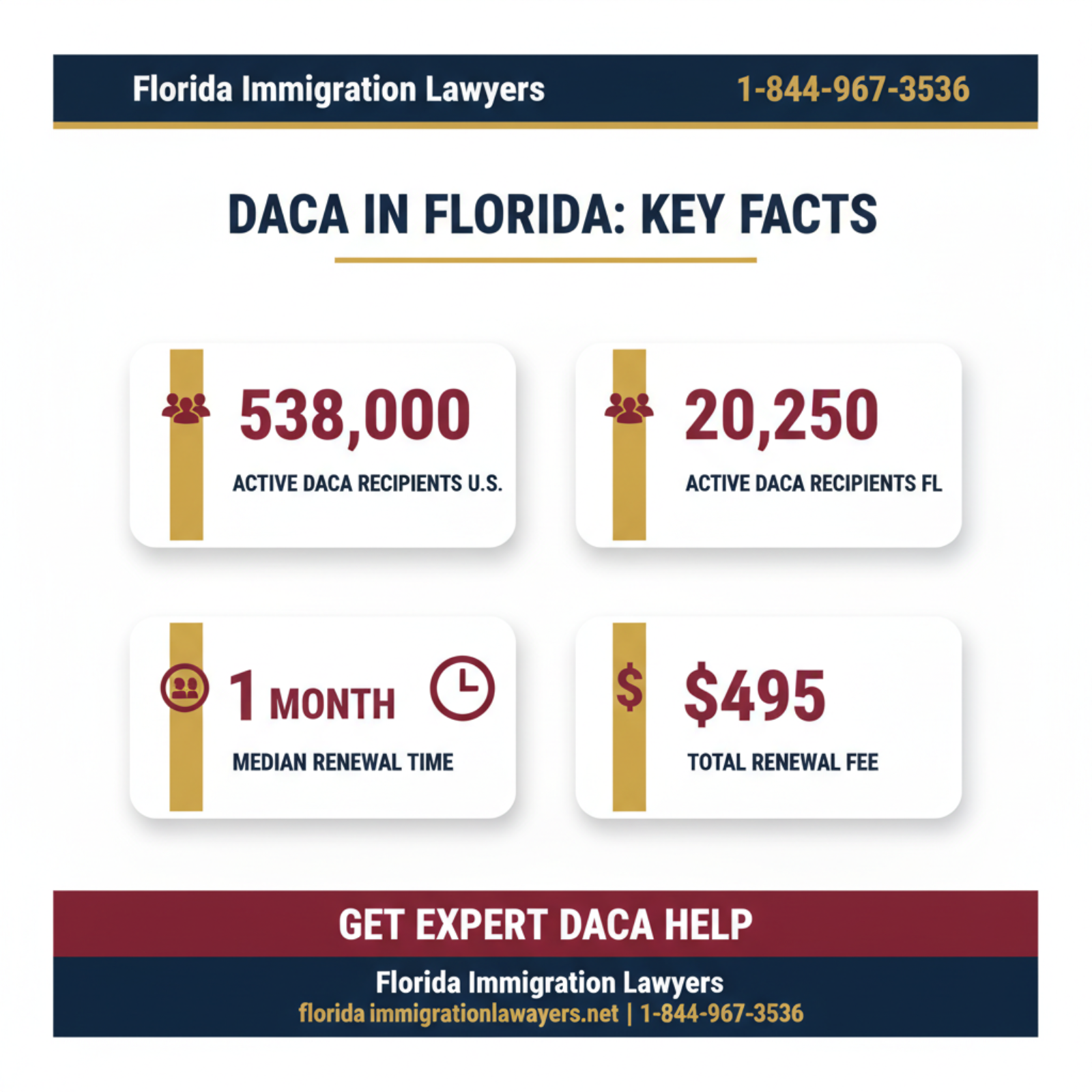
- Total USCIS Filing Fees: The combined fee for Form I-765 and the biometrics services fee is the primary cost directly paid to USCIS. As of early 2026, these fees often total around $495, but this is an estimate. Always check the current fees on the USCIS website before submitting your application.
- Legal Fees: While not mandatory, retaining an experienced immigration attorney, like those at Florida Immigration Lawyers, involves legal fees. These fees cover the attorney's expertise in preparing your application, reviewing documents, ensuring compliance, and responding to USCIS inquiries. Investing in legal representation can significantly increase the likelihood of a successful and timely approval.
- Other Potential Costs: You might also incur costs for obtaining certified translations of documents, passport photos, postage, and potentially educational transcripts or other supporting evidence.
It is important to budget for all these potential expenses. USCIS generally does not offer fee waivers for DACA applications, so you must be prepared to pay the full amount at the time of filing.
Do not navigate this process alone. The complexities of immigration law, especially concerning DACA, require precise adherence to regulations. Contact Florida Immigration Lawyers today for expert guidance on your DACA work permit Florida application or renewal. Our team is here to support you.
Common Mistakes to Avoid When Applying for Your DACA Work Permit
Applying for a DACA work permit Florida requires meticulous attention to detail. Even minor errors can lead to delays, Requests for Evidence (RFEs), or outright denial, potentially impacting your ability to work. Avoiding these common pitfalls is crucial for a smooth process.
- Filing an Initial DACA Application: As of 2026, USCIS is generally not accepting initial DACA applications due to ongoing litigation. Attempting to file one will result in rejection. Ensure you are only filing for a renewal if you are a current DACA recipient.
- Missing the Renewal Deadline: Failing to submit your renewal application within the recommended 120-150 day window before expiration can lead to a lapse in your work authorization. This means you cannot legally work during the processing period, potentially impacting your employment and financial stability.
- Incomplete or Incorrect Forms: Any blank fields, unanswered questions, or inaccurate information on Forms I-821D, I-765, or I-765WS can cause your application to be rejected or delayed. Always double-check all entries and ensure forms are signed correctly.
- Insufficient Supporting Documentation: Not including all required documents, such as copies of your previous DACA approval, EAD card, or proof of continuous residence, will prompt an RFE. This adds significant time to the processing period and increases stress.
- Incorrect Filing Fees: Submitting an incorrect payment amount or an improperly formatted payment (e.g., wrong payee on a check) will lead to rejection of your entire application. Always verify the current fees on the USCIS website.
- Not Attending Biometrics Appointment: The biometrics appointment is mandatory. Missing it without proper rescheduling can result in the denial of your DACA and EAD application. Always attend or reschedule in advance if absolutely necessary.
- Providing False Information: Any attempt to provide false or misleading information on your application can lead to severe immigration consequences, including denial, potential bars to future immigration benefits, and even deportation proceedings. Honesty is paramount.
- Failing to Disclose Criminal History: Even minor arrests or convictions, including those that were expunged, must be disclosed. Failure to do so can be considered misrepresentation and lead to denial. Provide certified court dispositions for all incidents.
- Moving Without Notifying USCIS: If you move while your application is pending, you must notify USCIS of your new address within 10 days using Form AR-11, Alien's Change of Address Card, or online. Failure to do so means you might not receive important notices or your new EAD card.
- Assuming Automatic Renewal: DACA and EAD are not automatically renewed. You must proactively file a complete renewal application to maintain your status.
- Not Keeping Copies: Always keep a complete copy of your entire application packet, including all forms, documents, and proof of mailing. This is essential for your records and if USCIS requests further information.
- Ignoring Legal Advice: While you can file independently, DACA is a complex area. Ignoring professional legal advice can lead to mistakes that are costly to correct.
When to Call a Florida Immigration Lawyer for Your DACA Work Permit
While the information provided aims to be comprehensive, the DACA work permit Florida process can be intricate, especially with its evolving legal landscape. There are specific scenarios where the expertise of a qualified immigration attorney is not just helpful, but often essential. Florida Immigration Lawyers are here to provide the dedicated support you need.
You should strongly consider contacting our firm if:
- You Have a Criminal Record: Any arrests, charges, or convictions, even minor ones, can significantly impact your DACA eligibility. An attorney can assess your record, advise on potential issues, and help mitigate risks. This is particularly important in Florida, given enhanced state-federal immigration enforcement initiatives like Operation Tidal Wave and 287(g) partnerships.
- You Have a Gap in Your Continuous Residence: If you have left the U.S. without advance parole since August 15, 2012, or have a complex travel history, an attorney can help determine if you still meet the continuous residence requirement for renewal.
- You Received a Request for Evidence (RFE) or Notice of Intent to Deny (NOID): These notices indicate USCIS has concerns about your application. An attorney can help you understand the RFE/NOID, gather the necessary documentation, and formulate a strong, timely response.
- You Have an Expired DACA/EAD: If your DACA or EAD has already expired, an attorney can advise you on the best course of action for filing a late renewal and address any potential employment gaps.
- You Are Unsure About Any Eligibility Requirement: If you are uncertain about meeting any specific DACA eligibility criteria, including educational requirements or continuous presence, an attorney can provide clarity and guidance.
- You Are Being Placed in Removal Proceedings: If you are a DACA recipient and have been placed in deportation proceedings, it is critical to seek legal counsel immediately. Your DACA status may be at risk, and an attorney can help you explore all available defenses and options.
- You Need to Travel Internationally: DACA recipients generally need to apply for advance parole to travel outside the U.S. and return legally. An attorney can guide you through this complex application process.
- You Are Seeking Other Immigration Pathways: While DACA does not lead to a green card, an attorney can assess if you have alternative pathways to legal status, such as through family petitions (family immigration) or employment-based visas (business immigration).
At Florida Immigration Lawyers, we understand the stakes involved. We offer comprehensive immigration services to individuals throughout Florida, including Orlando, Miami, and Tampa. Our dedicated attorneys are committed to protecting your rights and helping you achieve your immigration goals. Contact us today at 1-844-967-3536 to discuss your specific situation.
About Florida Immigration Lawyers
Florida Immigration Lawyers is a leading immigration law firm dedicated to serving individuals and families across the entire state of Florida. With a deep understanding of U.S. immigration laws and a passion for helping our clients, we provide compassionate yet aggressive legal representation. Our firm is committed to empowering immigrants to achieve their dreams and secure their future in the United States. We serve all of Florida, from Orlando to Miami, Jacksonville to Tampa, and everywhere in between, offering personalized legal strategies tailored to your unique circumstances.
Our Services Include: We offer a comprehensive range of immigration legal services, including but not limited to:
- Family-based immigration petitions
- Employment-based visas
- Deportation defense and removal proceedings
- Asylum and refugee claims
- Citizenship and naturalization applications
- DACA applications and renewals
- And more complex immigration matters.
Why Choose Florida Immigration Lawyers? Choosing the right legal representation is crucial. At Florida Immigration Lawyers, we pride ourselves on:
- Expertise: Our attorneys possess extensive knowledge of immigration law and stay updated on all policy changes.
- Client-Centered Approach: We prioritize your needs, communicate clearly, and provide empathetic support.
- Proven Track Record: We have a history of successfully guiding clients through challenging immigration processes.
- Bilingual Services: Our team is fluent in English and Spanish, ensuring effective communication.
- Accessibility: We are available 24/7 to answer your urgent questions.
Do not face the complexities of immigration law alone. We offer free consultations to discuss your case and explore your legal options. Call us today at 1-844-967-3536 or visit our website at https://www.floridaimmigrationlawyers.net to schedule your confidential consultation.
Sources and References
- U.S. Citizenship and Immigration Services (USCIS)
- USCIS Forms and Fees
- USCIS Processing Times
- Executive Office for Immigration Review (EOIR)
- 8 U.S.C. Chapter 12 - Immigration and Nationality Act (INA)
- 8 CFR § 274a.12(c)(14) - Classes of aliens authorized to accept employment.
- USCIS Policy Manual, Volume 1, Part D, Chapter 2 - Deferred Action for Childhood Arrivals (DACA)
This article provides general legal information and is not intended as legal advice. Every case is unique, and outcomes depend on specific facts and circumstances. Contact an attorney for advice about your particular situation. Immigration laws are complex and subject to change.
Securing or renewing your DACA work permit Florida is a critical step towards maintaining your life and career in the Sunshine State. The process can be challenging, but you do not have to face it alone. The dedicated legal team at Florida Immigration Lawyers is here to provide the guidance and representation you deserve. We serve DACA recipients throughout Florida, including Orlando, Miami, and Tampa, offering comprehensive support for all your immigration needs.
Call Florida Immigration Lawyers today at 1-844-967-3536 for a free, confidential consultation. Let us help you navigate the complexities and protect your future. Se Habla Español - Estamos aquí para ayudarle.
Frequently Asked Questions
Florida Immigration Lawyers
Legal Team
Our experienced attorneys at Florida Immigration Lawyers have been serving clients across Florida for over 20 years. We specialize in immigration, personal injury, criminal defense, workers compensation, and family law.