DACA News 2026 Florida: Updates for Dreamers and Renewals
Stay informed on the latest DACA news 2026 in Florida, including updates on renewals, eligibility, and the ongoing legal challenges impacting Dreamers. This comprehensive guide from Florida Immigration Lawyers covers the step-by-step renewal process, essential documents, processing times, and common mistakes to avoid. Learn how federal court rulings affect DACA recipients in Jacksonville, Orlando, and across Florida. Discover when to seek legal counsel to protect your status and explore other immigration pathways. Get answers to frequently asked questions about DACA's safety and future in Florida, and understand the critical role an experienced immigration lawyer plays in navigating these complexities.
DACA (Deferred Action for Childhood Arrivals) continues to be a critical program for eligible non-citizens in Florida. As of 2026, the program faces ongoing legal challenges, yet renewals are still being processed. New applications remain paused under current court orders. Dreamers in Florida should stay informed about policy changes and seek legal counsel to navigate their status effectively and protect their futures.
- DACA renewals are generally still available for current recipients.
- New DACA applications are currently not being accepted.
- Legal challenges continue to impact the program's long-term future.
- Consulting an immigration lawyer in Florida is crucial for up-to-date guidance.
- Staying informed on USCIS updates is essential for all DACA recipients.
Navigating the complexities of immigration law can feel overwhelming, especially when programs like DACA are subject to continuous legal and political shifts. If you are a DACA recipient or a potential applicant in Florida, you are likely seeking clarity and reliable information regarding DACA news 2026. Understanding the latest updates is crucial for protecting your status and planning your future.
At Florida Immigration Lawyers, we understand the anxieties and uncertainties you face. Our dedicated team is committed to providing compassionate and expert legal guidance to Dreamers across Florida, from Jacksonville to Miami. We are here to help you understand how current policies and potential changes in 2026 may impact your deferred action status.
Do not navigate these complex waters alone. For personalized advice and a clear understanding of your options, call Florida Immigration Lawyers at 1-844-967-3536 for a free consultation today. Our experienced immigration team is ready to assist you.
Understanding DACA News 2026 in Florida: What Dreamers Need to Know
Deferred Action for Childhood Arrivals (DACA) has provided a lifeline to hundreds of thousands of young people who were brought to the U.S. as children. This program offers temporary protection from deportation and provides work authorization. However, its future has been a subject of intense legal and political debate since its inception.
As we move into 2026, the DACA program continues to operate under the shadow of ongoing litigation. Federal court rulings have significantly impacted who can apply for DACA and the scope of its protections. For DACA recipients in Florida, staying abreast of these developments is not just recommended, it is essential for maintaining your status.
Current DACA Policy and Court Rulings Impact
The primary legal challenge to DACA stems from a lawsuit filed by several states. This litigation has led to federal court injunctions that have stopped U.S. Citizenship and Immigration Services (USCIS) from approving new DACA applications. While renewals for existing DACA recipients generally continue to be processed, the path for new applicants remains closed as of early 2026.
The Fifth Circuit Court of Appeals has played a significant role in recent decisions concerning DACA's legality. These rulings often challenge the program's initial implementation. The Supreme Court may ultimately decide the program's fate, but until then, DACA operates under a cloud of uncertainty. This is why following all DACA news 2026 is so important.
Specifics for Florida DACA Recipients
Florida is home to a significant population of DACA recipients, often referred to as Dreamers. These individuals contribute immensely to our communities and economy, particularly in major cities like Jacksonville, Orlando, Tampa, and Miami. The legal and policy shifts surrounding DACA have profound implications for them.
While federal courts issue nationwide injunctions, the practical impact on individuals often varies by state due to local resources and enforcement priorities. For example, understanding local USCIS field office procedures in Florida, such as those in Jacksonville or Orlando, can be crucial for your DACA renewal process. Our firm remains vigilant on all Florida-specific nuances.
DACA Eligibility and Updates for 2026: Navigating the Legal Landscape
For those considering DACA or seeking to renew their status, understanding the eligibility criteria is paramount. While new applications are currently halted, existing recipients must still meet specific requirements for renewal. These requirements have largely remained consistent, even amidst the legal turmoil.
You must have met the original DACA requirements upon filing your initial application. This includes being under the age of 31 as of June 15, 2012; having come to the U.S. before your 16th birthday; continuous residence in the U.S. since June 15, 2007; physical presence in the U.S. on June 15, 2012; and having no lawful status on that date. Additionally, you must be currently in school, have graduated, or obtained a certificate of completion from high school, or have obtained a GED certificate, or be an honorably discharged veteran of the Coast Guard or U.S. Armed Forces. You must also not have been convicted of a felony, a significant misdemeanor, or three or more other misdemeanors, and not pose a threat to national security or public safety.
Preparing Your Application Package
Even for renewals, meticulous preparation of your application package is vital. Any errors or omissions can lead to delays or even denial. This includes accurately completing all forms, gathering supporting documents, and ensuring all information is consistent with previous filings. The goal is to present a clear and compelling case for continued deferred action.
We advise all DACA recipients to maintain an organized file of their initial application and all subsequent renewals. This historical record can be invaluable if USCIS requests additional information or if you need to address any discrepancies. Proactive organization is key to a smooth renewal process.
Biometrics Appointments and USCIS Interviews in Florida
As part of the DACA renewal process, USCIS typically requires a biometrics appointment. This involves submitting fingerprints, photographs, and a signature. These appointments usually take place at an Application Support Center (ASC) in Florida, such as those near Jacksonville, Orlando, or Miami.
While interviews are less common for DACA renewals, USCIS reserves the right to request one. If you receive an interview notice, it is often due to a specific concern or discrepancy in your application. Preparing for an interview with an experienced immigration lawyer can make a significant difference in the outcome. Our attorneys can help you understand potential questions and prepare your responses.
The DACA Renewal Process Step-by-Step for Florida Residents
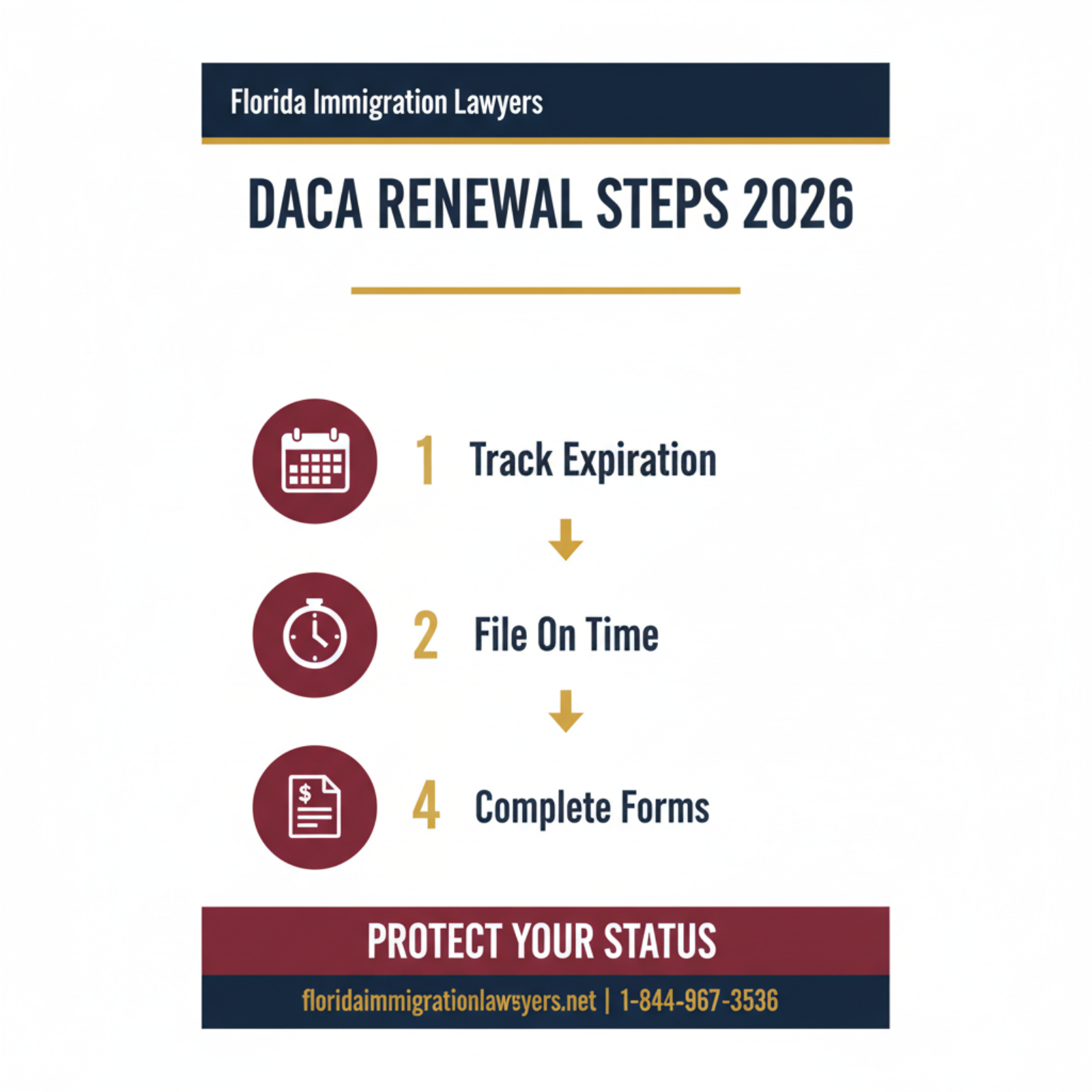
For current DACA recipients in Florida, understanding the renewal process is essential to maintaining your status. While new applications are on hold, renewals are still critical. Here is a general step-by-step guide to help you navigate the process:
- Monitor Your Expiration Date: USCIS recommends filing your DACA renewal application between 120 and 150 days before your current DACA and Employment Authorization Document (EAD) expire. Filing too early or too late can lead to complications.
- Gather Required Documents: Collect all necessary forms and supporting documentation. This includes proof of continuous residence, identity documents, and any evidence of educational or military status. A comprehensive list is provided in the next section.
- Complete USCIS Forms: You will typically need to complete Form I-821D (Consideration of Deferred Action for Childhood Arrivals), Form I-765 (Application for Employment Authorization), and Form I-765 Worksheet. Ensure all forms are filled out accurately and completely. Any discrepancies from previous applications should be carefully explained.
- Pay the Filing Fees: Submit the required filing fees with your application package. USCIS fees are subject to change, so always check the most current fee schedule on the official USCIS website. Fee waivers or exemptions are rarely granted for DACA renewals.
- Mail Your Application: Send your complete application package to the correct USCIS lockbox facility. The specific address depends on your state of residence. For Florida residents, check the USCIS website for the most up-to-date filing address. It is advisable to send your application via certified mail with a return receipt requested.
- Attend Biometrics Appointment: After USCIS accepts your application, you will receive a notice for a biometrics appointment at a local Application Support Center (ASC). Attend this appointment as scheduled to provide your fingerprints, photograph, and signature.
- Receive Decision: USCIS will review your application and biometrics. If approved, you will receive a new DACA approval notice and an updated Employment Authorization Document (EAD) by mail. If there are issues, USCIS may send a Request for Evidence (RFE) or a Notice of Intent to Deny (NOID).
Essential Documents for Your DACA Application or Renewal
Submitting a complete and accurate set of documents is critical for a successful DACA renewal. Missing or incorrect documents can cause significant delays or even lead to a denial. Here is a general checklist of documents you will likely need:
- Copy of your most recent DACA approval notice (Form I-797).
- Copy of your most recent Employment Authorization Document (EAD).
- Copy of your birth certificate with translation (if not in English).
- Copy of your passport or national identity document from your country of origin.
- Proof of continuous residence in the U.S. since June 15, 2007 (e.g., school records, employment records, tax returns, utility bills, medical records, financial statements).
- Proof of physical presence in the U.S. on June 15, 2012 (e.g., school transcripts, employment records).
- Educational documents (e.g., high school diploma, GED certificate, college transcripts).
- Military discharge records (Form DD-214) if applicable.
- Two passport-style photos taken within 30 days of filing.
- Any court dispositions or police records for arrests or convictions (even if charges were dismissed).
- Receipts for USCIS filing fees.
It is always best to consult with an immigration lawyer to ensure you have all the necessary and most up-to-date documentation for your specific case, especially with fluctuating DACA news 2026.
DACA Processing Times, Fees, and Financial Considerations
Understanding the financial and time commitments involved in the DACA renewal process is vital for proper planning. Processing times can vary significantly, and the associated fees are a mandatory part of the application.
Processing Expectations
USCIS processing times for DACA renewals can fluctuate based on caseloads, policy changes, and the specific service center handling your application. Typically, renewals can take anywhere from 3 to 6 months to process. However, some cases may be processed faster or take longer.
It is crucial to file your renewal application well in advance of your current DACA and EAD expiration date. This proactive approach helps prevent any lapse in your work authorization or protection from deportation. You can check current processing times on the USCIS website for a general estimate.
Cost Factors and Fee Breakdown
The primary cost associated with DACA renewal is the USCIS filing fee. This fee covers both the Application for Employment Authorization (Form I-765) and the biometrics services fee. As of early 2026, the total fee is typically composed of these two components. It is important to note that USCIS fees are subject to change, so always verify the exact amount on the official USCIS website before mailing your application.

Beyond the government filing fees, you may also incur costs for legal assistance, document translation, and mailing services. While the DACA renewal process might seem straightforward, the legal complexities often warrant the investment in experienced legal counsel. An immigration lawyer can help ensure your application is complete, accurate, and submitted correctly, potentially saving you time and stress in the long run.
Do not navigate this process alone. Contact Florida Immigration Lawyers today for expert guidance on your DACA renewal or any other immigration concerns. Our team is ready to provide the support you need.
Common DACA Mistakes to Avoid
Even experienced applicants can make mistakes that jeopardize their DACA status. Being aware of these common pitfalls can help you avoid them:
- Filing Late: Failing to submit your renewal application within the recommended 120-150 day window before expiration can lead to a lapse in DACA status and work authorization. This could put you at risk of unauthorized employment or even deportation if encountered by immigration enforcement.
- Incomplete or Inaccurate Forms: Submitting forms with missing information, incorrect dates, or inconsistent data from previous applications can cause significant delays or outright denial. USCIS is very particular about accuracy.
- Forgetting to Include All Required Documents: Omitting crucial supporting evidence, such as proof of continuous residence or identity documents, will result in a Request for Evidence (RFE) and prolong the processing time. In some cases, it can lead to denial.
- Failure to Disclose Arrests or Convictions: Even minor arrests or charges that were dismissed must be disclosed to USCIS. Concealing this information can be viewed as misrepresentation and lead to severe immigration consequences, including denial and potential inadmissibility.
- Not Checking the Current Filing Fees: USCIS fees can change. Submitting an incorrect fee amount will cause your application to be rejected, delaying the entire process. Always verify the current fees on the USCIS website.
- Sending to the Wrong Lockbox: USCIS has different lockbox facilities for different types of applications and states. Sending your application to the incorrect address will cause significant delays and could result in it being returned.
- Traveling Without Advance Parole: DACA generally does not grant the right to travel internationally. Leaving the U.S. without an approved Advance Parole document (Form I-131) can result in being unable to re-enter the country and the termination of your DACA status.
- Ignoring RFEs or NOIDs: If USCIS sends a Request for Evidence (RFE) or a Notice of Intent to Deny (NOID), it is critical to respond promptly and thoroughly. Failing to respond or providing an inadequate response will likely lead to a denial.
- Not Updating Your Address with USCIS: If you move, you must update your address with USCIS within 10 days. Failure to do so can result in missed notices, RFEs, or even a denial if important mail cannot be delivered.
- Assuming DACA is a Path to Green Card: DACA provides temporary relief from deportation and work authorization, but it does not directly lead to a green card or U.S. citizenship. Exploring other avenues for permanent residency requires separate applications and eligibility criteria.
When to Call a Lawyer for DACA Assistance in Florida
While some DACA renewals may seem straightforward, certain situations absolutely warrant the expertise of an immigration lawyer. Florida Immigration Lawyers are here to help you navigate these complex scenarios and ensure your rights are protected.
You should strongly consider contacting us if:
- You have ever been arrested, charged, or convicted of any crime, no matter how minor or old the offense. Even dismissed charges can impact your eligibility under the DACA guidelines (8 CFR § 274a.12(c)(14)).
- You have had any previous immigration violations, such as prior deportation orders or unlawful entries after June 15, 2012.
- You have questions about your continuous residence or physical presence requirements, or if there are gaps in your documentation.
- You have received a Request for Evidence (RFE) or a Notice of Intent to Deny (NOID) from USCIS.
- You are unsure about filling out the forms correctly or gathering all necessary supporting documents.
- You are considering applying for Advance Parole to travel outside the U.S.
- You want to explore other potential immigration pathways beyond DACA, such as family-based petitions or asylum claims. Our firm specializes in various immigration services, including deportation defense, asylum, and family immigration.
- You simply want peace of mind knowing your application is handled professionally and correctly, especially with the evolving DACA news 2026.
Our attorneys stay current on all federal court rulings and USCIS policy updates, including the latest DACA news 2026. We can help you understand your options and develop a strong legal strategy. Visit our attorneys page to learn more about our team.
Frequently Asked Questions About DACA in Florida
Is DACA allowed in Florida?
Yes, DACA is a federal program, and DACA recipients reside in Florida. While the state of Florida has its own laws, DACA protections and renewal processes are governed by federal immigration law and USCIS policies. Current DACA recipients in Florida are generally eligible to renew their deferred action, though new applications remain paused due to federal court orders. The legal landscape for DACA is national, not state-specific, but local USCIS offices in Florida handle the processing.
Can DACA recipients get deported by ICE?
DACA provides temporary protection from deportation. However, this protection is not absolute. DACA status can be terminated if a recipient commits certain crimes, such as a felony or significant misdemeanor, or if they are found to pose a threat to national security or public safety. If DACA status is revoked or expires, an individual becomes subject to deportation by ICE (Immigration and Customs Enforcement). Additionally, individuals without DACA or those who lose their DACA status are generally considered priorities for immigration enforcement. Consulting with an immigration lawyer is critical if you face any criminal charges or interactions with law enforcement.
Is it safe to go to Florida with DACA?
As a federal program, DACA status is recognized nationwide, including in Florida. For current DACA recipients, traveling to or residing in Florida is generally safe in terms of their DACA status, provided they continue to abide by all DACA requirements and laws. However, all individuals, including DACA recipients, should be aware of their rights when interacting with law enforcement. It is always advisable to carry proof of your DACA status and valid identification. If you are concerned about specific travel or legal situations, seek advice from an experienced immigration attorney.
Is DACA going to reopen?
As of early 2026, new DACA applications remain paused due to federal court injunctions. The program's future is subject to ongoing litigation, particularly at the federal appellate level and potentially the U.S. Supreme Court. Whether DACA will reopen for new applicants depends entirely on the outcome of these legal challenges and potential legislative action by Congress. While many advocate for a permanent legislative solution for Dreamers, no immediate reopening for new applications is anticipated without significant legal or political developments. We encourage you to stay informed through reliable sources and legal counsel.
About Florida Immigration Lawyers
Florida Immigration Lawyers is a leading law firm dedicated to serving the immigration needs of individuals and families across the entire state of Florida. Our firm is built on a foundation of empathy, expertise, and a steadfast commitment to justice. We understand the profound impact immigration matters have on your life and strive to provide personalized, effective legal solutions.
Our experienced attorneys offer comprehensive services, including family-based immigration, business immigration, deportation defense, asylum, citizenship, and DACA assistance. We pride ourselves on offering clear communication, strategic advocacy, and unwavering support to our clients through every step of their immigration journey. We are available 24/7 to address your urgent concerns and offer free, confidential consultations to help you understand your legal options.
When you choose Florida Immigration Lawyers, you choose a partner who will fight tirelessly for your rights and your future. We serve all Florida communities, including Jacksonville, Orlando, Tampa, and Miami, ensuring that quality legal representation is accessible to everyone. Visit our website at https://www.floridaimmigrationlawyers.net or call us directly at 1-844-967-3536 to schedule your free consultation.
Sources and References
- U.S. Citizenship and Immigration Services (USCIS) - Deferred Action for Childhood Arrivals
- Executive Office for Immigration Review (EOIR)
- 8 U.S.C. Chapter 12 - Immigration and Nationality Act (INA)
- 8 U.S.C. § 1227 - Deportable aliens
- 8 CFR § 274a.12(c)(14) - Classes of aliens authorized to work for a specific employer incident to status.
This article provides general legal information and is not intended as legal advice. Every case is unique, and outcomes depend on specific facts and circumstances. Contact an attorney for advice about your particular situation.
The landscape of DACA news 2026 can be daunting, but you do not have to face it alone. Florida Immigration Lawyers are here to provide the expert guidance and compassionate support you need. Whether you are renewing your DACA status, exploring other immigration pathways, or simply seeking clarity on the latest policies, our team is ready to assist.
Take the crucial step towards securing your future. Call Florida Immigration Lawyers today at 1-844-967-3536 for a free consultation. Se Habla Español - Estamos aquí para ayudarle.
Need help with Immigration?
Our Florida immigration attorneys offer free consultations. Call today or schedule online.
Frequently Asked Questions
Florida Immigration Lawyers
Legal Team
Our experienced attorneys at Florida Immigration Lawyers have been serving clients across Florida for over 20 years. We specialize in immigration, personal injury, criminal defense, workers compensation, and family law.