Inmigración11 min de lectura
Immigration Bond Hearing Florida: Your Guide to Release from ICE Detention
Facing an immigration bond hearing in Florida? Learn how to secure release from ICE detention in Homestead, Miami, and across Florida. Contact Florida Immigration Lawyers for a free consultation.
Vasquez Law FirmPublicado el March 3, 2026
0 vistas
Quick Answer: Immigration Bond Hearings in Florida
An immigration bond hearing in Florida determines if an individual detained by ICE can be released from custody by posting a bond. An Immigration Judge assesses factors like flight risk and danger to the community. Eligibility and the bond amount vary greatly depending on immigration status, criminal history, and ties to the U.S. Legal representation is crucial to present a strong case for release.- Immigration Judges decide bond eligibility and amounts.
- Factors include flight risk, danger, and U.S. ties.
- Not all detained individuals are eligible for a bond hearing.
- Legal representation significantly improves chances of release.
- Bond hearings typically occur at Florida immigration courts like Orlando or Miami.
Introduction: Facing an Immigration Bond Hearing in Florida
Imagine the sudden distress of learning a loved one has been detained by Immigration and Customs Enforcement (ICE) in Florida. The news can be overwhelming, leaving you with urgent questions about their well-being and how to secure their release. Many families in Homestead, Miami, and across the Sunshine State experience this challenging situation annually. The path to release often involves an **immigration bond hearing Florida**. This legal proceeding is a critical step where an Immigration Judge decides if a detained individual can be released from custody by paying a bond. Understanding this process is vital for anyone hoping to reunite with a family member. Beyond the legal complexities, the emotional toll of having a family member in immigration detention can be immense. Families often face significant financial strain, emotional distress, and uncertainty about the future. Swift and informed action is paramount, as delays can prolong detention and complicate the legal process. Early intervention by an experienced immigration attorney can make a profound difference in the outcome. This comprehensive guide from Florida Immigration Lawyers will walk you through everything you need to know about immigration bond hearings in Florida. We will cover eligibility, the procedural steps, necessary documentation, and common pitfalls to avoid. Our goal is to empower you with information and clarify this complex legal journey. Do not face this difficult time alone. For immediate assistance and to discuss your specific situation, **call Florida Immigration Lawyers at 1-844-967-3536 for a free consultation**. Our experienced attorneys are ready to help you.Understanding the Immigration Bond Hearing Process in Florida
When someone is detained by ICE in Florida, they are typically held at facilities such as the Krome Service Processing Center near Homestead or the Broward Transitional Center. For many, the first opportunity for release comes through an **immigration bond hearing Florida**. An immigration bond is essentially a sum of money paid to the Department of Homeland Security (DHS) to ensure that a noncitizen will appear for all scheduled immigration court hearings. If the individual attends all their hearings, the bond money is returned. If they fail to appear, the bond is forfeited. It's important to distinguish between an administrative bond set by ICE and a bond set by an Immigration Judge. Sometimes, ICE may initially set an administrative bond amount. However, if this amount is excessively high or if ICE denies bond altogether, the detained individual has the right to request a bond hearing before an Immigration Judge, who can then review and potentially lower the bond amount or grant bond if previously denied. This judicial review is a crucial safeguard.Who is Eligible for an Immigration Bond Hearing?
Eligibility for an immigration bond is not universal. Generally, individuals who are lawfully admitted to the U.S. and have not committed certain serious crimes may be eligible for a bond hearing. However, individuals deemed "arriving aliens" or those with specific criminal convictions might be subject to mandatory detention under the Immigration and Nationality Act (INA) Section 236(c) (8 U.S.C. § 1226(c)), making them ineligible for bond. Mandatory detention provisions are particularly stringent, often applying to individuals with past convictions for aggravated felonies or certain drug offenses, regardless of their ties to the U.S. or their immigration status. For example, a lawful permanent resident with a prior conviction for a controlled substance offense might face mandatory detention, significantly complicating their path to release. Navigating these complex eligibility rules requires an in-depth understanding of immigration law, which our attorneys at Florida Immigration Lawyers possess. The Immigration Judge (IJ) has the authority to grant bond in many cases. The IJ will consider several factors when deciding whether to grant bond and the appropriate amount. These factors include whether the individual poses a flight risk or a danger to the community.Factors Influencing Bond Decisions
During an **immigration bond hearing Florida**, the Immigration Judge will evaluate specific criteria. These include the individual's ties to the community, such as family in the U.S., employment history, and length of residency. The judge will also review their criminal record, if any, and their history of appearing at court hearings. To demonstrate a low flight risk, evidence of strong community ties is essential. This could include U.S. citizen children, a spouse, ownership of property, a stable job, and a long history of residence in the U.S. For instance, presenting proof of a mortgage, utility bills spanning several years, and letters from U.S. citizen family members can paint a picture of deep roots that make an individual unlikely to abscond. Conversely, demonstrating no danger to the community involves highlighting a clean criminal record, or if there are minor infractions, showing rehabilitation and no history of violent behavior. Other important considerations are the individual's financial resources and whether they have a strong likelihood of success in their underlying immigration case. Presenting a compelling case for release requires careful preparation and an understanding of these judicial considerations. Our firm specializes in helping clients demonstrate strong ties and minimal risk in immigration cases, often by constructing a comprehensive narrative supported by robust evidence. The judge ultimately evaluates the totality of the circumstances, seeking a reasonable assurance that the individual will appear for future hearings and not pose a threat to public safety.Navigating the Immigration Bond Hearing: A Step-by-Step Guide
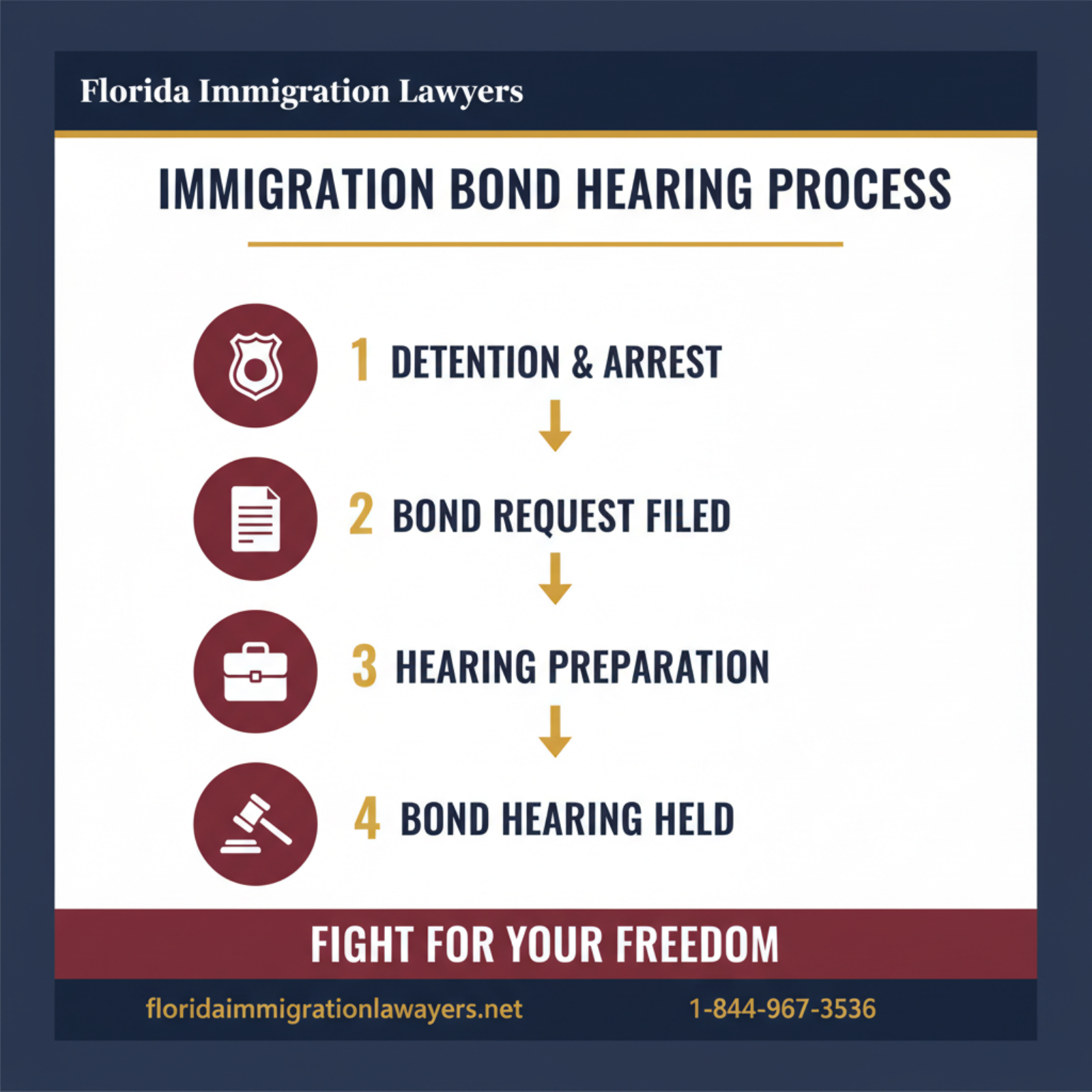
The process of securing an **immigration bond hearing Florida** can seem complex, but breaking it down into manageable steps can help. Success in these hearings often hinges on meticulous preparation and skilled legal advocacy. Having an experienced attorney from Florida Immigration Lawyers guiding you through each stage can significantly enhance the chances of a favorable outcome. Here is a general overview of what typically occurs:- Initial Detention and Notice to Appear (NTA): After an individual is detained by ICE, they will typically receive a Notice to Appear (NTA). This document initiates removal proceedings and lists the charges of removability against them. The NTA is crucial as it outlines why the government believes the individual should be deported. It also specifies the immigration court where the individual's case will be heard, often the Orlando Immigration Court or Miami Immigration Court, depending on the detention facility.
- Requesting a Bond Hearing: In most cases, the detained individual or their attorney must formally request an **immigration bond hearing Florida** from the Immigration Court. Sometimes, ICE may set an administrative bond directly, but if the family believes it is too high, they can request a hearing to ask a judge to lower it. This request is typically made to the Executive Office for Immigration Review (EOIR) courts, such as the Orlando Immigration Court or the Miami Immigration Court. An attorney can strategically determine the best time to request this hearing, ensuring all necessary evidence is prepared.
- Preparing Your Case: This is a critical phase. You will gather evidence demonstrating the individual's strong ties to the community, lack of flight risk, and absence of danger to others. This includes affidavits from family and friends, proof of employment, property ownership, and any medical conditions requiring attention outside detention. An experienced attorney from Florida Immigration Lawyers can help you compile a comprehensive bond packet, advising on what specific documents and testimonies will be most persuasive to the Immigration Judge. For example, letters from employers detailing consistent work history and future job offers can be highly impactful.
- Attending the Bond Hearing: The hearing will take place before an Immigration Judge. The judge will listen to arguments from the detained individual's attorney and the ICE attorney. The judge will then weigh the evidence and decide whether to grant bond and, if so, the amount. The bond amount must be "reasonable" and is typically set to ensure the individual's future appearance. During the hearing, the detained individual may be asked to testify, and their attorney will present evidence and cross-examine the ICE attorney's witnesses. It's crucial for the individual to appear calm and respectful, as their demeanor can also influence the judge's perception.
- Posting the Bond: If the judge grants bond, the bond amount must be paid to ICE. This is usually done at a local ICE office. The bond can be paid by anyone, not necessarily a family member, and the person paying is known as the obligor. The obligor must be a U.S. citizen or lawful permanent resident and will be responsible for ensuring the detained individual attends all future court hearings. For example, if a bond is set at $10,000, the obligor would pay this amount via cashier's check or money order at a designated ICE facility.
- Release from Detention: After the bond is posted, it can take some time for the individual to be processed and released from the detention facility. This timeframe can vary, typically taking a few hours to a few days. Our team can help coordinate this final step, providing updates and ensuring all necessary paperwork is in order for a smooth release. It's important to remember that release on bond is not the end of the immigration case; it simply allows the individual to pursue their case from outside detention.
Essential Documents for Your Immigration Bond Hearing
A well-prepared **immigration bond hearing Florida** requires a comprehensive set of documents. These documents help the Immigration Judge assess the individual's ties to the community and reduce perceived flight risk or danger. Gathering these items ahead of time can significantly strengthen your case, painting a clear picture of the individual's stability and reliability. Your attorney from Florida Immigration Lawyers will work closely with you to identify and organize every piece of evidence. Here is a typical checklist of documents and information you should prepare:- Proof of Identity and Immigration Status: Passport, birth certificate, visa, I-94 arrival/departure record, or any existing immigration documents. Consistent and verifiable identity is fundamental to establishing credibility with the court.
- Proof of Residence in the U.S.: Lease agreements, utility bills, mail showing address, or property deeds. Documents demonstrating a long-term, stable address in the U.S. are crucial for showing community ties.
- Family Ties in the U.S.: Birth certificates of U.S. citizen children, marriage certificates, affidavits from family members detailing their relationship and support. These documents help illustrate the individual's deep personal connections and support network within the U.S.
- Employment History and Financial Stability: Pay stubs, employment letters, tax returns, bank statements, or proof of a job offer upon release. A stable work history indicates reliability and provides evidence against flight risk, as the individual has a reason to remain in the community.
- Community Ties: Letters of support from community leaders, religious figures, or school officials. Proof of volunteer work or community involvement. These demonstrate integration into the local community beyond immediate family.
- Medical Records: Any documentation of serious medical conditions requiring specialized care not available or adequate in detention. Such records can highlight humanitarian concerns and the practical need for release to access appropriate medical treatment.
- Criminal Records (if any): Certified disposition of any past arrests or convictions. It is crucial to be transparent and provide all relevant court documents, as attempting to conceal information can severely damage credibility.
- Previous Immigration History: Records of prior immigration applications, court appearances, or any voluntary departure orders. This history helps the judge understand the individual's past interactions with immigration authorities.

Preguntas Frecuentes
There's no fixed 'average' as bond amounts vary widely, typically ranging from $1,500 to $25,000 or more. The Immigration Judge considers factors like flight risk, criminal history, and community ties. For example, someone with minor infractions and strong family ties might receive a $5,000 bond, while a higher flight risk could face a $15,000 bond. An attorney from Florida Immigration Lawyers can argue for the lowest possible amount based on your specific circumstances.
The actual bond hearing itself is usually quite brief, often lasting between 20 to 60 minutes. However, the wait time to get a hearing scheduled can be several weeks or even months, especially in busy immigration courts like Miami or Orlando. The speed of scheduling can depend on court backlogs and how quickly your attorney can file the necessary requests and prepare your case with Florida Immigration Lawyers.
Yes, if an Immigration Judge denies bond or sets an unreasonably high amount, the decision can be appealed to the Board of Immigration Appeals (BIA). There are strict deadlines for filing an appeal, typically within 30 days of the judge's decision. For instance, if a bond is denied, your attorney must act quickly to submit the appeal and present arguments for why the judge's decision was incorrect or an abuse of discretion.
If an immigration bond is denied, the individual remains in ICE detention while their removal proceedings continue. However, a denial is not necessarily the final word. Your attorney can appeal the decision to the BIA, or if circumstances change (e.g., new evidence of community ties emerges), a motion to reconsider or a new bond hearing might be requested. It is crucial to consult with Florida Immigration Lawyers immediately to explore all available options.
Anyone can pay an immigration bond, provided they are a U.S. citizen or lawful permanent resident and can prove their identity. This person is known as the 'obligor.' The bond is paid directly to ICE at a designated facility, usually via a cashier's check or money order for the exact amount. The obligor is responsible for ensuring the detained individual appears for all future immigration court hearings; failure to do so will result in the forfeiture of the bond money.
VLF
Vasquez Law Firm
Equipo Legal
Por más de 15 años, Vasquez Law Firm ha estado sirviendo a clientes en Florida. Nos especializamos en inmigración, lesiones personales, defensa criminal, compensación laboral y derecho familiar.
Enlaces Relacionados
Temas Relacionados
#immigration#florida#immigration bond#detention#florida