Green Card Renewal Florida Process 2026: Your Guide to I-90
Navigate your green card renewal in Florida for 2026. Learn the I-90 application process, requirements, and USCIS timeline. Contact Florida Immigration Lawyers for a free consultation.
Navigating the complexities of immigration law can be daunting, especially when it comes to renewing your Green Card. For lawful permanent residents in Florida, understanding the specific process for 2026 is crucial to maintaining your status. This comprehensive guide will walk you through everything you need to know about the Form I-90, Application to Replace Permanent Resident Card, ensuring a smooth and successful renewal. For personalized guidance and to navigate any unique challenges, consulting with experienced Florida Immigration Lawyers is always a wise decision.
Understanding Your Green Card and the Need for Renewal
A Green Card, officially known as a Permanent Resident Card, is proof of your authorization to live and work permanently in the United States. While the status of permanent residency itself is indefinite, the card typically has a 10-year expiration date. Renewing your Green Card is not about renewing your permanent resident status, but rather replacing an expiring or expired card. Failing to renew your card can lead to difficulties proving your status, impacting employment, travel, and access to certain benefits. It's essential to start the renewal process well in advance of your card's expiration date, ideally six months prior.
Even if your Green Card has already expired, you should still file to renew it. There are very few situations where an expired Green Card means you've lost your permanent resident status. However, an expired card can cause significant inconvenience, particularly if you need to travel internationally or prove your work authorization. For those facing complex immigration situations, such as potential deportation defense issues or concerns about their status, consulting with an experienced immigration attorney is highly recommended. They can provide clarity and strategic advice tailored to your unique circumstances.
The practical implications of an expired Green Card extend beyond just travel and employment. In Florida, you might encounter difficulties when trying to renew your driver's license, open a bank account, or even apply for certain state-level benefits, as many institutions require valid proof of permanent residency. Your Green Card serves as your primary identification in these scenarios, and an expired card can create unnecessary hurdles in your daily life. While your permanent resident status remains intact, the lack of a valid, unexpired card can severely limit your ability to exercise the rights associated with that status.
Consider Maria, a long-term resident in Miami who delayed her Green Card renewal. When she attempted to renew her Florida driver's license, she was denied because her Green Card was expired, causing significant inconvenience for her daily commute and family responsibilities. Similarly, proving her work authorization to a new employer became a bureaucratic nightmare until her renewed card arrived. These real-world scenarios underscore the critical importance of proactive planning and timely renewal to avoid disruptions to your life.
To prevent such complications, we reiterate the importance of initiating the renewal process within the recommended six-month window before your card's expiration. Set reminders, gather your documents early, and if you have any doubts about your status or the renewal process, do not hesitate to seek guidance. Florida Immigration Lawyers are readily available to help clarify any ambiguities about the distinction between your permanent resident status and the physical card itself, ensuring you remain compliant and secure.
Who Needs to Renew Their Green Card?
Most lawful permanent residents receive a Green Card that is valid for 10 years. You will need to renew your Green Card if:
- Your existing Green Card is expiring within the next six months or has already expired.
- Your Green Card was issued without an expiration date (older versions) and you are now required to replace it.
- Your Green Card was lost, stolen, mutilated, or destroyed.
- You never received your Green Card after it was issued.
- You have legally changed your name or other biographical information since your last card was issued, and you want an updated card.
- You were a commuter immigrant and are now taking up actual residence in the U.S.
- You have been identified as a permanent resident who needs to replace their card for other reasons by USCIS.
If your Green Card was issued without an expiration date, it typically means it's an older version that USCIS now requires to be replaced. These older cards lack modern security features and can be difficult for authorities to verify. Replacing it ensures you have a card that meets current identification and security standards, preventing potential issues with travel, employment, or interactions with government agencies. It's a proactive step to ensure your documentation is up-to-date and compliant.
In cases where your Green Card has been lost, stolen, or mutilated, filing Form I-90 is crucial. While not always strictly mandatory, it is highly advisable to file a police report if your card was stolen. This report can serve as valuable evidence for your application, demonstrating due diligence and providing an official record of the incident. Losing your Green Card can be stressful, but acting quickly to replace it minimizes the period during which you lack official proof of your status.
Furthermore, if you've legally changed your name due to marriage, divorce, or another court order, while not strictly required to replace your Green Card immediately, it's highly recommended. Having a Green Card that reflects your current legal name ensures consistency across all your identification documents, such as your passport, driver's license, and social security card. This consistency can prevent future complications when proving your identity or applying for other benefits. An updated card simplifies administrative processes and reduces potential discrepancies.
It's important to note that conditional permanent residents (those with a 2-year Green Card obtained through marriage or investment) do not renew their Green Card using Form I-90. Instead, they must file Form I-751 (Petition to Remove Conditions on Residence) or Form I-829 (Petition by Investor to Remove Conditions on Permanent Resident Status) to remove the conditions on their residency. For example, a spouse who received a conditional Green Card through marriage must file Form I-751 within the 90-day period before their card expires. Misfiling with Form I-90 can lead to denial, loss of status, and even deportation proceedings. If you are unsure about your specific situation, seeking guidance from an experienced immigration lawyer can prevent costly mistakes and delays, ensuring you file the correct form at the appropriate time.
The I-90 Application Process: Step-by-Step for Florida Residents
The Form I-90 is the primary application used to renew or replace a Permanent Resident Card. The process is largely standardized across the U.S., but understanding the steps is key to a successful application.
1. Determine Your Eligibility
Before you begin, ensure you meet one of the criteria listed above for filing Form I-90. Double-check the reason for your application, as this will influence the specific sections you need to complete on the form.
A common pitfall in eligibility determination is mistaking your status as a conditional resident for a permanent resident needing renewal. For instance, if you received your Green Card through marriage less than two years ago, you are likely a conditional resident and must file Form I-751. A quick consultation with Florida Immigration Lawyers can save significant time and money by ensuring you understand your specific immigration status and file the correct form from the outset, preventing unnecessary delays or denials.
2. Complete Form I-90
You can file Form I-90 either online or by mail. USCIS strongly encourages online filing for its efficiency and immediate confirmation. The form asks for personal information, details about your previous Green Card, and the reason for your application. Be meticulous in filling out every section. Any errors or omissions can lead to delays or even rejection.
- Online Filing: Create a USCIS online account. This allows you to fill out the form, upload supporting documents, and pay fees electronically. You'll receive instant confirmation of submission.
- Mail Filing: Download Form I-90 from the USCIS website. Complete it neatly, preferably by typing or using black ink. Make copies of your entire application for your records before mailing it. The filing address depends on the reason for your application, so always check the latest USCIS instructions.
When completing the form, pay close attention to details such as your full legal name, date of birth, and Alien Registration Number (A-Number). These must precisely match your existing immigration documents. Common mistakes include typographical errors, incorrect dates, or providing an outdated address. Double-check every entry, and if filing by mail, ensure your handwriting is legible or type the information. An accurately completed form is the first and most critical step towards a smooth renewal process.
Online filing offers several advantages, including real-time error checking, immediate confirmation of submission, and the ability to track your application status easily through your USCIS account. For those who prefer mail filing, remember to use certified mail with a return receipt requested. This provides proof of mailing and delivery, which can be invaluable if there are any questions about your application's submission. Always keep a complete copy of your submitted application and all supporting documents for your personal records.
3. Gather Required Documents
The documents you need will vary slightly based on why you're filing. Generally, you will need:
- A copy of your current Green Card (if available).
- Government-issued identification (e.g., driver's license, state ID).
- Proof of identity and residency (e.g., birth certificate, passport).
- Marriage certificate or court order for name change (if applicable).
- Police report for lost/stolen cards (if applicable).
Always refer to the official USCIS instructions for Form I-90 for the most up-to-date list of required evidence. Submitting incomplete documentation is a common reason for delays.
For specific scenarios, additional documentation may be necessary. For instance, if you are replacing a Green Card due to a name change, you must provide a certified copy of the legal document that authorized the change, such as a marriage certificate, divorce decree, or court order. If your card was lost or stolen, while a police report is not always mandatory, it is highly recommended as it provides official documentation of the incident and can strengthen your application. Ensure all copies are clear, legible, and complete.
If any of your supporting documents are not in English, you must include a complete and accurate English translation, along with a certification from the translator stating that they are competent to translate and that the translation is accurate. Failing to provide certified translations is a common cause for Requests for Evidence (RFEs) from USCIS, which can significantly delay your application. Taking the time to gather all necessary and properly translated documents upfront can save considerable time and stress later on.
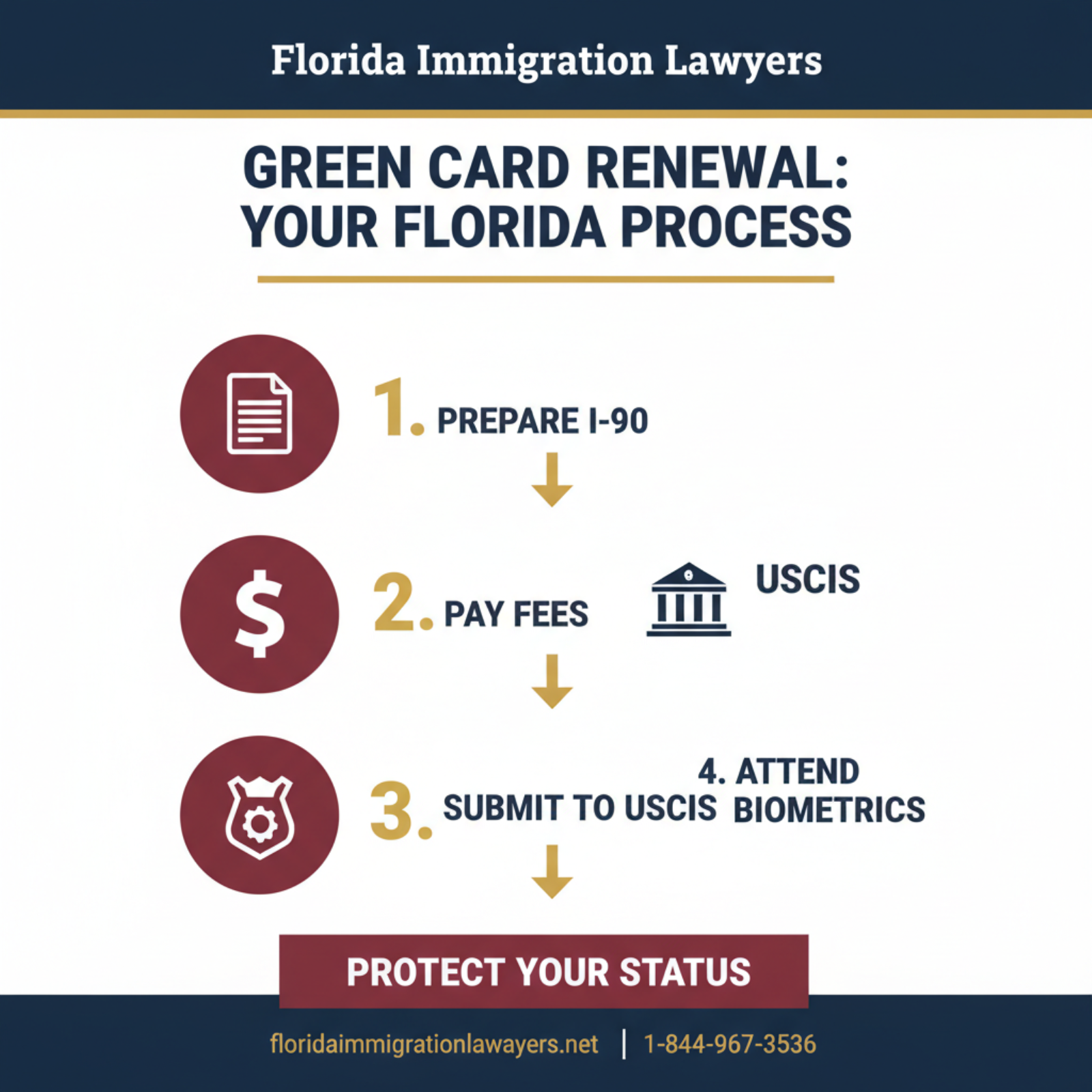
4. Pay the Filing Fee
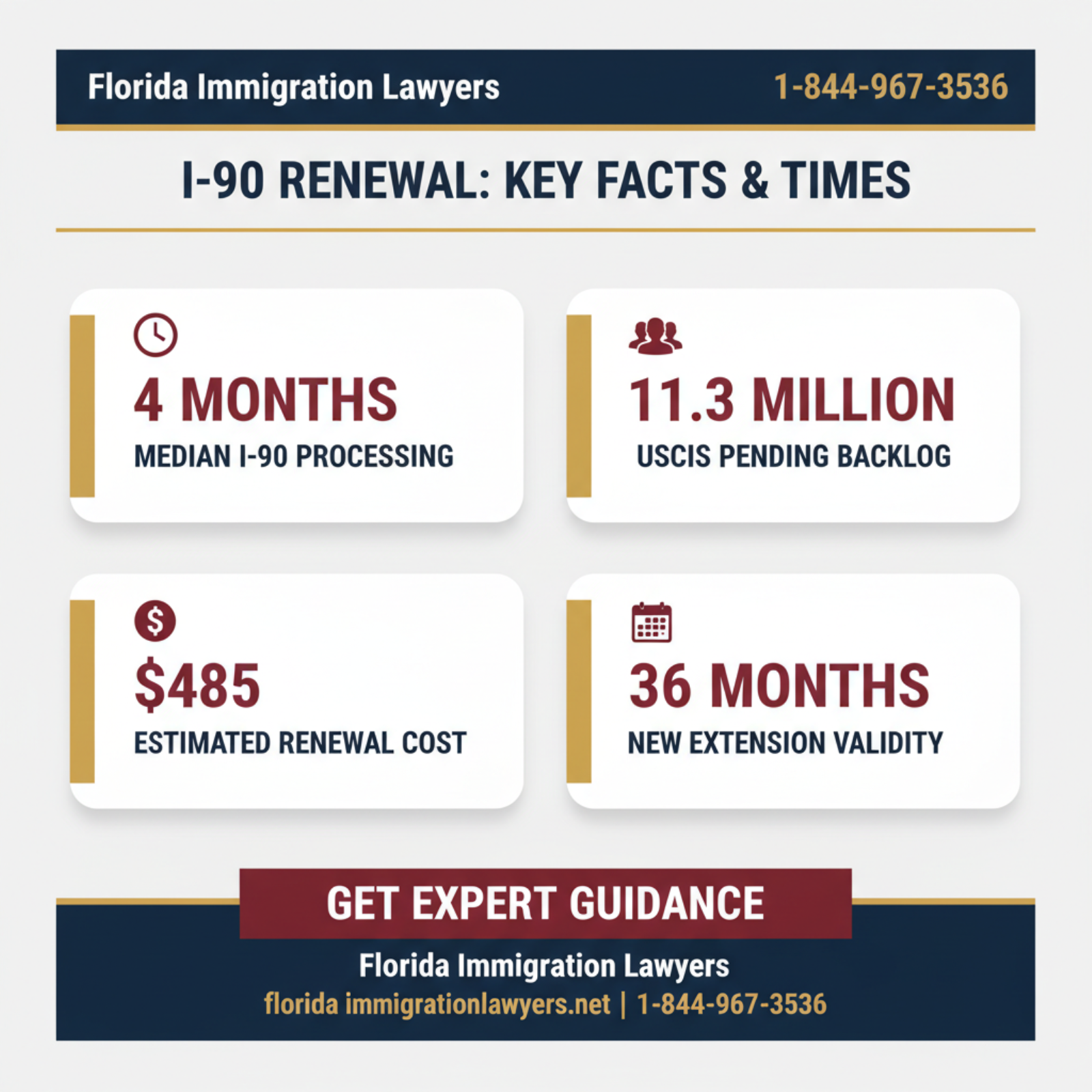
As of late 2023/early 2024, the filing fee for Form I-90 is $465, plus an additional $85 for biometric services, totaling $550. These fees are subject to change, so always verify the current amounts on the USCIS website or by consulting Florida Immigration Lawyers.
For online applications, fees can typically be paid using a credit or debit card. If filing by mail, you can pay by money order, personal check, or cashier's check. Make checks payable to the "U.S. Department of Homeland Security" and ensure the amount is correct to avoid rejection. Do not send cash through the mail.
USCIS offers fee waivers for certain applicants who demonstrate an inability to pay. You may be eligible for a fee waiver if your household income is at or below 150% of the Federal Poverty Guidelines, you are currently receiving a means-tested public benefit, or you are experiencing financial hardship. To apply for a fee waiver, you must file Form I-912, Application for Fee Waiver, along with your Form I-90. While a fee waiver can be a vital option for those who qualify, be aware that it adds an additional layer of review to your application and may extend processing times.
The biometric services fee covers the cost of collecting your fingerprints, photograph, and signature. This fee is generally required for all I-90 applicants unless you are exempt (e.g., certain applicants over 79 years old). This fee is typically paid concurrently with the filing fee for Form I-90, making the total payment a combined sum. Ensure both components of the fee are included in your payment to prevent your application from being rejected for insufficient funds.
5. Attend Your Biometrics Appointment
After USCIS accepts your Form I-90 application, you will typically receive an appointment notice (Form I-797C) for biometrics. This appointment will take place at a local Application Support Center (ASC) in Florida. During this brief visit, USCIS will collect your fingerprints, a photograph, and your signature. These biometrics are crucial for conducting necessary background and security checks to verify your identity and ensure your continued eligibility for permanent residency.
It is imperative to attend your biometrics appointment as scheduled. Bring your appointment notice, a valid government-issued photo identification (such as your driver's license or passport), and your current Green Card (if available). Arrive on time, as missing this appointment without proper rescheduling can lead to significant delays in your application processing or even a denial. If you have an unavoidable conflict, follow the instructions on your appointment notice to request a reschedule promptly.
6. Track Your Application Status
Once your application is submitted and your biometrics are processed, you can track the status of your Form I-90 online using the receipt number provided by USCIS. This receipt number, usually starting with three letters (e.g., EAC, WAC, LIN, SRC, NBC), allows you to monitor your case's progress through the USCIS Case Status Online tool.
It's also advisable to regularly check the USCIS website for current processing times, which can vary significantly based on the service center and current caseloads. If your application's processing time exceeds the published estimates, or if you encounter any issues with your case status, you can contact USCIS customer service. For more complex inquiries or if you feel your application is unduly delayed, consulting with Florida Immigration Lawyers can provide valuable assistance in navigating the system and escalating your case if necessary.
7. Receive Your New Green Card
The final step in the renewal process is receiving your new Permanent Resident Card in the mail. Once USCIS approves your application, they will produce and mail your card to the address on file. Upon receipt, immediately inspect the card to ensure all information – your name, A-Number, date of birth, and expiration date – is accurate. Any errors should be reported to USCIS promptly to avoid future complications.
If your card contains errors due to a USCIS mistake, you may need to file another Form I-90 with specific documentation to correct it, often without an additional fee. If you do not receive your card within the expected timeframe after approval, you should contact USCIS customer service. Keeping your mailing address updated with USCIS is vital throughout the entire process to ensure you receive all notices and your new card without interruption.
What to Do While Your Application is Pending
A common concern for applicants is what to do if their Green Card expires while their I-90 application is still pending. Fortunately, USCIS typically provides an automatic extension of your lawful permanent resident status. Once your I-90 application is accepted, USCIS will send you a Form I-797C, Notice of Action, which serves as a receipt notice. This notice, when presented with your expired Green Card, generally extends the validity of your status for up to 24 months from the expiration date printed on your old card.
This temporary proof of status is usually sufficient for domestic purposes, such as employment verification (Form I-9) and obtaining a driver's license in Florida. However, for international travel, while the I-797C with your expired card is often accepted for re-entry into the U.S., it's crucial to exercise caution. Always confirm with your airline and the embassy or consulate of your destination country regarding their specific requirements before traveling. For urgent travel needs or any employment verification challenges, seeking advice from Florida Immigration Lawyers by calling 1-844-967-3536 can provide peace of mind and ensure you have proper documentation.
Vasquez Law Firm
Equipo Legal
Por más de 15 años, Vasquez Law Firm ha estado sirviendo a clientes en Florida. Nos especializamos en inmigración, lesiones personales, defensa criminal, compensación laboral y derecho familiar.