U Visa for Crime Victims in Florida: Your Path to Immigration Relief
Victims of crime in Florida may qualify for a U visa, offering critical immigration relief. Learn about eligibility, the application process, and how Florida Immigration Lawyers can help. Call us for a free consultation.
If you are a victim of certain serious crimes in Florida, you may feel lost, vulnerable, and unsure of your future, especially if your immigration status is uncertain. The U Nonimmigrant Status, commonly known as the U Visa, offers a beacon of hope and a critical path to immigration relief for those who have suffered substantial physical or mental abuse and are willing to assist law enforcement in the investigation or prosecution of the criminal activity. This visa not only provides temporary legal status but also a potential pathway to permanent residency, allowing victims to rebuild their lives in safety.
Understanding the complexities of the U Visa process can be daunting, but you don't have to face it alone. Contact Florida Immigration Lawyers today at 1-844-967-3536 for a confidential consultation to discuss your specific situation and explore your eligibility for this vital immigration protection.
Understanding the U Visa: What It Is and Who It Helps
The U Visa was created by Congress with the passage of the Victims of Trafficking and Violence Protection Act (VTVPA) in October 2000. Its primary purpose is to strengthen the ability of law enforcement agencies to investigate and prosecute cases of domestic violence, sexual assault, trafficking, and other serious crimes, while simultaneously offering protection to immigrant victims who might otherwise be afraid to report crimes or cooperate with authorities due to their immigration status. It acknowledges the invaluable role that victims play in the justice system and provides a humanitarian form of relief.
For victims in Florida, the U Visa offers a unique opportunity to escape dangerous situations, gain legal work authorization, and eventually apply for a Green Card. This protection extends beyond the primary victim, potentially including eligible family members, thereby offering a comprehensive solution for families impacted by crime. It's a testament to the principle that no one should suffer in silence, regardless of their immigration background. Our firm specializes in various immigration law matters, and we are dedicated to helping crime victims navigate these sensitive cases with compassion and expertise.
Beyond the immediate legal benefits, the U Visa provides a profound sense of security and stability. Victims, who often live in constant fear of deportation or further abuse, can finally begin to heal and rebuild their lives without the looming threat of removal. This newfound safety allows them to access critical support services, pursue education, and secure stable employment, fostering a path towards full integration into their communities. It's a transformative tool designed to empower individuals to move from vulnerability to resilience.
The humanitarian aspect of the U Visa cannot be overstated. It recognizes the inherent dignity of every individual, ensuring that those who have endured severe trauma are not further victimized by a broken immigration system. By offering a pathway to legal status, the U Visa encourages reporting of crimes that might otherwise go unpunished, making communities safer for everyone. If you or a loved one in Florida has been a victim of a qualifying crime, understanding these benefits is the first step towards recovery, and Florida Immigration Lawyers are here to guide you.
Eligibility Requirements for the U Visa in Florida
Qualifying for a U Visa involves meeting several stringent criteria set forth by U.S. Citizenship and Immigration Services (USCIS). It's not enough to simply be a victim of a crime; specific conditions must be met regarding the nature of the crime, the harm suffered, and your cooperation with law enforcement.
Qualifying Criminal Activities
The U Visa is specifically designed for victims of certain serious crimes. These include, but are not limited to, rape, torture, trafficking, incest, domestic violence, sexual assault, abusive sexual contact, prostitution, female genital mutilation, hostage taking, peonage, involuntary servitude, kidnapping, abduction, unlawful criminal restraint, blackmail, extortion, murder, manslaughter, felonious assault, witness tampering, obstruction of justice, perjury, or attempt, conspiracy, or solicitation to commit any of these crimes. The crime must have occurred in the U.S. or violated U.S. law. For more information on victim rights and resources, you can visit the U.S. Department of Justice website.
It's important to understand that the list of qualifying crimes is broad and often includes attempts, conspiracies, and solicitations to commit these offenses. For example, a victim of an attempted kidnapping, even if unsuccessful, could still qualify. Similarly, victims of domestic violence, which can encompass various forms of abuse, are often strong candidates. The key is demonstrating that the criminal activity falls within the specified categories and directly led to substantial harm. An experienced attorney with Florida Immigration Lawyers can help you determine if your specific situation meets these complex criteria.
Proving Substantial Harm
Applicants must demonstrate that they have suffered substantial physical or mental abuse as a direct result of the qualifying criminal activity. This harm can manifest in various ways, including physical injuries, psychological trauma, emotional distress, or significant financial losses. Documenting this harm is crucial and can involve medical records, psychological evaluations, police reports, and personal affidavits detailing the impact of the crime on your life.
To effectively prove substantial harm, gathering comprehensive evidence is paramount. This might include medical records detailing injuries and treatments, psychological evaluations from licensed therapists outlining PTSD, anxiety, or depression, and expert testimony. Personal affidavits, while powerful, should be supported by objective evidence whenever possible. For instance, if a victim suffered a broken arm during an assault, X-rays and doctor's notes would be critical. If the harm is primarily psychological, a detailed report from a mental health professional is essential to illustrate the lasting impact of the crime.
Helpfulness to Law Enforcement
A cornerstone of U Visa eligibility is your willingness and ability to assist law enforcement officials in the investigation or prosecution of the criminal activity. This cooperation is certified by a qualifying law enforcement agency (LEA) or other authorized entity, such as a prosecutor's office, judge, or Child Protective Services. This certification, typically on Form I-918 Supplement B, is a critical component of your application. It confirms that you have been, are being, or are likely to be helpful to the authorities. Without this certification, securing a U Visa is generally not possible. You can find official forms and detailed instructions on the USCIS website.
Securing the I-918 Supplement B certification can be one of the most challenging aspects of the U Visa process. It requires active engagement with the certifying agency, which could be local police, a sheriff's department, or even federal agencies. Your attorney can play a vital role in facilitating communication with law enforcement, explaining your rights, and ensuring that your cooperation is properly documented. It’s important to remember that "helpfulness" doesn't necessarily mean the perpetrator must be convicted; simply providing information, testifying, or assisting in the investigation is often sufficient.
Admissibility and Waivers
Even if you meet the above criteria, certain grounds of inadmissibility (reasons you might be denied entry or status in the U.S.) could still pose a challenge. However, the U Visa includes provisions for waivers of many common grounds of inadmissibility, recognizing the unique circumstances of crime victims. An experienced immigration attorney can help assess potential inadmissibility issues and prepare a strong waiver application, if necessary.
Common grounds of inadmissibility that might affect U Visa applicants include past immigration violations, certain criminal convictions, or misrepresentations. For example, if an applicant previously overstayed a visa or entered the U.S. without inspection, these issues could normally lead to denial. However, the U Visa allows for waivers based on humanitarian grounds, family unity, or public interest. Crafting a compelling waiver argument requires a deep understanding of immigration law and careful presentation of your case, emphasizing how the waiver serves justice and protects a vulnerable individual. Our team at Florida Immigration Lawyers has extensive experience in successfully navigating these complex waiver processes.
Navigating these complex eligibility requirements demands meticulous attention to detail and a thorough understanding of immigration law. Don't risk your future by attempting this process alone. For dedicated legal support, call Florida Immigration Lawyers at 1-844-967-3536 today.
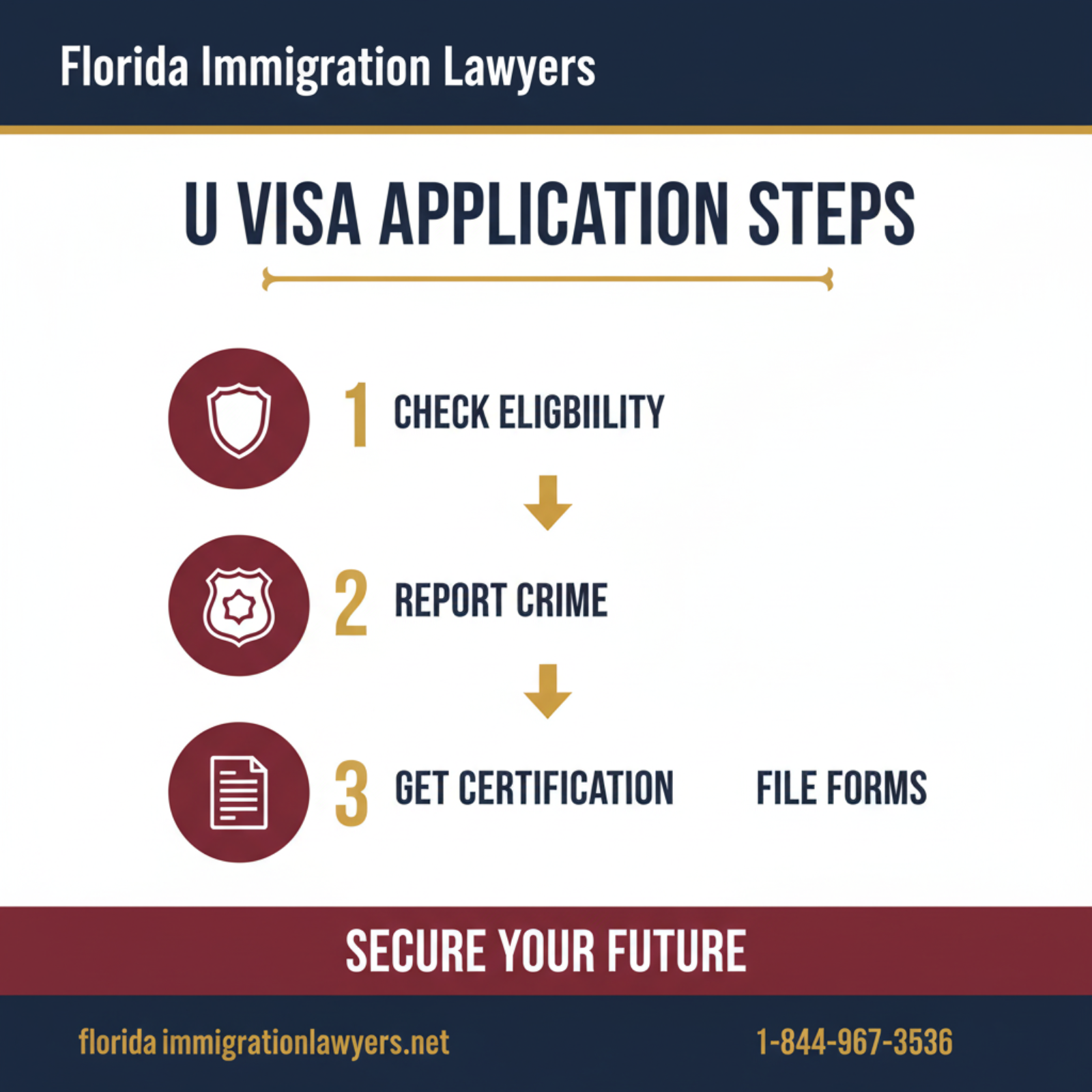
The U Visa Application Process: A Step-by-Step Guide
The U Visa application process is multi-faceted and often lengthy, requiring careful preparation and submission of extensive documentation. Understanding each step is vital for a successful outcome.
Gathering Documentation
The core of your application will be Form I-918, Petition for U Nonimmigrant Status, along with its supplements. You'll need to compile a comprehensive package that includes:
- Form I-918, Petition for U Nonimmigrant Status: The main application form, which details your personal information and eligibility claims.
- Form I-918, Supplement B, U Nonimmigrant Status Certification: Signed by a certifying agency (law enforcement, prosecutor, judge, etc.), confirming your helpfulness. This is arguably the most critical document.
- Personal Statement: A detailed narrative describing the crime, the harm you suffered, and how you assisted law enforcement. This statement is your opportunity to tell your story in your own words, providing crucial context for USCIS.
- Evidence of Substantial Harm: Medical records, psychological evaluations, police reports, court documents, and affidavits from witnesses or experts attesting to the physical or mental abuse suffered.
- Evidence of Helpfulness: Any additional documentation demonstrating your cooperation with law enforcement, such as emails, transcripts of interviews, or commendation letters.
- Identity and Nationality Documents: Copies of your passport, birth certificate, national identity card, or any other proof of identity and nationality.
- Proof of Relationship (if applicable): For qualifying family members (spouse, children, parents for child victims), documents like marriage certificates, birth certificates, or adoption decrees are necessary.
- Passport-style Photographs: Recent photos meeting USCIS specifications.
- Form I-192, Application for Advance Permission to Enter as Nonimmigrant: If you have any grounds of inadmissibility, this form and supporting documentation for a waiver will be included.
Organizing these documents meticulously is crucial. A missing or improperly completed form can cause significant delays or even a denial. Florida Immigration Lawyers can assist you in compiling a thorough and persuasive application package, ensuring all requirements are met.
Submission and Biometrics
Once your application package is complete, it is filed with USCIS. There are no filing fees for Form I-918. After submission, you will receive a receipt notice, confirming that USCIS has received your application. Subsequently, you will typically receive an appointment notice for biometrics (fingerprints, photograph, and signature). This appointment is mandatory and is used for background checks.
The biometrics appointment is a standard part of most immigration applications. It's a straightforward process, but missing the appointment without rescheduling can jeopardize your case. Your attorney will ensure you are prepared for this step and understand its purpose in the overall security screening process.
Waiting Period and Bona Fide Determination
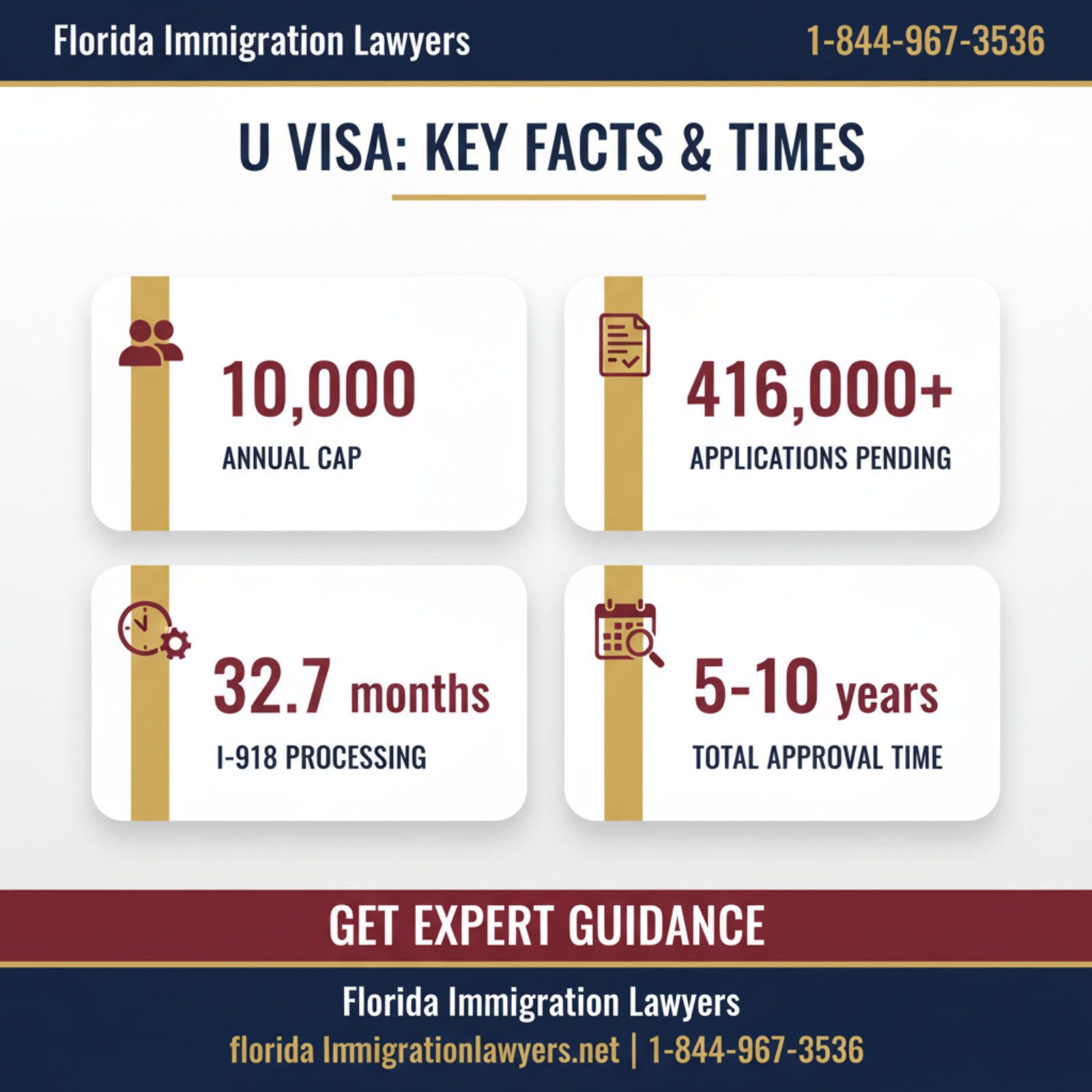
The U Visa program has an annual cap of 10,000 principal visas, which often leads to a lengthy waiting list. During this period, USCIS reviews applications to determine if they are "bona fide" – meaning they appear to meet the eligibility requirements. If your application is deemed bona fide, you may be granted "bona fide determination (BFD) work authorization" and deferred action, allowing you to legally work and remain in the U.S. while you wait for a U Visa to become available.
This waiting period can span several years due to high demand. However, the BFD work authorization is a significant benefit, providing immediate relief and stability. It allows victims to secure employment, obtain a driver's license, and begin to build a new life without fear of deportation. Our firm actively monitors the progress of your application and keeps you informed about any updates, including the issuance of work permits.
Interview (if applicable)
While not all U Visa applicants are required to attend an interview, USCIS reserves the right to request one. If an interview is scheduled, it typically takes place at a local USCIS office. The purpose of the interview is to clarify information in your application, verify details of your personal statement, and assess your credibility. An attorney can prepare you thoroughly for this potential step, ensuring you understand the types of questions that may be asked and how to respond effectively.
Decision and Adjustment of Status
If your application is approved and a U Visa becomes available, you will be granted U nonimmigrant status for a period of four years. This status allows you to live and work legally in the United States. After maintaining U nonimmigrant status for three continuous years, and demonstrating continued helpfulness to law enforcement and good moral character, you become eligible to apply for lawful permanent residency (a Green Card) by filing Form I-485, Application to Register Permanent Residence or Adjust Status. This is the ultimate goal for many U Visa recipients, offering a permanent pathway to safety and stability in the U.S.
Life After U Visa Approval: Path to Permanent Residency
Receiving U nonimmigrant status is a monumental step, but it's often seen as a stepping stone towards a more permanent future. The U Visa is designed with a clear pathway to lawful permanent residency, offering victims the chance to truly rebuild their lives without the constant worry of their immigration status. After holding U nonimmigrant status for three continuous years, and as long as certain conditions are met, you can apply for a Green Card.
To transition from U status to a Green Card, you must demonstrate that you have not unreasonably refused to assist law enforcement since receiving your U Visa. You must also prove that you have been physically present in the United States for a continuous period of at least three years while in U nonimmigrant status, and that you continue to meet the good moral character requirements. This means avoiding any further criminal activity and generally adhering to U.S. laws. The application for adjustment of status, Form I-485, is a separate and distinct process from the initial U Visa petition, requiring its own set of documentation and careful preparation.
The benefits of obtaining a Green Card are extensive. It provides permanent authorization to live and work anywhere in the U.S., allows for easier travel, and opens doors to federal benefits, higher education opportunities, and the ability to petition for certain family members. For many, it represents the culmination of a long and difficult journey, offering true peace of mind and the foundation for a stable, prosperous future. Our team at Florida Immigration Lawyers can guide you through every step of this adjustment process, ensuring you meet all requirements for permanent residency.
It's crucial to maintain open communication with your immigration attorney during these three years. Any changes in your situation, such as new addresses, travel plans, or interactions with law enforcement, should be promptly reported. This proactive approach ensures that your eligibility for adjustment of status remains intact and that your application for a Green Card is as strong as possible when the time comes.
Why Choose Florida Immigration Lawyers for Your U Visa Case?
Navigating the U Visa process requires not only legal expertise but also a deep understanding of the sensitive nature of these cases. At Florida Immigration Lawyers, we approach every client with compassion, discretion, and a steadfast commitment to justice. We understand the trauma you may have experienced and are dedicated to providing a safe and supportive environment where you can share your story and seek the protection you deserve.
Our team of experienced immigration attorneys specializes in U Visa petitions, possessing a comprehensive knowledge of USCIS regulations, Florida state laws concerning victims' rights, and the intricacies of working with law enforcement agencies. We meticulously prepare each application, gather compelling evidence, and advocate vigorously on behalf of our clients. From the initial consultation to the final decision, we stand by your side, demystifying the legal jargon and guiding you through every complex step of the journey.
Choosing the right legal representation can make all the difference in the outcome of your U Visa case. With Florida Immigration Lawyers, you gain a trusted advocate committed to securing your safety, legal status, and a brighter future in the United States. Don't let fear or uncertainty prevent you from seeking the vital protection available to you. Call us today at 1-844-967-3536 for a confidential consultation and take the first step towards rebuilding your life.
Frequently Asked Questions
Florida Immigration Lawyers
Legal Team
Our experienced attorneys at Florida Immigration Lawyers have been serving clients across Florida for over 20 years. We specialize in immigration, personal injury, criminal defense, workers compensation, and family law.