USCIS Office Locations in Florida: Your Essential Guide
Discover essential information about USCIS office locations in Florida, including Jacksonville, Miami, and Orlando. This guide provides a step-by-step overview of appointments, required documents, and processing expectations for 2026. Learn about common mistakes to avoid and when to seek legal help from Florida Immigration Lawyers. We offer expert guidance for all your immigration needs, ensuring a smooth and successful journey. Contact us for a free consultation and personalized support.
Navigating USCIS office locations in Florida can be complex. There are multiple field offices and Application Support Centers (ASCs) across the state, each serving specific purposes like interviews or biometrics collection. You generally need a scheduled appointment to visit a USCIS office. Understanding their functions and how to prepare is key to a smooth immigration process in Florida.
- Florida has several USCIS Field Offices and Application Support Centers.
- Appointments are typically required for all visits, including interviews and biometrics.
- Field Offices handle interviews and specific case inquiries.
- ASCs are primarily for biometrics collection.
- Legal guidance from Florida Immigration Lawyers can simplify your visit.
Are you an immigrant in Florida seeking to understand the intricacies of the U.S. immigration system? Perhaps you've received an appointment notice and need to locate a specific USCIS office, or you're simply trying to understand where to go for various immigration services. The process can feel overwhelming, especially when dealing with bureaucratic requirements and specific locations.
This comprehensive guide from Florida Immigration Lawyers will walk you through everything you need to know about USCIS office locations in Florida, with a special focus on Jacksonville and its surrounding areas. We will cover the different types of offices, how to schedule appointments, what to expect, and how to avoid common pitfalls. Our goal is to empower you with the knowledge to navigate your immigration journey successfully in 2026 and beyond.
Don't face this journey alone. For personalized assistance and expert legal guidance, call Florida Immigration Lawyers at 1-844-967-3536 for a free consultation. We are here to help you understand your options and ensure your case is handled with precision and care.
Understanding USCIS Field Offices and Application Support Centers in Florida
The United States Citizenship and Immigration Services (USCIS) operates various facilities nationwide, and Florida, with its diverse immigrant population, hosts several crucial ones. These facilities primarily fall into two categories: Field Offices and Application Support Centers (ASCs). Each plays a distinct role in the immigration process, and understanding their functions is vital for anyone applying for immigration benefits.
USCIS Field Offices are where most in-person interviews for applications like adjustment of status (green cards), naturalization, and asylum claims take place. These offices handle complex case adjudications and provide limited information services by appointment. In Florida, key field offices are located in Jacksonville, Miami, Orlando, and Tampa, serving different geographical regions of the state.
Application Support Centers (ASCs), on the other hand, are primarily responsible for collecting biometrics-fingerprints, photographs, and signatures. This data is essential for background checks and identity verification. ASCs do not handle interviews or provide case status updates; their function is specific and appointment-based. Florida has several ASCs strategically placed to serve its large population, ensuring accessibility for biometrics appointments.
Key USCIS Office Locations in Florida
Florida is home to several critical USCIS office locations, each playing a vital role in processing immigration applications for residents across the state. Knowing the primary locations and their functions can help you prepare for your immigration journey.
- Jacksonville Field Office: This office serves Northeast Florida, including areas like Gainesville, St. Augustine, and Tallahassee. It handles interviews for various applications, including family-based petitions and naturalization.
- Miami Field Office: As one of the busiest offices in the nation, the Miami office serves South Florida, including Fort Lauderdale and West Palm Beach. It processes a high volume of cases, particularly those related to family-based immigration and asylum.
- Orlando Field Office: Serving Central Florida, this office is crucial for applicants in areas like Kissimmee, Daytona Beach, and Lakeland. It processes a wide range of applications, similar to the Jacksonville and Miami offices.
- Tampa Field Office: Located on the Gulf Coast, the Tampa office covers West Central Florida, including cities like St. Petersburg and Clearwater. It handles interviews for adjustment of status, citizenship, and other immigration benefits.
USCIS Application Support Centers (ASCs) in Florida
Beyond the primary field offices, Florida also hosts several Application Support Centers (ASCs). These are critical for collecting biometric data, which is a mandatory step for most immigration applications. You will receive an appointment notice specifying the exact ASC you need to visit.
- Hialeah ASC: Serving the greater Miami-Dade area.
- Fort Lauderdale ASC: Covers Broward County and surrounding regions.
- West Palm Beach ASC: Serves Palm Beach County.
- Orlando ASC: For applicants in Central Florida.
- Jacksonville ASC: Handles biometrics for Northeast Florida.
- Tampa ASC: Serves the Tampa Bay area.
- Pensacola ASC: Located in the Florida Panhandle.
Remember, you cannot simply walk into an ASC without an appointment. Your appointment notice will provide the date, time, and location for your biometrics collection. Always bring the original notice and a valid government-issued ID.
Navigating Your USCIS Appointment: A Step-by-Step Guide for Florida Residents
Attending a USCIS appointment at a Florida field office or ASC is a crucial step in your immigration journey. Proper preparation and understanding the process can significantly reduce stress and potential issues. This guide outlines the typical steps involved, ensuring you are well-informed for your visit.
-
Receive Your Appointment Notice: USCIS will mail you an official appointment notice (Form I-797C, Notice of Action) indicating the date, time, and location of your interview or biometrics appointment. This notice is critical and you must bring it with you.
It will specify whether you need to visit a Field Office for an interview or an Application Support Center (ASC) for biometrics. For those in Jacksonville, your notice will direct you to the local USCIS office or ASC.
-
Gather Required Documents: Carefully review your appointment notice for a list of necessary documents. For interviews, this often includes your passport, birth certificate, marriage certificate, photos, and any original documents submitted with your application. For biometrics, typically only the appointment notice and a valid ID are required.
Organize your documents neatly in a folder. Having all originals and copies readily accessible will demonstrate your preparedness and attention to detail. This can prevent delays or requests for additional evidence.
-
Plan Your Travel to the USCIS Office: Ensure you know the exact address of the USCIS office and plan to arrive at least 15-30 minutes before your scheduled time. Traffic in Florida, particularly in metropolitan areas like Miami or Orlando, can be unpredictable. Factor in parking availability and security check-in times.
Public transportation or ride-sharing services may be viable options, depending on the office's location. For the Jacksonville Field Office, consider local traffic patterns, especially during peak hours.
-
Go Through Security: Upon arrival, you will typically go through a security checkpoint similar to an airport. Be prepared to remove items from your pockets and potentially walk through a metal detector. Prohibited items, such as weapons, will not be allowed inside.
Follow all instructions from security personnel. They are there to ensure the safety of everyone in the facility. Patience during this process is always recommended.
-
Check-In at the Front Desk: Present your appointment notice and valid identification to the front desk officer. They will verify your appointment and provide further instructions, such as where to wait or which window to approach.
It is important to remain polite and clear when communicating. If you have any questions, this is a good opportunity to ask for clarification.
-
Attend Your Interview or Biometrics Appointment: For interviews, an immigration officer will call your name. Be prepared to answer questions about your application truthfully and thoroughly. For biometrics, a technician will take your fingerprints, photo, and signature.
An immigration attorney from Florida Immigration Lawyers can accompany you to your interview, providing crucial support and advocacy. This can be especially valuable for complex cases or if you feel anxious about the process.
-
Receive Next Steps: After your appointment, the officer will typically inform you of the next steps. For interviews, you might receive a decision on the spot, a request for additional evidence (RFE), or a notice that a decision will be mailed. For biometrics, the process is usually complete once collected.
Ensure you understand what is expected of you next. If you are unsure, ask the officer for clarification before leaving the USCIS office. Keep all correspondence from USCIS for your records.
Essential Document Checklist for Your USCIS Office Visit
Preparing the correct documents for your USCIS office visit is paramount to avoiding delays and ensuring a smooth process. The specific documents required will vary based on the type of application and appointment (interview vs. biometrics). However, a general checklist can help you organize effectively.
Always refer to your official USCIS appointment notice and the instructions for your specific form (e.g., Form I-485 for adjustment of status, Form N-400 for naturalization) for the most accurate and up-to-date requirements. Missing documents can lead to significant setbacks.
- USCIS Appointment Notice (Form I-797C): This is non-negotiable. You will not be admitted without it.
- Valid Government-Issued Photo Identification: Your passport, driver's license, state ID, or employment authorization document (EAD) are commonly accepted. Ensure it is current and matches the name on your application.
- Originals of All Documents Submitted with Your Application: This includes birth certificates, marriage certificates, divorce decrees, police clearances, medical exam results (Form I-693), and any other supporting evidence.
- Copies of All Documents Submitted: It is always wise to bring a complete set of copies, even if not explicitly requested. This can be helpful if an officer needs to retain a copy.
- Proof of Financial Support: For many applications, evidence like tax returns, W-2s, employment letters, and bank statements may be required to demonstrate financial stability.
- Photographs: If your application requires passport-style photos, ensure they meet USCIS specifications (2x2 inches, white background, taken within the last 6 months).
- Translation of Foreign Language Documents: Any document not in English must be accompanied by a complete English translation certified by a competent translator.
- Your Attorney's Contact Information: Have your attorney's business card or contact details readily available, especially if they are not accompanying you.
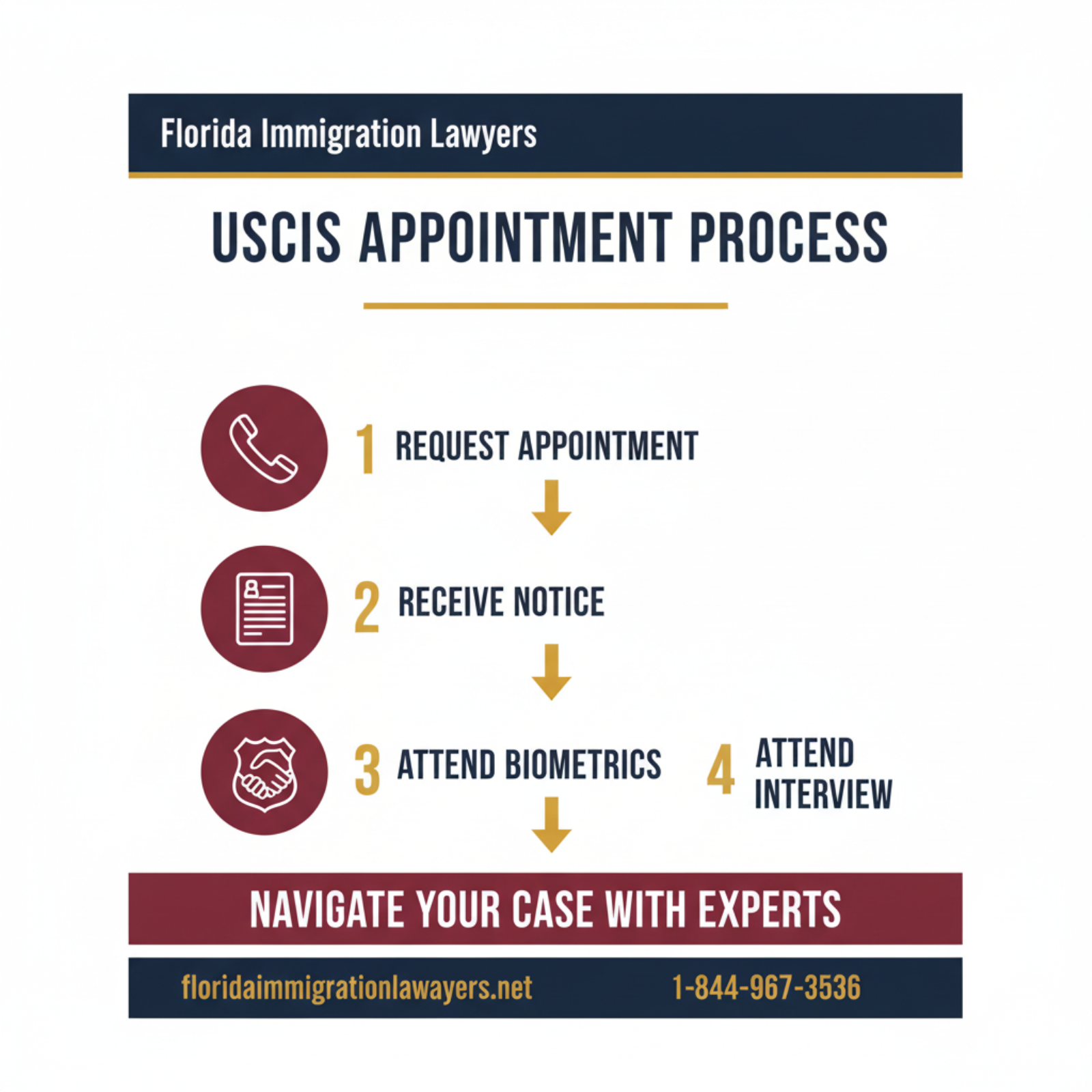
Remember to keep all documents organized and easily accessible. A binder or folder with clearly labeled sections can be incredibly helpful. If you are unsure about any document, err on the side of bringing it. Consulting with Florida Immigration Lawyers can provide clarity on your specific document requirements, saving you time and stress.
Timeline and Processing Expectations at Florida USCIS Offices in 2026
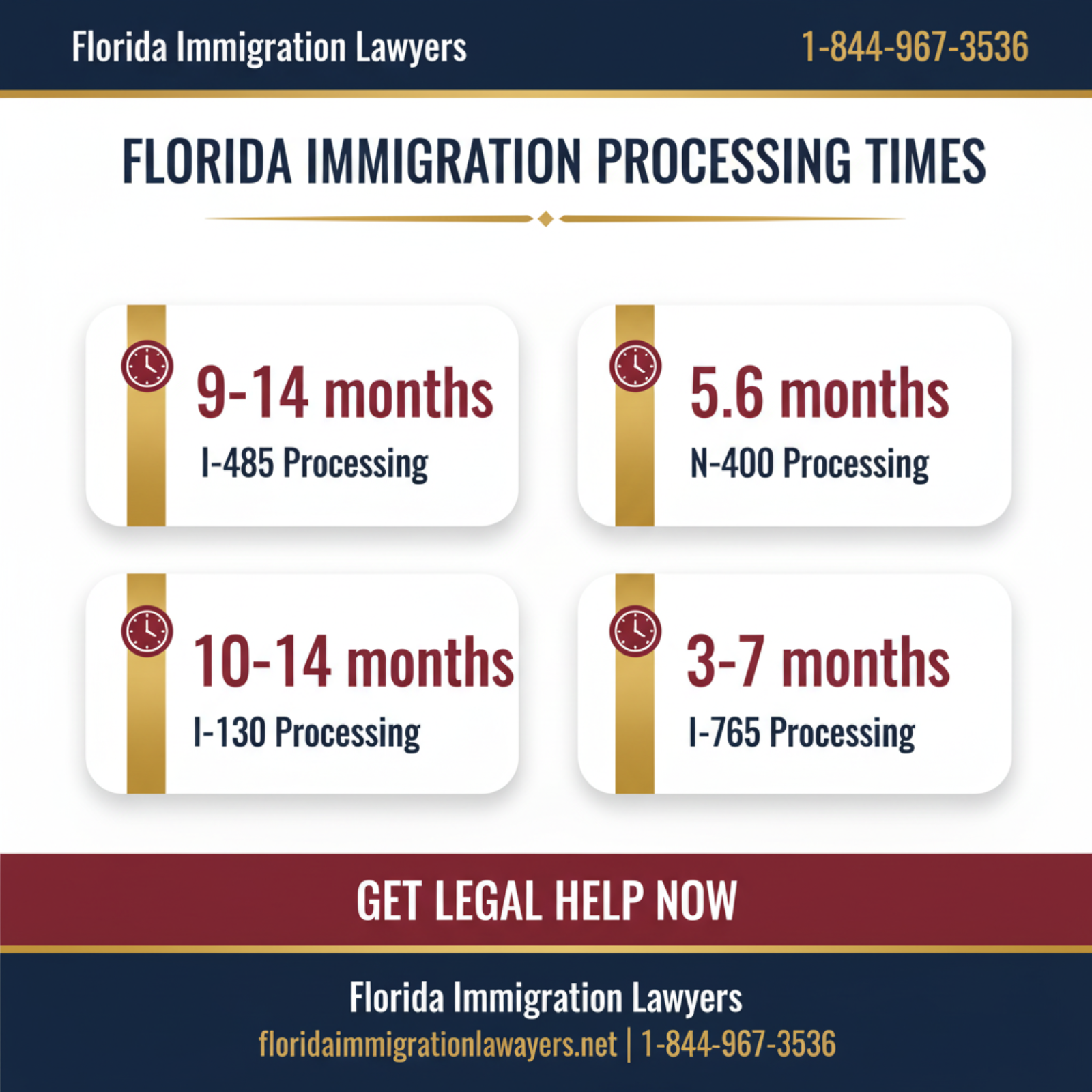
Understanding the processing times for immigration applications is a common concern for individuals interacting with a USCIS office. While USCIS strives for efficiency, processing times can vary significantly based on the type of application, the specific field office, and current caseloads. It is important to set realistic expectations for your immigration journey in Florida.
General Processing Time Factors
Several factors influence how long it takes for USCIS to process an application. These include the complexity of your case, the volume of applications at a particular field office (like the busy Miami or Orlando offices), and whether additional evidence or interviews are required. Legislative changes or policy updates can also impact processing speeds.
You can check estimated processing times on the USCIS website using your form type and the specific field office or service center. These times are estimates and can change, so regular monitoring is advisable. For instance, processing times at the Jacksonville Field Office may differ from those in Tampa.
Biometrics Appointments and Interviews
After filing your application, you will typically receive a biometrics appointment notice within a few weeks to a few months. This appointment usually takes place at an Application Support Center (ASC) near your Florida residence. The biometrics collection itself is a quick process, but the wait for the appointment notice can vary.
Interviews at a USCIS office, particularly for adjustment of status or naturalization, generally occur several months after your biometrics. The wait time for an interview can range from a few months to over a year, depending on the application type and the specific field office's backlog. For example, while the Orlando Field Office might have certain wait times, the Miami office, due to its volume, could have different ones.
Urgent Situations and Expedite Requests
Can I walk into a USCIS field office for an urgent situation? Generally, no. USCIS field offices do not accept walk-ins for inquiries or urgent situations without a pre-scheduled appointment (InfoPass, which is now largely replaced by online scheduling or direct call). For truly urgent matters, such as life-threatening emergencies, you may be able to request an emergency appointment by calling the USCIS Contact Center.
Expedite requests for applications are considered on a case-by-case basis and require compelling evidence of severe financial loss, urgent humanitarian reasons, or other critical circumstances. Simply having a long processing time is usually not sufficient for an expedite request. Consulting with an attorney from Florida Immigration Lawyers is highly recommended to assess if your situation qualifies for an expedite request and to assist with the process.
Do not navigate this process alone. The complexities of immigration law and procedures require expert guidance. Contact Florida Immigration Lawyers today to ensure your case is handled efficiently and accurately. We can help you understand processing times and advocate for you.
Cost Factors and Fee Breakdown for USCIS Applications in Florida
Understanding the costs associated with immigration applications is a critical part of the planning process for anyone interacting with a USCIS office. Immigration fees are subject to change and vary widely depending on the type of application you are filing. It is essential to budget appropriately and understand the potential financial implications of your immigration journey in Florida.
USCIS Filing Fees
USCIS charges various fees for filing different forms. These fees are set by regulation and are non-refundable, even if your application is denied. Examples include fees for Form I-485 (Application to Register Permanent Residence or Adjust Status), Form N-400 (Application for Naturalization), and Form I-130 (Petition for Alien Relative). There are also fees for biometrics services, although these are sometimes included in the primary application fee.
It is crucial to check the most current fee schedule on the USCIS website before submitting any application, as fees can change periodically. For instance, in early 2024, USCIS updated many of its filing fees, which came into effect later in the year. Always verify the exact amount for each form you intend to file.
Additional Potential Costs
Beyond the direct USCIS filing fees, applicants should anticipate other potential costs:
- Medical Examination Fees: Most adjustment of status applicants are required to undergo a medical examination by a USCIS-approved civil surgeon. The cost of this exam is separate from USCIS fees and varies by provider.
- Translation Services: If any of your supporting documents are not in English, you will need to pay for certified translations.
- Document Procurement: Obtaining official copies of birth certificates, marriage certificates, or police records from foreign countries can incur costs.
- Travel Expenses: Traveling to a USCIS office for biometrics or an interview, especially if you live far from a field office like the Jacksonville or Miami locations, will involve transportation and potentially accommodation costs.
- Attorney Fees: While not mandatory, hiring an experienced immigration attorney from Florida Immigration Lawyers can be an invaluable investment. Legal fees cover expert advice, preparation of documents, representation at interviews, and handling complex legal issues.
Fee Waivers and Reduced Fees
In certain circumstances, applicants may be eligible for a fee waiver or a reduced fee. Eligibility for fee waivers is typically based on income levels or receipt of means-tested public benefits. Not all forms are eligible for fee waivers. You must submit Form I-912, Request for Fee Waiver, with your application and provide supporting documentation.
It is important to consult with an attorney to determine if you qualify for a fee waiver and to ensure the request is properly submitted. Improperly submitted fee waiver requests can lead to rejection of your entire application. Our firm, Florida Immigration Lawyers, can assess your eligibility and assist with this process.
Common Mistakes to Avoid When Dealing with USCIS in Florida
Navigating the immigration system can be fraught with potential pitfalls. Avoiding these common mistakes can save you significant time, money, and stress, especially when interacting with a USCIS office in Florida. Being proactive and informed is your best defense against errors.
-
Submitting Incomplete or Inaccurate Applications: This is perhaps the most frequent mistake. Failing to fill out every section, providing inconsistent information, or omitting required signatures will almost certainly lead to a Request for Evidence (RFE) or outright denial. Double-check everything before submission.
Consequence: Delays in processing, RFE, or denial, requiring resubmission and additional fees.
-
Missing Deadlines: USCIS provides strict deadlines for responding to RFEs, Notices of Intent to Deny (NOID), or attending appointments. Missing these can result in your application being considered abandoned or denied.
Consequence: Application denial, potential loss of status, or even initiation of deportation proceedings.
-
Not Keeping Copies of Everything: Always make and retain copies of every form, document, and piece of correspondence you send to or receive from USCIS. This provides a paper trail in case of discrepancies or lost mail.
Consequence: Inability to prove submission or provide evidence if requested, leading to delays or denials.
-
Failing to Notify USCIS of Address Changes: If you move, you are legally required to inform USCIS within 10 days using Form AR-11, Alien's Change of Address Card. Failure to do so can result in missed notices, including interview appointments.
Consequence: Missing critical communications, leading to delays, missed appointments, and potential application abandonment or denial. This is particularly important with the dynamic populations in Florida cities like Miami and Orlando.
-
Attending Interviews Unprepared or Without Legal Counsel: Going to a USCIS office interview without reviewing your application or understanding potential questions can be detrimental. While not always required, having an attorney present can provide invaluable support.
Consequence: Providing inconsistent or damaging answers, leading to an RFE, NOID, or denial. Legal counsel can help protect your rights.
-
Ignoring USCIS Mail: All mail from USCIS is important. Do not discard it without carefully reading and understanding its contents. If you don't understand English, seek immediate translation.
Consequence: Missing critical requests or notices, leading to application abandonment or denial.
-
Not Seeking Legal Advice for Complex Cases: Attempting to handle complicated immigration matters, such as those involving criminal history, previous denials, or complex family relationships, without legal assistance is a significant risk.
Consequence: Making irreversible mistakes, leading to permanent bars from immigration benefits or even deportation.
-
Providing False Information: Intentionally misrepresenting facts on an application or during an interview is a serious offense that can lead to severe penalties, including a permanent bar from future immigration benefits.
Consequence: Permanent inadmissibility to the U.S., criminal charges, or loss of existing immigration status.
-
Overlooking Medical Exam Requirements: For many green card applications, a medical exam by a USCIS-approved civil surgeon is mandatory. Failing to submit a valid Form I-693 can cause significant delays.
Consequence: RFE or delays in adjustment of status processing.
-
Assuming All Green Cards are Permanent: While a green card grants permanent residency, some are conditional (e.g., for marriage-based petitions filed within two years of marriage). These require a petition to remove conditions (Form I-751) to become truly permanent. Failure to file on time can lead to loss of status.
Consequence: Loss of permanent resident status and potential deportation.
When to Call a Florida Immigration Lawyer
While this guide provides general information about USCIS office locations and processes in Florida, it is crucial to recognize when your situation warrants professional legal assistance. Immigration law is incredibly complex and constantly evolving. A misstep can have profound, long-lasting consequences for your future in the United States.
You should consider contacting Florida Immigration Lawyers if any of the following scenarios apply to you:
- Complex Case History: If you have previous denials, a criminal record, past immigration violations, or a history of deportation, your case is inherently complex. Our attorneys specialize in deportation defense and can help navigate these challenges.
- Unsure About Eligibility: If you are unsure which visa or green card category you qualify for, or if you meet the specific requirements, an attorney can assess your eligibility and recommend the best path forward. This applies to family-based or business-based immigration alike.
- Received a Request for Evidence (RFE) or Notice of Intent to Deny (NOID): These notices indicate that USCIS requires more information or intends to deny your application. Responding correctly and comprehensively is vital, and an attorney can help craft a strong response.
- Preparing for an Interview at a USCIS Office: While you can attend an interview alone, having legal representation can be immensely beneficial. An attorney can prepare you for questions, ensure your rights are protected, and address any issues that arise during the interview.
- Seeking Asylum or Protection: Asylum cases are highly sensitive and require strong legal arguments and extensive documentation. Our firm has experience with asylum applications and can provide compassionate, effective representation.
- Facing Delays or Unexplained Processing Issues: If your application is experiencing unusual delays beyond published processing times, or if you are receiving conflicting information, an attorney can intervene and inquire with USCIS on your behalf.
- Applying for Citizenship: The naturalization process has specific residency and good moral character requirements. An attorney can help ensure you meet all criteria and prepare you for the civics test and interview.
Florida Immigration Lawyers is dedicated to providing comprehensive and compassionate legal services to immigrants across Florida. Our experienced attorneys understand the nuances of immigration law and are committed to protecting your rights and achieving your immigration goals. We serve clients throughout the state, from Jacksonville to Miami, and are available to discuss your unique situation.
About Florida Immigration Lawyers
Florida Immigration Lawyers is a premier immigration law firm dedicated to serving individuals and families across the entire state of Florida. Our team of experienced and compassionate attorneys provides comprehensive legal representation for a wide range of immigration matters, from simple visa applications to complex deportation defense cases.
We understand that navigating the U.S. immigration system can be daunting and emotionally challenging. That's why we are committed to offering personalized, client-focused legal services, ensuring that each client receives the attention and expert guidance they deserve. Our firm prides itself on its deep knowledge of immigration law and our unwavering commitment to our clients' success.
Our Services Include:
- Family-Based Immigration (Green Cards, Visas)
- Business and Employment Immigration (Work Visas, Investor Visas)
- Deportation Defense and Removal Proceedings (Protecting Your Rights)
- Asylum and Refugee Protection (Seeking Safety)
- Naturalization and Citizenship (Becoming a U.S. Citizen)
- Visa Applications (Tourist, Student, Work)
- Adjustment of Status
- Waivers of Inadmissibility
Why Choose Florida Immigration Lawyers?
- Expertise: Our attorneys possess extensive knowledge and experience in all facets of immigration law.
- Compassion: We approach every case with empathy, understanding the personal impact of immigration issues.
- Accessibility: We are available 24/7 to address your urgent concerns and offer free consultations to get you started.
- Bilingual Services: Se Habla Español – our team is fluent in both English and Spanish to serve Florida's diverse population effectively.
- Statewide Reach: We represent clients in all Florida counties, from Pensacola to Key West.
Visit our website at https://www.floridaimmigrationlawyers.net or call us directly at 1-844-967-3536 to schedule your free consultation. Let Florida Immigration Lawyers be your trusted partner in your immigration journey.
Sources and References
- U.S. Citizenship and Immigration Services (USCIS)
- USCIS Fee Schedule
- USCIS Check Case Processing Times
- Executive Office for Immigration Review (EOIR)
- 8 U.S.C. Chapter 12 - Immigration and Nationality Act (INA)
- 8 CFR Part 103 - Adjudication of applications, petitions, and other documents
- INA § 245 - Adjustment of Status of Nonimmigrant to That of Person Admitted for Permanent Residence
- INA § 316 - Requirements for Naturalization
This article provides general legal information and is not intended as legal advice. Every case is unique, and outcomes depend on specific facts and circumstances. Contact an attorney for advice about your particular situation.
Ready to take the next step in your immigration journey? Don't leave your future to chance. Contact Florida Immigration Lawyers at 1-844-967-3536 today for a free, confidential consultation. Our dedicated team is here to provide the expert legal guidance and support you need. Se Habla Español - Estamos aquí para ayudarle.
Frequently Asked Questions
Florida Immigration Lawyers
Legal Team
Our experienced attorneys at Florida Immigration Lawyers have been serving clients across Florida for over 20 years. We specialize in immigration, personal injury, criminal defense, workers compensation, and family law.