Exclusive Citizenship Act of 2025 Florida: What...
The proposed Exclusive Citizenship Act of 2025 (S.3283) aims to require sole allegiance to the U.S., potentially impacting dual citizenship for immigrants in Florida. As of 2026, this bill has not passed into law but warrants close monitoring. Understanding its implications for the USCIS citizenship process and existing dual citizens is crucial. This comprehensive guide covers the bill's background, potential effects on naturalization, essential documentation, and common mistakes to avoid. Florida Immigration Lawyers provides expert guidance through these uncertain times, offering free consultations to help you navigate complex immigration laws and protect your status in Florida.

The **Exclusive Citizenship Act of 2025 Florida** is a proposed federal bill (S.3283) that aims to require sole allegiance to the U.S., potentially impacting dual citizenship for current and future citizens. As of 2026, it has not passed into law. Its implications for Florida residents, especially those with ties to other nations, could be significant if enacted.
- It is a **proposed bill**, not current law.
- Aims to require **sole allegiance** to the U.S.
- Could impact **dual citizenship** for many.
- Requires careful monitoring by Florida immigrants.
- Consult an immigration lawyer for personalized advice.
Exclusive Citizenship Act of 2025 Florida: What Immigrants Need to Know
Navigating the complexities of U.S. immigration law can be challenging, especially when new legislation is proposed. For many residents of Florida, a state with a vibrant and diverse immigrant population, staying informed about potential changes is crucial. The **Exclusive Citizenship Act of 2025 Florida** has emerged as a topic of significant discussion, raising questions and concerns among those who call the Sunshine State home.
As of early 2026, this bill (S.3283) remains a proposed piece of legislation at the federal level, not an enacted law. However, its potential implications for dual citizens and those seeking U.S. citizenship, particularly in a state like Florida, warrant close attention. Understanding the nuances of such proposals is vital for protecting your immigration status and future in the United States.
At Florida Immigration Lawyers, we understand the anxiety and uncertainty that proposed immigration laws can create. Our dedicated team is committed to providing clarity and guidance through these complex times. If you have concerns about the **Exclusive Citizenship Act of 2025 Florida** or any other immigration matter, we are here to assist you. Call Florida Immigration Lawyers at 1-844-967-3536 for a free consultation.
Understanding the Exclusive Citizenship Act of 2025 Florida
The **Exclusive Citizenship Act of 2025 Florida**, introduced as S.3283, is a federal legislative proposal. Its primary goal is to establish that U.S. citizens shall owe sole and exclusive allegiance to the United States. This means it seeks to eliminate or significantly restrict dual citizenship, a concept currently recognized under U.S. law.
For individuals in Florida, where many residents maintain strong ties to their countries of origin, such a change could have profound effects. It challenges the long-standing principle that a person can be a citizen of two countries simultaneously, a status often acquired through birth, parentage, or naturalization. The bill's language suggests a push towards a singular national identity, which has sparked considerable debate.
It is important to reiterate that as of our current date in 2026, the **Exclusive Citizenship Act of 2025 Florida** has not passed into law. It is still in the legislative process, meaning it would need to pass both houses of Congress and be signed by the President to become effective. Our firm closely monitors the status of this and other relevant immigration legislation to provide the most current advice to our clients.
What is Dual Citizenship and Why is it Important in Florida?
Dual citizenship, or dual nationality, means a person is a citizen of two countries at the same time. This status is generally accepted in the United States. Many U.S. citizens, including a significant portion of Florida's diverse population, hold dual nationality without issue.
For many, dual citizenship offers numerous benefits. These can include the ability to live and work in both countries, own property, vote, and travel more freely. In Florida, with its large populations from Latin America, the Caribbean, and Europe, dual citizenship is a common and valued aspect of life for countless families and individuals.
The **Exclusive Citizenship Act of 2025 Florida** directly targets this status. If enacted, it could force individuals to choose between their U.S. citizenship and their citizenship in another country. This would represent a fundamental shift in U.S. immigration policy and could have far-reaching consequences for millions.
Potential Impact on the USCIS Citizenship Process in Florida
If the **Exclusive Citizenship Act of 2025 Florida** were to become law, it would undoubtedly alter the USCIS citizenship process. The current naturalization oath requires applicants to swear allegiance to the U.S. and renounce allegiance to any foreign state. However, current interpretation allows for dual citizenship in practice.
Under a new law, the interpretation could become much stricter. Applicants for naturalization might be required to provide concrete proof of renunciation of their prior citizenship before their U.S. citizenship is granted. This could add significant hurdles and complexities to an already detailed process.
Existing dual citizens in Florida might face new requirements to affirm sole allegiance or even risk losing their U.S. citizenship. The exact mechanisms for enforcement and compliance would depend on the final text of the law and subsequent regulations issued by agencies like USCIS. This emphasizes the critical need for expert legal guidance.
Navigating Future Citizenship Requirements: A Step-by-Step Guide
While the **Exclusive Citizenship Act of 2025 Florida** is not yet law, it is prudent for individuals to understand the general steps involved in obtaining U.S. citizenship and how proposed changes might affect them. This guide outlines the typical naturalization process and highlights areas that could be impacted.
- Determine Eligibility: You must meet specific requirements, including age, lawful permanent residency for a certain period (typically 5 years, or 3 years if married to a U.S. citizen), continuous residency, physical presence, good moral character, and an ability to read, write, and speak English, and a knowledge of U.S. history and government. Any new law could add or modify these foundational requirements.
- Prepare and File Form N-400: The Application for Naturalization, Form N-400, is the cornerstone of the citizenship process. This form collects detailed personal information, residency history, and background. If the **Exclusive Citizenship Act of 2025 Florida** passes, this form or supplementary documents might require explicit declarations regarding foreign allegiances.
- Attend Biometrics Appointment: After filing, USCIS will schedule an appointment to collect your fingerprints, photograph, and signature. This data is used for background checks. The biometrics process itself is unlikely to change, but the subsequent background checks might be more stringent regarding foreign ties.
- Complete the Naturalization Interview: An immigration officer will interview you to verify the information on your N-400, test your English and civics knowledge, and assess your good moral character. Under a new law, questions about dual citizenship or foreign allegiances could become a central focus of this interview, requiring careful preparation.
- Receive a Decision from USCIS: USCIS will issue a decision on your application. If approved, you will be scheduled for an Oath of Allegiance ceremony. If denied, you will receive a written explanation and may be able to appeal. A denial could occur if new dual citizenship rules are not met.
- Take the Oath of Allegiance: At the Oath of Allegiance ceremony, you officially become a U.S. citizen. You will renounce allegiance to any foreign state. If the **Exclusive Citizenship Act of 2025 Florida** is enacted, this renunciation could require more formal and verifiable steps than currently practiced.
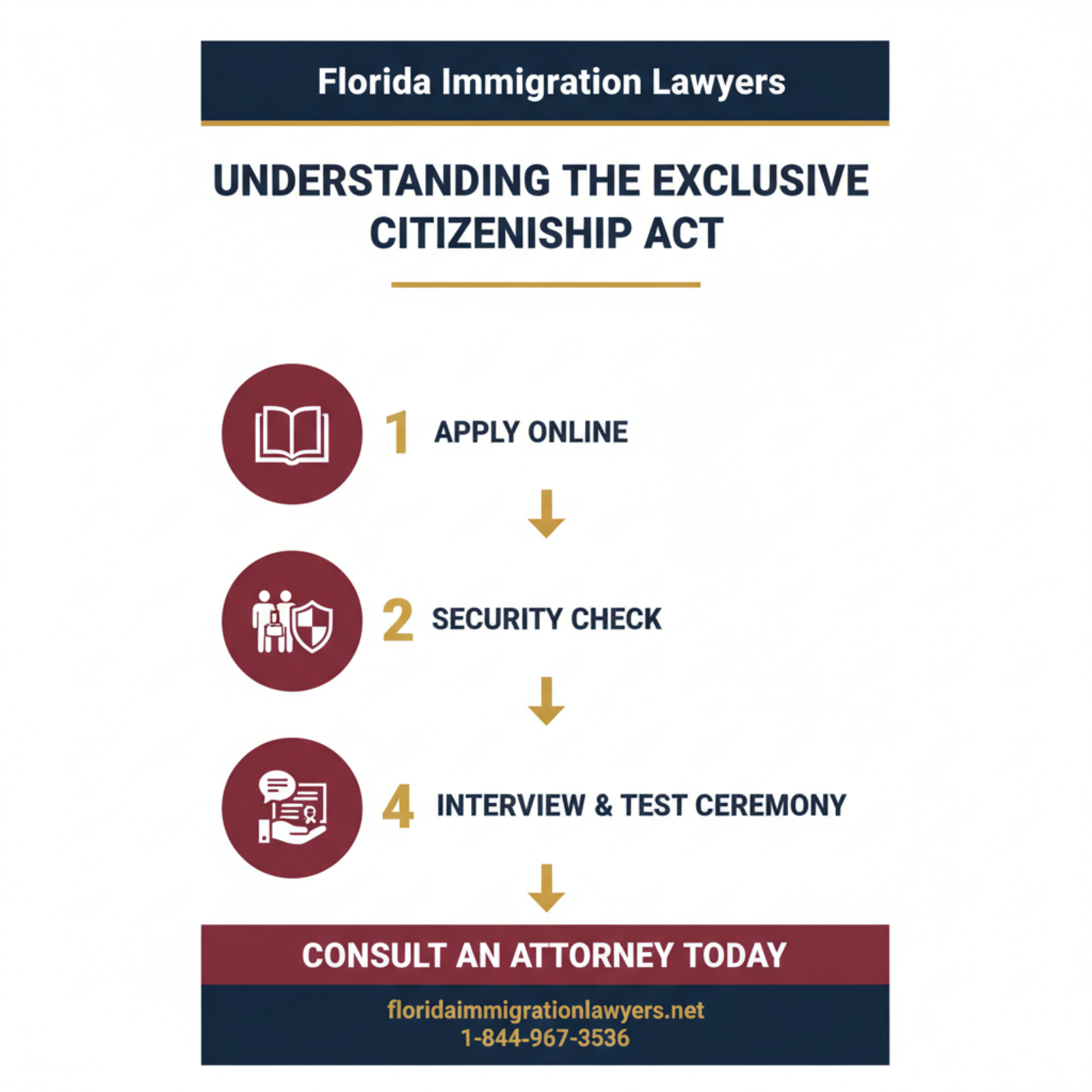
Each step requires meticulous attention to detail and adherence to USCIS guidelines. Any legislative changes would be implemented through new regulations and policy manuals, making the guidance of an experienced attorney invaluable.
Essential Document Checklist for Naturalization
Preparing the correct documentation is paramount for a successful naturalization application. While the **Exclusive Citizenship Act of 2025 Florida** may introduce new requirements, the following documents are generally essential:
- Copy of your Green Card (Form I-551)
- Copies of all passports, foreign and U.S.
- Copies of marriage certificate (if applicable)
- Copies of divorce decrees (if applicable)
- Copies of birth certificates for dependents
- Tax returns for the past 5 years (or 3 years, if applicable)
- Proof of selective service registration (for males 18-26)
- Certified court dispositions for any arrests or citations
- Travel records, including dates of all trips outside the U.S.
- Proof of payment for child support or alimony (if applicable)
- Evidence of good moral character (e.g., community involvement)
- Medical examination results (if required for certain waivers)
If the **Exclusive Citizenship Act of 2025 Florida** becomes law, additional documents proving the renunciation of foreign citizenship or an explicit declaration of sole allegiance might be required. It is crucial to work with an attorney to ensure your file is complete and accurate.
Timeline and Processing Expectations for Citizenship in Florida
The timeline for citizenship applications can vary significantly, even within Florida. Processing times are influenced by the specific USCIS field office handling your case (e.g., Miami, Orlando, Tampa) and the national backlog.
Typically, from filing Form N-400 to taking the Oath of Allegiance, the process can take anywhere from 8 to 24 months, or sometimes longer. Factors like the complexity of your case, response to Requests for Evidence (RFEs), and interview scheduling all play a role. The **Exclusive Citizenship Act of 2025 Florida** could potentially lengthen these timelines.
If new requirements are introduced, USCIS would need to establish new protocols, potentially leading to initial delays. Monitoring the official USCIS website for updated processing times specific to your Florida location is always recommended. An attorney can also help track your case and address any unusual delays.
Cost Factors and Fee Breakdown for Citizenship
Applying for U.S. citizenship involves various fees, which are subject to change by USCIS. While we cannot provide specific amounts here, these generally include:
- Filing Fee for Form N-400: This is the primary fee for processing your naturalization application.
- Biometrics Fee: A separate fee for fingerprinting and background checks.
- Attorney Fees: If you choose to hire an immigration lawyer, their fees will be an additional cost. These fees cover expertise, preparation, and representation throughout the process.
- Translation Fees: If any of your supporting documents are not in English, you will need certified translations, incurring additional costs.
- Document Retrieval Fees: Costs associated with obtaining necessary records, such as court documents or birth certificates.
It is important to budget for all these potential expenses. USCIS offers fee waivers for certain low-income applicants, which can significantly reduce the financial burden. The **Exclusive Citizenship Act of 2025 Florida** itself would not directly introduce new fees, but any additional required renunciations or certifications could incur costs from foreign governments or service providers.
Do not navigate this process alone. The stakes are too high. Contact Florida Immigration Lawyers today to understand how we can protect your interests and guide you through any legislative changes.
Common Mistakes to Avoid Regarding the Exclusive Citizenship Act of 2025
Missteps in immigration matters can have severe consequences. When considering the potential impact of the **Exclusive Citizenship Act of 2025 Florida**, it is especially important to avoid these common errors:
- Ignoring Proposed Legislation: Believing that a proposed bill like the **Exclusive Citizenship Act of 2025 Florida** is irrelevant until it becomes law is a mistake. Early awareness allows for strategic planning and preparation, which can be critical for your status.
- Assuming the Bill Has Passed: Conversely, many people fall prey to misinformation. As of 2026, the S.3283 bill has NOT passed. Acting on the assumption that it is law can lead to unnecessary panic or incorrect decisions regarding your citizenship.
- Misunderstanding Dual Citizenship: Many incorrectly assume that U.S. law prohibits dual citizenship. While the naturalization oath involves renunciation, the U.S. generally tolerates dual nationality. A new law would change this, making a clear understanding crucial.
- Providing Incomplete Documentation: Even without new laws, incomplete or inaccurate documentation is a leading cause of delays or denials. If new requirements arise from the **Exclusive Citizenship Act of 2025 Florida**, document preparation will become even more critical.
- Failing to Disclose All Relevant Information: Hiding information, even seemingly minor details, can be deemed misrepresentation and lead to severe penalties, including deportation. Always be honest and transparent in all immigration applications.
- Missing Application Deadlines: Strict deadlines apply to various immigration processes. Missing these can result in your application being rejected, requiring you to start over, or even affecting your eligibility.
- Not Updating Address with USCIS: If you move within Florida or to another state, you must inform USCIS of your new address within 10 days. Failure to do so can result in missed notices, interviews, or decisions, severely impacting your case.
- Trying to Navigate Complex Changes Alone: Immigration law is incredibly intricate and constantly evolving. Attempting to interpret potential new laws like the **Exclusive Citizenship Act of 2025 Florida** and manage your case without legal counsel significantly increases your risk of error.
- Believing Misinformation from Unofficial Sources: Social media and informal discussions can be rife with inaccurate legal advice. Always rely on official government websites (USCIS, Travel.State.Gov) and experienced immigration attorneys for reliable information.
- Not Preparing for the Naturalization Interview: The interview is a critical step. Lack of preparation for English and civics tests, or for detailed questions about your application, can lead to delays or denial. New laws could add more challenging questions.
- Failing to Meet Continuous Residency Requirements: Applicants for naturalization must maintain continuous residency in the U.S. for the required period. Extended trips outside the U.S. can break this continuity, impacting eligibility.
- Committing Minor Offenses that Impact Eligibility: Even seemingly minor legal issues, such as traffic violations or misdemeanors, can impact your good moral character assessment during the naturalization process. Always disclose and provide full documentation for any infractions.
When to Call a Lawyer About the Exclusive Citizenship Act of 2025 Florida
The uncertainty surrounding legislative proposals like the **Exclusive Citizenship Act of 2025 Florida** makes expert legal guidance more important than ever. You should contact Florida Immigration Lawyers if any of the following scenarios apply to you:
- You are a **dual citizen** living in Florida and are concerned about your status.
- You are considering applying for U.S. citizenship and want to understand potential changes.
- You have received **misinformation** about the bill and need accurate facts.
- You have a complex immigration history or prior legal issues.
- You are unsure about the documents required for your naturalization application.
- You need assistance preparing for your **naturalization interview**.
- You are facing delays or denials in your immigration case.
- You wish to explore other family-based or employment-based immigration options.
- You are seeking asylum or other forms of protection.
Our attorneys at Florida Immigration Lawyers stay abreast of all legislative developments, including the **Exclusive Citizenship Act of 2025 Florida**. We can provide personalized advice based on your unique situation, helping you navigate potential challenges and protect your future in the United States. Don't wait for a bill to become law to understand its implications; proactive legal counsel is your best defense.
About Florida Immigration Lawyers
Florida Immigration Lawyers is a leading immigration law firm dedicated to serving individuals and families across all of Florida. With offices conveniently located, including near Miami, we pride ourselves on providing compassionate, effective, and results-driven legal representation.
Our experienced attorneys specialize in a wide range of immigration services, from general immigration and naturalization to complex deportation defense, asylum claims, and citizenship applications. We understand the unique challenges faced by immigrants in Florida and are committed to advocating tirelessly on your behalf.
When you choose Florida Immigration Lawyers, you gain a partner who is available 24/7 to address your concerns. We offer free consultations to discuss your case and provide clear, honest assessments. Our bilingual team ensures that language is never a barrier to receiving top-tier legal support. Your future in Florida is our priority. Visit our website at https://www.floridaimmigrationlawyers.net or call us at 1-844-967-3536.
Sources and References
- U.S. Citizenship and Immigration Services (USCIS)
- U.S. Department of State - Bureau of Consular Affairs
- Executive Office for Immigration Review (EOIR)
- Immigration and Nationality Act (INA) - 8 U.S.C. Chapter 12
- 8 CFR (Code of Federal Regulations) - Title 8, Aliens and Nationality
- S.3283 - Exclusive Citizenship Act of 2025 (119th Congress, 2025-2026, as proposed)
This article provides general legal information and is not intended as legal advice. Every case is unique, and outcomes depend on specific facts and circumstances. Contact an attorney for advice about your particular situation.
The path to U.S. citizenship, especially with potential legislative changes like the **Exclusive Citizenship Act of 2025 Florida**, requires careful planning and expert guidance. Don't leave your future to chance.
Contact Florida Immigration Lawyers today for a free consultation. Call us at 1-844-967-3536. Se Habla Español - Estamos aquí para ayudarle.
Do Not Navigate This Process Alone
Our experienced immigration attorneys are ready to fight for you. Get a free, confidential consultation today.
Se Habla Español
Frequently Asked Questions
Florida Immigration Lawyers
Immigration Attorney | Founder, Vasquez Law Firm
U.S. Air Force veteran and immigration attorney with thousands of cases resolved. J.D., NCCU School of Law. AILA member. Admitted to the 4th, 5th, and 11th Circuit Courts.
Available 24/7 - Free Evaluations
Related Legal Services
Our Florida immigration attorneys can help you with immigration practice areas, free immigration consultation and experienced immigration attorneys. Call today at 1-844-967-3536 for a free consultation.
Related Links
Related Topics
Free Legal Consultation
Discuss your case with our experienced attorneys. We're available 24/7.
Se Habla Español - Estamos aquí para ayudarle.
Related Articles
Stokes Interview: Navigating Marriage Fraud in Florida
A Stokes interview is a specialized, separate interview conducted by USCIS when there are suspicions of marriage fraud in a green card application. This rigorous process involves individual questioning of spouses, focusing on inconsistencies in their testimonies to determine the authenticity of their marital bond. For couples in Florida, navigating this high-stakes interview requires meticulous preparation, extensive documentation, and often the strategic guidance of an experienced immigration lawyer. Understanding the process, preparing for detailed questions, and presenting a strong case are crucial for overcoming marriage fraud allegations and securing your immigration future. Florida Immigration Lawyers stands ready to assist you.
Immigration Attorney Gainesville: North Florida Legal Help
For those in Gainesville, Alachua County, and throughout North Florida, navigating U.S. immigration law requires expert guidance. An experienced immigration attorney can simplify complex processes, from family-based petitions and employment visas to critical asylum claims and deportation defense. This comprehensive guide outlines the essential services provided by an immigration attorney, details necessary documentation, clarifies processing timelines, and discusses associated costs. We also highlight common mistakes to avoid and crucial scenarios where legal counsel is indispensable. Florida Immigration Lawyers serves all of Florida, including Gainesville and St. Petersburg, providing dedicated legal support to help you achieve your immigration goals. Contact us for a free consultation to discuss your specific needs.
Military Naturalization Expedited at Florida Bases
Explore expedited military naturalization processes for service members at Florida bases like MacDill. Learn about eligibility, steps, and common mistakes. Contact Florida Immigration Lawyers for a free consultation.
Protect Yourself from Immigration Scams in Florida
Learn how to protect against immigration scams in Florida, focusing on St. Petersburg. This guide covers identifying scams, verifying credentials, and getting legal help. Call Florida Immigration Lawyers at 1-844-967-3536 for assistance.