DACA News 2026 Florida: Navigating Updates for Dreamers
DACA recipients in Florida, including those in Coral Springs, face continued uncertainty in 2026 due to ongoing legal challenges, yet USCIS continues to process renewal applications. This comprehensive guide details the step-by-step DACA renewal process, essential document checklists, and expected processing timelines. Learn about crucial cost factors, common mistakes to avoid, and when it is vital to seek legal assistance. Florida Immigration Lawyers provides expert guidance, helping Dreamers navigate the complexities of DACA to protect their status and work authorization. Stay informed and secure your future by understanding current policies and seeking professional legal support.
In 2026, DACA renewals continue to be processed by USCIS, offering a pathway for eligible individuals to maintain their protected status in Florida. However, the program remains subject to ongoing legal challenges, creating uncertainty about its long-term future. Understanding current requirements and seeking legal guidance is crucial for Dreamers in Coral Springs and across Florida.
- DACA renewals are still being accepted and processed by USCIS.
- Legal challenges continue to impact DACA's future status.
- Eligibility criteria and application processes remain in effect.
- Consulting an immigration lawyer is highly recommended for guidance.
- Stay informed on official USCIS announcements for the latest updates.
DACA News 2026 Florida: Navigating Updates for Dreamers
For thousands of young people across Florida, including those in Coral Springs, the Deferred Action for Childhood Arrivals (DACA) program represents a vital lifeline. It provides protection from deportation and the ability to work legally. As we move into 2026, many DACA recipients, often called Dreamers, are asking critical questions about the program's future amidst ongoing legal battles and policy discussions.
The landscape of immigration law is constantly shifting, and DACA is no exception. Understanding the latest developments, renewal processes, and potential challenges is essential for maintaining your status. This comprehensive guide from Florida Immigration Lawyers aims to provide clarity and actionable advice for DACA recipients throughout the Sunshine State.
Do you have questions about your DACA status or need assistance with a renewal? Do not hesitate to seek expert legal guidance. Call Florida Immigration Lawyers at 1-844-967-3536 for a free consultation today. Our experienced team is here to help you navigate these complex issues.
Understanding DACA in 2026: An Overview for Florida Dreamers
The Deferred Action for Childhood Arrivals (DACA) program, established in 2012, offers temporary protection from deportation and work authorization to eligible undocumented immigrants who came to the United States as children. For over a decade, DACA has allowed hundreds of thousands of young people, including a significant population in Florida, to pursue education and careers.
However, DACA's legal standing has been consistently challenged. As of early 2026, the program continues to operate under federal court orders that permit U.S. Citizenship and Immigration Services (USCIS) to accept and process DACA renewal requests. This means that if you are a current DACA recipient, you generally retain the ability to apply for a renewal of your deferred action and employment authorization.
Legal Challenges and Their Impact on DACA in Florida
The primary legal challenge to DACA stems from a lawsuit, Texas v. United States, which argues that the program was unlawfully created. While federal courts have generally allowed renewals to continue, they have also placed injunctions preventing USCIS from approving new initial DACA applications. This creates a challenging situation for those who were eligible but unable to apply before the injunctions took effect.
For Florida Dreamers, these legal battles mean a persistent cloud of uncertainty. While your current DACA status may be renewable, the long-term future of the program is still in question, subject to future court rulings or potential legislative action. It is crucial to stay informed through official channels like USCIS.gov.
DACA in Florida: Specific Context for Dreamers
Florida is home to a substantial Dreamer population, with many residing in metropolitan areas like Miami, Orlando, Tampa, and communities such as Coral Springs. While DACA is a federal program, state-level policies and sentiments can also influence the environment for immigrants. It's important for DACA recipients in Florida to understand their federal rights under DACA while being mindful of the state's broader immigration climate.
For example, while DACA protects you from federal deportation, state and local law enforcement interactions should always be handled with care. Knowing your rights and having proper documentation on hand is always advisable. Florida Immigration Lawyers is dedicated to protecting the rights of Dreamers across the state.
Step-by-Step DACA Renewal Process for Florida Residents
Renewing your DACA status is a critical process that requires careful attention to detail. Missing deadlines or making errors can lead to serious consequences, including a lapse in your work authorization or even potential deportation proceedings. Follow these steps to ensure a smooth renewal process.
-
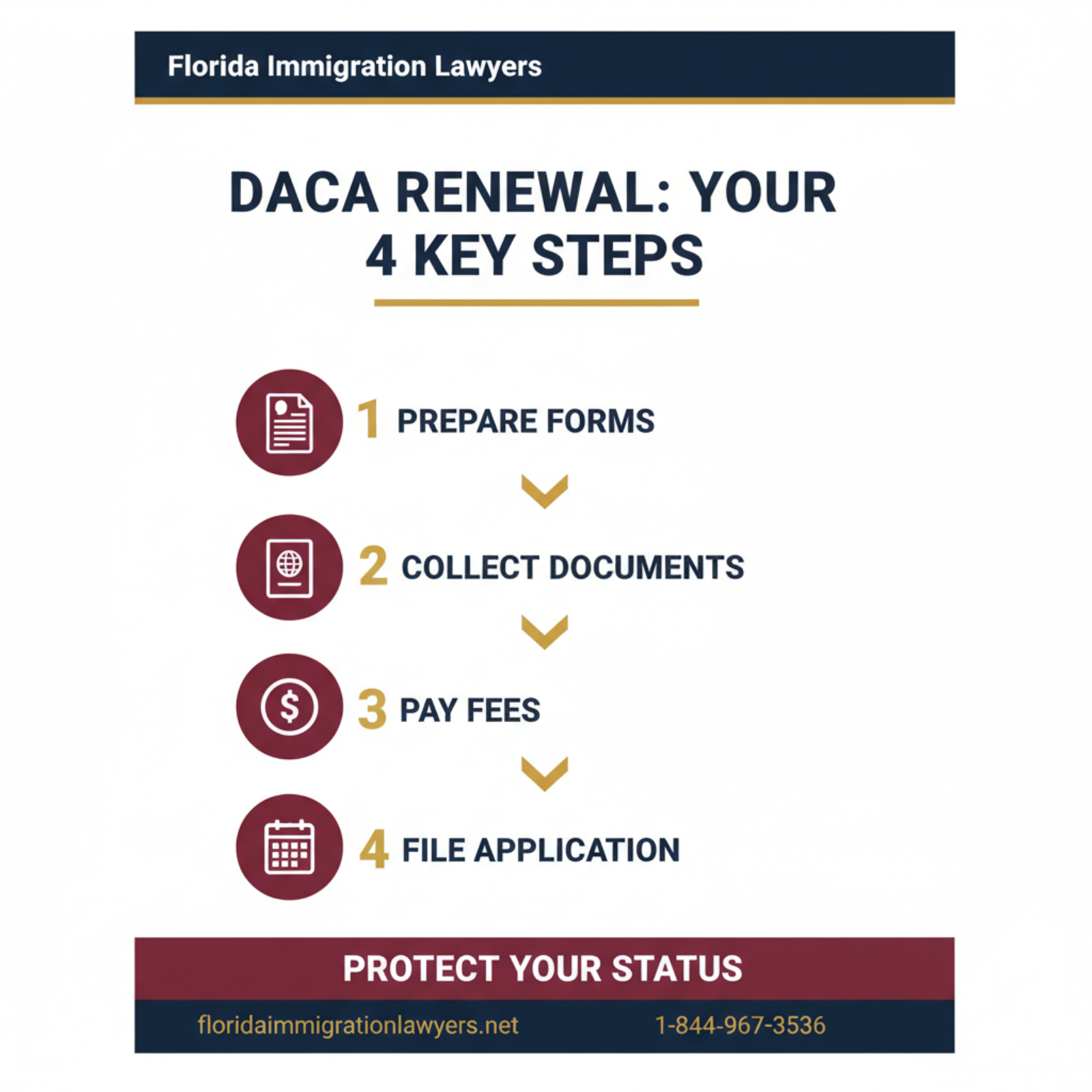
Determine Your Eligibility for Renewal: To renew DACA, you must generally meet the original DACA guidelines and not have departed the United States without advance parole since August 15, 2012. You must also not have been convicted of a felony, a significant misdemeanor, or three or more other misdemeanors, and not pose a threat to national security or public safety. Consult with an attorney if you have any doubts about your eligibility.
-
Gather Required Documents: Collect all necessary supporting documents. This typically includes proof of identity, previous DACA approval notices, and documentation of continuous residence. We will detail a comprehensive checklist in the next section.
-
Complete Forms I-821D, I-765, and I-765WS: You must submit three forms for your DACA renewal: Form I-821D (Consideration of Deferred Action for Childhood Arrivals), Form I-765 (Application for Employment Authorization), and Form I-765 Worksheet (Worksheet for Form I-765). Ensure all sections are completed accurately and truthfully. Any discrepancies can cause delays or denials.
-
Pay the Filing Fees: As of 2026, there are government filing fees associated with the DACA renewal application. These fees typically include the Form I-765 fee and a biometric services fee. USCIS does not accept fee waivers for DACA applications, but in very limited circumstances, a fee exemption may be possible. You can find current fee information on the USCIS website.
-
Mail Your Application Packet: Once all forms are completed, signed, and all supporting documents are compiled, mail your application to the correct USCIS lockbox facility. The correct address depends on your state of residence and the courier service you use. Always use a trackable mailing service.
-
Attend Biometrics Appointment: After USCIS receives your application, you will typically receive a notice to appear for a biometrics (fingerprinting) appointment at an Application Support Center (ASC). It is crucial to attend this appointment, as failure to do so can lead to your application being denied.
-
Receive Decision and New Documents: If your renewal is approved, you will receive an approval notice and a new Employment Authorization Document (EAD) card. This card serves as proof of your work authorization and DACA status. If you are facing delays or a denial, it is important to contact a legal professional immediately. Our firm assists with various immigration processes, including DACA renewals.
Essential Document Checklist for Your DACA Application
Having all your documents organized and ready is key to a successful DACA renewal. This checklist outlines the typical documents required. Remember, specific circumstances may require additional evidence.
- Most Recent DACA Approval Notice (Form I-797): This proves your prior DACA status.
- Current Employment Authorization Document (EAD) Card: Your existing work permit.
- Proof of Identity: Such as a copy of your birth certificate with translation, passport, or national identity document from your country of origin.
- Proof of Entry Before Age 16 (for initial applicants, but good to have for renewals if questions arise): Such as school records, medical records, or sworn affidavits.
- Proof of Continuous Residence in the U.S. Since June 15, 2007: This can include school transcripts, employment records, tax returns, bank statements, utility bills, or rental agreements.
- Proof of Presence in the U.S. on June 15, 2012: Similar documents as continuous residence, specifically showing presence on this date.
- Proof of Enrollment in School, GED Program, or High School Diploma/GED Certificate: Evidence that you meet the educational requirements.
- All Criminal History Records (if applicable): Court dispositions, police reports, and any other relevant documentation for any arrests or convictions.
- Two Passport-Style Photos: Taken within 30 days of filing your application.
DACA Processing Timelines and Expectations in 2026
The time it takes for USCIS to process DACA renewal applications can vary significantly. While USCIS aims to process renewals efficiently, several factors can influence the timeline. It is always best to file your renewal application well in advance of your current DACA expiration date.
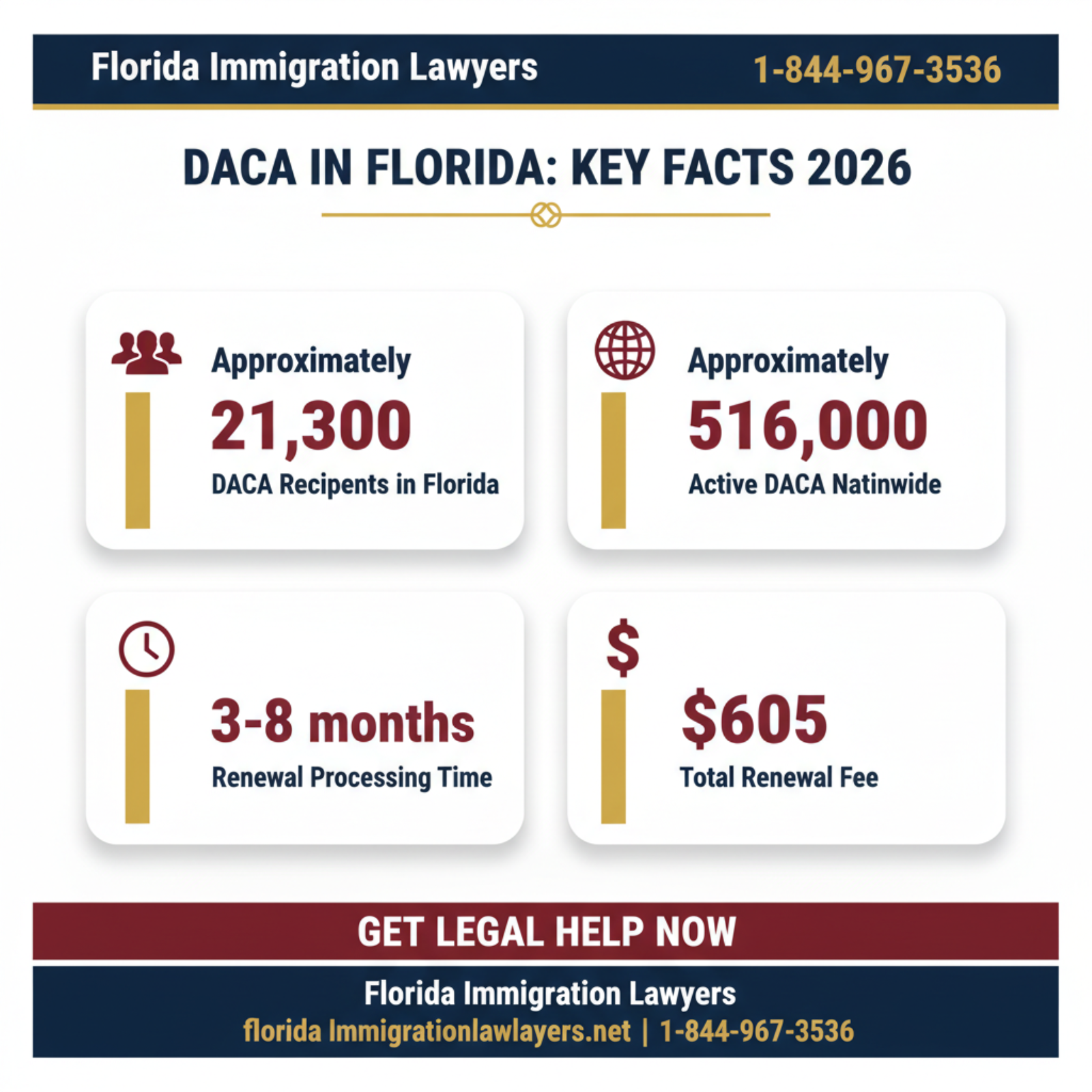
Typically, USCIS recommends filing your DACA renewal 120 to 150 days (approximately 4 to 5 months) before your current DACA and EAD expire. This allows ample time for processing, including the biometrics appointment, and helps prevent a lapse in your work authorization. Processing times can be found on the USCIS website by selecting Form I-821D.
Factors Affecting Processing Times
Several elements can impact how long your DACA renewal takes. These include the volume of applications USCIS receives, staffing levels, and any legal or policy changes that may occur. Incomplete applications or requests for additional evidence (RFE) will also cause significant delays. Legal challenges like those impacting DACA can also lead to unpredictable processing fluctuations.
For Dreamers in Florida, particularly those in areas served by the Miami or Orlando USCIS Field Offices, local operational issues can sometimes play a role, though DACA applications are processed centrally. Planning ahead and submitting a complete, accurate application is your best strategy for a timely renewal.
Cost Factors and Fee Breakdown for DACA
Understanding the financial aspects of your DACA renewal is important for budgeting and planning. The primary costs associated with DACA applications are the government filing fees. These fees are subject to change, so always verify the latest amounts directly on the USCIS website before filing.
As of 2026, the DACA renewal application generally requires two main fees: one for Form I-765 (Application for Employment Authorization) and a separate fee for biometric services. These fees are combined into a single payment. USCIS does not typically offer fee waivers for DACA applications, though limited fee exemptions may be considered in extreme circumstances of financial hardship.
Legal Fees and the Value of Representation
Beyond the government fees, you may also incur legal fees if you choose to hire an immigration attorney. While not mandatory, legal representation can be an invaluable investment. An experienced attorney can help ensure your application is correctly prepared, all necessary documents are included, and potential issues are identified and addressed proactively.
For complex cases, such as those involving a criminal history, prior denials, or questions about continuous residence, legal counsel is highly recommended. The cost of legal fees can vary based on the complexity of your case and the services provided. Many firms, including Florida Immigration Lawyers, offer free initial consultations to discuss your options and potential costs.
Do not navigate this process alone. The complexities of DACA renewal, combined with the ongoing legal uncertainty, make expert legal guidance more important than ever. Contact Florida Immigration Lawyers today to ensure your application is handled with precision and care.
Common Mistakes to Avoid in Your DACA Renewal
Renewing DACA can be straightforward for many, but several common pitfalls can lead to delays or even denial. Being aware of these mistakes can help you avoid them and ensure a successful outcome.
-
Missing the Renewal Deadline: Filing your renewal too late can result in a lapse in your DACA status and employment authorization. This means you could lose your job and potentially become subject to deportation. USCIS recommends filing 120-150 days before expiration.
-
Incomplete or Incorrect Forms: Leaving fields blank, providing inconsistent information, or failing to sign forms are common errors. These mistakes will almost certainly lead to a Request for Evidence (RFE) or outright denial, significantly delaying your process.
-
Insufficient Supporting Documentation: Not providing all required evidence, such as proof of continuous residence or identity, can halt your application. Always double-check the checklist and provide clear copies.
-
Incorrect Filing Fees: Submitting the wrong fee amount, an expired check, or failing to include the payment can cause your application to be rejected. Verify the current fees on the USCIS website.
-
Undisclosed Criminal History: Attempting to hide arrests, charges, or convictions, even minor ones, is a serious mistake. USCIS will uncover this information during background checks and it can lead to a denial and potentially more severe immigration consequences, as per INA Section 212(a)(2).
-
Traveling Internationally Without Advance Parole: Leaving the U.S. without an approved Form I-131, Application for Travel Document (Advance Parole), can lead to your DACA being automatically terminated and may bar you from re-entry. DACA does not grant legal status for re-entry.
-
Not Updating USCIS with Address Changes: If you move, you are legally required to notify USCIS of your new address within 10 days using Form AR-11. Failure to do so can result in missed notices, appointments, or even a denial of your DACA.
-
Misrepresenting Facts or Providing False Information: Any attempt to deceive USCIS with false statements or documents is taken very seriously. This can lead to a permanent bar from future immigration benefits and even criminal charges, as outlined in 18 U.S.C. Section 1001.
-
Ignoring Requests for Evidence (RFEs): If USCIS sends an RFE, it means they need more information to make a decision. Failing to respond by the deadline or providing an inadequate response will likely lead to a denial of your application.
-
Not Seeking Legal Advice for Complex Cases: If you have a criminal record, previous denial, or other complications, trying to navigate the renewal process alone is risky. An attorney can assess your situation and advise on the best course of action.
When to Call a Lawyer for Your DACA Renewal
While some DACA renewals are straightforward, many situations warrant the expertise of an immigration attorney. Seeking legal counsel can protect your interests and prevent costly mistakes, especially with the ongoing legal uncertainty surrounding DACA.
Specific Scenarios Requiring Legal Help
You should strongly consider contacting an attorney if any of the following apply to your situation:
- Criminal History: Even minor arrests or convictions can significantly impact your DACA eligibility. An attorney can evaluate your record and advise on potential risks or waivers. This is particularly relevant given the strict guidelines in 8 CFR 274a.12(c)(14).
- Prior DACA Denial or Termination: If your previous DACA application was denied or your status was terminated, you face a much more complex renewal process. An attorney can help understand the reasons for denial and strategize a new approach.
- Issues with Continuous Residence or Physical Presence: If you have gaps in your residency documentation or questions about your physical presence in the U.S., legal guidance is crucial to establish eligibility.
- Travel Outside the U.S. Without Advance Parole: If you left the country without an approved advance parole document, your DACA may have been terminated, potentially leading to deportation proceedings upon re-entry.
- Changes in Marital Status or Family Situation: While not directly affecting DACA, these changes can open doors to other immigration pathways, such as family-based immigration, which an attorney can explore.
- Concerns About Immigration Enforcement: If you or a family member are facing threats of deportation, or if you have questions about your rights during encounters with ICE, an attorney can provide critical advice.
Warning Signs and Red Flags
Any communication from USCIS that seems unusual, such as a Request for Evidence (RFE) or a Notice of Intent to Deny (NOID), should prompt immediate legal consultation. These are not routine and indicate that there might be an issue with your application that needs expert attention.
Moreover, if you feel overwhelmed by the application process, or if you are unsure about any part of the forms or required documents, it is always better to seek professional help. The peace of mind that comes from knowing your application is handled correctly is invaluable. Our experienced attorneys at Florida Immigration Lawyers are ready to assist you.
About Florida Immigration Lawyers
Florida Immigration Lawyers is a leading immigration law firm dedicated to serving individuals and families throughout Florida, including the Coral Springs area. We understand the profound impact that immigration matters have on people's lives, and we are committed to providing compassionate, effective, and ethical legal representation.
Our firm specializes in a wide range of immigration services, including DACA renewals, asylum applications, deportation defense, citizenship applications, family-based immigration, and business immigration. We pride ourselves on offering personalized attention and strategic advice tailored to your unique circumstances.
Why choose Florida Immigration Lawyers? Our team combines extensive legal knowledge with a deep understanding of the challenges faced by immigrants in Florida. We are available 24/7 to answer your questions and offer free, confidential consultations to help you understand your options. Your future is our priority.
Contact us today at 1-844-967-3536 or visit www.floridaimmigrationlawyers.net to schedule your free consultation. We are here to help you achieve your immigration goals.
Sources and References
- U.S. Citizenship and Immigration Services (USCIS) - Deferred Action for Childhood Arrivals
- U.S. Citizenship and Immigration Services (USCIS) - Filing Fees
- U.S. Citizenship and Immigration Services (USCIS) - Check Case Processing Times
- Executive Office for Immigration Review (EOIR)
- 8 U.S.C. Chapter 12 - Immigration and Nationality Act (INA)
- 8 CFR 274a.12(c)(14) - Classes of Aliens Authorized to Accept Employment
- 18 U.S.C. Section 1001 - Statements or Entries Generally
- INA Section 212(a)(2) - Criminal and Related Grounds for Inadmissibility
This article provides general legal information and is not intended as legal advice. Every case is unique, and outcomes depend on specific facts and circumstances. Contact an attorney for advice about your particular situation.
The evolving nature of DACA requires diligent attention and expert guidance. Do not leave your future to chance. Contact Florida Immigration Lawyers today at 1-844-967-3536 for a free, confidential consultation. We are ready to provide the dedicated legal support you deserve. Se Habla Español - Estamos aquí para ayudarle.
Florida Immigration Lawyers
Legal Team
Our experienced attorneys at Florida Immigration Lawyers have been serving clients across Florida for over 20 years. We specialize in immigration, personal injury, criminal defense, workers compensation, and family law.