Florida PERM Labor Certification: Your Employer Green Card Guide
Navigating PERM Labor Certification in Florida? Get our expert guide on employer-sponsored green card steps, requirements, and strategies for success. Secure

Florida PERM Labor Certification: Your Employer Green Card Guide
For many foreign nationals aspiring to live and work permanently in the United States, an employer-sponsored green card is a crucial pathway. In Florida, navigating this complex journey often begins with the Program Electronic Review Management (PERM) Labor Certification process. PERM is a critical first step, designed to protect U.S. workers by ensuring that employers recruit American workers for a position before hiring a foreign national. This comprehensive guide will demystify the PERM process in Florida, outlining the steps, requirements, potential challenges, and why expert legal assistance is indispensable for a successful outcome.
Understanding PERM is not just about filling out forms; it's about meticulous preparation, strict adherence to Department of Labor (DOL) regulations, and strategic planning. A single misstep can lead to delays, denials, or even permanent bars from immigration benefits. Whether you are an employer seeking to retain a valuable foreign employee or a foreign national pursuing your American dream, comprehending PERM is paramount.
What is PERM Labor Certification?
PERM Labor Certification is the process by which U.S. employers demonstrate to the Department of Labor (DOL) that there are no qualified, willing, and available U.S. workers for a specific job opening. This certification is a prerequisite for most employment-based (EB-2 and EB-3) immigrant visa petitions. The core principle behind PERM is to protect the U.S. labor market by ensuring that foreign workers are not taking jobs away from qualified U.S. citizens or permanent residents. The process is highly regulated and requires employers to conduct specific recruitment efforts to test the labor market.
The PERM process is entirely electronic, managed through the DOL's online system. It requires employers to meticulously document their recruitment efforts and attest to various conditions, such as offering a prevailing wage and having a legitimate job opportunity. Once certified, the PERM approval allows the employer to file an Immigrant Petition for Alien Worker (Form I-140) with U.S. Citizenship and Immigration Services (USCIS). Without an approved PERM, most EB-2 and EB-3 green card applications cannot proceed. For more general information on immigration pathways, visit our Immigration Practice Area page.
The PERM Labor Certification Process: A Step-by-Step Guide
The PERM process is intricate and demands precision. Here's a breakdown of the key stages:
Step 1: Prevailing Wage Determination (PWD)
Before any recruitment can begin, the employer must obtain a Prevailing Wage Determination (PWD) from the DOL. This involves submitting Form ETA-9141, Application for Prevailing Wage Determination, which describes the job duties, minimum requirements, and work location. The DOL then determines the appropriate wage for that position in the specific geographic area, ensuring that the foreign worker will be paid at least the prevailing wage. This step is crucial because the employer must commit to paying at least this wage once the green card is approved and the foreign national begins working permanently in the role. The PWD request can take several months to process, making early planning essential.
Step 2: The Recruitment Process
Once the PWD is issued, the employer must conduct a series of recruitment activities to test the U.S. labor market. The specific requirements vary depending on whether the position is professional or non-professional. For professional positions, mandatory recruitment steps include:
- Placing two Sunday advertisements in a newspaper of general circulation.
- Placing a job order with the State Workforce Agency (SWA) for 30 days.
- Posting a notice of the job opportunity at the employer's worksite.
Additionally, employers must choose three other recruitment methods from a list of ten options, such as job fairs, employer websites, campus recruitment, trade or professional organizations, private employment firms, employee referral programs, or on-campus recruiting. All recruitment must occur within a 30- to 180-day period before filing the PERM application. The employer must review all applications received and document legitimate, job-related reasons for rejecting any U.S. applicants. This documentation is critical and must be retained for five years.
Step 3: Filing Form ETA-9089
After completing the recruitment period and determining that no qualified and available U.S. workers were found, the employer can file Form ETA-9089, Application for Permanent Employment Certification, with the DOL. This form electronically summarizes all the recruitment efforts, job requirements, and the prevailing wage information. It also includes attestations from the employer regarding compliance with all PERM regulations. Accuracy is paramount here, as any inconsistencies with the recruitment documentation or PWD can lead to an audit or denial. The DOL reviews these applications, and if approved, issues the PERM Labor Certification.
Common Challenges and Strategies for Success
The PERM process is fraught with potential pitfalls that can lead to significant delays or outright denials. One of the most common challenges is failing to adhere strictly to the recruitment regulations. Employers must ensure all advertisements run for the correct duration, contain the necessary information, and are placed in appropriate media. Documentation of every recruitment step, including copies of ads, interview notes, and rejection reasons, must be meticulously maintained.
Another frequent issue arises with the Prevailing Wage Determination. If the job requirements are too restrictive or the wage offered is below the DOL's determined prevailing wage, the application can be denied. Employers must be careful not to tailor job requirements specifically to the foreign national, as this is considered unduly restrictive and can trigger an audit. Furthermore, delays in the DOL's processing times for PWDs and ETA-9089 applications can be frustrating. Staying organized, planning well in advance, and having an experienced immigration attorney guide you through each step can mitigate many of these risks. For instance, understanding the nuances of how to respond to an audit, or how to handle a Request for Information (RFI), is critical to maintaining the integrity of your application.
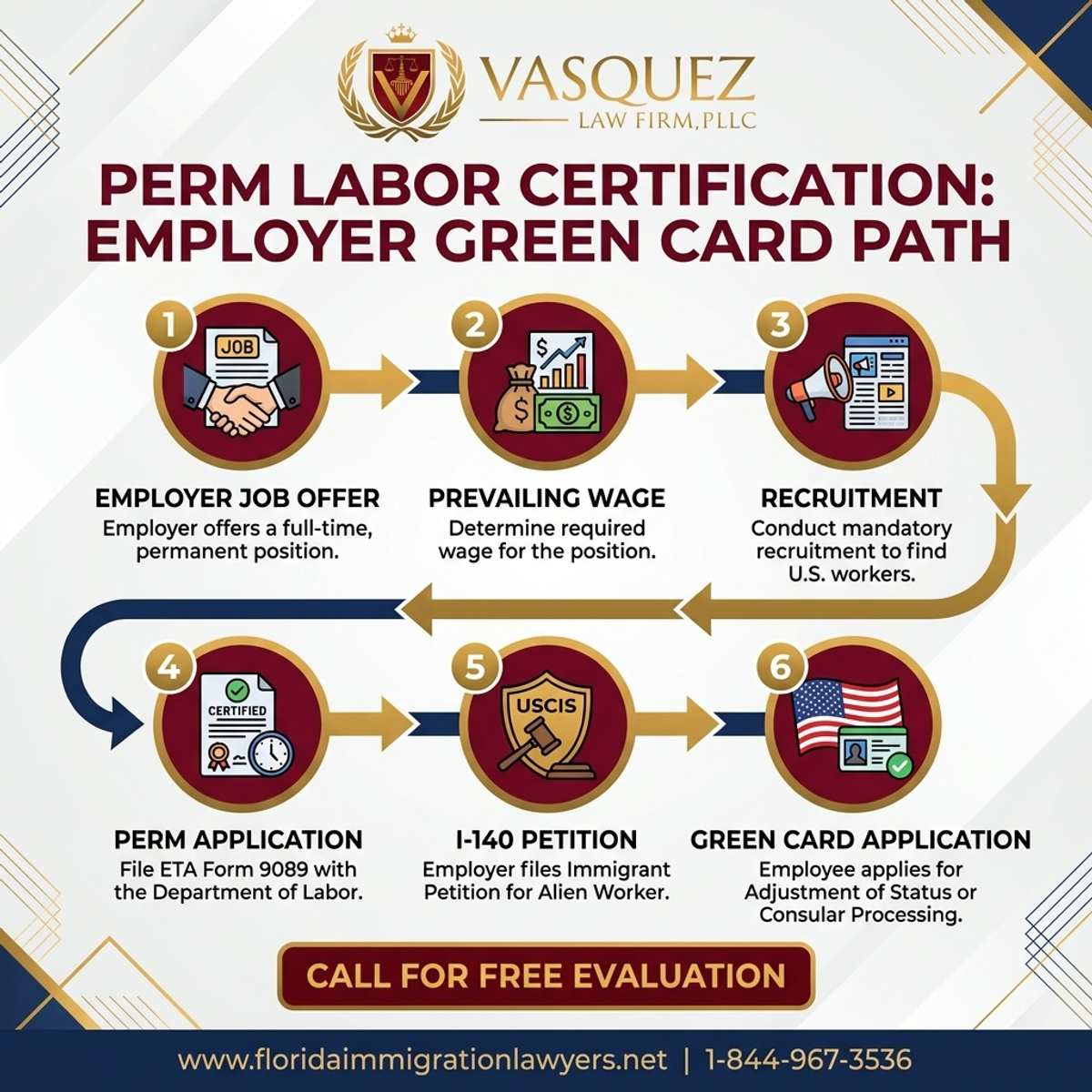
Step-by-Step Process — Florida PERM Labor Certification: Your Employer Green Card Guide
PERM Labor Certification: Comparing with Other Employment-Based Green Card Options
While PERM Labor Certification is the most common route for employer-sponsored green cards (EB-2 and EB-3 categories), it's important for both employers and foreign nationals to understand that other employment-based options exist. These alternatives often cater to individuals with extraordinary abilities or those whose work is deemed to be in the national interest, thereby bypassing the lengthy PERM process. Understanding these distinctions can help determine the most efficient and appropriate pathway for a given situation.
EB-1: Extraordinary Ability, Outstanding Professors/Researchers, Multinational Managers
The EB-1 visa category is reserved for individuals at the very top of their field. It includes three subcategories, none of which require a PERM Labor Certification:
- EB-1A (Extraordinary Ability): For individuals with extraordinary ability in the sciences, arts, education, business, or athletics, demonstrated by sustained national or international acclaim. These individuals must show extensive documentation of their achievements and that they will continue to work in their area of extraordinary ability in the U.S. No employer sponsor is required, meaning the foreign national can self-petition.
- EB-1B (Outstanding Professors and Researchers): For outstanding professors and researchers who have at least three years of experience in teaching or research in their academic area, and who are recognized internationally as outstanding. They must be seeking to enter the U.S. to pursue a tenured or tenure-track teaching or comparable research position at a university or other institution of higher education. An employer sponsor is required, but PERM is not.
- EB-1C (Multinational Managers or Executives): For multinational executives and managers who have been employed outside the U.S. for at least one year in the preceding three years by a firm or corporation and are seeking to enter the U.S. to continue to render services to the same employer or to a subsidiary or affiliate in a managerial or executive capacity. An employer sponsor is required, but PERM is not.
The primary advantage of the EB-1 category is the exemption from PERM, which significantly shortens the overall green card process and avoids the complexities of labor market testing. However, the eligibility criteria are exceptionally stringent, making it suitable for a select group of highly accomplished individuals.
EB-2 National Interest Waiver (NIW)
The EB-2 category generally requires a PERM Labor Certification, but there is a significant exception: the National Interest Waiver (NIW). An NIW allows individuals with advanced degrees or exceptional ability in the sciences, arts, or business to bypass the PERM process if their work is deemed to be in the national interest of the United States. To qualify for an NIW, the applicant must demonstrate that:
- The proposed endeavor has both substantial merit and national importance.
- They are well-positioned to advance the endeavor.
- On balance, it would be beneficial to the United States to waive the requirements of a job offer and thus the labor certification.
Like the EB-1A, the NIW allows for self-petitioning, meaning an employer sponsor is not required. This can be a highly attractive option for researchers, entrepreneurs, and professionals whose work has broader societal benefits, as it eliminates the need for employer sponsorship and the time-consuming PERM process. However, proving "national interest" requires a compelling case supported by extensive evidence.
While these alternatives offer faster routes by avoiding PERM, they are not suitable for everyone. For the majority of skilled workers, the PERM Labor Certification remains the primary and most viable path to an employer-sponsored green card. Consulting with an experienced immigration attorney can help individuals and employers determine the most appropriate strategy based on the foreign national's qualifications and the job opportunity.
Beyond PERM: The I-140 Petition and Adjustment of Status/Consular Processing
An approved PERM Labor Certification is a significant milestone, but it's not the end of the journey. The next critical step is for the employer to file Form I-140, Immigrant Petition for Alien Worker, with U.S. Citizenship and Immigration Services (USCIS). This petition establishes the foreign national's eligibility for an employment-based immigrant visa based on their qualifications and the approved PERM. The I-140 requires extensive documentation, including the approved PERM certificate, evidence of the employer's ability to pay the offered wage, and the foreign national's educational and professional credentials. USCIS reviews this petition to ensure all requirements are met. You can find more information about USCIS processes on their official website: uscis.gov.
Once the I-140 is approved and an immigrant visa number becomes available (based on the foreign national's country of birth and the visa bulletin published by the Department of State at travel.state.gov), the foreign national can proceed with the final stage: obtaining permanent resident status. This can be done through two main avenues:
- Adjustment of Status (AOS): If the foreign national is already in the U.S. and maintains a valid nonimmigrant status, they can apply for Adjustment of Status by filing Form I-485 with USCIS. This allows them to adjust their status to that of a lawful permanent resident without leaving the country.
- Consular Processing: If the foreign national is outside the U.S. or chooses to do so, they can apply for an immigrant visa at a U.S. consulate or embassy in their home country. This involves an interview and medical examination before being issued an immigrant visa to enter the U.S. as a permanent resident.
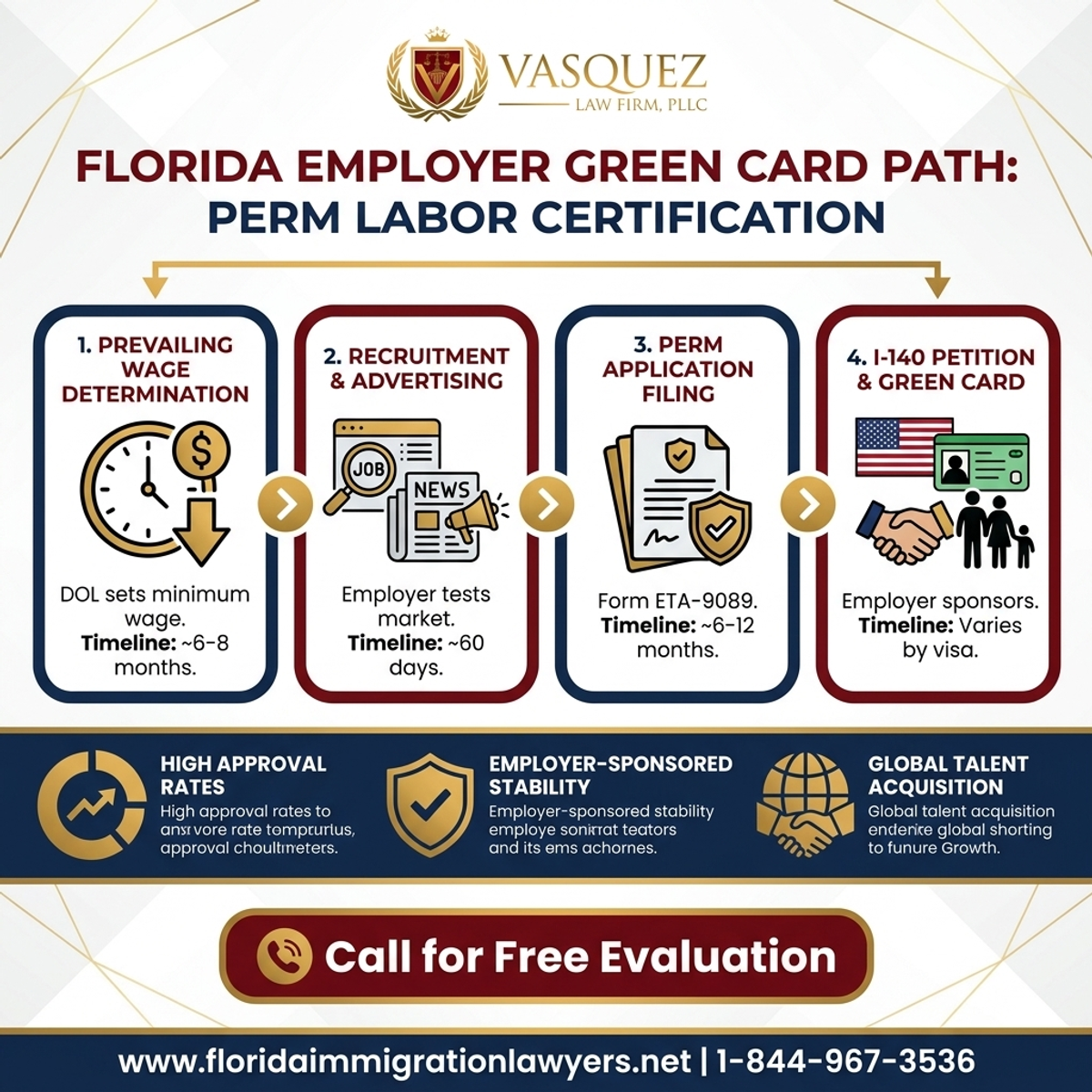
Key Statistics — Florida PERM Labor Certification: Your Employer Green Card Guide
Both AOS and Consular Processing have their own complexities and timelines. It's crucial to understand the implications of each, especially regarding travel restrictions and maintaining legal status throughout the process. Errors during these stages can lead to serious consequences, including potential deportation defense issues.
Why Expert Legal Guidance is Crucial for PERM in Florida
Given the intricate regulations, strict deadlines, and potential for costly errors, navigating the PERM Labor Certification process in Florida without expert legal guidance is highly risky. An experienced immigration attorney can provide invaluable assistance by:
- Ensuring Compliance: Attorneys are well-versed in the latest DOL regulations and can ensure every step, from PWD to recruitment, adheres to the letter of the law, minimizing the risk of audits or denials.
- Strategic Planning: They can help employers and foreign nationals develop a comprehensive strategy, including determining the appropriate job description, minimum requirements, and prevailing wage, to optimize the chances of success.
- Documentation Management: Attorneys assist in organizing and maintaining the extensive documentation required for PERM, which is crucial in case of an audit.
- Responding to Challenges: If an audit or Request for Information (RFI) is issued, an attorney can prepare a robust and timely response, protecting the integrity of the application.
- Post-PERM Guidance: Beyond PERM, an attorney can guide you through the I-140 petition and the subsequent Adjustment of Status or Consular Processing, ensuring a seamless transition to permanent residency.
The investment in legal expertise far outweighs the potential costs of delays, denials, or having to restart the entire process. Our firm has a proven track record of helping employers and foreign nationals successfully navigate the PERM process in Florida. Contact us today for a consultation to discuss your specific needs and how we can assist you in achieving your immigration goals.
Conclusion
The PERM Labor Certification is a cornerstone of the employer-sponsored green card process in Florida. While challenging, with meticulous preparation, strict adherence to DOL regulations, and the invaluable guidance of an experienced immigration attorney, it is a surmountable hurdle. From the initial Prevailing Wage Determination to the complex recruitment phase and the final filing of Form ETA-9089, every step demands precision and expertise. By understanding the process, anticipating challenges, and leveraging professional legal support, employers can secure the talent they need, and foreign nationals can confidently advance towards their goal of permanent residency in the United States. Don't leave your future to chance; partner with legal experts who understand the nuances of U.S. immigration law.
No Navegue Este Proceso Solo
Nuestros abogados de inmigración con experiencia están listos para luchar por usted. Obtenga una consulta gratuita y confidencial hoy.
We Speak English
O deje sus datos y le llamamos:
Evaluación Gratis en 24 Horas
O hable con nosotros ahora

Asistente de voz IA — disponible 24/7
GratisPreguntas Frecuentes

William J. Vásquez
Abogado Fundador · Vasquez Law Firm
Veterano de la Fuerza Aérea de EE.UU. y abogado de inmigración con años de experiencia práctica en inmigración de EE.UU. J.D., NCCU School of Law. Miembro de AILA. Admitido en los Circuitos 4.º, 5.º y 11.º.
Disponible 24/7 - Consultas Gratis
Revisado para exactitud legal por William J. Vásquez
Con licencia en Carolina del Norte; la inmigración a EE.UU. es una práctica federal.
Servicios legales relacionados
Nuestros abogados de inmigración en Florida pueden ayudarle con consulta gratis de inmigración, áreas de práctica de inmigración y servicios de inmigración familiar. Llame hoy al 1-844-967-3536 para una consulta gratuita.
Enlaces Relacionados
Temas Relacionados
Consulta Legal Gratuita
Discuta su caso con nuestros abogados experimentados. Estamos disponibles 24/7.
Artículos Relacionados
Abogado de Inmigración Orlando Consulta Gratuita: Su Guía
Navegar los procedimientos de la corte de inmigración en Florida requiere orientación legal experta. Esta guía completa detalla el proceso paso a paso de los procedimientos de deportación, documentos esenciales y plazos críticos a partir de 2026. Aprenda sobre los costos de representación y los errores comunes a evitar. Para aquellos en Orlando, Tallahassee o cualquier parte de Florida, obtener una consulta gratuita con un abogado de inmigración en Orlando es su primer paso para comprender sus derechos y construir una sólida defensa contra la deportación. Florida Immigration Lawyers ofrece apoyo legal compasivo y efectivo para todos los desafíos de la corte de inmigración, asegurando que tenga un defensor dedicado a su lado.
Asilo I-589 en Florida 2026: Entienda la 'Narrativa de
Solicitar asilo en EE. UU. requiere una convincente "narrativa de miedo" – una declaración personal que detalla por qué no puede regresar a su país de origen debido a la persecución. Esta guía ofrece una visión general completa del proceso de solicitud de asilo I-589 en Florida para 2026, incluyendo los pasos esenciales, la documentación requerida, los plazos típicos y los costos asociados. Aprenda cómo elaborar una narrativa sólida, qué evidencia es crucial y los errores comunes a evitar. Con información específica sobre el panorama migratorio de Florida, desde West Palm Beach hasta Miami, este artículo destaca la importancia del asesoramiento legal para navegar las intrincadas regulaciones federales y los procedimientos judiciales locales. Florida Immigration Lawyers ofrece orientación experta para proteger sus derechos y ayudarle a asegurar su seguridad.
Abogado de Inmigración OPT STEM: Guía para Graduados de
Para los graduados de Florida con títulos STEM, la extensión OPT STEM de 24 meses ofrece una vía crítica para una autorización de trabajo extendida. Esta guía detallada explora los requisitos de elegibilidad, el proceso de solicitud paso a paso, la documentación necesaria y los plazos de procesamiento típicos para 2026. Destacamos la importancia de un empleador E-Verify y abordamos los errores comunes que pueden provocar retrasos o denegaciones en la solicitud. Comprender estas complejidades es vital para los estudiantes internacionales que buscan construir sus carreras en la dinámica economía de Florida. Florida Immigration Lawyers brinda asistencia experta, ayudándole a navegar las regulaciones de USCIS y asegurar una solicitud exitosa, ofreciendo tranquilidad y protegiendo su futuro profesional.