Derived Citizenship Florida: Your 2026 Guide for Children
Navigating the path to U.S. citizenship for children born abroad to U.S. citizen parents can be complex. This comprehensive guide details the requirements for derived citizenship in Florida, covering the legal framework, application process, and what to expect in 2026. We empower families in Gainesville and across Florida to understand their options and secure their children's future. Learn how Florida Immigration Lawyers can assist you.
Derived citizenship in Florida allows eligible children born abroad to automatically become U.S. citizens through their U.S. citizen parent(s). This occurs when a U.S. citizen parent transmits citizenship at birth, or when a child, already a lawful permanent resident, has a U.S. citizen parent and meets specific criteria before their 18th birthday.
- Children can acquire citizenship at birth or before age 18.
- At least one parent must be a U.S. citizen.
- The child must be a lawful permanent resident (LPR) if acquiring after birth.
- Physical presence in the U.S. with the citizen parent is often required.
- An N-600 application is used to obtain a Certificate of Citizenship.
For families across Florida, including Gainesville, U.S. citizenship for their children is a priority. If your child was born abroad and you are a U.S. citizen, or became one later, you may wonder about their path to American citizenship. Laws surrounding derived citizenship Florida are complex, but understanding them is key to securing your child's future.
This guide from Florida Immigration Lawyers clarifies parents citizenship rules. We focus on how children acquire citizenship, whether born abroad or now living in the U.S. We explore legal requirements, the application process for a Certificate of Citizenship, and common pitfalls to avoid in 2026.
Do not navigate this crucial process alone. Precise adherence to immigration laws is essential. For personalized guidance on derived citizenship Florida, call Florida Immigration Lawyers at 1-844-967-3536 for a free consultation. Our experienced team serves families throughout Florida, from Gainesville to Miami.
Understanding Derived Citizenship for Children in Florida
Derived citizenship is a U.S. immigration law provision. It allows a child to automatically become a U.S. citizen through their U.S. citizen parent(s). This differs from naturalization (an application process) and birthright citizenship (born in the U.S.).
This concept is primarily governed by the Immigration and Nationality Act (INA), sections INA 320 and INA 322 (8 U.S.C. §§ 1431, 1433). These sections outline conditions for children to acquire citizenship, either automatically or through application.
For Florida families, understanding these distinctions is vital. Whether your child was born abroad to a U.S. citizen parent or immigrated here and a parent naturalized, their citizenship status is directly affected. Our firm assists clients in Gainesville and other Florida communities.
Citizenship at Birth Abroad (Acquisition) vs. Derived Citizenship After Birth
Distinguish between "acquisition of citizenship" at birth abroad and "derived citizenship" after birth. Acquisition refers to children becoming U.S. citizens at birth outside the U.S. because one or both parents were U.S. citizens and met specific residency rules.
Derived citizenship applies to children not citizens at birth but who become citizens later. This typically happens under 18, as lawful permanent residents, and residing in the U.S. in the legal and physical custody of a U.S. citizen parent. Both lead to U.S. citizenship, but conditions and timing differ.
The Child Citizenship Act of 2000 (CCA) streamlined the process for many children to acquire parents citizenship. This act clarified requirements, easing the path for children of U.S. citizens to obtain recognition of their citizenship.
Eligibility for Derived Citizenship in 2026
To qualify for derived citizenship Florida under INA 320, a child must meet all the following criteria on or after February 27, 2001, and before their 18th birthday:
- At least one parent is a U.S. citizen by birth or naturalization.
- The child is under 18 years of age.
- The child is a lawful permanent resident (LPR), holding a green card.
- The child is residing in the United States in the legal and physical custody of the U.S. citizen parent.
If these conditions are met, citizenship is acquired automatically by law. No naturalization application (Form N-400) is needed. However, many families file Form N-600, Application for Certificate of Citizenship, for official documentation.
For children born abroad to a U.S. citizen parent, rules for acquiring citizenship at birth (INA 301 and 309) involve specific parental physical presence requirements prior to the child's birth. These rules are distinct from derived citizenship.
Step-by-Step Guide to Documenting Derived Citizenship in Florida
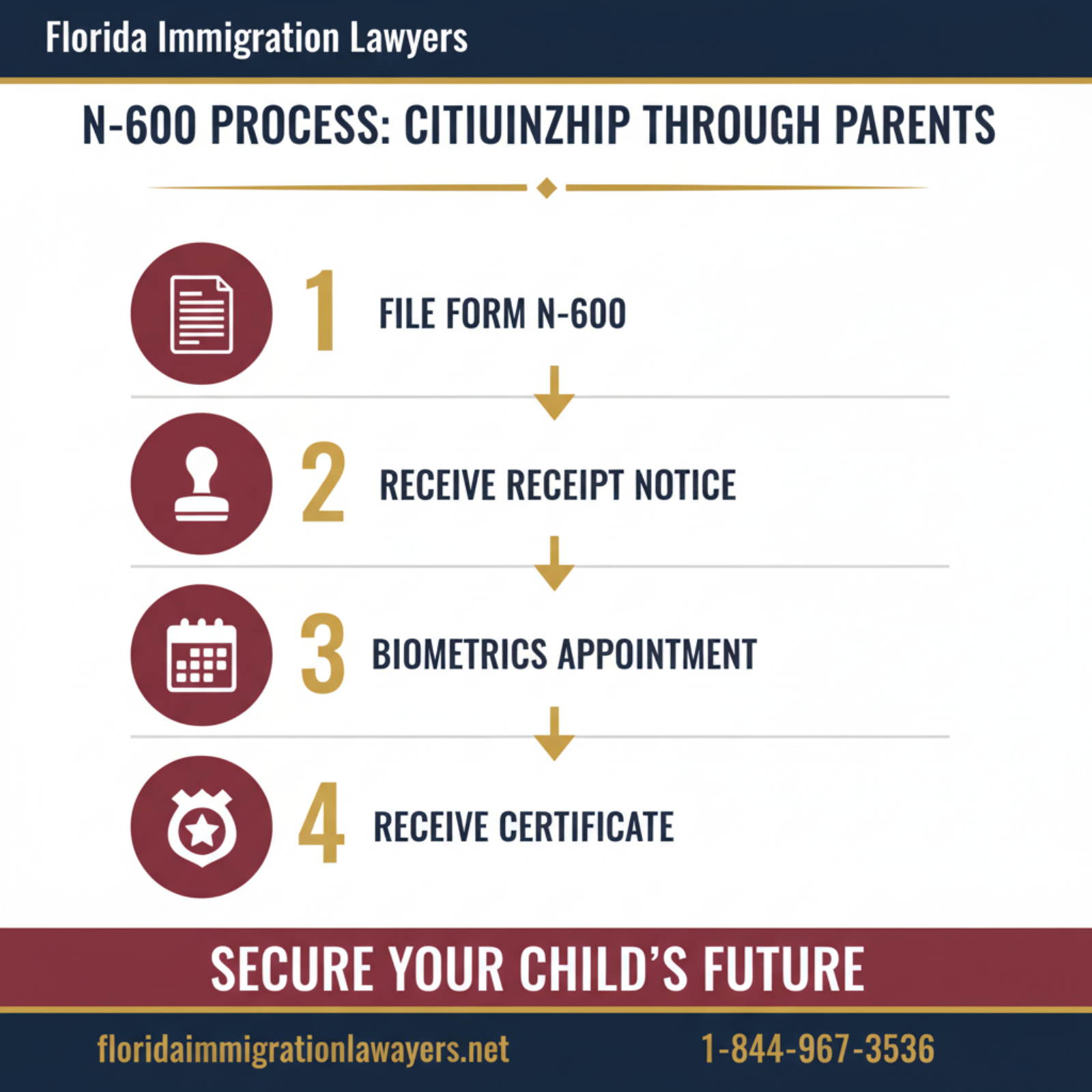
While derived citizenship is often automatic, official proof is crucial for travel and other benefits. The primary way to document derived citizenship Florida is by applying for a Certificate of Citizenship using Form N-600.
Here’s a general step-by-step guide for families in Gainesville and across Florida:
- Determine Eligibility: Review INA 320 or INA 322 criteria. Ensure your child meets all conditions before their 18th birthday.
- Gather Required Documents: Collect all necessary supporting documentation. Missing or incorrect documents can significantly delay your application. See checklist below.
- Complete Form N-600: Fill out Form N-600 accurately and completely. It requests detailed information about the child and U.S. citizen parent(s).
- Pay the Filing Fee: Submit the required USCIS filing fee. Always check the official USCIS website for Form N-600 for the current amount. Fee waivers may be available.
- Mail the Application Package: Send the completed Form N-600, all supporting documents, and the fee to the correct USCIS filing address.
- Attend Biometrics Appointment (if required): USCIS may require the child and/or U.S. citizen parent to attend a biometrics appointment for fingerprints, photos, and signature.
- Attend Interview (if required): Not all N-600 applications require an interview. USCIS may schedule one at a local field office (e.g., Miami, Orlando, Tampa).
- Receive Decision and Certificate: If approved, USCIS mails a Certificate of Citizenship. If denied, USCIS provides a reason, and you may appeal or refile.
This process can be intricate. Minor errors can lead to delays or denials. Our team at Florida Immigration Lawyers guides you through each step, ensuring your application for a Certificate of Citizenship N-600 is strong and accurate.
Essential Document Checklist for Derived Citizenship
Preparing accurate documents is paramount for a successful N-600 application. Here is a general checklist for derived citizenship Florida:
- Child's Birth Certificate: Original or certified copy.
- Child's Green Card (Form I-551): Copy of both sides.
- Parent's Proof of U.S. Citizenship: Birth Certificate, Certificate of Naturalization, Form FS-240, or U.S. Passport.
- Marriage Certificate of U.S. Citizen Parent(s): If applicable.
- Divorce Decrees or Death Certificates: For previous marriages of the U.S. citizen parent, if applicable.
- Evidence of Legal and Physical Custody: Court orders, school/medical records showing child resides with U.S. citizen parent.
- Proof of Child's Residence in the U.S.: School records, utility bills, etc.
- Passport-Style Photographs: Two identical color photographs of the child.
- Form N-600, Application for Certificate of Citizenship: Completed and signed.
- Filing Fee: Check current fee on USCIS website.
All foreign language documents must include a certified English translation. This list helps ensure you cover all bases when applying for parents citizenship for your child.
Timeline and Processing Expectations for N-600 Applications
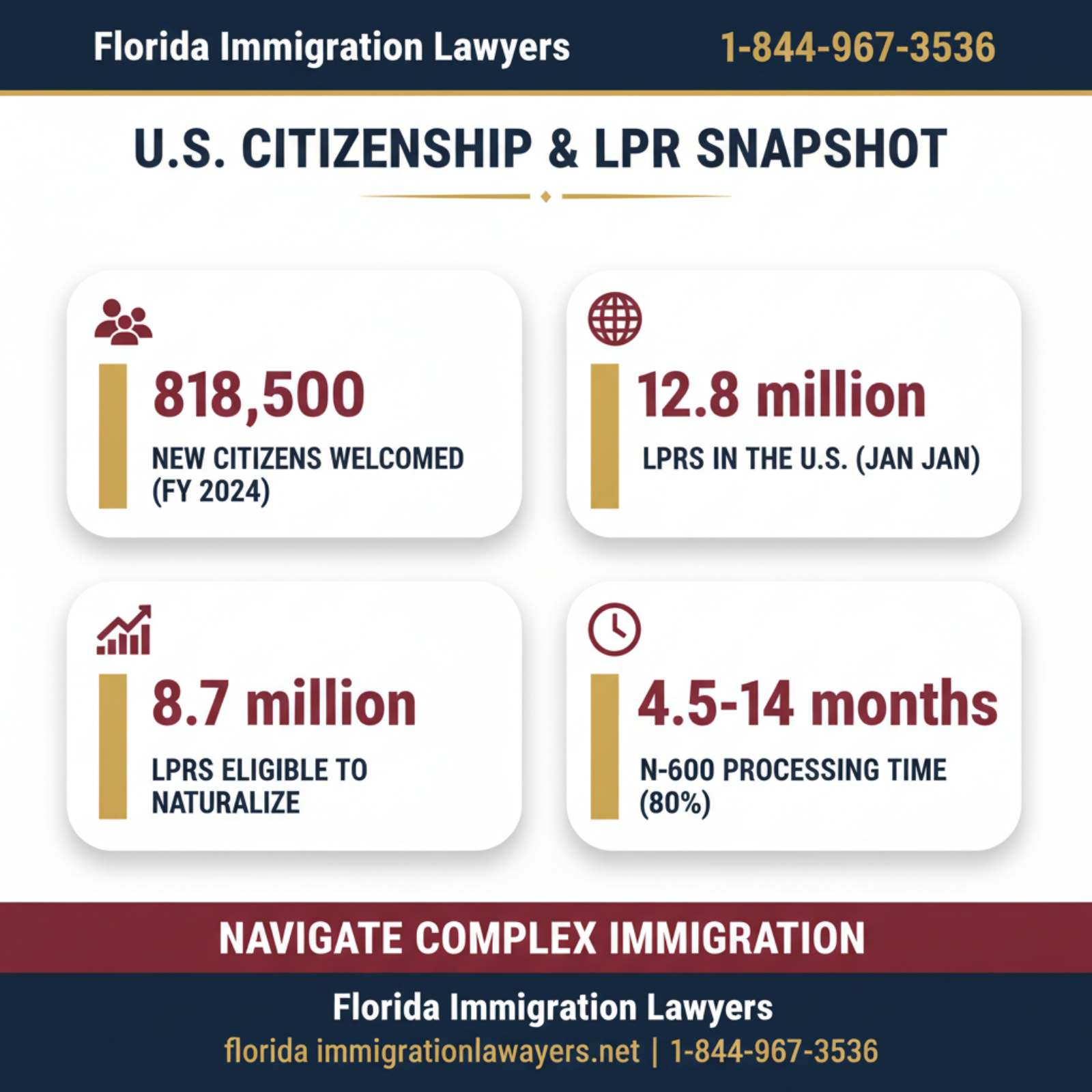
Processing time for Form N-600 varies significantly by USCIS office. For Florida applicants, times can range from several months to over a year. Factors include application volume, documentation accuracy, and interview requirements.
USCIS provides estimated processing times on its website, regularly updated. Check the USCIS processing times page for current information relevant to your local Florida office.
After filing, expect a receipt notice in weeks, then a biometrics appointment notice in months. If an interview is needed, you'll receive a notice. Patience is key, but legal assistance can help address delays.
Understanding these expectations reduces anxiety. Our firm assists families in Gainesville and throughout Florida in monitoring application status.
Cost Factors and Fee Breakdown for Derived Citizenship
Applying for a Certificate of Citizenship (Form N-600) involves fees. The primary cost is the USCIS filing fee. This fee is subject to change, so verify the current amount on the official USCIS website.
Other potential costs:
- Biometrics Fee: Confirm if a separate fee applies.
- Document Translation Fees: For non-English supporting documents.
- Photocopying and Mailing Costs: Minor administrative costs.
- Legal Fees: Cost of hiring an experienced immigration attorney. Legal representation improves efficiency and success, especially for complex cases involving born abroad children.
Florida Immigration Lawyers offers transparent fee structures. We discuss costs for your derived citizenship Florida case during your free consultation. Legal counsel saves time, stress, and potential re-filing costs.
Do not navigate this complex process alone. The nuances of immigration law, especially concerning derived citizenship, require expert attention. Contact Florida Immigration Lawyers today to schedule your consultation. We serve families across Florida, including Gainesville, with their critical immigration needs.
Common Mistakes to Avoid When Documenting Derived Citizenship
Navigating U.S. parents citizenship for your child can involve missteps. Avoiding common errors is crucial for a smooth derived citizenship Florida application. Here are frequent mistakes and their consequences:
-
Filing After the Child's 18th Birthday:
Consequence: Derived citizenship under INA 320 occurs automatically before age 18. Filing later typically requires naturalization, a longer process.
-
Incorrectly Assuming U.S. Citizen Parent Status:
Consequence: Lacking adequate proof of a U.S. citizen parent leads to denial. This is a fundamental requirement.
-
Lack of Lawful Permanent Resident (LPR) Status:
Consequence: The child must be an LPR. If not, the application will be denied, potentially jeopardizing their immigration status.
-
Failure to Prove Legal and Physical Custody:
Consequence: The child must reside in the U.S. in the legal and physical custody of the U.S. citizen parent. Insufficient documentation, especially for divorced parents, can lead to denial.
-
Incomplete or Inaccurate Form N-600:
Consequence: Errors or omissions result in RFEs, delays, or denial. Precision is key for the Certificate of Citizenship N-600.
-
Missing or Incorrect Supporting Documents:
Consequence: Failing to provide all required documents, or submitting uncertified copies/un-translated foreign documents, leads to RFEs or denial.
-
Not Understanding Acquisition vs. Derivation:
Consequence: Confusing rules for citizenship at birth abroad with derived citizenship can lead to filing the wrong application or misunderstanding eligibility.
-
Failure to Update USCIS on Address Changes:
Consequence: Missing important notices like biometrics appointments can lead to delays or application abandonment.
-
Not Consulting an Experienced Immigration Attorney:
Consequence: Navigating complex immigration laws without legal counsel increases risk of costly mistakes, delays, or denials. An attorney ensures proper documentation and representation.
When to Call Florida Immigration Lawyers for Derived Citizenship
While derived citizenship may seem straightforward, the N-600 application often benefits from legal expertise. Contact Florida Immigration Lawyers if any of these apply to your family in Gainesville or Florida:
- Complex Family Situations: Divorced parents, stepparents, or adopted children complicate legal and physical custody. Our family immigration attorneys clarify these.
- Uncertain Eligibility: Unsure if your child meets derived citizenship Florida criteria, especially regarding parental naturalization timing, child's age, or LPR status.
- Child Born Abroad to U.S. Citizen Father Only: Cases for children born out of wedlock to a U.S. citizen father and non-citizen mother may have additional INA 309 requirements.
- Previous Immigration Issues: Past immigration violations, criminal history, or other issues for child or parent can impact eligibility.
- Requests for Evidence (RFEs) or Notice of Intent to Deny (NOID): If USCIS sends an RFE or NOID, seek immediate legal counsel for effective response.
- Expedited Processing Needs: For urgent travel or employment needs, an attorney can assist in requesting expedited processing.
- General Guidance and Peace of Mind: Even in simple cases, expert review provides invaluable peace of mind and prevents costly errors.
Our firm specializes in citizenship and immigration matters. We understand laws governing parents citizenship and their application to children born abroad or residing in Florida. We help gather documentation, prepare applications, and represent you.
Do not risk your child's future. Our team ensures your Certificate of Citizenship N-600 application is handled with utmost care. We also offer deportation defense services for complex issues.
Frequently Asked Questions About Derived Citizenship in Florida
Are you automatically a U.S. citizen if your parent is a citizen?
Not always automatically at birth, especially if born abroad. If born outside the U.S. to a U.S. citizen parent, you might acquire citizenship at birth if specific parental residency requirements were met. If you became a lawful permanent resident (green card holder) and your parent was a U.S. citizen, you may have automatically derived citizenship before your 18th birthday under INA 320. Eligibility depends on age, parent's citizenship, and residence.
What is the 3-3-3 rule for citizenship?
The "3-3-3 rule" is not a formal legal term within U.S. immigration law. It might refer to an informal way some remember naturalization eligibility, like needing three years of LPR status if married to a U.S. citizen. For derived citizenship, the key is meeting specific criteria before age 18, not a "3-3-3" rule.
What are the drawbacks of birthright citizenship?
Birthright citizenship, based on the 14th Amendment, grants citizenship to nearly everyone born on U.S. soil. Critics argue it encourages illegal immigration. Supporters emphasize its historical importance for equality and integration. For children seeking derived citizenship, birthright citizenship is not directly applicable as they are born outside the U.S.
Which is the toughest citizenship to get?
The "toughest" citizenship is subjective, depending on individual circumstances and U.S. immigration history. Proving eligibility for asylum or seeking citizenship after a complex immigration history can be very challenging. For children, meeting specific criteria for derived citizenship or acquisition at birth is often straightforward if all conditions are met, but any deviation can make it challenging.
About Florida Immigration Lawyers
Florida Immigration Lawyers is a leading law firm providing exceptional legal services to immigrants and their families across Florida. From Gainesville to the Keys, our experienced attorneys navigate U.S. immigration law on your behalf.
We specialize in immigration services, including family-based petitions, employment visas, asylum claims, deportation defense, and naturalization. Our mission is to offer compassionate, effective, and results-driven legal representation, ensuring your rights are protected and goals met.
Why choose Florida Immigration Lawyers? Our firm stands out due to our deep understanding of federal immigration law and Florida's diverse immigrant communities. We pride ourselves on clear communication, personalized strategies, and unwavering advocacy. We offer free consultations and are available 24/7.
For expert legal assistance with derived citizenship Florida or any other immigration matter, contact us today. Our attorneys are ready to help. Visit our attorneys page to learn more.
Sources and References
- U.S. Citizenship and Immigration Services (USCIS)
- USCIS Form N-600, Application for Certificate of Citizenship
- USCIS Policy Manual, Volume 12, Part H - Citizenship and Naturalization
- U.S. Department of State - Consular Report of Birth Abroad (CRBA)
- 8 U.S.C. Chapter 12 - Immigration and Nationality Act (INA)
- INA Section 320 (8 U.S.C. § 1431) - Children born outside the United States and residing permanently in the United States; conditions for automatic citizenship
- INA Section 322 (8 U.S.C. § 1433) - Children born and residing outside the United States; conditions for application for certificate of citizenship
- INA Section 301 (8 U.S.C. § 1401) - Nationals and citizens of United States at birth
- INA Section 309 (8 U.S.C. § 1409) - Children born out of wedlock
This article provides general legal information and is not intended as legal advice. Every case is unique, and outcomes depend on specific facts and circumstances. Contact an attorney for advice about your particular situation.
Securing your child's future as a U.S. citizen is a vital step. Whether your child was born abroad or is a lawful permanent resident in Florida, understanding the path to derived citizenship is essential. Let Florida Immigration Lawyers be your trusted partner.
Do not hesitate to seek professional legal assistance. Our dedicated team provides the guidance and representation you need. Call Florida Immigration Lawyers at 1-844-967-3536 for a free consultation today. Se Habla Español - Estamos aquí para ayudarle.
No Navegue Este Proceso Solo
Nuestros abogados de inmigración con experiencia están listos para luchar por usted. Obtenga una consulta gratuita y confidencial hoy.
We Speak English
Preguntas Frecuentes
Florida Immigration Lawyers
Abogado de Inmigración | Fundador, Vasquez Law Firm
Veterano de la Fuerza Aérea de EE.UU. y abogado de inmigración con miles de casos resueltos. J.D., NCCU School of Law. Miembro de AILA. Admitido en los Circuitos 4.°, 5.° y 11.°
Disponible 24/7 - Consultas Gratis
Servicios legales relacionados
Nuestros abogados de inmigración en Florida pueden ayudarle con consulta gratis de inmigración, áreas de práctica de inmigración y servicios de inmigración familiar. Llame hoy al 1-844-967-3536 para una consulta gratuita.
Enlaces Relacionados
Temas Relacionados
Consulta Legal Gratuita
Discuta su caso con nuestros abogados experimentados. Estamos disponibles 24/7.
Artículos Relacionados
Entendiendo la Lotería de Visas de Diversidad en Florida
Descubra cómo la Lotería de Visas de Diversidad puede abrir puertas al sueño americano desde Pembroke Pines, Florida. Aprenda los pasos, evite errores comunes y entienda cuándo llamar a un abogado para obtener asistencia.
Certificación Visa U: Guía para Víctimas de Crímenes en Florida
Víctimas de crímenes en Florida que buscan la certificación de la Visa U necesitan apoyo policial. Conozca el Suplemento B del I-918 y contacte a nuestros
Florida PERM Labor Certification: Your Employer Green Card Guide
Navigating PERM Labor Certification in Florida? Get our expert guide on employer-sponsored green card steps, requirements, and strategies for success. Secure