I-601 Waiver Florida: Overcoming Inadmissibility for a New Life
Discover how the I-601 waiver can help you overcome grounds of inadmissibility and achieve your immigration goals in Florida. This comprehensive guide from Florida Immigration Lawyers covers eligibility, the step-by-step application process, essential documents, and what to expect in 2026. Learn about demonstrating extreme hardship to a qualifying relative and common mistakes to avoid. Our expert attorneys specialize in I-601 waivers for Florida residents, including those in Kissimmee, offering personalized legal guidance. Don't navigate this complex legal journey alone—contact us for a free consultation and secure your future in the Sunshine State.
An I-601 waiver, officially known as the Application for Waiver of Grounds of Inadmissibility, allows certain individuals who are otherwise ineligible to enter or remain in the United States to overcome specific legal barriers. This waiver is granted when an applicant can demonstrate extreme hardship to a qualifying U.S. citizen or lawful permanent resident relative if they are denied admission. It is a critical path for many seeking to reunite with family in Florida.
- Overcomes specific grounds of inadmissibility.
- Requires demonstration of extreme hardship to a qualifying relative.
- Applicable for both immigrants and non-immigrants.
- Complex process often benefits from legal guidance.
- Allows individuals to pursue a new life in the U.S., including Florida.
Dreaming of a new life in Florida, or perhaps reuniting with your loved ones in Kissimmee? For many, the path to immigration can be fraught with unexpected challenges, particularly when facing grounds of inadmissibility. These legal barriers can prevent you from obtaining a visa, adjusting your status, or even entering the United States.
Fortunately, immigration law provides mechanisms like the I-601 waiver, which can offer a lifeline to individuals facing such hurdles. This comprehensive guide from Florida Immigration Lawyers is designed to demystify the I-601 waiver process, specifically for those residing in or planning to move to Florida. We understand the anxieties and complexities involved, and our goal is to provide clear, actionable information.
Navigating the intricacies of U.S. immigration law requires precision and a deep understanding of legal requirements. Whether you are in Orlando, Tampa, Miami, or anywhere else in the Sunshine State, understanding the immigration waiver process is crucial. We will walk you through eligibility, application steps, required documents, and what to expect in 2026.
Before delving into the details, remember that every immigration case is unique. For personalized advice and to discuss your specific situation, we urge you to seek professional legal assistance. Call Florida Immigration Lawyers at 1-844-967-3536 for a free consultation. Our dedicated team is here to help you understand your options and pursue the best possible outcome.
Understanding the I-601 Waiver: Your Path to Overcoming Inadmissibility in Florida
The I-601 waiver, formally known as the Application for Waiver of Grounds of Inadmissibility, is a vital tool within the U.S. immigration system. It allows individuals who are found inadmissible to the United States to request forgiveness for certain violations or conditions that would otherwise prevent their entry or adjustment of status. This waiver is often a last resort for those hoping to stay in or come to Florida.
Inadmissibility can arise from a variety of situations, as outlined in Section 212(a) of the Immigration and Nationality Act (INA). Common grounds of inadmissibility include certain criminal offenses, prior immigration violations (such as unlawful presence), misrepresentations to immigration officials, or certain health-related issues. If you have been deemed inadmissible, an immigration waiver may be your only option.
To be eligible for an I-601 waiver, you generally must demonstrate that your denial of admission would result in extreme hardship to a qualifying relative. A qualifying relative is typically a U.S. citizen or lawful permanent resident spouse or parent. In some specific cases, a U.S. citizen or lawful permanent resident son or daughter may also qualify, depending on the ground of inadmissibility being waived.
Demonstrating extreme hardship is the cornerstone of a successful I-601 waiver application. This is a high legal standard, requiring compelling evidence that your qualifying relative would suffer significantly more than the usual separation or relocation difficulties. Factors considered include medical conditions, financial impact, psychological distress, educational disruption, and specific country conditions if the relative were to relocate.
Florida Immigration Lawyers has extensive experience assisting individuals throughout Florida, including Kissimmee, in preparing strong I-601 waiver petitions. We understand the specific challenges and opportunities within the state's diverse communities. Our attorneys can help you identify all applicable grounds of inadmissibility and strategize the most effective arguments for your case.
The I-601 Waiver Application Process: A Step-by-Step Guide for Florida Residents
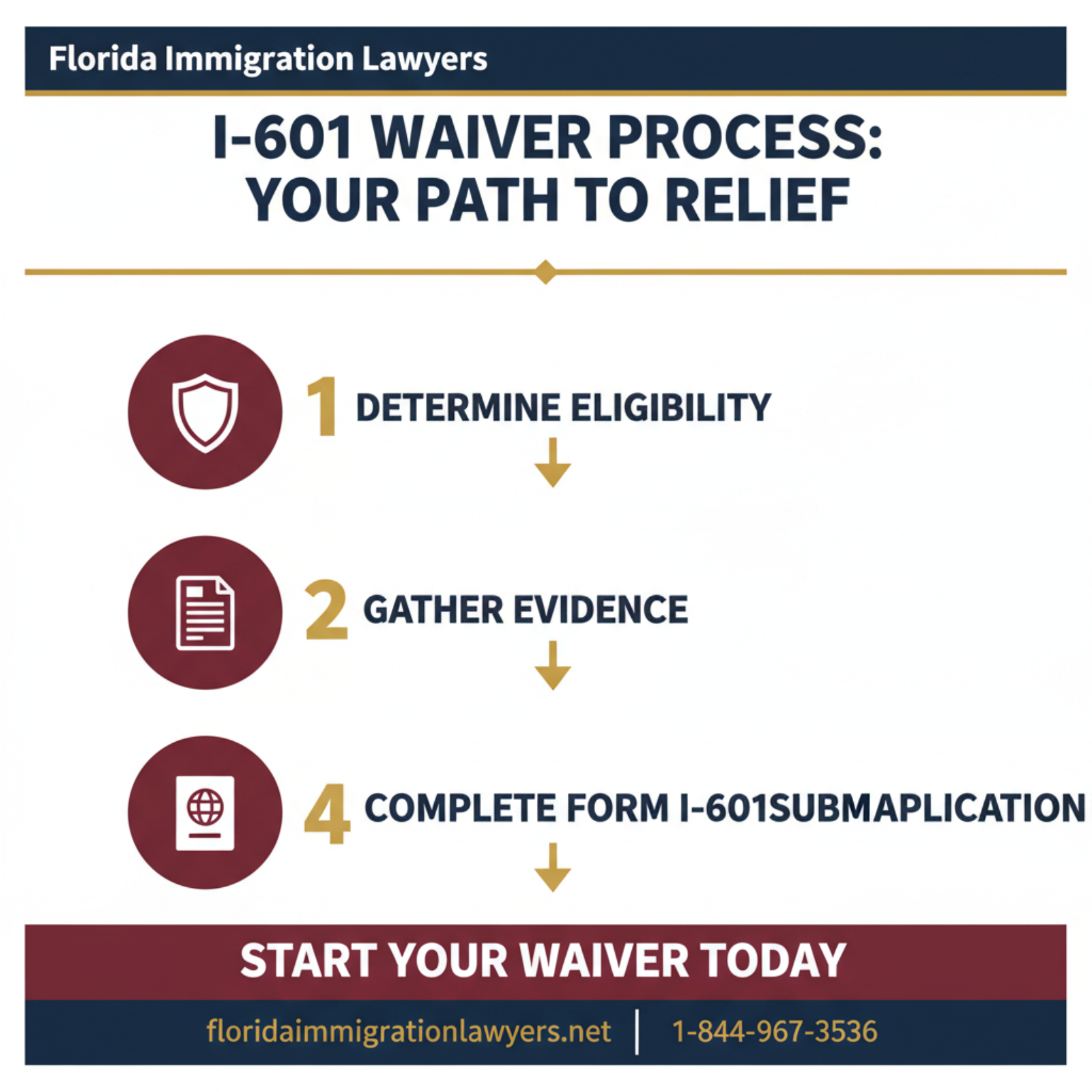
Applying for an I-601 waiver is a detailed and often lengthy process. Following each step meticulously is crucial for a successful outcome. Here is a general guide to help you understand the journey:
-
Determine Your Eligibility and Grounds of Inadmissibility: First, you must clearly identify why you are inadmissible to the United States. This could involve reviewing your immigration history, any prior arrests or convictions, and past interactions with immigration officials. Our firm can help you meticulously review your record to pinpoint all applicable grounds of inadmissibility, which is a critical first step for any immigration waiver.
-
Identify Your Qualifying Relative: You must have a U.S. citizen or lawful permanent resident spouse or parent who would suffer extreme hardship if your waiver is not approved. Confirm this relationship and their status. This relative will be central to your waiver application.
-
Gather Comprehensive Evidence of Extreme Hardship: This is arguably the most critical part of your application. You need to collect extensive documentation proving that your qualifying relative would face exceptional and unusual suffering. This evidence can include medical records, psychological evaluations, financial statements, employment letters, educational records, and country condition reports. The more compelling and well-documented your evidence, the stronger your case for the I-601 waiver.
-
Complete Form I-601, Application for Waiver of Grounds of Inadmissibility: Fill out the form accurately and completely. Any errors or omissions can lead to delays or even denial. Ensure all sections are addressed, providing detailed explanations where necessary. This form is available on the USCIS website.
-
Pay the Required Filing Fees: USCIS charges a fee for processing the I-601 waiver. Ensure you pay the correct amount, which is subject to change. Fee waivers may be available in limited circumstances, but generally, the fee must be paid at the time of filing. Always check the USCIS website for the most current fee information.
-
File Your Application: The filing location for Form I-601 depends on your specific immigration process. If you are applying from outside the U.S. as part of consular processing, you will typically file the I-601 with USCIS after an interview at a U.S. embassy or consulate. If you are adjusting status within the U.S., you might file it with your adjustment application or as requested by USCIS. Our team can clarify the correct filing procedure for your situation in Florida.
-
Attend Biometrics Appointment and Interview (If Required): USCIS may require you to attend a biometrics appointment for fingerprints and photos. In some cases, you might also be called for an interview to discuss your application and the evidence of hardship. Preparing thoroughly for any interview is essential.
-
Receive a Decision: After review, USCIS will issue a decision. If approved, you can proceed with your immigration process. If denied, you may have options to appeal or refile, depending on the reasons for denial. An experienced attorney from Florida Immigration Lawyers can help you understand your options following a decision.
Essential Documents for Your I-601 Waiver Application
A well-prepared I-601 waiver application relies heavily on comprehensive and persuasive documentation. Missing or insufficient evidence can significantly jeopardize your case. Here is a checklist of typical documents you will need to gather:
- Form I-601, Application for Waiver of Grounds of Inadmissibility: The completed and signed form itself.
- Proof of Qualifying Relationship: Marriage certificates, birth certificates, adoption decrees demonstrating your relationship to the U.S. citizen or lawful permanent resident spouse or parent.
- Evidence of Qualifying Relative's U.S. Citizenship or LPR Status: Copy of birth certificate, U.S. passport, Certificate of Naturalization, or Green Card (Form I-551).
- Detailed Personal Statement from Applicant: A letter explaining your situation, the reasons for your inadmissibility, and why you believe the waiver should be granted.
- Detailed Personal Statement from Qualifying Relative: A letter describing the extreme hardship they would face if you are denied admission. This should be deeply personal and specific.
- Medical Records: If the hardship is health-related, provide diagnoses, treatment plans, prognoses, and statements from doctors.
- Psychological Evaluations: Assessments from licensed therapists or psychologists detailing mental health impacts on the qualifying relative due to separation or relocation.
- Financial Records: Bank statements, tax returns, pay stubs, mortgage statements, utility bills, and evidence of debts to show financial dependence or burdens.
- Employment Documentation: Letters from employers, proof of income, and evidence of job loss risk if the qualifying relative must relocate.
- Educational Records: Proof of enrollment, transcripts, and letters from schools if children's education would be severely disrupted.
- Country Conditions Reports: Objective evidence of dangerous or difficult living conditions in the applicant's home country if the qualifying relative were to move there. This can be sourced from government reports or human rights organizations.
- Affidavits from Friends, Family, and Community Members: Letters from individuals who can attest to the qualifying relative's reliance on you and the potential hardship they would face.
- Police Records and Court Dispositions: If inadmissibility is due to criminal history, provide certified copies of all arrest records and court outcomes.
- Any Previous Immigration Applications or Decisions: Copies of previous visa applications, denials, or other relevant immigration documents.
- Translations: Any document not in English must be accompanied by a certified English translation. See USCIS Policy Manual, Volume 1, Part B, Chapter 2.
Organizing these documents can be overwhelming. Florida Immigration Lawyers can assist you in compiling a strong, evidence-based package, ensuring that your florida inadmissibility case is presented effectively. We understand the nuances of what USCIS considers compelling evidence for extreme hardship.
I-601 Waiver Processing Times & Expectations for 2026 in Florida
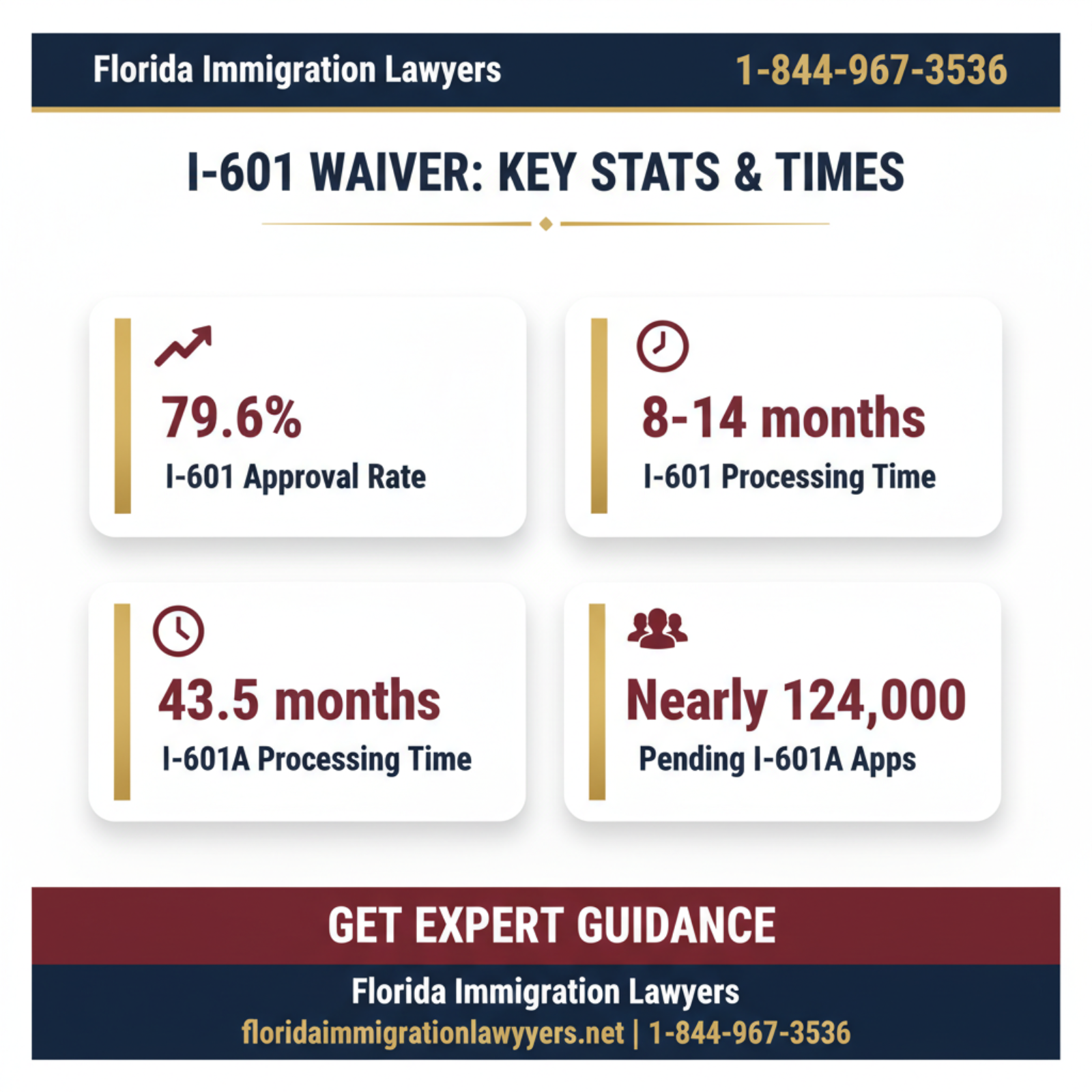
The processing time for an I-601 waiver can vary significantly depending on several factors. These include the specific USCIS service center handling your case, the complexity of your application, the volume of petitions USCIS is receiving, and whether additional evidence or an interview is required. As of 2026, applicants should continue to anticipate varying timelines.
Generally, I-601 waiver processing can take anywhere from several months to over a year. While USCIS provides online processing time estimates, these are averages and not guarantees. It is important to remember that these times are subject to change and can fluctuate without prior notice. Patience is key throughout this process.
Factors that can influence your processing time include the thoroughness of your initial submission – a complete, well-organized application with strong evidence is less likely to face requests for additional evidence (RFEs), which can cause significant delays. Responding promptly and comprehensively to any USCIS requests is also crucial. For those in Kissimmee and other Florida areas, your application will be routed to the appropriate service center based on USCIS guidelines.
You can check the status of your I-601 waiver application online using the receipt number provided by USCIS after they accept your petition. This online tool allows you to track significant milestones in your case. While our firm cannot control USCIS processing times, we can ensure your application is submitted correctly and advocate on your behalf.
Cost Factors and Fees Associated with the I-601 Waiver
Understanding the potential costs involved in an I-601 waiver application is an important part of your planning. There are several categories of expenses you should anticipate:
-
USCIS Filing Fee: U.S. Citizenship and Immigration Services charges a non-refundable fee for filing Form I-601. This fee is subject to change, so always check the official USCIS website for the most current amount before filing. USCIS does not guarantee a fee waiver for the I-601 in most cases.
-
Attorney Fees: Legal fees for assistance with an immigration waiver vary widely based on the complexity of your case, the attorney's experience, and the services provided. While hiring an attorney is an additional cost, the expertise can be invaluable in preparing a strong application and avoiding costly mistakes. Florida Immigration Lawyers offers transparent fee structures and discusses all costs upfront during your free consultation.
-
Document Preparation Costs: This can include fees for obtaining certified copies of birth certificates, marriage licenses, police records, court documents, and medical records. These costs can add up, especially if documents are needed from multiple sources.
-
Translation Services: If any of your supporting documents are not in English, you will need to pay for certified translations. This is a mandatory requirement for USCIS submissions.
-
Psychological Evaluations/Medical Exams: If your claim of extreme hardship involves psychological or medical conditions, you may incur costs for evaluations or examinations by licensed professionals. These reports are often crucial evidence.
Key Statistics & Data -
Travel and Miscellaneous Expenses: You might incur costs for travel to interviews, biometrics appointments, or to meet with your attorney. Postage and courier services for mailing your application also contribute to the overall expenses.
While the overall cost can seem daunting, consider it an investment in your future and your family's unity in Florida. A well-prepared application, often facilitated by legal counsel, can save you time, stress, and potential re-filing fees in the long run.
Do not navigate this complex process alone. The stakes are too high to risk errors that could jeopardize your future in Florida. Contact Florida Immigration Lawyers today for expert guidance and support every step of the way.
Common Mistakes to Avoid When Filing Your I-601 Waiver
The I-601 waiver process is notoriously complex, and even minor errors can lead to significant delays or outright denial. Understanding and avoiding common pitfalls is essential for a successful outcome. Here are some of the most frequent mistakes applicants make:
-
Failing to Identify All Grounds of Inadmissibility: Many applicants only address one obvious ground, missing others that USCIS may uncover. If you don't waive all applicable grounds, your application will be denied. A thorough legal review is critical to ensure all bases of florida inadmissibility are addressed.
-
Insufficient Evidence of Extreme Hardship: This is the most common reason for denial. Applicants often submit general statements rather than specific, compelling, and well-documented proof of severe suffering to the qualifying relative. The evidence must go beyond typical separation difficulties.
-
Not Having a Qualifying Relative: The I-601 waiver generally requires a U.S. citizen or lawful permanent resident spouse or parent to demonstrate extreme hardship. Some mistakenly believe a U.S. citizen child is sufficient for most grounds, which is often not the case under INA 212(h) or other sections.
-
Incomplete or Inaccurate Application Forms: Any missing information, incorrect dates, or unanswered questions on Form I-601 can lead to a Request for Evidence (RFE) or outright denial. Double-check every field for accuracy.
-
Submitting Poor Quality or Uncertified Translations: All foreign language documents must be accompanied by a complete and accurate English translation, certified by the translator. Uncertified or poorly translated documents will not be accepted.
-
Missing Deadlines or Filing in the Wrong Place: Strict deadlines apply, and filing locations vary depending on your specific immigration process (e.g., consular processing versus adjustment of status). Missing a deadline or sending your application to the wrong address can have severe consequences.
-
Not Addressing Rehabilitation (for criminal grounds): If your inadmissibility is due to criminal offenses, you often need to demonstrate rehabilitation and positive contributions to society, in addition to extreme hardship. Simply stating you regret past actions is usually not enough.
-
Overlapping with I-601A Provisional Waiver: The I-601 and I-601A waivers serve different purposes. The I-601A is for unlawful presence only and is filed from within the U.S. before departing for a consular interview. Confusing the two can lead to significant processing delays or denials. Ensure you are filing the correct immigration waiver for your situation.
-
Failing to Keep Copies of Everything: Always retain complete copies of your submitted application, all supporting documents, and any correspondence with USCIS. This is crucial for your records and for addressing any future inquiries.
-
Not Seeking Legal Counsel: Attempting to navigate the I-601 waiver process without an experienced immigration attorney significantly increases the risk of errors and denial. An attorney can identify all grounds of inadmissibility, help gather compelling evidence, and present your case effectively.
When to Call Florida Immigration Lawyers for Your I-601 Waiver Case
While this guide provides a comprehensive overview, the complexities of the I-601 waiver process often necessitate professional legal assistance. Knowing when to engage an attorney can be the difference between approval and denial, securing your future in Florida. Florida Immigration Lawyers are here to help you.
You should consider contacting our firm immediately if any of the following scenarios apply to you:
-
Complex Grounds of Inadmissibility: If your inadmissibility involves multiple issues, serious criminal history, or intricate immigration violations, a lawyer can help dissect the legal challenges and formulate a robust strategy. We have extensive experience with immigration cases.
-
Difficulty Proving Extreme Hardship: If you are struggling to gather sufficient evidence or articulate how your qualifying relative would face truly exceptional suffering, our attorneys can guide you in building a compelling narrative supported by strong documentation.
-
Previous Denials or Immigration Issues: If you have had previous waiver applications denied, or if you are currently in deportation proceedings, legal counsel is essential to assess your options and improve your chances of success.
-
Uncertainty About Which Waiver to File: Distinguishing between the I-601 and I-601A waivers, or other types of family immigration waivers, can be confusing. An attorney will ensure you file the correct application for your specific situation.
-
Need for Strategic Advice: An immigration attorney can provide strategic advice on the best timing for your application, how to present sensitive information, and anticipate potential challenges from USCIS. Our attorneys are well-versed in immigration law.
-
Language Barriers or Limited Understanding of Legal Jargon: If English is not your first language, or if you find legal terminology daunting, an attorney can explain the process clearly and ensure all communications and documents are accurately handled.
Our team at Florida Immigration Lawyers serves clients across Florida, including the Kissimmee area, and is dedicated to providing compassionate and effective legal representation. We understand the profound impact an I-601 waiver can have on your life and your family's future. Do not hesitate to reach out for professional support.
About Florida Immigration Lawyers
Florida Immigration Lawyers is a leading immigration law firm dedicated to serving individuals and families throughout the entire state of Florida. With a deep understanding of U.S. immigration laws and a passion for helping people achieve their American dreams, our firm offers comprehensive legal services tailored to your unique needs.
Our experienced attorneys specialize in a wide range of immigration matters, including family-based visas, employment immigration, deportation defense, asylum, citizenship, and waivers of inadmissibility like the I-601 waiver. We are committed to providing zealous advocacy and personalized attention to every client.
Why choose Florida Immigration Lawyers? Our firm stands out due to our unwavering commitment to client success, our empathetic approach, and our proven track record. We pride ourselves on clear communication, transparent processes, and making complex legal concepts understandable. Your journey is our priority, and we work tirelessly to achieve the best possible outcomes for you and your family.
We offer free, confidential consultations to discuss your immigration needs. Our team is available 24/7 to answer your questions and provide the support you deserve. Contact us today to learn how we can assist you with your I-601 waiver or any other immigration challenge. Your future in Florida starts here.
Phone: 1-844-967-3536
Website: https://www.floridaimmigrationlawyers.net
Sources and References
- U.S. Citizenship and Immigration Services (USCIS) - Form I-601
- USCIS Policy Manual - Volume 9, Part F, Chapter 3 (I-601 Waivers)
- Executive Office for Immigration Review (EOIR) - Virtual Law Library
- Immigration and Nationality Act (INA) Section 212(a) - Grounds of Inadmissibility
- Immigration and Nationality Act (INA) Section 212(h) - Waiver for Criminal and Related Grounds
- 8 U.S. Code § 1182 - Inadmissible aliens
- 8 CFR § 212.7 - Applications for waiver of grounds of inadmissibility
This article provides general legal information and is not intended as legal advice. Every case is unique, and outcomes depend on specific facts and circumstances. Contact an attorney for advice about your particular situation.
Securing an I-601 waiver can be a life-changing opportunity, allowing you to overcome significant legal barriers and build a secure future in Florida. While the process is challenging, you do not have to face it alone. Our dedicated team at Florida Immigration Lawyers is ready to provide the compassionate and expert legal representation you need.
Do not let grounds of inadmissibility stand in the way of your dreams. Take the first step towards a brighter future by contacting us today for a free consultation. We are here to guide you through every stage of your immigration waiver process with diligence and care.
Call Florida Immigration Lawyers at 1-844-967-3536 for your free consultation. Se Habla Español - Estamos aquí para ayudarle.
Florida Immigration Lawyers
Legal Team
Our experienced attorneys at Florida Immigration Lawyers have been serving clients across Florida for over 20 years. We specialize in immigration, personal injury, criminal defense, workers compensation, and family law.