Asylum Application Florida: Navigating the I-589 Process in 2026
Navigating the asylum application process in Florida requires a deep understanding of U.S. immigration laws, particularly Form I-589. This comprehensive guide details the step-by-step process for affirmative asylum, from the crucial one-year filing deadline to the biometrics appointment, the asylum interview with USCIS, and the final decision. We also cover essential documents, expected timelines, and cost factors, emphasizing that while Form I-589 itself has no filing fee, other related expenses exist. Learn to avoid common mistakes that can jeopardize your case and understand when professional legal assistance from Florida Immigration Lawyers is indispensable. Our firm is dedicated to providing empathetic, expert guidance for those seeking protection in Florida. Contact us for a free consultation to secure your future.
Applying for asylum in Florida involves demonstrating a well-founded fear of persecution in your home country based on race, religion, nationality, particular social group, or political opinion. The process typically starts with filing Form I-589, followed by an interview with USCIS. Seeking legal guidance from experienced attorneys is crucial to navigate this complex legal journey effectively.
- File Form I-589 within one year of your last arrival to the U.S.
- Attend a USCIS asylum interview to present your case.
- Demonstrate a well-founded fear of persecution.
- Consult an immigration lawyer for expert assistance.
- Understand the difference between affirmative and defensive asylum.
Asylum Application Florida: Navigating the I-589 Process in 2026
Imagine living in fear, where returning home means facing danger because of who you are, what you believe, or where you come from. For many individuals and families seeking safety, the United States offers a beacon of hope through its asylum laws. If you are in Florida and considering applying for asylum, understanding the intricate legal process is your first critical step towards securing your future.
This comprehensive guide will walk you through the asylum application process in Florida, focusing on Form I-589, eligibility requirements, and what to expect in 2026. We understand the challenges you face, and our goal is to provide clear, actionable information. We will cover everything from initial filing to interview preparation and potential outcomes.
Navigating the complexities of U.S. immigration law, especially for asylum, can be overwhelming. Do not face this journey alone. Call Florida Immigration Lawyers at 1-844-967-3536 for a free consultation. Our dedicated team is here to provide the expert legal guidance you need.
Understanding Asylum in Florida: An Overview
Asylum offers protection to individuals already in the United States who meet the definition of a refugee. This means you must prove a well-founded fear of persecution in your home country. The persecution must be based on one of five protected grounds: race, religion, nationality, membership in a particular social group, or political opinion.
Florida, with its diverse population and international connections, is a common destination for those seeking refuge. Understanding the specific requirements and procedures is vital for anyone considering an asylum application Florida residents can pursue.
What is Asylum and Who Qualifies?
Asylum status allows you to remain in the U.S. and eventually apply for lawful permanent residency. To qualify, you must demonstrate past persecution or a well-founded fear of future persecution. This fear must be objectively reasonable and subjectively genuine.
The U.S. Citizenship and Immigration Services (USCIS) evaluates each case individually. They consider the conditions in your home country and the specific threats you face. Eligibility is not automatic and requires substantial evidence and testimony.
Affirmative vs. Defensive Asylum Applications
There are two primary ways to seek asylum in the United States. The path you take depends on your current immigration status.
- Affirmative Asylum: You apply for asylum proactively with USCIS. This happens when you are not currently in removal proceedings. You typically file Form I-589 directly with USCIS. Most cases in Florida begin this way.
- Defensive Asylum: You apply for asylum as a defense against deportation. This occurs when you are already in removal proceedings before an immigration judge. Your I-589 application is filed with the Executive Office for Immigration Review (EOIR) through the immigration court system.
Both processes require meticulous preparation and adherence to strict deadlines. Understanding which path applies to your situation is crucial. Our firm assists clients with both affirmative and defensive asylum cases.
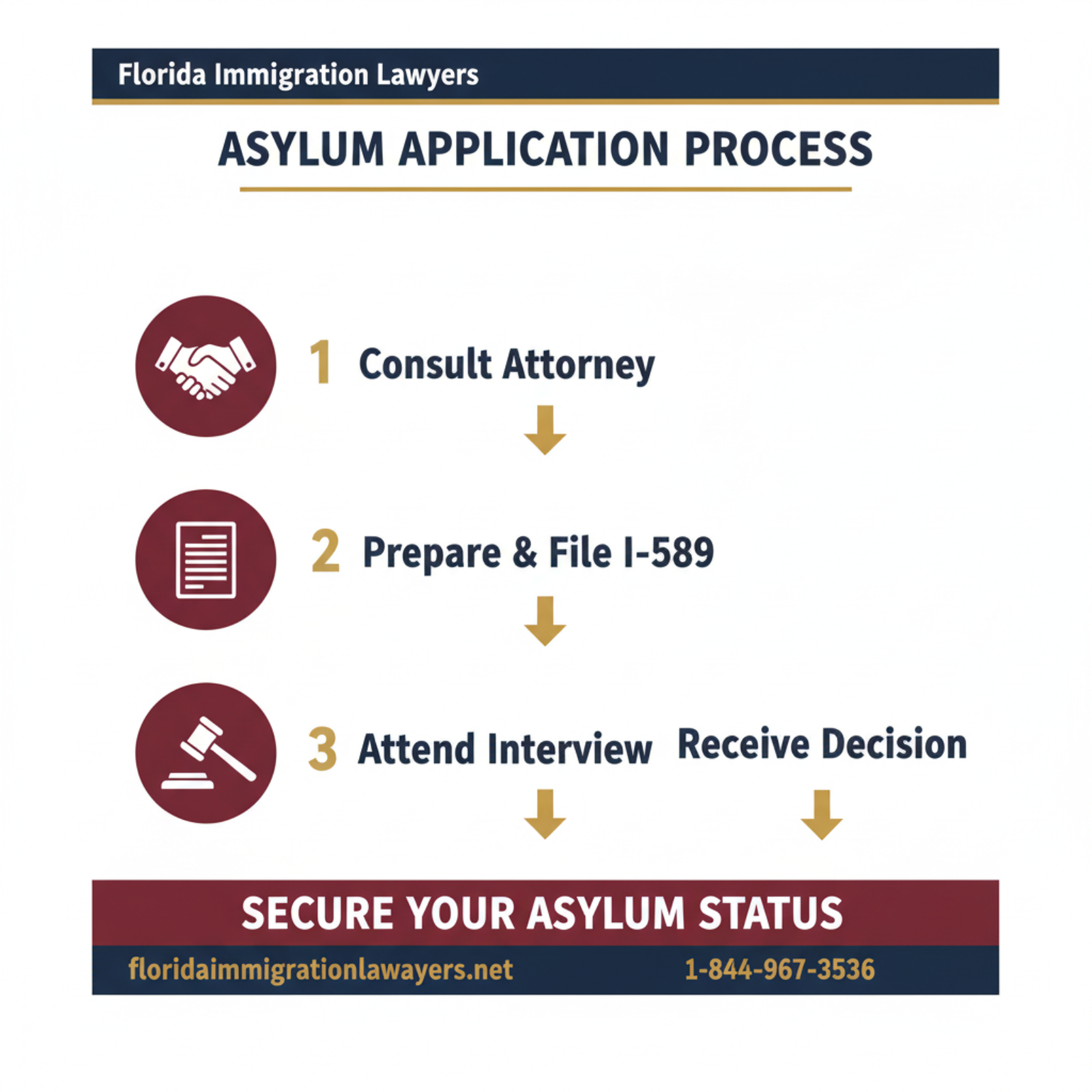
The Affirmative Asylum Application Process in Florida (Step-by-Step Guide)
The affirmative asylum application Florida process involves several key stages. Each step requires careful attention to detail and timely action. Missing deadlines or submitting incomplete information can severely jeopardize your case.
-
Step 1: Arriving in the U.S. and the One-Year Filing Deadline
Generally, you must file your Form I-589, Application for Asylum and for Withholding of Removal, within one year of your last arrival in the United States. This is a critical deadline, and exceptions are rare. If you missed this deadline, you must prove changed circumstances or extraordinary circumstances directly related to the delay. This is a very high bar to meet.
It is vital to consult with an attorney immediately upon arrival or as soon as possible if you believe you qualify for asylum. Our firm can help assess your eligibility and adherence to this strict timeline. See USCIS.gov for more details on this requirement.
-
Step 2: Preparing and Filing Form I-589
Form I-589 is the cornerstone of your asylum application. This detailed form requires extensive personal information, family history, and a thorough explanation of your fear of persecution. You must clearly articulate how you meet the definition of a refugee based on one of the five protected grounds.
Along with the form, you will submit supporting documents. These include identification, travel documents, and any evidence corroborating your claim. This is not a form to be filled out lightly; every detail matters. There is no filing fee for Form I-589 itself.
-
Step 3: Biometrics Appointment
After filing your I-589, USCIS will send you a notice for a biometrics appointment. This involves fingerprinting, photographs, and a signature collection. This information is used for background and security checks. It is a mandatory step in the process.
You must attend this appointment. Failure to do so without a valid reason may lead to the denial of your application or referral to an immigration judge. Ensure your contact information with USCIS is always up-to-date.
-
Step 4: Asylum Interview with USCIS
Once your background checks are complete, you will typically receive a notice for an asylum interview. This interview is conducted by an Asylum Officer from USCIS. In Florida, interviews may take place at offices like the USCIS Asylum Office in Miami.
During the interview, the Asylum Officer will ask detailed questions about your Form I-589 and your claim of persecution. You have the right to have an attorney present with you at this interview. Your lawyer can clarify questions, object to inappropriate inquiries, and ensure your rights are protected. This interview is a crucial step for your case.
-
Step 5: Decision and Next Steps
After the interview, the Asylum Officer will make a recommendation. If your application is approved, you will be granted asylum status. This means you can live and work in the U.S., and after one year, apply for a Green Card.
If your application is not approved by USCIS, and you are not in lawful status, your case will generally be referred to an immigration judge for defensive asylum proceedings. This means your case will move to the immigration court system, where you will have another opportunity to present your case. If you are in lawful status and denied, your case may simply be denied without referral to court.
Essential Documents for Your I-589 Asylum Application
A well-prepared I-589 application includes a comprehensive set of supporting documents. These documents are crucial for corroborating your testimony and strengthening your claim of persecution. Gathering these materials carefully is a key part of the process.
Here is a general checklist of documents you should consider including:
- Form I-589: The completed and signed Application for Asylum and for Withholding of Removal.
- Copies of Identity Documents: Passport, birth certificate, national identity card, visa, I-94 arrival/departure record. Include copies for yourself and any family members included on your application.
- Photographs: Passport-style photos for each applicant.
- Personal Statement/Declaration: A detailed narrative explaining your fear of persecution, including specific incidents, dates, locations, and individuals involved. This is often the most critical piece of evidence.
- Evidence of Persecution:
- Police reports, medical records, hospital records, or other official documents detailing harm you suffered.
- Newspaper articles, human rights reports, or country condition reports from reputable organizations (e.g., U.S. State Department, Amnesty International, Human Rights Watch) demonstrating general conditions in your home country and risk to people like you.
- Statements from witnesses who can corroborate your story.
- Proof of your membership in a protected group (e.g., religious affiliation documents, political party membership cards, evidence of sexual orientation/gender identity).
Step-by-Step Process Guide - Marriage Certificate and Birth Certificates: If including a spouse or children in your application.
- Translation of Documents: Any document not in English must be accompanied by a certified English translation. The translator must certify that they are competent to translate and that the translation is accurate.
Our firm helps clients in Pembroke Pines and across Florida organize and present their evidence effectively. We ensure your documentation is thorough and persuasive.
Understanding Asylum Timelines and Processing Expectations in Florida
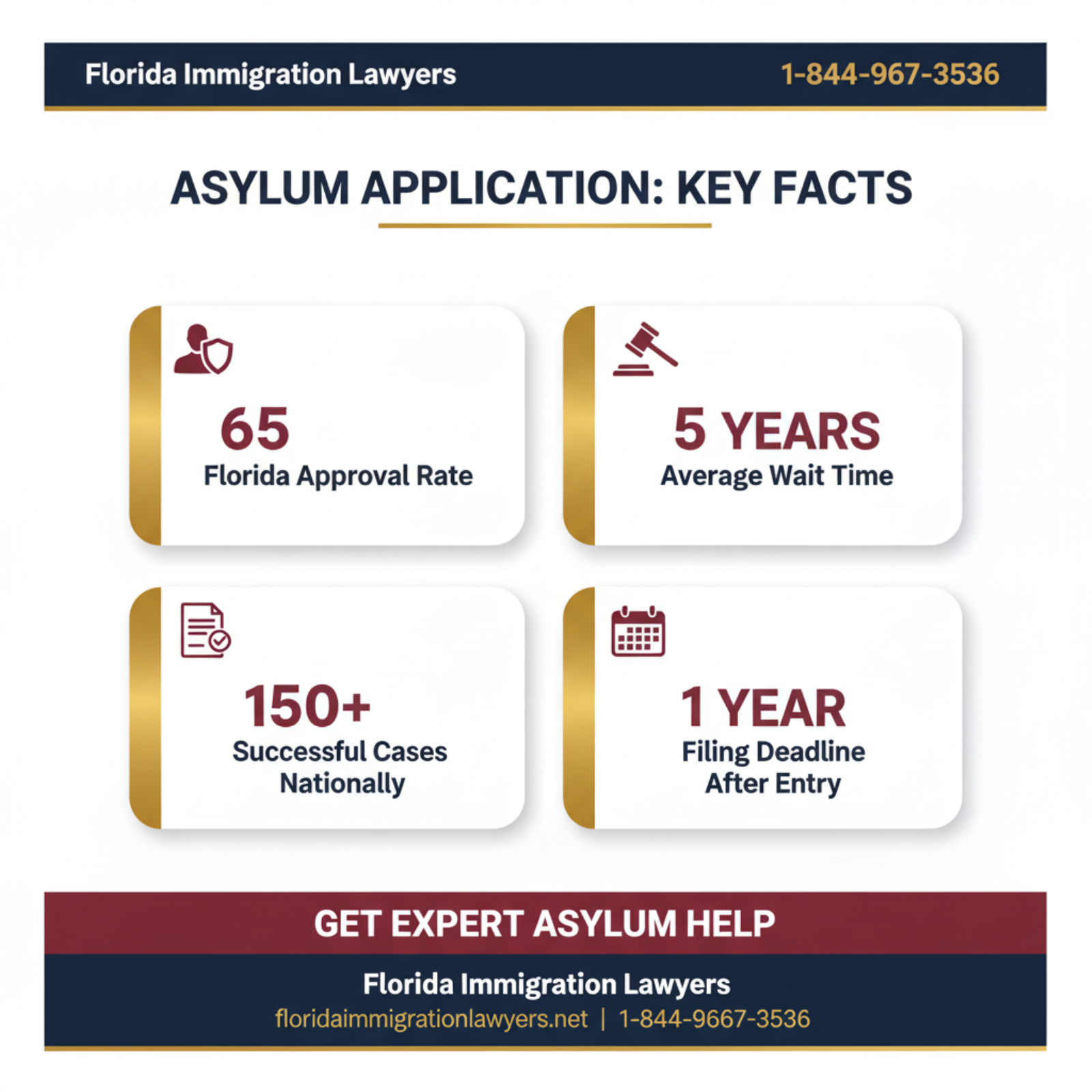
One of the most common questions asylum seekers have is, "How long does it take for asylum to be approved?" The answer is complex, as processing times can vary significantly. Factors influencing the timeline include the volume of applications, staffing levels at USCIS, and the complexity of individual cases.
Historically, asylum cases could take several years to process. While USCIS has implemented a "last in, first out" interview scheduling policy for affirmative asylum cases (prioritizing newer filings), a significant backlog still exists. This means some applicants might wait for a long time for an interview.
Typical Processing Stages and Durations
- I-589 Filing to Biometrics: Typically a few weeks to a few months after filing.
- Biometrics to Interview Notice: This is where the longest delays often occur. It can range from several months to several years, especially for older cases filed before the "last in, first out" policy.
- Interview to Decision: USCIS aims to issue a decision within a reasonable time after the interview, often within a few weeks to a few months. However, some cases may be "held" for further review or security checks.
During these waiting periods, you may be eligible to apply for an Employment Authorization Document (EAD), also known as a work permit, after your I-589 application has been pending for at least 150 days and is not subject to any delays caused by you. This allows you to legally work in the U.S. while your asylum case is pending.
The Miami Asylum Office, which serves much of Florida, has a substantial caseload. This can contribute to longer wait times compared to some other regions. Staying informed and prepared for potential delays is essential.
Cost Factors and Fee Breakdown for Asylum Applications
When pursuing an asylum application Florida residents must consider various potential costs. It is important to clarify that there is no filing fee for Form I-589, Application for Asylum and for Withholding of Removal, itself. This is a deliberate policy to ensure access to protection for those fleeing persecution.
However, while the application itself is free, there are other expenses that you should anticipate. These costs can add up, and planning for them is a practical step in your journey.
Potential Expenses to Budget For:
- Legal Fees: This is often the most significant cost. Hiring an experienced immigration attorney is highly recommended for asylum cases due to their complexity. Legal fees vary based on the attorney's experience, the complexity of your case, and the services provided (e.g., preparing the I-589, gathering evidence, interview preparation, representation at interview, court appearances).
- Translation Costs: Any document not in English must be translated by a certified translator. The cost depends on the volume and complexity of the documents.
- Document Gathering Fees: You might incur costs for obtaining official documents from your home country, such as birth certificates, marriage certificates, or police reports.
- Medical Examinations: If you are granted asylum and later apply for a Green Card (Form I-485), you will need a medical examination by a USCIS-approved civil surgeon. These fees vary by provider.
- Travel Expenses: You will need to travel to your biometrics appointment and your asylum interview. For residents of Pembroke Pines, this might involve travel to the Miami Asylum Office.
- Postage and Copying: Basic administrative costs for mailing your application and making copies of all documents for your records.
- Employment Authorization Document (EAD) Fee: While there's no fee for the I-589, if you apply for a work permit (Form I-765) based on your pending asylum application, there is typically a filing fee for the EAD (though fee waivers may be available for certain low-income applicants).
Investing in legal representation can significantly increase your chances of a successful outcome. Our firm, Florida Immigration Lawyers, offers transparent fee structures and can discuss payment options during your free consultation. We believe that everyone deserves competent legal assistance.
Do not navigate this complex and life-altering process alone. The stakes are too high to risk common mistakes or misunderstandings. Contact Florida Immigration Lawyers today at 1-844-967-3536 for a free consultation. Our experienced asylum attorneys are ready to provide the dedicated support you need.
Common Mistakes to Avoid in Your Florida Asylum Application
The asylum application Florida process is fraught with potential pitfalls. Even small errors can lead to significant delays, denials, or even referral to immigration court. Being aware of these common mistakes can help you protect your case and improve your chances of success.
-
Missing the One-Year Filing Deadline
This is arguably the most critical mistake. Failing to file your I-589 within one year of your last arrival to the U.S. usually bars you from applying for asylum, unless you can prove extraordinary or changed circumstances. These exceptions are very narrowly interpreted by USCIS and the courts.
-
Incomplete or Inconsistent Form I-589
Submitting an I-589 with missing information, contradictory statements, or inaccuracies can raise red flags with USCIS. This can lead to delays, requests for evidence, or even a finding that you lack credibility.
-
Lack of Sufficient Corroborating Evidence
Your testimony is crucial, but it must be supported by evidence whenever possible. Without police reports, medical records, country condition reports, or witness statements, your claim may be seen as unsubstantiated. A strong case relies on both credible testimony and robust documentation.
-
Failing to Articulate a Protected Ground for Persecution
Many applicants describe suffering harm, but fail to clearly connect that harm to one of the five protected grounds (race, religion, nationality, particular social group, political opinion). Your narrative must explicitly demonstrate that the persecution is "on account of" one of these grounds.
-
Poor Preparation for the Asylum Interview
The interview is your opportunity to tell your story in detail. Being unprepared, unable to recall details, or appearing evasive can severely harm your credibility. You must be ready to answer questions about your experiences, your I-589, and country conditions.
-
Not Disclosing All Relevant Information
Attempting to hide past arrests, immigration violations, or other potentially negative information can lead to severe consequences, including findings of fraud or misrepresentation. Transparency, guided by legal counsel, is always the best approach.
-
Failing to Update Contact Information
If you move or change your phone number, you must inform USCIS immediately. Missing important notices, like an interview appointment, because USCIS sent it to an old address can lead to your case being denied or referred to court without your knowledge.
-
Traveling Outside the U.S. While Your Case is Pending
Generally, you should not travel outside the U.S. while your asylum application is pending without obtaining advance parole. Doing so can be seen as an abandonment of your asylum claim, especially if you return to the country from which you are seeking protection.
-
Not Seeking Legal Counsel
While not legally required, navigating the complex asylum process without an attorney significantly lowers your chances of success. An experienced immigration lawyer understands the law, can prepare you, and advocate on your behalf. This is especially true for complex deportation defense cases.
When to Call a Florida Asylum Lawyer
The decision to seek asylum is often made under duress and involves profound personal risk. The legal process is intricate and unforgiving of errors. While you can technically apply for asylum without an attorney, the statistics overwhelmingly show that applicants with legal representation have a significantly higher success rate.
You should consider contacting Florida Immigration Lawyers immediately if any of the following scenarios apply to you:
- You have just arrived in the U.S. and believe you qualify for asylum. The one-year filing deadline starts ticking from your last arrival.
- You are preparing your Form I-589 and need help articulating your fear of persecution. Crafting a compelling and legally sound narrative is crucial.
- You have received a notice for an asylum interview. Our attorneys can prepare you thoroughly and accompany you to the interview, providing invaluable support.
- You are in removal proceedings before an immigration judge. This is a defensive asylum case, and legal representation is absolutely essential to protect your rights. Our deportation defense attorneys are highly experienced.
- You missed the one-year filing deadline and need to argue for an exception. Proving changed or extraordinary circumstances is a complex legal challenge.
- You have a complicated case history, such as previous immigration issues or criminal convictions. These factors can impact your eligibility and require expert legal navigation.
- You are concerned about the safety of family members. We can advise on including family in your application or helping them seek protection. Our family immigration team works seamlessly.
Florida Immigration Lawyers has extensive experience representing asylum seekers throughout Florida, including Pembroke Pines, Miami, Orlando, and Tampa. We understand the nuances of the law and the challenges you face. Our goal is to provide compassionate, effective legal advocacy. We also assist with citizenship and business immigration matters.
Do not leave your future to chance. Let our dedicated attorneys guide you through every step of your asylum application Florida process. Your safety and future are our priority. Contact us today.
Frequently Asked Questions (FAQs) About Asylum in Florida
Many individuals seeking protection have similar questions about the asylum process. Here are answers to some commonly asked questions:
-
How to apply for asylum in Florida?
To apply for asylum in Florida affirmatively, you generally file Form I-589, Application for Asylum and for Withholding of Removal, with USCIS. You must submit it within one year of your last arrival to the U.S., unless an exception applies. The process includes a biometrics appointment and an interview with a USCIS Asylum Officer, often at the Miami Asylum Office.
-
How long does it take for asylum to be approved?
Asylum processing times vary significantly, ranging from several months to several years, largely due to backlogs. While USCIS aims for efficiency, many factors can influence the timeline. You may be eligible for a work permit (EAD) while your application is pending.
-
Can USCIS approve asylum without an interview?
For affirmative asylum applications, USCIS almost always requires an in-person interview with an Asylum Officer. It is an essential step where you present your testimony and evidence directly. Approvals without an interview are extremely rare and typically only occur in very specific, limited circumstances, if at all.
-
How to pay the $100 asylum fee?
There is no filing fee for Form I-589, Application for Asylum and for Withholding of Removal. Therefore, you do not need to pay a $100 asylum fee. However, you may incur other costs, such as legal fees, translation services, medical exams (for future Green Card applications), and the fee for an Employment Authorization Document (work permit) if you choose to apply for one.
-
Who qualifies for asylum in the United States?
Individuals qualify for asylum if they can demonstrate a well-founded fear of persecution in their home country. This persecution must be based on their race, religion, nationality, membership in a particular social group, or political opinion. The fear must be both objectively reasonable and subjectively genuine.
About Florida Immigration Lawyers
Florida Immigration Lawyers is a leading law firm dedicated to providing exceptional immigration legal services across the entire state of Florida. With a deep understanding of complex U.S. immigration laws, our experienced attorneys are committed to helping individuals and families achieve their immigration goals.
Our firm offers a comprehensive range of immigration services, including but not limited to: asylum applications, deportation defense, family-based immigration, business immigration, naturalization and citizenship, and visa petitions. We pride ourselves on offering personalized attention and strategic advocacy tailored to your unique situation.
Why choose Florida Immigration Lawyers? Our team is known for its compassionate approach, meticulous preparation, and unwavering dedication to our clients. We understand the profound impact immigration matters have on your life and are here to fight for your rights.
We are available 24/7 to answer your questions and provide support. We offer free consultations to discuss your case and outline the best path forward. Let us be your trusted legal partners on your immigration journey.
Call us today at 1-844-967-3536 or visit our website at www.floridaimmigrationlawyers.net.
Sources and References
- U.S. Citizenship and Immigration Services (USCIS) - Asylum
- U.S. Citizenship and Immigration Services (USCIS) - Form I-589
- Executive Office for Immigration Review (EOIR) - Immigration Court Locations
- 8 U.S.C. § 1158 - Asylum
- INA § 208 - Asylum
- 8 CFR Part 208 - Asylum and Withholding of Removal
This article provides general legal information and is not intended as legal advice. Every case is unique, and outcomes depend on specific facts and circumstances. Contact an attorney for advice about your particular situation.
Your journey to safety and a new life in Florida is important. Do not face the complex asylum process without experienced legal counsel. Contact Florida Immigration Lawyers today for a free, confidential consultation. Call us at 1-844-967-3536. Se Habla Español - Estamos aquí para ayudarle.
Need help with Immigration?
Our Florida immigration attorneys offer free consultations. Call today or schedule online.
Frequently Asked Questions
Florida Immigration Lawyers
Legal Team
Our experienced attorneys at Florida Immigration Lawyers have been serving clients across Florida for over 20 years. We specialize in immigration, personal injury, criminal defense, workers compensation, and family law.