O-1 Visa Florida: Your Comprehensive Guide to...
Discover the O-1 visa in Florida, designed for individuals with extraordinary ability in arts, science, business, education, or athletics. Learn eligibility, application steps, and how to secure your future. Contact our Florida immigration lawyers for expert guidance and a free consultation.
O-1 Visa Florida: Your Comprehensive Guide to Extraordinary Ability
Florida, with its vibrant economy, diverse cultural landscape, and burgeoning industries, is a magnet for talent from across the globe. For individuals who have reached the pinnacle of their professional fields, the O-1 visa offers a unique pathway to live and work in the Sunshine State. This nonimmigrant visa is specifically designed for those with "extraordinary ability" in the sciences, arts, education, business, or athletics, as well as extraordinary achievement in the motion picture or television industry. If you possess exceptional skills and a proven track record of success, the O-1 visa could be your golden ticket to pursuing unparalleled opportunities in Florida.
Navigating the complexities of U.S. immigration law can be daunting, but with the right guidance, securing an O-1 visa is an achievable goal. This comprehensive guide will delve into the intricacies of the O-1 visa, outlining eligibility requirements, the application process, and how our experienced Florida immigration lawyers can assist you every step of the way. Whether you're an award-winning artist, a groundbreaking scientist, a top-tier athlete, or an innovative entrepreneur, understanding the O-1 visa is the first step towards realizing your American dream in Florida.
What is the O-1 Visa for Extraordinary Ability?
The O-1 nonimmigrant visa is reserved for individuals who demonstrate extraordinary ability or achievement in their respective fields. It is a temporary work visa that allows foreign nationals to come to the United States to continue working in their area of expertise. Unlike some other work visas, the O-1 visa does not require a labor certification, making it a more streamlined option for highly distinguished individuals. The U.S. Citizenship and Immigration Services (USCIS) categorizes O-1 visas into two main types:
- O-1A: For individuals with extraordinary ability in the sciences, education, business, or athletics. This category requires a showing of sustained national or international acclaim and recognition that the individual is one of the small percentage who has risen to the very top of their field.
- O-1B: For individuals with extraordinary ability in the arts or extraordinary achievement in the motion picture or television industry. This category has slightly different criteria tailored to the unique nature of these professions.
The O-1 visa is employer-sponsored, meaning a U.S. employer or agent must file a petition on behalf of the foreign national. It is initially granted for up to three years, with unlimited one-year extensions possible, provided the individual continues to work in their field of extraordinary ability. For detailed official information, you can always refer to the USCIS website.
Who Qualifies for an O-1 Visa in Florida? Understanding the Criteria
Qualifying for an O-1 visa hinges on demonstrating a high level of extraordinary ability. This is often the most challenging aspect of the application, as it requires compelling evidence to prove that you are among the elite in your field. USCIS defines “extraordinary ability” differently for O-1A and O-1B visas, but the core principle remains the same: you must show sustained national or international acclaim.
Demonstrating Extraordinary Ability: The Key Evidence
For O-1A applicants (sciences, education, business, or athletics), you must either have received a major internationally recognized award, such as a Nobel Prize, Olympic Medal, or Pulitzer Prize, or meet at least three of the following eight criteria:
- Receipt of nationally or internationally recognized prizes or awards for excellence in the field of endeavor.
- Membership in associations in the field for which classification is sought, which require outstanding achievements of their members, as judged by recognized national or international experts in their disciplines or fields.
- Published material in professional or major trade publications or other major media about the alien, relating to the alien's work in the field for which classification is sought.
- Participation on a panel or individually as a judge of the work of others in the same or an allied field of specialization.
- Original scientific, scholarly, or artistic contributions of major significance in the field.
- Authorship of scholarly articles in the field, in professional journals, or other major media.
- Employment in a critical or essential capacity for organizations and establishments that have a distinguished reputation.
- Commanding a high salary or other remuneration for services, as evidenced by contracts or other reliable evidence.
For O-1B applicants (arts), you must demonstrate extraordinary ability by showing distinction, which means a high level of achievement in the field of arts evidenced by a degree of skill and recognition substantially above that ordinarily encountered. This can be proven by a major award (e.g., an Academy Award, Emmy, Grammy, or Director's Guild Award) or by meeting at least three of the following six criteria:
- Performed, and will perform, services as a lead or starring participant in productions or events which have a distinguished reputation.
- Achieved national or international recognition for achievements, as evidenced by critical reviews or other published materials by or about the beneficiary in major newspapers, periodicals, journals, or other publications.
- Performed, and will perform, in a lead, starring, or critical role for organizations and establishments that have a distinguished reputation.
- A record of major commercial or critically acclaimed successes, as evidenced by box office receipts or record, cinematic, or television ratings.
- Received significant recognition for achievements from organizations, critics, government agencies, or other recognized experts in the field.
- Commanded a high salary or other substantial remuneration for services in relation to others in the field.
The key to a successful O-1 petition lies in meticulously gathering and presenting robust evidence for each criterion claimed. This often involves collecting testimonials from experts, media clippings, contracts, awards, and other documentation that unequivocally demonstrates your extraordinary standing. Our attorneys are adept at helping clients identify, organize, and present this critical evidence in the most compelling manner possible.
The O-1 Visa Application Process: A Step-by-Step Guide
The O-1 visa application process, while complex, can be broken down into several key stages. Understanding each step is vital for a smooth and successful outcome.
Securing a U.S. Sponsor or Agent
The first crucial step is to secure a U.S. employer or agent who will act as your petitioner. This entity will file the O-1 petition on your behalf. For artists and entertainers, an agent is often preferred as it allows for greater flexibility, enabling you to work for multiple employers or on various projects during your stay in the U.S. The petitioner must provide a detailed itinerary of the events or activities in which you will participate, demonstrating how your extraordinary ability will be utilized in the U.S.
Required Documentation and Petition Filing (Form I-129)
Once a petitioner is secured, the next step involves compiling a comprehensive package of supporting documents. This includes:
- Form I-129, Petition for a Nonimmigrant Worker: The primary form filed by the petitioner with USCIS.
- Evidence of Extraordinary Ability: All the documentation you've gathered to meet the O-1 criteria (awards, publications, testimonials, etc.).
- Advisory Opinion: A written consultation from an appropriate peer group, labor organization, or management organization in your field. This is often a mandatory component, especially for O-1B visas, and provides an expert assessment of your qualifications.
- Contracts: Copies of contracts between you and the petitioner, or summaries of oral agreements.
- Itinerary: A detailed outline of your engagements, performances, or work activities in the U.S.
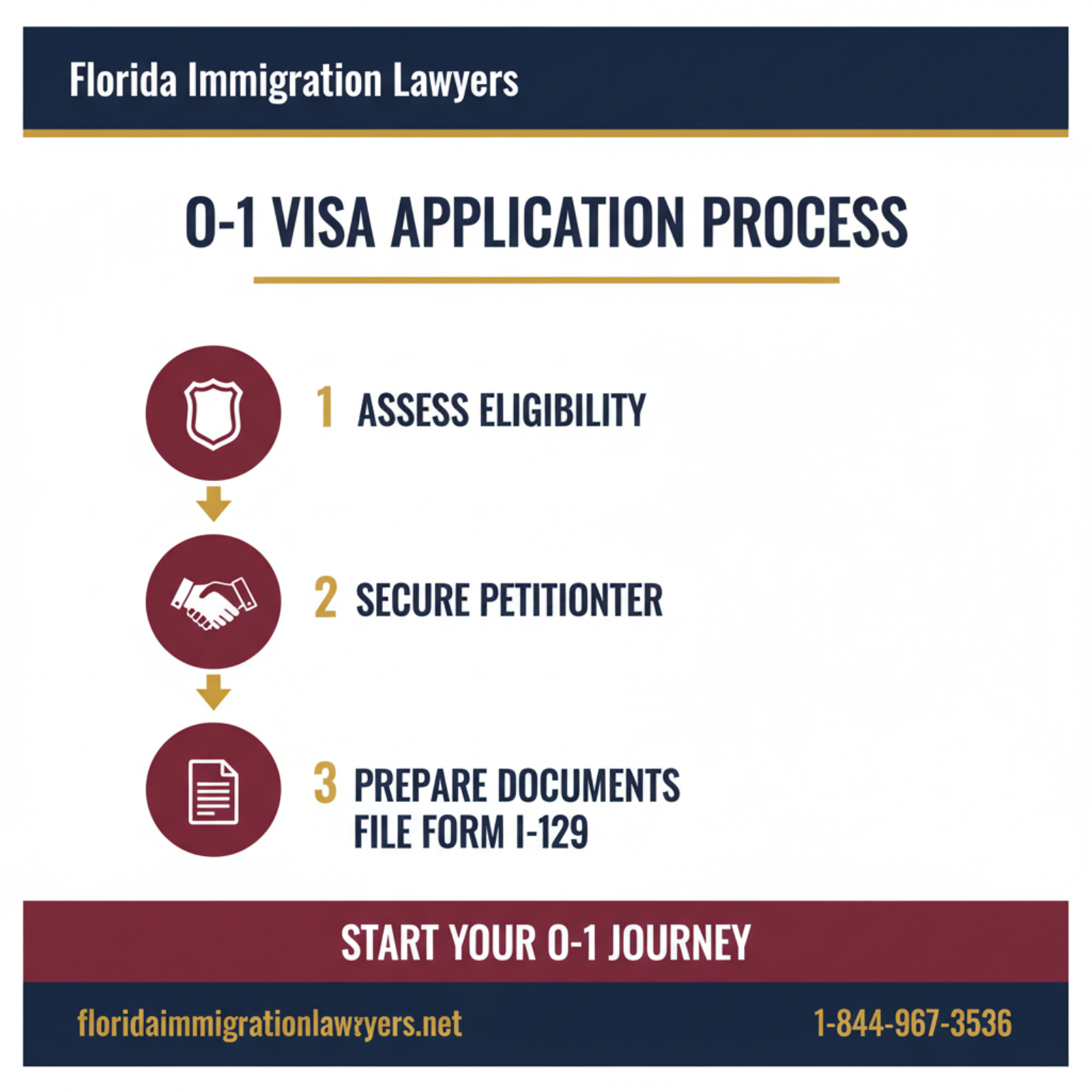
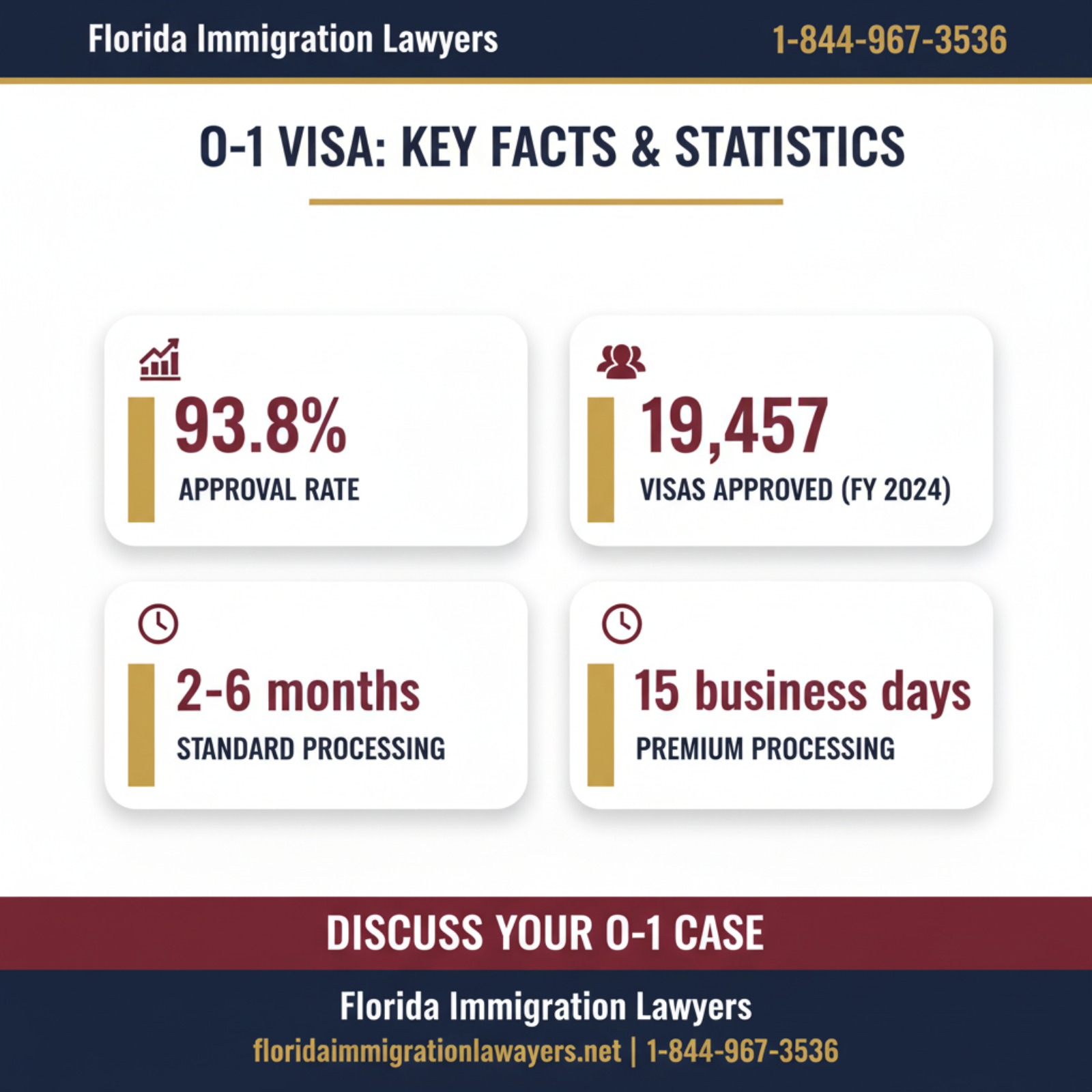
After assembling the petition package, the petitioner files it with the appropriate USCIS service center. Premium Processing is available for an additional fee, which guarantees a response from USCIS within 15 calendar days.
Consular Processing or Adjustment of Status
Once USCIS approves the I-129 petition, the next step depends on your current location:
- Consular Processing: If you are outside the U.S., you will attend an interview at a U.S. embassy or consulate in your home country. Upon successful interview, the O-1 visa will be stamped in your passport, allowing you to enter the U.S. For more information on this process, refer to the Department of State website.
- Adjustment of Status: If you are already in the U.S. in a valid nonimmigrant status, you may be eligible to apply for an Adjustment of Status to O-1 status without leaving the country. This involves filing Form I-485 with USCIS.
Maintaining Your O-1 Status in Florida: Duration and Extensions
An O-1 visa is initially granted for the period necessary to accomplish the event or activity, up to a maximum of three years. This initial period is determined by the itinerary provided in your petition.
Changes in Employment and O-1 Portability
If your employment circumstances change—for example, if you wish to work for a new employer or your original employer's project concludes prematurely—a new O-1 petition must be filed by the new employer or agent. It is crucial to address these changes promptly to maintain your legal status in the U.S. USCIS generally allows for a grace period of up to 60 days (or until the end of your authorized validity period, whichever is shorter) after your employment ends, during which you can seek new employment or prepare to depart the U.S. Timely action is key to avoiding complications.
O-3 Visas for Family Members
Your spouse and unmarried children under the age of 21 may be eligible for O-3 nonimmigrant visas. O-3 visa holders can reside in the U.S. for the same duration as the O-1 principal visa holder and are permitted to attend school or college. However, they are generally not authorized to work in the United States. If your family members wish to work, they would need to qualify independently for a separate work-authorized visa category.
Benefits of Choosing Florida for Your O-1 Visa Journey
Florida offers a compelling environment for O-1 visa holders, combining professional opportunities with an exceptional quality of life. The state's appeal extends across various sectors:
- Thriving Industries: Florida boasts rapidly growing sectors in technology, aerospace, biomedical sciences, finance, and renewable energy, offering abundant opportunities for professionals with extraordinary abilities. Major cities like Miami, Orlando, and Tampa are also cultural hubs, attracting artists, entertainers, and athletes.
- Cultural Diversity and Lifestyle: With its rich cultural tapestry, beautiful beaches, and vibrant arts scene, Florida provides an inspiring backdrop for innovation and creativity. The state's diverse population also offers a welcoming environment for international professionals.
- No State Income Tax: A significant financial advantage for many, Florida does not impose a state income tax, allowing O-1 visa holders to retain more of their earnings.
- Strategic Location: Florida's proximity to Latin America and its robust international airports make it a global gateway, ideal for individuals whose work involves international collaboration or travel.
- World-Class Institutions: The state is home to numerous top-tier universities, research institutions, and artistic organizations, fostering an environment of intellectual and creative exchange.
These factors collectively make Florida an incredibly attractive destination for individuals seeking to leverage their extraordinary talents on a global stage.
Common Challenges and Expert Solutions for O-1 Applicants
While the O-1 visa offers a fantastic opportunity, the application process is rigorous and can present several challenges. Being aware of these potential pitfalls and knowing how to address them is crucial for success.
- Insufficient Evidence: One of the most common reasons for O-1 denials is a lack of sufficient, compelling evidence to meet the stringent criteria. Applicants often underestimate the quantity and quality of documentation required.
- Weak Advisory Opinions: An unsupportive or generic advisory opinion from a peer group or labor organization can significantly weaken a petition. It's vital to engage with the right organizations and clearly articulate your achievements.
- Improperly Structured Petitions: Errors in filling out forms, missing documents, or a poorly organized petition package can lead to delays, Requests for Evidence (RFEs), or even denials.
- Defining the Field: Clearly defining your specific field of extraordinary ability is crucial. A broad or ill-defined field can make it harder to prove you are at the very top.
- Changes in Circumstances: Unexpected changes in employment, project scope, or personal situations during the application or validity period can complicate matters.
Overcoming these challenges often requires the expertise of an experienced immigration attorney. Our legal team specializes in O-1 visas and can help you strategize the best approach, identify the strongest evidence, secure appropriate advisory opinions, and meticulously prepare your petition to maximize your chances of approval. We anticipate potential issues and proactively address them, minimizing delays and increasing the likelihood of a favorable outcome.
Transitioning from O-1 to Permanent Residency: Green Card Options
Many O-1 visa holders view their temporary status as a stepping stone to permanent residency in the United States. The good news is that the O-1 visa often provides an excellent foundation for pursuing a Green Card, particularly through the EB-1A (Employment-Based First Preference for Extraordinary Ability) category.
The criteria for the EB-1A Green Card are remarkably similar to those for the O-1 visa, making it a natural progression for individuals who have already demonstrated extraordinary ability. Unlike many other Green Card categories, EB-1A does not require a labor certification, and in some cases, individuals can self-petition without an employer sponsor. This offers significant flexibility and control over the Green Card process.
While EB-1A is the most direct path, O-1 visa holders may also explore other employment-based Green Card options, such as EB-2 (for professionals with advanced degrees or exceptional ability) or EB-3 (for skilled workers, professionals, and other workers), though these typically involve a more extensive process, including labor certification. Planning your long-term immigration strategy while on an O-1 visa is crucial, and our attorneys can help you assess the best path to permanent residency based on your unique circumstances and achievements.
Why Expert Legal Guidance is Crucial for Your O-1 Visa
The O-1 visa process is highly subjective and demands a deep understanding of U.S. immigration law, nuanced interpretation of USCIS guidelines, and meticulous preparation of evidence. Attempting to navigate this complex process without experienced legal counsel can lead to costly delays, denials, and missed opportunities.
Our Florida immigration lawyers specialize in O-1 visas and possess a proven track record of helping extraordinary individuals achieve their immigration goals. We provide comprehensive support, from initial eligibility assessment and evidence gathering to petition preparation and responding to USCIS inquiries. We understand the specific requirements for various fields and can tailor your application to highlight your unique achievements effectively. Navigating the U.S. immigration system can be complex, involving various federal agencies including USCIS and, in some cases, the Department of Justice's Executive Office for Immigration Review (justice.gov) for appeals or specific legal proceedings.
Beyond O-1
No Navegue Este Proceso Solo
Nuestros abogados de inmigración con experiencia están listos para luchar por usted. Obtenga una consulta gratuita y confidencial hoy.
We Speak English
O deje sus datos y le llamamos:
Evaluación Gratis en 24 Horas
O hable con nosotros ahora

Asistente de voz IA — disponible 24/7
GratisPreguntas Frecuentes

William J. Vásquez
Abogado Fundador · Vasquez Law Firm
Veterano de la Fuerza Aérea de EE.UU. y abogado de inmigración con años de experiencia práctica en inmigración de EE.UU. J.D., NCCU School of Law. Miembro de AILA. Admitido en los Circuitos 4.º, 5.º y 11.º.
Disponible 24/7 - Consultas Gratis
Revisado para exactitud legal por William J. Vásquez
Con licencia en Carolina del Norte; la inmigración a EE.UU. es una práctica federal.
Servicios legales relacionados
Nuestros abogados de inmigración en Florida pueden ayudarle con consulta gratis de inmigración, áreas de práctica de inmigración y servicios de inmigración familiar. Llame hoy al 1-844-967-3536 para una consulta gratuita.
Enlaces Relacionados
Temas Relacionados
Consulta Legal Gratuita
Discuta su caso con nuestros abogados experimentados. Estamos disponibles 24/7.
Artículos Relacionados
Abogado de Inmigración Orlando Consulta Gratis 2026
Descubra cómo encontrar un abogado de inmigración en Orlando que ofrezca una consulta gratuita. Comprenda los servicios disponibles y por qué elegir a Florida Immigration Lawyers puede hacer la diferencia en su caso.
Naturalización Militar Acelerada en Bases de Florida
Explora opciones de naturalización militar para familias en bases de Florida, incluyendo beneficios de parole en lugar en Miami. Aprende a acelerar tu aplicación con la guía experta de Florida Immigration Lawyers.
Abogado en Orlando para Visa K-3: Qué Esperar
Conozca el proceso de visa K-3 en Florida, incluyendo pasos, costos y requisitos. Explore sus opciones en 2026 con la ayuda de Florida Immigration Lawyers.