Visa L-1: Guía de Transferencia para Empresas de Florida
Para las empresas de Florida que buscan transferir ejecutivos, gerentes o empleados con conocimientos especializados desde una oficina en el extranjero, la visa L-1 es una herramienta vital. Esta guía completa para 2026 profundiza en los requisitos de elegibilidad tanto para el empleador estadounidense como para el empleado extranjero, describiendo el meticuloso proceso de solicitud paso a paso con USCIS. Cubrimos la documentación esencial, los tiempos de procesamiento esperados y los diversos factores de costo involucrados, incluidas las tarifas gubernamentales y los gastos legales. Comprender estos elementos es crucial para una transferencia exitosa dentro de la misma empresa. Además, destacamos los errores comunes que deben evitarse y que podrían poner en peligro su petición y explicamos cuándo la asistencia legal profesional de Florida Immigration Lawyers se vuelve indispensable. Nuestra firma se dedica a ayudar a las empresas de Florida a navegar estas complejas vías de inmigración de manera eficiente y efectiva.
Respuesta Rápida: Transferencia de Visa L-1 para Empresas de Florida
Una transferencia de visa L-1 permite a las empresas multinacionales con relaciones calificadas transferir ejecutivos, gerentes o empleados con conocimientos especializados de una oficina en el extranjero a una oficina en los EE. UU., incluidas las de Florida. Esta visa de no inmigrante es crucial para las empresas que expanden o mantienen operaciones en los EE. UU. Facilita el movimiento fluido de personal clave, asegurando la continuidad y el crecimiento del negocio. El proceso implica demostrar una relación calificada entre las entidades, la elegibilidad del empleado y la capacidad operativa de la entidad estadounidense, especialmente para nuevas oficinas. Navegar los requisitos detallados exige una preparación cuidadosa y, a menudo, orientación legal para asegurar una petición exitosa.
- Las visas L-1 son para transferencias dentro de la misma empresa: L-1A para ejecutivos/gerentes, L-1B para conocimientos especializados.
- Requiere una relación calificada entre las entidades extranjeras y estadounidenses (matriz, subsidiaria, afiliada, sucursal).
- El empleado debe haber trabajado para la entidad extranjera durante al menos un año continuo en los últimos tres años.
- La empresa estadounidense, particularmente en Florida, debe estar operando activamente o preparándose para hacerlo.
- Se recomienda encarecidamente la asistencia legal para gestionar la documentación compleja y el cumplimiento normativo.
Mover personal clave a través de fronteras internacionales puede ser un desafío complejo para cualquier empresa multinacional. Si su negocio opera en Florida y necesita transferir un ejecutivo, gerente vital o un empleado con conocimientos especializados de una oficina en el extranjero, la visa L-1 es a menudo la solución más efectiva. Esta categoría de visa de no inmigrante está diseñada específicamente para facilitar las transferencias dentro de la misma empresa, permitiendo a las empresas globales mantener la continuidad operativa y aprovechar su talento en todo el mundo.
Florida, con su ubicación estratégica, economía diversa y creciente comunidad empresarial internacional, es un destino principal para las empresas que utilizan la visa L-1. Desde los bulliciosos centros financieros de Miami hasta los centros tecnológicos de Orlando y los negocios en auge en Coral Springs, comprender las complejidades de una transferencia de visa L-1 es vital para un crecimiento sostenible. Esta guía completa lo guiará a través de los requisitos esenciales, el proceso de solicitud, los errores comunes y cómo navegar con éxito el viaje de la visa L-1 para su empresa con sede en Florida en 2026.
El proceso puede parecer desalentador, pero con la información correcta y el apoyo profesional, su empresa puede traer con éxito su talento invaluable al Estado del Sol. No permita que las complejidades de la ley de inmigración obstaculicen el potencial de su negocio. Llame a Florida Immigration Lawyers al 1-844-YO-PELEO para una consulta gratuita para discutir sus necesidades específicas de visa L-1 hoy mismo.
Comprendiendo la Visa L-1 para Empresas de Florida
La categoría de visa L-1 es una visa de no inmigrante que permite a los empleadores estadounidenses transferir a un ejecutivo, gerente o un profesional con conocimientos especializados de una de sus oficinas afiliadas en el extranjero a una de sus oficinas en los Estados Unidos. Esta visa es particularmente beneficiosa para las empresas de Florida que buscan expandir sus operaciones, establecer nuevas sucursales o integrar talento internacional en su fuerza laboral existente en EE. UU. Reconoce la naturaleza global de los negocios modernos y la necesidad de un movimiento de personal sin interrupciones.
Existen dos subcategorías principales de la visa L-1: la visa L-1A para ejecutivos y gerentes, y la visa L-1B para empleados con conocimientos especializados. Un titular de visa L-1A puede permanecer inicialmente hasta por tres años, con extensiones posibles hasta un máximo total de siete años. Los titulares de visa L-1B también reciben una estadía inicial de tres años, pero su estadía total máxima es de cinco años. Estas visas proporcionan un camino claro para que el personal esencial trabaje legalmente en los EE. UU. y contribuya al éxito de su negocio en Florida.
Para una empresa de Florida, utilizar la visa L-1 significa que puede traer liderazgo que comprenda su estrategia global o expertos especializados cuyas habilidades únicas son críticas para sus operaciones en EE. UU. Esto puede tener un impacto particularmente significativo en los mercados competitivos de Florida, donde el conocimiento específico de la industria o la experiencia en gestión pueden proporcionar una ventaja considerable. La visa L-1 también es única en el sentido de que ofrece un camino hacia la residencia permanente para los titulares de la visa L-1A a través de la categoría de tarjeta verde EB-1C para ejecutivos o gerentes multinacionales, lo que la convierte en una opción atractiva para la planificación a largo plazo. Esto demuestra el reconocimiento del gobierno de EE. UU. del valor que dichos transferidos aportan a la economía, como se describe en la sección 101(a)(15)(L) de la Ley de Inmigración y Nacionalidad (INA).
Requisitos de Elegibilidad para una Transferencia de Visa L-1
Para obtener con éxito una visa L-1 para una transferencia dentro de la misma empresa a una compañía de Florida, tanto el empleador peticionario como el empleado transferido deben cumplir con criterios de elegibilidad específicos establecidos por los Servicios de Ciudadanía e Inmigración de EE. UU. (USCIS). Comprender estos requisitos es fundamental para preparar una petición sólida y aprobable. El incumplimiento de cualquiera de ellos puede provocar retrasos significativos o una denegación total, lo que afectaría las operaciones de su negocio en Coral Springs o en cualquier otro lugar de Florida.
Requisitos del Empleador
El empleador estadounidense, que debe ser una organización calificada, debe demostrar una relación específica con la entidad extranjera. Esta relación puede ser la de una matriz, subsidiaria, afiliada o sucursal. Tanto la entidad estadounidense como la extranjera deben estar realizando negocios activamente, o preparándose para hacerlo, en sus respectivos países. Para nuevas oficinas en EE. UU., la petición debe demostrar que la empresa ha asegurado un local físico suficiente y tiene la capacidad financiera para iniciar operaciones y compensar al empleado. Esto es particularmente importante para las nuevas empresas en Florida que buscan aprovechar el talento internacional.
Requisitos del Empleado
El empleado debe haber trabajado para la organización extranjera calificada durante al menos un año continuo dentro de los tres años inmediatamente anteriores a su transferencia a EE. UU. Este empleo debe haber sido en una capacidad ejecutiva, gerencial o de conocimiento especializado. El empleado también debe venir a EE. UU. para ocupar un puesto en una de estas mismas capacidades. USCIS examina cuidadosamente las funciones laborales para asegurarse de que se alineen con las definiciones de L-1A (ejecutivo/gerente) o L-1B (conocimiento especializado), como se describe en 8 CFR 214.2(l).
Para L-1A, el puesto debe implicar la dirección de la organización, un departamento o una función, la supervisión de otros gerentes o profesionales, o la gestión de una función esencial dentro de la organización a un alto nivel sin supervisión directa. Para L-1B, el conocimiento especializado se refiere al conocimiento propietario del producto, servicio, investigación, equipo, técnicas, gestión u otros intereses de la empresa, y su aplicación en los mercados internacionales, o un nivel avanzado de experiencia en los procesos y procedimientos de la organización. Es crucial que su empresa de Florida defina claramente estos roles y responsabilidades en la petición para evitar cualquier ambigüedad.
El Proceso Paso a Paso de Solicitud de Visa L-1
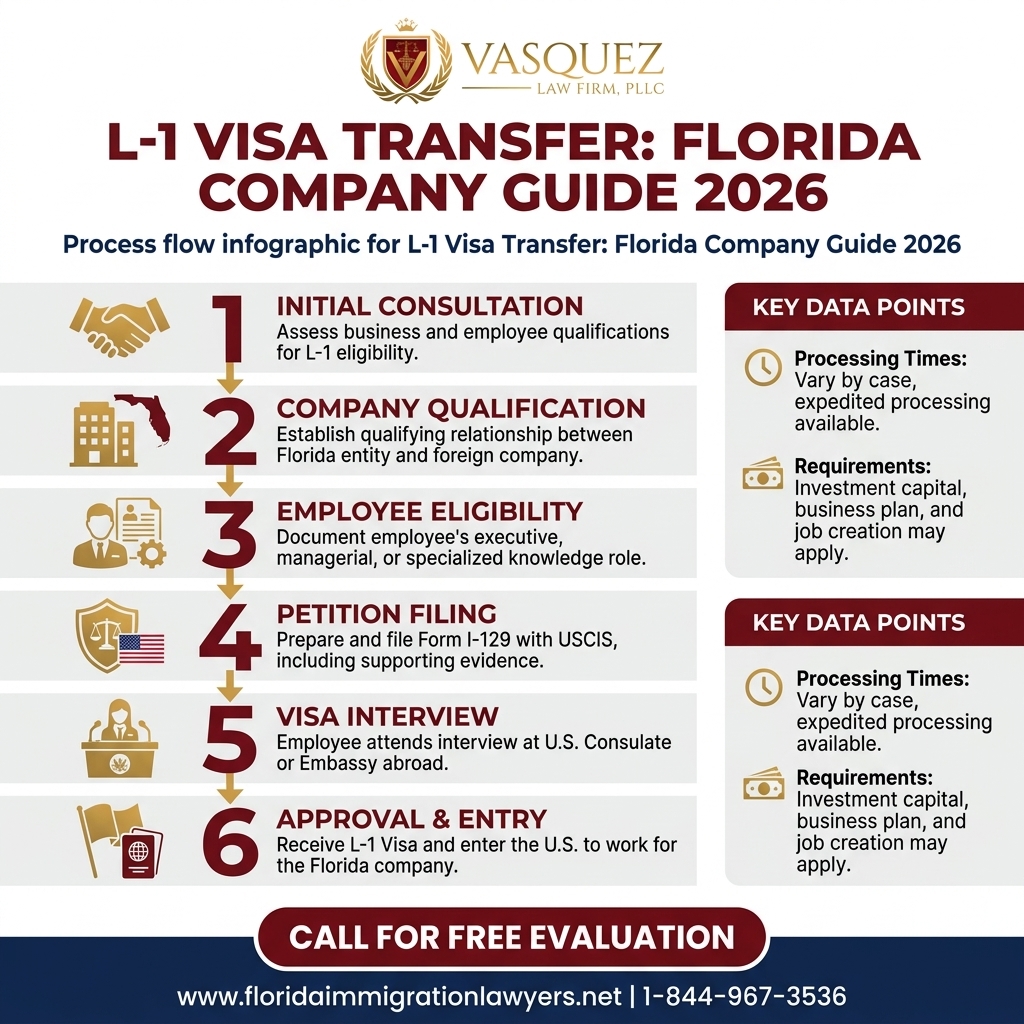
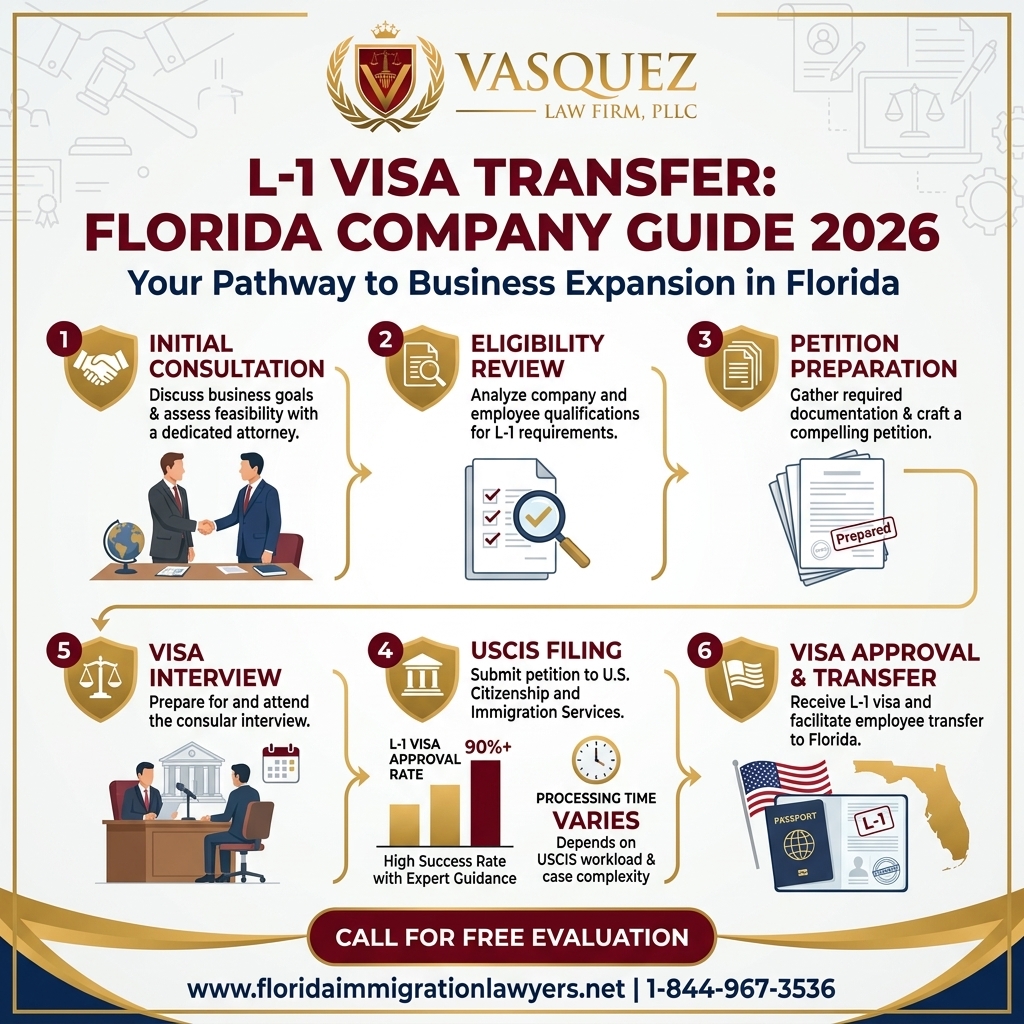
Navegar el proceso de solicitud de visa L-1 requiere una atención meticulosa a los detalles y el cumplimiento de pasos procesales específicos. Para una empresa de Florida, comprender esta secuencia es clave para una transferencia fluida y oportuna de su personal esencial. Si bien cada caso tiene sus matices únicos, el camino general sigue siendo consistente.
-
Establecer la Relación Calificada: Antes de presentar la solicitud, el peticionario estadounidense debe asegurarse de que exista y pueda probarse una relación corporativa calificada (matriz, subsidiaria, afiliada o sucursal) entre las entidades estadounidense y extranjera. Este es el paso fundamental para cualquier petición L-1.
-
Preparar y Presentar el Formulario I-129, Petición de Trabajador No Inmigrante: El empleador estadounidense presenta el Formulario I-129, Petición de Trabajador No Inmigrante, junto con el Suplemento L y toda la documentación de respaldo requerida, ante USCIS. Este paquete completo debe demostrar claramente la elegibilidad tanto de la empresa como del empleado. La petición debe enviarse al Centro de Servicio de USCIS correcto según la ubicación de la empresa estadounidense; por ejemplo, el Centro de Servicio de Vermont o el Centro de Servicio de California suelen manejar estos casos, dependiendo de la dirección de la entidad estadounidense.
-
Responder a Solicitudes de Evidencia (RFE) (Si Corresponde): USCIS puede emitir una RFE si requiere información adicional o aclaración sobre cualquier aspecto de la petición. Una respuesta oportuna y exhaustiva es crucial para que el proceso siga adelante. Esto a menudo ocurre cuando la documentación inicial es insuficiente para establecer la elegibilidad.
-
Aprobación de la Petición: Si la petición es aprobada, USCIS enviará una Notificación de Aprobación I-797. Esta notificación es esencial para el siguiente paso, ya sea que el empleado ya esté en EE. UU. o esté solicitando desde el extranjero.
-
Procesamiento Consular o Ajuste de Estatus:
- Procesamiento Consular: Si el empleado se encuentra fuera de EE. UU., solicitará el sello de la visa L-1 en una embajada o consulado de EE. UU. en su país de origen. Esto implica programar una entrevista, presentar los documentos requeridos y asistir a la entrevista. La Oficina de Asuntos Consulares del Departamento de Estado de EE. UU. proporciona pautas para este proceso.
- Ajuste de Estatus: Si el empleado ya se encuentra legalmente en EE. UU. con otro estatus de no inmigrante, puede ser elegible para presentar el Formulario I-485, Solicitud para Registrar la Residencia Permanente o Ajustar Estatus, simultáneamente con el I-129 o después de su aprobación, si es elegible para una tarjeta verde (típicamente L-1A a EB-1C). Sin embargo, para una simple transferencia L-1 desde otro estatus de no inmigrante, presentarían el Formulario I-539 para cambiar de estatus a L-1.
-
Entrevista de Visa y Entrada a EE. UU.: Para el procesamiento consular, una entrevista exitosa lleva al sello de la visa en el pasaporte. El empleado puede entonces viajar a EE. UU. y presentar su pasaporte y visa en el puerto de entrada, como el Aeropuerto Internacional de Miami o el Aeropuerto Internacional de Orlando, donde un oficial de Aduanas y Protección Fronteriza (CBP) tomará la decisión final sobre la admisión y emitirá un registro I-94. Para aquellos que ajustan su estatus, una vez aprobado, pueden comenzar a trabajar para la empresa de Florida bajo el estatus L-1.
Documentos Esenciales para su Petición de Visa L-1
Una petición de visa L-1 exitosa depende de la presentación de documentación completa y precisa a USCIS. Para su empresa de Florida, recopilar estos documentos esenciales de manera sistemática agilizará el proceso de solicitud y fortalecerá significativamente su caso. Cuanta más evidencia pueda proporcionar para respaldar sus reclamos de elegibilidad, mayores serán sus posibilidades de aprobación. Esta lista de verificación cubre las categorías principales de documentos que normalmente se requieren.
- Formularios:
- Formulario I-129, Petición de Trabajador No Inmigrante, y el Suplemento L.
- Formulario G-28, Notificación de Comparecencia como Abogado o Representante Acreditado (si corresponde).
- Evidencia de Relación Calificada:
- Documentos corporativos: Artículos de incorporación, estatutos, certificados de acciones, acuerdos de asociación, organigramas.
- Prueba de propiedad y control entre las entidades de EE. UU. y extranjeras (por ejemplo, registros de acciones, informes anuales).
- Evidencia de Negocio Activo:
- Estados financieros, informes anuales, declaraciones de impuestos para ambas entidades.
- Licencias comerciales, contratos, facturas, acuerdos de arrendamiento de oficinas.
- Para nuevas oficinas en EE. UU.: Plan de negocios que detalle las operaciones propuestas, proyecciones financieras y planes de personal.
- Cualificaciones y Rol del Empleado:
- Carta del empleador extranjero que verifique el empleo del empleado durante un año continuo dentro de los últimos tres años, detallando su puesto, deberes y salario.
- Organigramas para ambas entidades, extranjera y estadounidense, que muestren claramente la posición y la estructura de informes del empleado.
- Descripción detallada del puesto de trabajo propuesto en EE. UU., enfatizando las funciones ejecutivas, gerenciales o de conocimiento especializado.
- Currículum vitae del empleado, títulos educativos y licencias profesionales.
- Prueba de salario y beneficios del empleador extranjero.
- Documentos Personales del Empleado:
- Copia de la página biográfica del pasaporte.
- Sellos de visas estadounidenses anteriores y registros I-94 (si corresponde).
- Certificado de matrimonio y certificados de nacimiento para cualquier familiar acompañante (solicitantes de visa L-2).
Tiempos de Procesamiento de la Visa L-1 y Qué Esperar en Florida
Comprender los tiempos de procesamiento típicos para una petición de visa L-1 es crucial para cualquier empresa de Florida que planifique una transferencia dentro de la misma empresa. Estos plazos pueden variar significativamente según varios factores, incluido el Centro de Servicio de USCIS específico que maneja la petición, las cargas de trabajo actuales y si se utiliza el procesamiento premium. Si bien USCIS proporciona tiempos de procesamiento estimados en su sitio web, estos están sujetos a cambios y deben monitorearse regularmente.
Para el procesamiento estándar, las peticiones L-1 pueden tardar entre 4 y 12 meses, o incluso más en algunos casos, en recibir una decisión inicial. Esta larga espera puede ser un desafío para las empresas que necesitan desplegar rápidamente personal crítico. Es importante tener en cuenta estos posibles retrasos en su planificación comercial, especialmente si la presencia del empleado en su oficina de Coral Springs o Miami es sensible al tiempo. La Oficina Ejecutiva de Revisión de Inmigración (EOIR) del Departamento de Justicia de EE. UU. a menudo se ocupa de casos complejos, pero las peticiones iniciales de L-1 son manejadas por USCIS.
Para acelerar el proceso, los peticionarios tienen la opción de utilizar el Servicio de Procesamiento Premium. Por una tarifa adicional, USCIS garantiza una respuesta (una aprobación, denegación o Solicitud de Evidencia) dentro de los 15 días calendario. Esta puede ser una opción invaluable para las empresas de Florida con necesidades urgentes de personal. Sin embargo, es importante tener en cuenta que una Solicitud de Evidencia (RFE) reiniciará el reloj de 15 días una vez que se presente una respuesta. Incluso con el procesamiento premium, si se requiere procesamiento consular, la programación de la entrevista de visa y el viaje real se sumarán al cronograma general.
Después de que se aprueba una petición, si el empleado se encuentra fuera de EE. UU., debe someterse a un procesamiento consular. Esto implica programar una entrevista en una embajada o consulado de EE. UU., lo que puede llevar de varias semanas a meses, dependiendo de la disponibilidad del puesto específico. Una vez que se emite la visa, el empleado puede viajar a EE. UU. Es esencial que su empresa de Florida planifique estas diversas etapas para garantizar una transición fluida para sus empleados y evitar interrupciones operativas.
Factores de Costo y Tarifas para una Transferencia de Visa L-1
Comprender las implicaciones financieras de una transferencia de visa L-1 es un aspecto crítico de la planificación para cualquier empresa de Florida. El costo total implica varios componentes, incluidas las tarifas de presentación del gobierno, los honorarios legales y los posibles gastos adicionales. Si bien los montos específicos de las tarifas están sujetos a cambios por parte de USCIS y siempre deben verificarse en el sitio web oficial de USCIS, aquí hay un desglose general de lo que puede esperar.
Las tarifas gubernamentales principales para una petición L-1 incluyen la tarifa de presentación base para el Formulario I-129. Además, una petición L-1 generalmente requiere una Tarifa de Prevención y Detección de Fraude. Para empresas con 50 o más empleados, donde más del 50% de su fuerza laboral estadounidense son no inmigrantes H-1B o L-1, puede aplicarse una tarifa adicional de la Ley de Mejora de la Competitividad y la Fuerza Laboral Estadounidense (ACWIA). Estas tarifas se pagan directamente a USCIS en el momento de presentar la petición.
Más allá de las tarifas gubernamentales obligatorias, el costo variable más significativo probablemente serán los honorarios legales. Contratar a un abogado de inmigración experimentado, como los de Florida Immigration Lawyers, es muy recomendable debido a la complejidad de las peticiones L-1. Los honorarios legales cubren el tiempo y la experiencia del abogado en la preparación de la petición, la compilación de la documentación de respaldo, la respuesta a las RFE y el asesoramiento sobre cuestiones de cumplimiento. Estas tarifas pueden variar ampliamente según la complejidad del caso, la experiencia del abogado y el nivel de servicio prestado. Invertir en asesoramiento legal puede prevenir errores costosos y aumentar la probabilidad de un resultado exitoso.
Además, si opta por el Servicio de Procesamiento Premium para acelerar la revisión de USCIS, existe una tarifa separada y sustancial por este servicio. Otros costos potenciales incluyen tarifas de traducción para documentos extranjeros, servicios de mensajería para el envío de documentos y gastos de viaje para la entrevista consular del empleado (si corresponde). Para los miembros de la familia acompañantes que buscan visas L-2, también habrá tarifas de solicitud separadas. Una evaluación financiera exhaustiva al principio ayudará a su empresa de Florida a presupuestar adecuadamente todo el proceso de transferencia de visa L-1.
No navegue este complejo proceso solo. El éxito de su transferencia de visa L-1 puede afectar significativamente las operaciones y el crecimiento de su empresa en Florida. Contacte hoy mismo a Florida Immigration Lawyers al 1-844-YO-PELEO para obtener orientación y apoyo.
Errores Comunes a Evitar Durante su Solicitud de Visa L-1
Solicitar una visa L-1 implica detalles intrincados, e incluso errores menores pueden provocar retrasos significativos, Solicitudes de Evidencia (RFE) o incluso denegaciones directas. Para las empresas de Florida, comprender y evitar estos errores comunes es crucial para una transferencia exitosa dentro de la misma empresa.
-
Prueba Insuficiente de Relación Calificada: No proporcionar evidencia clara y sólida de la relación matriz-subsidiaria, afiliada o sucursal entre las entidades de EE. UU. y extranjeras. USCIS requiere documentación verificable de propiedad y control.
-
Documentación Inadecuada de Negocio Activo: Olvidar demostrar que tanto la entidad estadounidense como la extranjera están activamente involucradas en operaciones comerciales. Esto incluye estados financieros, declaraciones de impuestos, contratos y acuerdos de arrendamiento.
-
No Cumplir con el Requisito de Un Año de Empleo en el Extranjero: El empleado debe haber trabajado para la entidad extranjera durante al menos un año continuo dentro de los últimos tres años. Las interrupciones en el empleo o la prueba insuficiente pueden causar problemas.
-
Clasificación Errónea del Rol del Empleado (L-1A vs. L-1B): Categorizar incorrectamente a un empleado como gerente/ejecutivo (L-1A) cuando sus deberes no cumplen con las definiciones estrictas de USCIS, o reclamar conocimiento especializado (L-1B) sin evidencia suficiente de experiencia propietaria.
-
Descripciones de Puestos Vagas: Presentar descripciones de puestos genéricas o poco convincentes para el puesto en EE. UU. que no demuestran claramente responsabilidades ejecutivas, gerenciales o de conocimiento especializado. La especificidad es clave.
-
Peticiones de Nueva Oficina que Carecen de Detalles: Para nuevas oficinas en EE. UU. en Florida, no proporcionar un plan de negocios detallado, prueba de locales físicos y evidencia de viabilidad financiera para apoyar la nueva operación y al empleado L-1.
-
Ignorar Exceso de Estancia de Visa o Violaciones de Estatus: Si el empleado ya se encuentra en EE. UU., cualquier exceso de estancia o violación de estatus migratorio previo puede poner en peligro la petición L-1 o el posterior ajuste de estatus.
-
Formularios Incompletos o Incorrectos: Errores administrativos simples, firmas faltantes o secciones pasadas por alto en el Formulario I-129 y sus suplementos pueden llevar a una RFE o un rechazo directo.
-
No Responder Oportuna o Adecuadamente a las RFE: Recibir una RFE significa que USCIS necesita más información. No responder dentro del plazo o presentar una respuesta incompleta a menudo lleva a la denegación.
-
Falta de Organigramas: No incluir organigramas claros para ambas entidades, extranjera y estadounidense, que representen visualmente la posición del empleado y la estructura jerárquica.
Cuándo Llamar a un Abogado de Inmigración en Florida
Si bien la información proporcionada aquí ofrece una visión general completa, las complejidades de una transferencia de visa L-1 a menudo requieren la experiencia de un abogado de inmigración experimentado. Para las empresas de Florida, particularmente aquellas en áreas como Coral Springs, Miami o Tampa, contratar asesoría legal de Florida Immigration Lawyers puede marcar una diferencia significativa en el éxito y la eficiencia de su petición L-1. Nuestro experimentado equipo legal está bien versado en los matices de la ley de inmigración de EE. UU., incluidos los requisitos específicos para empresas que operan en Florida.
Debe considerar llamar a un abogado de inmigración si su empresa está:
- Estableciendo una Nueva Oficina en EE. UU.: Las peticiones L-1 para nuevas oficinas son particularmente examinadas por USCIS y requieren un plan de negocios sólido y evidencia detallada de viabilidad financiera e intención de negocio activo.
- Lidiando con Estructuras Corporativas Complejas: Si su empresa multinacional tiene una estructura de propiedad complicada, probar la relación calificada puede ser un desafío sin orientación legal.
- Enfrentando una Solicitud de Evidencia (RFE): Una RFE indica que USCIS tiene preocupaciones o necesita más información. Un abogado puede ayudar a elaborar una respuesta completa y persuasiva.
- Experimentando una Denegación Previa de L-1: Si una petición L-1 anterior fue denegada, un abogado puede ayudar a analizar las razones de la denegación y elaborar una estrategia para una nueva presentación o apelación más sólida.
- Insegura sobre la Elegibilidad del Empleado: Si el rol del empleado o el conocimiento especializado es ambiguo, un abogado puede ayudar a evaluar si cumple con las definiciones de USCIS.
- Buscando Transicionar a la Residencia Permanente: Para los titulares de visa L-1A, un abogado puede asesorar sobre el proceso de tarjeta verde EB-1C y ayudar a navegar el camino hacia la residencia permanente.
- Preocupada por el Cumplimiento: Un abogado asegura que toda la documentación cumpla con las últimas regulaciones y políticas de inmigración, evitando problemas futuros.
Nuestra firma, Florida Immigration Lawyers, ofrece apoyo dedicado para asuntos de inmigración empresarial, incluidas las visas L-1. Entendemos las necesidades únicas de las empresas de Florida y estamos comprometidos a brindar asesoramiento legal estratégico y personalizado para ayudarlo a lograr sus objetivos de inmigración.
Acerca de Florida Immigration Lawyers
Florida Immigration Lawyers es un bufete de abogados de inmigración líder dedicado a servir a individuos y empresas en todo el estado de Florida. Desde nuestra oficina en Orlando, que atiende a clientes en toda Florida, nuestro experimentado equipo brinda servicios legales integrales en todas las áreas de la ley de inmigración. Entendemos que navegar el sistema de inmigración de EE. UU. puede ser abrumador, y nuestra misión es ofrecer una representación legal clara, compasiva y efectiva.
Nuestra firma se enfoca en una amplia gama de servicios de inmigración, incluida la inmigración familiar, la inmigración empresarial, la defensa contra la deportación, el asilo y las solicitudes de ciudadanía. Nos enorgullecemos de nuestro enfoque centrado en el cliente, asegurando que cada caso reciba la atención meticulosa que merece. Nuestros hábiles abogados están comprometidos a mantenerse al tanto de los últimos desarrollos en la ley de inmigración para proporcionar las estrategias más actuales y efectivas para nuestros clientes.
En Florida Immigration Lawyers, creemos que todos merecen acceso a una representación legal de calidad. Ofrecemos consultas gratuitas, estamos disponibles las 24 horas del día, los 7 días de la semana, y brindamos servicios bilingües (inglés y español) para garantizar una comunicación y comprensión efectivas. Confíe en nosotros para ser sus defensores dedicados durante su viaje de inmigración. Llámenos hoy al 1-844-YO-PELEO o visite floridaimmigrationlawyers.net para obtener más información sobre cómo podemos ayudarlo.
Fuentes y Referencias
- Servicios de Ciudadanía e Inmigración de EE. UU. (USCIS) - L-1A Transferido dentro de la Empresa Ejecutivo o Gerente
- Servicios de Ciudadanía e Inmigración de EE. UU. (USCIS) - L-1B Transferido dentro de la Empresa Conocimiento Especializado
- Departamento de Estado de EE. UU. - Visas L: Transferido dentro de la Empresa
- Oficina Ejecutiva de Revisión de Inmigración (EOIR)
- 8 U.S.C. Capítulo 12 - Ley de Inmigración y Nacionalidad (INA) Sección 101(a)(15)(L)
- 8 CFR 214.2(l) - Peticiones para la clasificación de no inmigrante L-1
Servicios relacionados: inmigración de negocios, visas de trabajo, visa L-1 transferencia, consulta de inmigración empresarial.
Este artículo proporciona información legal general y no pretende ser asesoramiento legal. Cada caso es único y los resultados dependen de hechos y circunstancias específicas. Contacte a un abogado para obtener asesoramiento sobre su situación particular. Las leyes de inmigración están sujetas a cambios.
Obtener una visa L-1 para su personal esencial es un movimiento estratégico para cualquier empresa de Florida que busque prosperar en el mercado global. No deje el futuro de su negocio al azar. Nuestro dedicado equipo en Florida Immigration Lawyers está listo para brindarle la orientación que necesita. Llámenos ahora para una consulta gratuita al 1-844-YO-PELEO. Se Habla Español - Estamos aquí para ayudarle.
No Navegue Este Proceso Solo
Nuestros abogados de inmigración con experiencia están listos para luchar por usted. Obtenga una evaluación gratis de su caso y confidencial hoy.
We Speak English
O deje sus datos y le llamamos:
Evaluación Gratis en 24 Horas
O hable con nosotros ahora

Asistente de voz IA — disponible 24/7
GratisPreguntas Frecuentes

William J. Vásquez
Abogado Fundador · Vasquez Law Firm
Veterano de la Fuerza Aérea de EE.UU. y abogado de inmigración con años de experiencia práctica en inmigración de EE.UU. J.D., NCCU School of Law. Miembro de AILA. Admitido en los Circuitos 4.º, 5.º y 11.º.
Disponible 24/7 - Evaluaciones Gratis de su Caso
Revisado para exactitud legal por William J. Vásquez
Con licencia en Carolina del Norte; la inmigración a EE.UU. es una práctica federal.
Servicios legales relacionados
Nuestros abogados de inmigración en Florida pueden ayudarle con servicios de inmigración familiar, ciudadanía y naturalización y defensa contra deportación. Llame hoy al 1-844-YO-PELEO para una evaluación gratis de su caso.
Enlaces Relacionados
Temas Relacionados
Evaluación Legal Gratis de su Caso
Discuta su caso con nuestros abogados experimentados. Estamos disponibles 24/7.
Artículos Relacionados
Abogado de Doble Ciudadanía en Florida: Su Guía 2026
Para los residentes de Florida, el concepto de doble ciudadanía, o poseer dos pasaportes, ofrece una convincente combinación de oportunidades y desafíos. Si bien Estados Unidos generalmente permite la doble nacionalidad, el camino para lograr este estatus requiere una comprensión meticulosa tanto de las leyes de inmigración de EE. UU. como de las políticas de ciudadanía de su país de origen. Esta guía explora la definición de doble ciudadanía, el proceso detallado paso a paso para la naturalización en EE. UU. y los importantes beneficios y posibles escollos involucrados. Cubrimos la documentación esencial, los plazos típicos y las consideraciones de costos para 2026, proporcionando información crucial para cualquier persona en Orlando, Miami o en toda Florida que esté considerando este importante paso legal. Conozca los errores comunes a evitar y comprenda cuándo buscar asesoramiento legal profesional para navegar este complejo proceso con éxito. Florida Immigration Lawyers está aquí para brindar apoyo experto y bilingüe en su viaje hacia la doble ciudadanía.
Abogado de Inmigración Orlando Consulta Gratuita en Florida
Abogado de Inmigración en Orlando, Florida. Consulta gratuita para visas, tarjetas verdes, ciudadanía, asilo y defensa de deportación. Asesoría legal
Tarjeta Combo EAD y Advance Parole en Florida 2026
Para las personas con un Formulario I-485, Solicitud para Registrar Residencia Permanente o Ajustar Estatus, pendiente, la Tarjeta Combo EAD y Advance Parole es un documento esencial. Esta tarjeta única combina la autorización para trabajar legalmente en EE. UU. (Documento de Autorización de Empleo - EAD) con el permiso para viajar internacionalmente y reingresar sin abandonar su solicitud de tarjeta verde (Advance Parole). Esta guía de Florida Immigration Lawyers proporciona una visión general completa para los solicitantes en Florida en 2026, cubriendo la elegibilidad, el proceso de solicitud paso a paso, los documentos requeridos, los tiempos de procesamiento esperados y los costos asociados. También destacamos los errores comunes a evitar y cuándo buscar asesoramiento legal para asegurar un viaje de inmigración sin problemas y exitoso.