Criminal Waiver Florida: Overcoming Convictions
Facing immigration challenges due to a criminal conviction in Florida? Learn about criminal waiver options like the I-601. Contact Florida Immigration Lawyers for a free consultation.
A criminal waiver, such as Form I-601 or I-212, allows certain individuals with past criminal convictions to overcome grounds of inadmissibility or deportability for immigration benefits in Florida. These waivers require demonstrating extreme hardship to a qualifying relative or meeting specific statutory criteria. An approved criminal waiver can pave the way for green cards, visas, or relief from removal, offering a second chance to those who qualify.
- Overcome past criminal grounds of inadmissibility.
- Requires demonstrating extreme hardship or specific criteria.
- Forms like I-601 and I-212 are common waivers.
- Essential for many seeking legal status in Florida.
- Consult an attorney for eligibility and application guidance.
Criminal Waiver Florida: Overcoming Convictions for Immigration
Navigating the complex world of U.S. immigration law can be daunting, especially when a past criminal conviction complicates your path. Many individuals in Florida, including those in Orlando, Miami, Tampa, and surrounding areas, find themselves facing inadmissibility or deportability due to prior legal issues. You might worry that your dreams of a green card, visa, or even U.S. citizenship are out of reach.
However, a criminal waiver offers a potential lifeline, allowing you to overcome certain immigration bars. Understanding these waivers, like the I-601, is crucial for anyone with a criminal history seeking to regularize their status or prevent removal. This comprehensive guide from Florida Immigration Lawyers will explain the various types of criminal waivers, the application process, and how our firm can assist you. Do not let a past mistake define your future. Call Florida Immigration Lawyers at 1-844-967-3536 for a free consultation to discuss your unique situation and explore your options.
Understanding Criminal Waivers in Florida Immigration Law
Immigration law is designed to protect national security and public safety. Because of this, certain criminal convictions can make an individual "inadmissible" to the United States or "deportable" if they are already here. This means you might be denied a visa, a green card, or even face removal proceedings.
A criminal waiver is a legal mechanism that allows the U.S. government to forgive or "waive" certain grounds of inadmissibility or deportability. These waivers are not automatic; you must actively apply for them and demonstrate that you meet specific eligibility requirements. The burden of proof is on you, the applicant, to show why a waiver should be granted.
In Florida, where diverse communities thrive, understanding these waivers is particularly important. Many individuals, perhaps unaware of the immigration consequences of certain minor offenses, find themselves in challenging positions. Our goal is to help you understand how these waivers work and whether you might qualify for one to continue your immigration journey in the Sunshine State.
What Makes Someone Inadmissible or Deportable Due to Criminal History?
The Immigration and Nationality Act (INA) outlines numerous grounds for inadmissibility and deportability, many of which are directly related to criminal activity. Common criminal grounds under INA Section 212(a)(2) include crimes involving moral turpitude (CIMT), controlled substance violations, multiple criminal convictions, prostitution, and aggravated felonies. These grounds can bar entry or lead to removal.
Even seemingly minor offenses can have significant immigration consequences. For example, a single conviction for shoplifting, simple assault, or simple marijuana possession could trigger inadmissibility. It is essential to remember that immigration definitions of crimes may differ from state law definitions. What one state considers a misdemeanor or a minor infraction, federal immigration law might classify as a serious criminal ground of inadmissibility.
This is why a thorough legal analysis of your criminal record is always necessary. Our attorneys at Florida Immigration Lawyers carefully review your entire history to identify any potential issues and determine the best strategy for your case. We serve clients across all of Florida, including Orlando, Miami, Tampa, Jacksonville, and Fort Lauderdale, providing crucial deportation defense services.
Key Types of Criminal Waivers: I-601, I-212, and I-601A
Several types of waivers exist to address criminal grounds of inadmissibility. The specific waiver you need depends on your immigration status, the nature of your conviction, and where you are in the immigration process. Understanding the distinctions between these forms is vital for a successful application and to avoid common pitfalls.
Form I-601, Application for Waiver of Grounds of Inadmissibility
The I-601 waiver is one of the most common waivers used for various grounds of inadmissibility, including many criminal grounds under INA 212(a)(2). This form is generally filed by individuals applying for immigrant visas abroad through consular processing or for adjustment of status within the U.S. who have been found inadmissible.
To qualify for an I-601 waiver based on criminal grounds, you typically must demonstrate "extreme hardship" to a qualifying U.S. citizen or lawful permanent resident (LPR) spouse, parent, or sometimes child. This "extreme hardship" is a high legal standard. It involves more than just normal separation; it requires documenting severe financial, medical, psychological, or other burdens that would befall your qualifying relative if you were denied admission to the U.S. For example, if your LPR spouse relies entirely on your income and would face severe financial ruin, or if your U.S. citizen child has a serious medical condition requiring your constant care, these could contribute to a showing of extreme hardship.
Form I-212, Application for Permission to Reapply for Admission into the United States After Deportation or Removal
While primarily used after a prior deportation or removal order, the I-212 waiver, specifically under INA 212(h), can also be highly relevant for individuals with certain criminal histories. This powerful waiver can waive specific criminal grounds, including single crimes involving moral turpitude (CIMT), multiple CIMTs, and prostitution. It can also waive certain controlled substance offenses if it was a single offense of simple possession of 30 grams or less of marijuana.
Eligibility for the 212(h) waiver often requires showing rehabilitation and positive equities. For criminal grounds, you must generally show that the criminal activity occurred more than 15 years before the application, and you have been rehabilitated. Alternatively, you can show extreme hardship to a qualifying relative (U.S. citizen or LPR spouse, parent, son, or daughter) or that you are a VAWA self-petitioner. This waiver is often used in conjunction with other applications, or in removal proceedings before an immigration judge at an Executive Office for Immigration Review (EOIR) court.
Form I-601A, Application for Provisional Unlawful Presence Waiver
The I-601A waiver addresses unlawful presence, not criminal grounds directly. However, it is highly relevant for many individuals in Florida with criminal histories who also have accrued unlawful presence. This waiver allows certain immediate relatives of U.S. citizens or lawful permanent residents to provisionally waive unlawful presence while remaining in the U.S., before departing for their immigrant visa interview abroad.
It is crucial to understand that the I-601A does not waive criminal inadmissibility. If you have both unlawful presence and a criminal conviction, you would typically need an approved I-601A for the unlawful presence and then apply for a separate I-601 (or I-212(h)) for the criminal grounds at your consular interview. Many people confuse these waivers, leading to significant delays or denials. Our family immigration attorneys can clarify these distinctions.
The I-601 Criminal Waiver Application Process: A Step-by-Step Guide
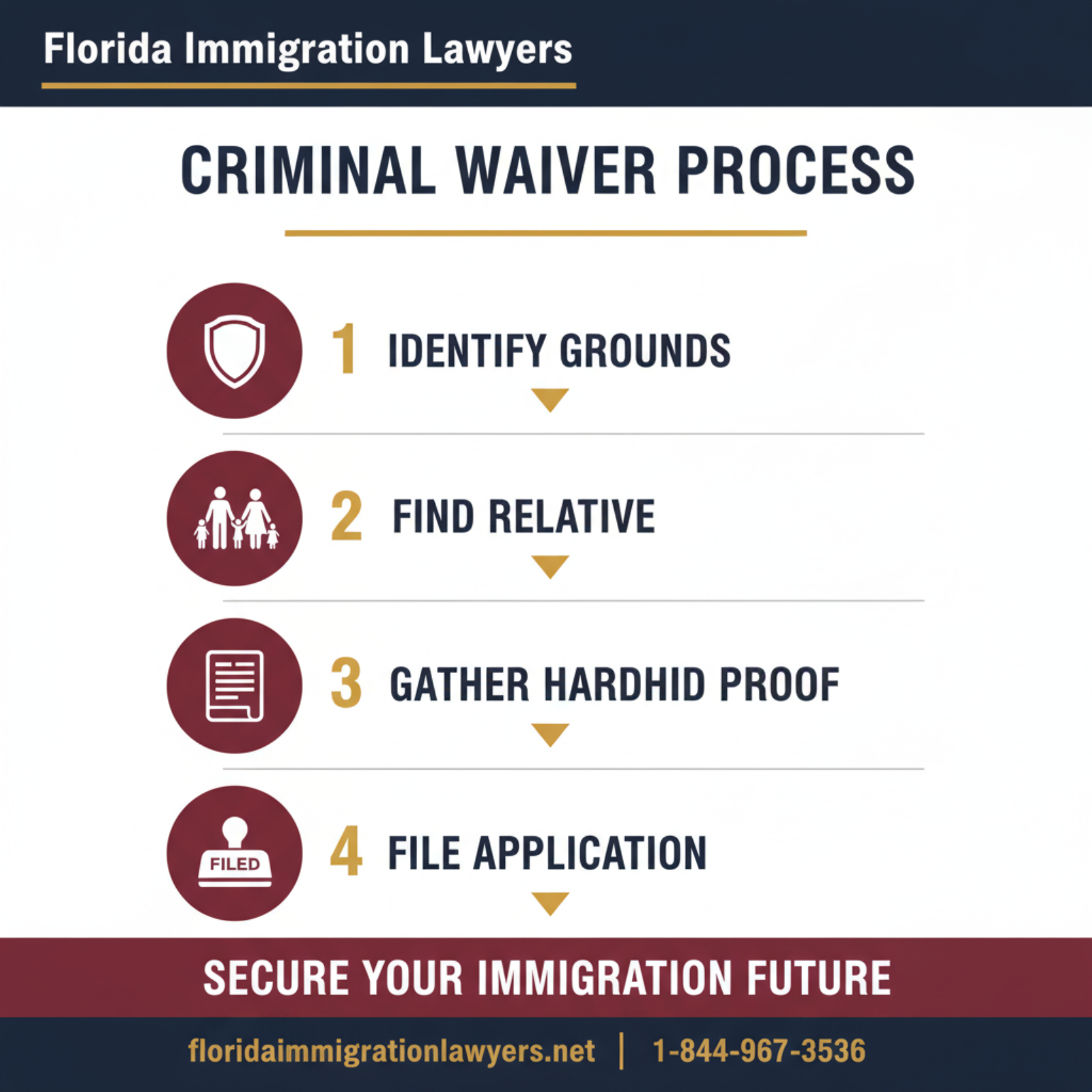
Applying for a criminal waiver is a detailed and often complex process. Precision and thoroughness are paramount to avoid delays or denials, especially when navigating federal immigration statutes. Here is a general step-by-step guide; however, your specific situation may require tailored actions and legal strategy.
- Determine Eligibility: First, a qualified immigration attorney must carefully review your entire criminal record and immigration history. This critical step identifies all potential grounds of inadmissibility or deportability and confirms which specific waiver, like the I-601 or 212(h), you may be eligible for. This includes analyzing the specific statutes under which you were convicted and their immigration equivalents, which can be a complex legal analysis often requiring expert opinion.
- Gather Supporting Documents: You will need to collect a wide array of documents to support your waiver application. This includes certified court dispositions for all convictions (even those expunged or sealed under state law), police records, and extensive evidence demonstrating the "extreme hardship" to your qualifying relative. Evidence can include medical records, psychological evaluations, financial statements, employment letters, school records, and detailed affidavits from various sources. This evidence must paint a clear picture of the severe impact your absence would have.
- Prepare Form I-601 (or other relevant waiver form): Complete the application form accurately and completely. Any errors, omissions, or inconsistencies can lead to Requests for Evidence (RFEs), significant processing delays, or outright denial. Ensure all questions are answered truthfully and all required sections are filled out in accordance with USCIS instructions.
- Draft a Detailed Legal Brief: A crucial part of a strong waiver application is a compelling legal brief prepared by your attorney. This brief outlines the legal arguments for why your waiver should be granted, citing relevant case law, statutory provisions (like 8 U.S.C. § 1182), and immigration policy manual guidance. It meticulously connects your personal circumstances and the submitted evidence to the legal requirements for extreme hardship or other waiver criteria, demonstrating that the positive factors outweigh the negative.
- File the Application with USCIS or EOIR: Once all documents are prepared and the brief is drafted, the application is filed with the appropriate agency. This is typically U.S. Citizenship and Immigration Services (USCIS) for I-601 and I-601A waivers, or with the Executive Office for Immigration Review (EOIR) if you are in removal proceedings before an Immigration Judge in an Orlando or Miami immigration court. The filing location depends on the underlying immigration benefit you are seeking.
- Respond to Requests for Evidence (RFEs): It is common to receive an RFE from USCIS asking for additional information or clarification. Your attorney will help you gather and submit a timely and comprehensive response that directly addresses USCIS's concerns. Failing to respond adequately or on time can lead to a denial without further consideration.
- Attend Interviews (if applicable): Depending on your case and where it is being processed, you may be required to attend an interview with USCIS or at a U.S. consulate abroad. Your attorney can help you prepare thoroughly for this interview, ensuring you understand the types of questions that may be asked and how to present your case effectively.
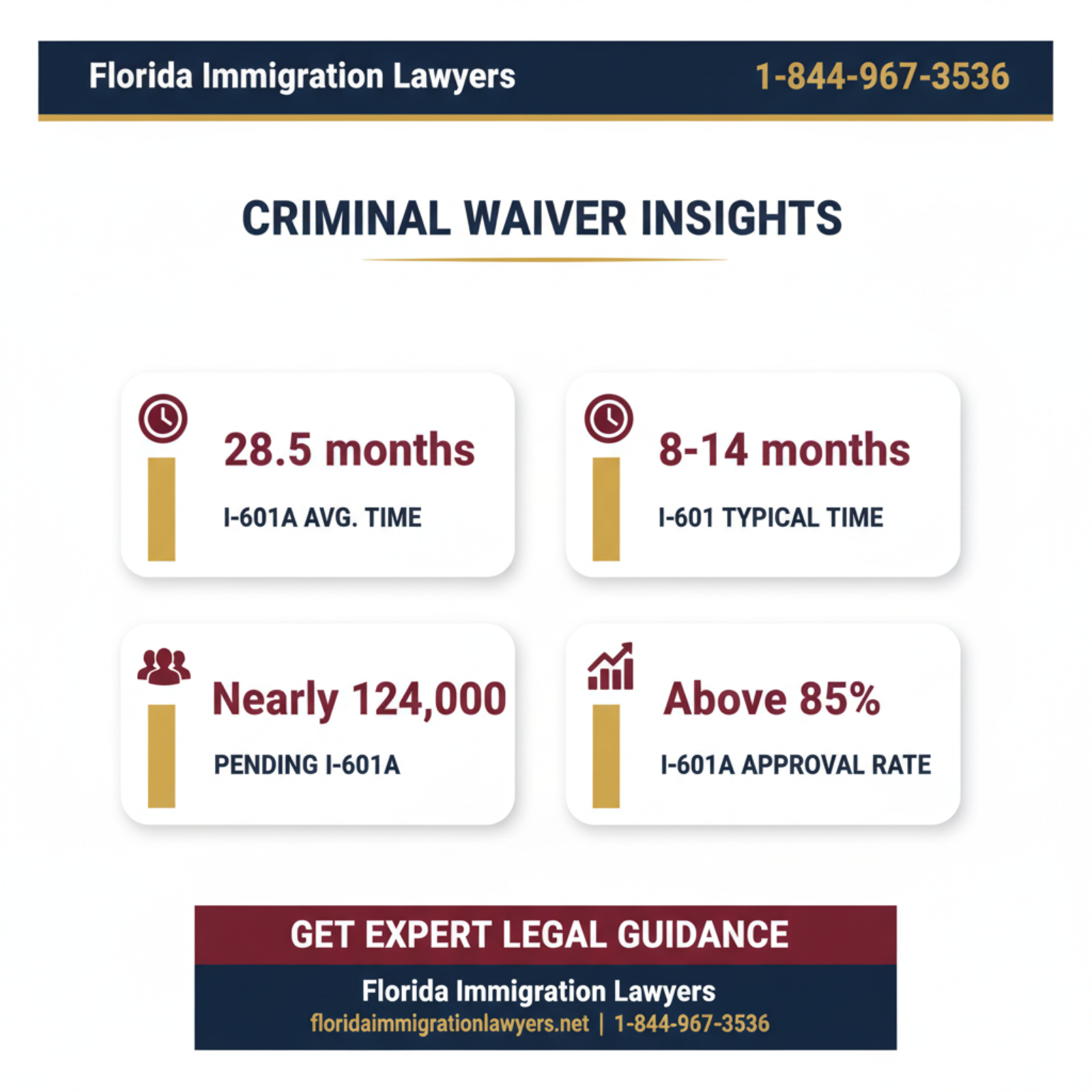
- Receive a Decision: After a thorough review, USCIS or the Immigration Judge will issue a decision on your waiver application. If approved, you can proceed with your underlying immigration application. If denied, your attorney can advise you on potential avenues for appeal, motions to reconsider, or other legal strategies, such as those related to general immigration matters.
Essential Document Checklist for Your Criminal Waiver Application
A successful criminal waiver application hinges on meticulous documentation. Missing even one crucial document can cause significant delays or lead to a denial. While this list is comprehensive, your specific case may require additional evidence, and your attorney will provide a tailored list.
- Certified Court Dispositions: You need certified copies for ALL arrests and convictions, regardless of how minor or old, and even if expunged or sealed. This includes final judgments, sentencing orders, and proof of completion (e.g., probation completion, fines paid). These documents clearly outline the charges, plea, and outcome, which are critical for immigration analysis.
- Police Records: Obtain police records for all arrests, including arrest reports and incident reports. These provide details about the circumstances of the arrest, which can be relevant to the immigration classification
No Navegue Este Proceso Solo
Nuestros abogados de inmigración con experiencia están listos para luchar por usted. Obtenga una consulta gratuita y confidencial hoy.
We Speak English
O deje sus datos y le llamamos:
Evaluación Gratis en 24 Horas
O hable con nosotros ahora

Asistente de voz IA — disponible 24/7
Gratis
William J. Vásquez
Abogado Fundador · Vasquez Law Firm
Veterano de la Fuerza Aérea de EE.UU. y abogado de inmigración con años de experiencia práctica en inmigración de EE.UU. J.D., NCCU School of Law. Miembro de AILA. Admitido en los Circuitos 4.º, 5.º y 11.º.
Disponible 24/7 - Consultas Gratis
Revisado para exactitud legal por William J. Vásquez
Con licencia en Carolina del Norte; la inmigración a EE.UU. es una práctica federal.
Servicios legales relacionados
Nuestros abogados de inmigración en Florida pueden ayudarle con consulta gratis de inmigración, áreas de práctica de inmigración y servicios de inmigración familiar. Llame hoy al 1-844-967-3536 para una consulta gratuita.
Enlaces Relacionados
Temas Relacionados
Consulta Legal Gratuita
Discuta su caso con nuestros abogados experimentados. Estamos disponibles 24/7.
Artículos Relacionados
Abogado de Perdón I-601 Florida: Guía Completa 2026
Abogado de Perdón I-601 en Florida. ¿Inadmisibilidad migratoria? Supera obstáculos y obtén tu residencia. Expertos en perdones I-601 para tu caso.
Abogado de Inmigración Orlando Consulta Gratis 2026
Navegar las complejidades de la ley de inmigración de EE. UU. requiere orientación experta. Para aquellos en Orlando y en toda Florida, una consulta gratuita con un abogado de inmigración puede proporcionar información crucial sobre sus opciones legales sin compromiso financiero. Esta guía completa de Florida Immigration Lawyers detalla por qué una consulta inicial es esencial, qué servicios ofrecen los abogados de inmigración, el proceso paso a paso, los plazos típicos y los costos asociados. También destacamos los errores comunes a evitar y cuándo es crítico buscar asistencia legal profesional. Nuestra firma atiende a toda Florida, incluyendo Naples y el Condado de Collier, asegurando una representación accesible y de alta calidad para familias, negocios, solicitantes de asilo y personas que enfrentan la deportación. Comprenda sus derechos y construya un caso sólido con socios legales de confianza.
Abogado de Inmigración OPT STEM: Guía Florida 2026
Para los estudiantes F-1 en Florida, la extensión OPT STEM ofrece una autorización de trabajo vital de 24 meses después de su OPT inicial. Esta guía, actualizada para 2026, cubre la elegibilidad, el proceso de solicitud paso a paso, los documentos requeridos y los plazos críticos. Los graduados de universidades de Florida en campos STEM deben navegar por las estrictas regulaciones de USCIS, incluido el requisito del empleador E-Verify. Aprenda cómo evitar errores comunes y cuándo buscar asistencia legal profesional de un abogado de inmigración OPT STEM dedicado para garantizar una solicitud exitosa y un crecimiento profesional continuo en EE. UU. Florida Immigration Lawyers ofrece orientación experta a estudiantes en todo el estado.