Canada Open Work Permit August 2025: Your Comprehensive...

Canada Open Work Permit August 2025: Your Comprehensive Guide from Florida
For many individuals in Florida, the dream of living and working in Canada represents an exciting opportunity for professional growth and personal enrichment. Canada's Open Work Permit program offers unparalleled flexibility, allowing foreign nationals to work for almost any employer in Canada without needing a specific job offer upfront. As we approach August 2025, understanding the nuances of this program, especially when applying from Florida, is crucial. This comprehensive guide will walk you through the essential steps, eligibility criteria, and common challenges, ensuring you are well-prepared for a successful application. If you're considering this life-changing move, remember that expert legal guidance can make all the difference. For personalized assistance, don't hesitate to reach out to ${FIRM_NAME} at ${FIRM_PHONE} today.
Understanding the Canada Open Work Permit: What It Is and Who Qualifies
An Open Work Permit in Canada is a non-employer-specific work permit, meaning it does not restrict the holder to a particular job or employer. This flexibility is a significant advantage, allowing permit holders to explore various employment opportunities across Canada's diverse job market. Unlike employer-specific work permits, which require a Labour Market Impact Assessment (LMIA) or an LMIA-exempt offer of employment, an Open Work Permit grants the freedom to work for almost any Canadian employer, subject to a few exceptions (e.g., employers on a list of ineligible employers or those offering adult entertainment services).
Key Benefits of an Open Work Permit
- Flexibility: Work for any eligible employer across Canada.
- Job Market Exploration: Allows individuals to test the waters in different industries and locations without commitment.
- Spousal/Common-Law Partner Eligibility: Often available to spouses or common-law partners of international students or skilled workers in Canada, facilitating family reunification.
- Pathway to Permanent Residency: Gaining Canadian work experience through an open work permit can significantly boost eligibility for various permanent residency programs, such as the Express Entry system.
General Eligibility Criteria
While an Open Work Permit offers broad flexibility, specific eligibility criteria must be met. These often depend on the applicant's current status or their connection to someone already in Canada. Common categories include:
- Spouses or common-law partners of international students or skilled workers in Canada.
- International students who have graduated from a designated learning institution (DLI) and are eligible for the Post-Graduation Work Permit (PGWP).
- Applicants for permanent residence in Canada who are awaiting a decision on their application.
- Refugee claimants and protected persons.
- Individuals under certain public policy or pilot programs.
- Those with a temporary resident permit valid for at least six months.
Regardless of the category, all applicants must meet general admissibility requirements, including being in good health, having no criminal record, and demonstrating sufficient funds to support themselves upon arrival. Understanding your specific category and its unique requirements is the first critical step in the application process. For detailed guidance on your eligibility, consulting with an immigration law expert is highly recommended.
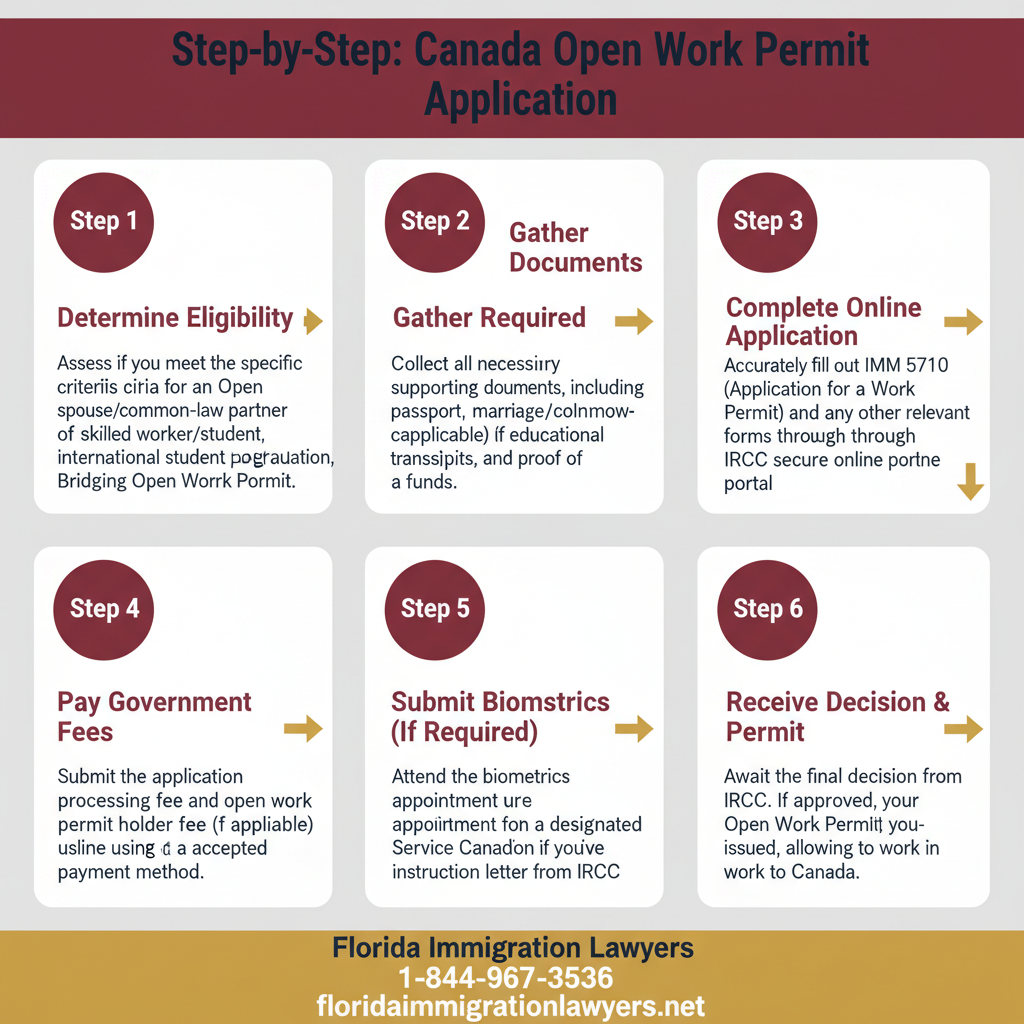
The Application Process from Florida: Step-by-Step Guide
Applying for a Canada Open Work Permit from Florida involves a structured process that requires meticulous attention to detail. While the core requirements are similar for all international applicants, those applying from the U.S. may have specific considerations regarding document collection and submission. It's essential to follow each step carefully to avoid delays or refusals.
Gathering Your Documents
The success of your application heavily relies on providing a complete and accurate set of supporting documents. These typically include:
- Valid Passport: Ensure your passport is valid for the entire duration you intend to stay in Canada.
- Proof of Funds: Demonstrate you have sufficient financial resources to support yourself and any accompanying family members in Canada.
- Medical Examination: Depending on your country of origin and duration of stay, you may need to undergo a medical exam by an IRCC-approved panel physician.
- Police Certificates: Obtain police certificates from any country or territory where you have lived for six months or more since turning 18.
- Marriage Certificate/Proof of Common-Law Relationship: If applying as a spouse or common-law partner.
- Educational Documents: Transcripts, diplomas, or degrees, especially if applying under a PGWP or similar stream.
- Digital Photos: Meeting specific IRCC requirements.
- Application Forms: Duly completed and signed forms, specific to your application stream.
Organizing these documents systematically is crucial. Any missing or incorrect information can lead to significant delays or even outright refusal. For comprehensive assistance with document preparation and review, contact ${FIRM_NAME} at ${FIRM_PHONE}.
Submitting Your Application
Most Open Work Permit applications are submitted online through the Immigration, Refugees and Citizenship Canada (IRCC) secure portal. The process generally involves:
- Creating an IRCC account.
- Completing the online application form.
- Uploading all required supporting documents.
- Paying the application fees (processing fee and open work permit holder fee).
- Providing biometrics (fingerprints and photo) at a designated Service Canada location in the U.S. once you receive an instruction letter.
After submission, you can track the status of your application online. Processing times can vary significantly based on the volume of applications and the specific stream you are applying under. It's advisable to apply well in advance of your intended travel date. Staying informed about the latest processing times on the IRCC website is essential.
Overcoming Common Challenges and Potential Pitfalls
While the Canada Open Work Permit offers incredible opportunities, the application process is not without its challenges. Applicants from Florida, like any other international applicant, may encounter various hurdles that could jeopardize their chances of approval. Understanding these common pitfalls and knowing how to address them proactively is key to a successful outcome. One of the most frequent issues is incomplete applications, where vital documents are missing or forms are filled out incorrectly. This can lead to immediate refusal or significant delays, pushing back your plans considerably. It's not enough to simply submit documents; they must meet IRCC's precise specifications, from photo dimensions to the format of police certificates. Furthermore, demonstrating sufficient financial resources can be a stumbling block for many. IRCC needs assurance that you will not become a public charge in Canada, requiring clear and verifiable proof of funds that meet or exceed their established thresholds. Misrepresentation, whether intentional or unintentional, is another severe issue that can lead to a ban from applying to Canada for several years. This includes providing false information or omitting crucial details on your application forms or during interviews. Therefore, absolute honesty and accuracy are paramount throughout the entire process.
Addressing Inadmissibility Concerns
A significant challenge for some applicants is inadmissibility. This refers to circumstances that prevent an individual from entering Canada, even if they meet the work permit criteria. Common reasons for inadmissibility include:
- Criminality: Having a criminal record, even for minor offenses, can make you inadmissible. This includes convictions outside Canada. Depending on the nature and severity of the crime, there might be options like criminal rehabilitation or a Temporary Resident Permit (TRP). For those with complex legal histories, especially if they have faced issues that might lead to deportation defense concerns in the U.S., seeking specialized legal counsel is critical.
- Health Reasons: Certain medical conditions that could pose a danger to public health or safety, or place an excessive demand on Canada's health or social services, can lead to inadmissibility.
- Security Reasons: Involvement in espionage, subversion, terrorism, or organized crime.
- Financial Reasons: Inability or unwillingness to support oneself or family members.
If you have concerns about potential inadmissibility, it is vital to address them head-on with the guidance of an experienced immigration lawyer. They can assess your situation, advise on possible waivers or remedies, and help prepare a strong case. For general information on travel restrictions and international law, resources like travel.state.gov and justice.gov can provide context, though Canadian immigration law has its own distinct framework.
Navigating Processing Delays
Processing times for Canadian immigration applications can be unpredictable. While IRCC provides estimated processing times, individual applications can take longer due to various factors, including the complexity of the case, the volume of applications, and unforeseen administrative issues. Delays can be frustrating, especially when you have made plans based on initial estimates. To mitigate the impact of delays, ensure your application is as complete and error-free as possible from the outset. Respond promptly to any requests for additional information from IRCC. If your application experiences an unusually long delay, an immigration lawyer can help inquire with IRCC on your behalf and provide updates. Proactive communication and meticulous preparation are your best defenses against these common challenges. For assistance in navigating these complexities, contact ${FIRM_NAME} at ${FIRM_PHONE}.
After Approval: What to Expect Upon Arrival in Canada
Once your Open Work Permit application is approved, you will receive a Letter of Introduction (LOI) from IRCC. This letter is not your actual work permit but rather an authorization to enter Canada and receive your permit. Upon arrival at a Canadian Port of Entry (POE), you will present your LOI, passport, and any other required documents to a Canada Border Services Agency (CBSA) officer. The officer will verify your identity and eligibility, and if everything is in order, they will issue your Open Work Permit. It is crucial to review the permit immediately to ensure all details, such as your name, validity period, and conditions, are correct. Your work permit will specify the conditions you must follow while working in Canada, which typically include the type of work you can do (open), the employer (any eligible employer), and the validity period. Be prepared to answer questions about your purpose of visit, financial means, and plans in Canada. Having all your original documents readily accessible will facilitate a smooth entry process.
Why Expert Legal Guidance is Crucial for Florida Applicants
Navigating the intricacies of Canadian immigration law, especially when applying for an Open Work Permit from Florida, can be a daunting task. The legal landscape is complex, with ever-evolving policies and strict requirements. Errors or omissions in your application can lead to significant delays, refusals, and even long-term bars from re-applying. This is where the expertise of a dedicated immigration law firm becomes invaluable.
${FIRM_NAME} specializes in assisting individuals from Florida with their Canadian immigration goals. Our experienced attorneys understand the unique challenges faced by U.S.-based applicants and can provide tailored advice and representation. We can help you:
- Assess Eligibility: Determine the most suitable Open Work Permit stream for your specific situation.
- Document Preparation: Ensure all required documents are accurately prepared, translated, and submitted according to IRCC guidelines.
- Application Review: Meticulously review your entire application package to minimize the risk of errors or omissions.
- Address Complex Issues: Provide strategic advice on how to handle inadmissibility concerns, previous refusals, or other complicated aspects of your case.
- Representation: Act as your authorized representative with IRCC, handling all communications and inquiries on your behalf.
Whether you're exploring options for immigration law, considering asylum claims, or facing deportation defense challenges, our firm offers comprehensive legal support. Our team of experienced attorneys is committed to providing clear, compassionate, and effective legal solutions. Don't leave your future to chance. For insights into U.S. immigration processes that might inform your overall strategy, you can also consult resources like USCIS, showcasing our broad understanding of immigration systems. Secure your Canadian dream with confidence. Contact us today to schedule a consultation and let ${FIRM_NAME} guide you through every step of your journey. Call us at ${FIRM_PHONE} for immediate assistance.
Conclusion
The Canada Open Work Permit for August 2025 presents an incredible opportunity for Florida residents seeking new professional and personal horizons. While the application process demands thoroughness and attention to detail, with the right preparation and expert legal guidance, a successful outcome is well within reach. By understanding the eligibility criteria, meticulously preparing your documents, and anticipating potential challenges, you can significantly enhance your chances of approval. Remember, securing your future in Canada begins with a well-executed application. For unparalleled support and peace of mind throughout this journey, trust the dedicated team at ${FIRM_NAME}. We are here to help you navigate the complexities of Canadian immigration law and turn your aspirations into reality. Reach out to us at ${FIRM_NAME} at ${FIRM_PHONE} to start your application process today.
No Navegue Este Proceso Solo
Nuestros abogados de inmigración con experiencia están listos para luchar por usted. Obtenga una consulta gratuita y confidencial hoy.
We Speak English
Preguntas Frecuentes
Vasquez Law Firm
Abogado de Inmigración | Fundador, Vasquez Law Firm
Veterano de la Fuerza Aérea de EE.UU. y abogado de inmigración con miles de casos resueltos. J.D., NCCU School of Law. Miembro de AILA. Admitido en los Circuitos 4.°, 5.° y 11.°
Disponible 24/7 - Consultas Gratis
Servicios legales relacionados
Nuestros abogados de inmigración en Florida pueden ayudarle con consulta gratis de inmigración, áreas de práctica de inmigración y servicios de inmigración familiar. Llame hoy al 1-844-967-3536 para una consulta gratuita.
Enlaces Relacionados
Temas Relacionados
Consulta Legal Gratuita
Discuta su caso con nuestros abogados experimentados. Estamos disponibles 24/7.
Artículos Relacionados
Entrevista Stokes: Navegando el Fraude Matrimonial en Florida
Una entrevista Stokes es una entrevista especializada y separada realizada por USCIS cuando existen sospechas de fraude matrimonial en una solicitud de tarjeta de residencia. Este riguroso proceso implica el interrogatorio individual de los cónyuges, centrándose en las inconsistencias de sus testimonios para determinar la autenticidad de su vínculo matrimonial. Para las parejas en Florida, navegar esta entrevista de alto riesgo requiere una preparación meticulosa, una documentación exhaustiva y, a menudo, la orientación estratégica de un abogado de inmigración experimentado. Comprender el proceso, prepararse para preguntas detalladas y presentar un caso sólido son cruciales para superar las acusaciones de fraude matrimonial y asegurar su futuro migratorio. Florida Immigration Lawyers está listo para ayudarle.
Abogado de Inmigración Gainesville: Ayuda Legal Norte Florida
Para aquellos en Gainesville, el Condado de Alachua y en todo el Norte de Florida, navegar por la ley de inmigración de EE. UU. requiere orientación experta. Un abogado de inmigración experimentado puede simplificar procesos complejos, desde peticiones familiares y visas de empleo hasta reclamos críticos de asilo y defensa contra la deportación. Esta guía completa describe los servicios esenciales proporcionados por un abogado de inmigración, detalla la documentación necesaria, aclara los tiempos de procesamiento y analiza los costos asociados. También destacamos los errores comunes a evitar y los escenarios cruciales donde el asesoramiento legal es indispensable. Florida Immigration Lawyers atiende a todo Florida, incluyendo Gainesville y St. Petersburg, brindando apoyo legal dedicado para ayudarle a alcanzar sus metas migratorias. Contáctenos para una consulta gratuita para discutir sus necesidades específicas.
Naturalización Militar Acelerada en Bases de Florida
Descubre el proceso de naturalización militar acelerada para miembros de servicio en bases de Florida como MacDill. Aprende sobre elegibilidad, pasos y errores comunes. Contacta a Florida Immigration Lawyers para una consulta gratuita.
