N-600 Certificate of Citizenship Florida Children | VLF Flor
For families in Florida, the N-600 Certificate of Citizenship is a vital document for children who have derived or acquired U.S. citizenship through their parents. This certificate provides official proof of citizenship, which is essential for obtaining a U.S. passport, accessing federal benefits, and establishing identity. This comprehensive guide from Florida Immigration Lawyers explains the eligibility criteria under INA 320 and 322, detailing who qualifies and the conditions that must be met, such as having a U.S. citizen parent and the child being under 18 and a lawful permanent resident. We outline a step-by-step process for filing the N-600 application, including gathering necessary documents like birth certificates, green cards, and proof of parental citizenship. The guide also covers expected processing timelines for 2026 and the various cost factors involved, from USCIS filing fees to potential legal expenses. We highlight common mistakes to avoid, such as incomplete documentation or incorrect eligibility assessments, which can lead to delays or denials. Finally, we discuss when it is crucial to seek legal counsel, particularly for complex cases involving adoptions, prior denials, or criminal histories. Florida Immigration Lawyers is dedicated to assisting families in Jacksonville and across Florida, offering expert guidance to ensure your child's citizenship is formally recognized.

An N-600 Certificate of Citizenship is an official document from USCIS proving a child's U.S. citizenship. It is crucial for children who derived citizenship automatically through their U.S. citizen parent(s) but lack a birth certificate from the U.S. This certificate confirms their status, easing access to passports, federal benefits, and educational opportunities. For families in Florida, navigating the N-600 process can be complex due to specific documentation and legal requirements. Understanding eligibility, gathering precise documents, and correctly submitting the application are vital steps to ensure your child's citizenship is formally recognized.
- The N-600 confirms U.S. citizenship for children who derived it through their parents.
- Eligibility typically requires a U.S. citizen parent, the child being under 18, and residing in the U.S. as a Legal Permanent Resident (LPR).
- The application process involves detailed documentation, fee payment, and potentially an interview at a USCIS office in Florida.
- A Certificate of Citizenship provides definitive proof, essential for passports and other benefits.
- Seeking legal guidance from Florida Immigration Lawyers can significantly streamline the application process.
For many families in Florida, securing their child's future begins with establishing their legal status. If your child acquired or derived U.S. citizenship through their parents, but they do not have a U.S. birth certificate, the N-600 Certificate of Citizenship is the official document that formally recognizes their status. This certificate is not just a piece of paper; it is a fundamental tool that opens doors to countless opportunities, from obtaining a U.S. passport to accessing federal student aid and proving identity without question. Understanding the nuances of the N-600 process, especially for children in Florida, is critical. This comprehensive guide from Florida Immigration Lawyers will walk you through the eligibility requirements, the step-by-step application process, necessary documentation, and potential challenges. We aim to empower you with the knowledge to secure your child's rightful place as a U.S. citizen. Do not leave your child's future to chance. Call Florida Immigration Lawyers at 1-844-967-3536 for a free consultation and let our experienced team assist you.
Understanding the N-600 Certificate of Citizenship for Children in Florida
The N-600, Application for Certificate of Citizenship, is a form filed with U.S. Citizenship and Immigration Services (USCIS) to obtain a Certificate of Citizenship. This document serves as official proof of U.S. citizenship for individuals who automatically became citizens through their U.S. citizen parents. Unlike naturalization (Form N-400), which grants citizenship, the N-600 simply provides official recognition of a citizenship status already acquired or derived by law. This is particularly relevant for children born outside the U.S. to U.S. citizen parents, or for children who became Legal Permanent Residents (LPRs) and whose U.S. citizen parent then naturalized.
In Florida, families often encounter situations where a child's citizenship status is clear under the law, but they lack a formal document like a U.S. birth certificate to prove it. For instance, a child might have entered the U.S. on a green card and automatically derived citizenship when a parent naturalized. While legally a citizen, they still need the N-600 certificate to easily obtain a U.S. passport, vote, or access other citizen benefits. This certificate is especially important for children adopted by U.S. citizens or those who moved to Florida after a parent's naturalization. Our firm, Florida Immigration Lawyers, understands the unique circumstances of families across Jacksonville and other Florida communities. We are dedicated to helping you navigate this vital process to secure your child's future.
The concept of derived citizenship is established under the Immigration and Nationality Act (INA), specifically INA Sections 320 and 322 (8 U.S.C. §§ 1431 and 1433). These sections outline the conditions under which children automatically become U.S. citizens. For example, INA 320 states that a child born outside the U.S. automatically becomes a U.S. citizen when certain conditions are met, including having at least one U.S. citizen parent, being under 18 years of age, being a lawful permanent resident, and residing in the U.S. in the legal and physical custody of the U.S. citizen parent. The N-600 process is designed to formalize this status, providing peace of mind and tangible proof of citizenship for your child.
Eligibility Requirements for Derived Citizenship via N-600
Determining eligibility for the N-600 Certificate of Citizenship involves specific criteria outlined by USCIS and the Immigration and Nationality Act. Generally, a child may be eligible for derived or acquired citizenship if they meet the following conditions under INA 320 or INA 322. It is crucial to understand these requirements fully, as even minor discrepancies can lead to delays or denials. Our team at Florida Immigration Lawyers can help assess your child's specific situation to ensure they meet all necessary criteria before filing.
Automatic (Derived) Citizenship under INA 320 (8 U.S.C. § 1431)
A child born outside the United States automatically becomes a U.S. citizen if all of the following conditions are met on or after February 27, 2001:
- At least one parent is a U.S. citizen by birth or naturalization.
- The child is under the age of 18.
- The child is a lawful permanent resident (has a Green Card).
- The child is residing in the United States in the legal and physical custody of the U.S. citizen parent.
If these conditions were met at any point before the child's 18th birthday, citizenship was automatically conferred. The N-600 then serves to document this existing citizenship. This is a common scenario for families throughout Florida, including those in Jacksonville, Orlando, and Miami, where children may have obtained green cards through a parent and then the parent later naturalized.
Acquired Citizenship under INA 322 (8 U.S.C. § 1433)
This section applies to children who did not automatically derive citizenship but whose U.S. citizen parent wants to apply for citizenship on their behalf. This is often relevant for children residing abroad. The requirements are similar, but the child does not need to be a lawful permanent resident (Green Card holder) at the time of application. The U.S. citizen parent must file Form N-600K (Application for Citizenship and Issuance of Certificate Under Section 322) and meet other specific criteria, including the parent's physical presence in the U.S. for a certain period. While less common for children already in Florida, it is an important distinction.
Understanding whether your child's citizenship is derived or acquired, and which INA section applies, is paramount. Mistakes in this initial assessment can lead to significant delays. The dedicated citizenship lawyers at Florida Immigration Lawyers are adept at analyzing complex family histories and immigration statuses to determine the correct path for your child. We ensure that all eligibility criteria are thoroughly reviewed before proceeding with the N-600 application, providing clarity and confidence to families across Florida.
Step-by-Step Guide to Filing Your N-600 Application in Florida
Filing the N-600 application can be a meticulous process, but breaking it down into manageable steps can help. For families in Florida, understanding each stage is key to a successful outcome. Our firm, Florida Immigration Lawyers, provides comprehensive assistance at every step, ensuring accuracy and compliance with USCIS requirements.
- Determine Eligibility: The very first step is to confirm that your child meets all the eligibility criteria for derived or acquired citizenship as outlined in INA 320 or 322. This involves reviewing the U.S. citizen parent's naturalization or birth certificate, the child's birth certificate, and their immigration history.
- Gather Required Documents: Collect all necessary supporting documents, which will include proof of parent's U.S. citizenship, proof of relationship, child's birth certificate, child's Green Card (if applicable), marriage certificates (if applicable), and any divorce decrees. We will provide a detailed checklist in the next section.
- Complete Form N-600: Accurately fill out Form N-600, Application for Certificate of Citizenship. Ensure all questions are answered truthfully and completely. Any omissions or errors can cause delays. Pay close attention to sections asking about dates of entry, residency, and parental status.
- Prepare Supporting Evidence: Organize your gathered documents clearly. Make copies of everything; never send original documents unless specifically requested by USCIS. Ensure all foreign language documents are accompanied by certified English translations.
- Pay the Filing Fee: As of 2026, there is a filing fee for Form N-600. Check the official USCIS website for the most current fee schedule. You can pay by money order, personal check, cashier's check, or credit card using Form G-1450. Fee waivers may be available for eligible applicants, but these are rare for N-600 filings.
- Mail the Application Package: Send your completed Form N-600, all supporting documents, and the fee payment to the correct USCIS lockbox facility. The specific address depends on where you reside in Florida. Always use a mailing service that provides tracking and delivery confirmation.
- Attend Biometrics Appointment: After filing, USCIS will send a notice for a biometrics appointment to collect fingerprints, photographs, and a signature. This typically occurs at a local Application Support Center (ASC) in Florida, such as the one in Jacksonville or Orlando. The child and the U.S. citizen parent may need to attend.
- Attend Interview (If Required): In some cases, USCIS may schedule an interview to clarify information or review documents. This interview would likely take place at a USCIS field office, such as the one in Jacksonville. While not all N-600 applicants are interviewed, it is important to be prepared.
- Receive Decision: USCIS will mail a decision. If approved, your child will receive their Certificate of Citizenship. If denied, the notice will explain the reasons, and you may have options to appeal or refile.
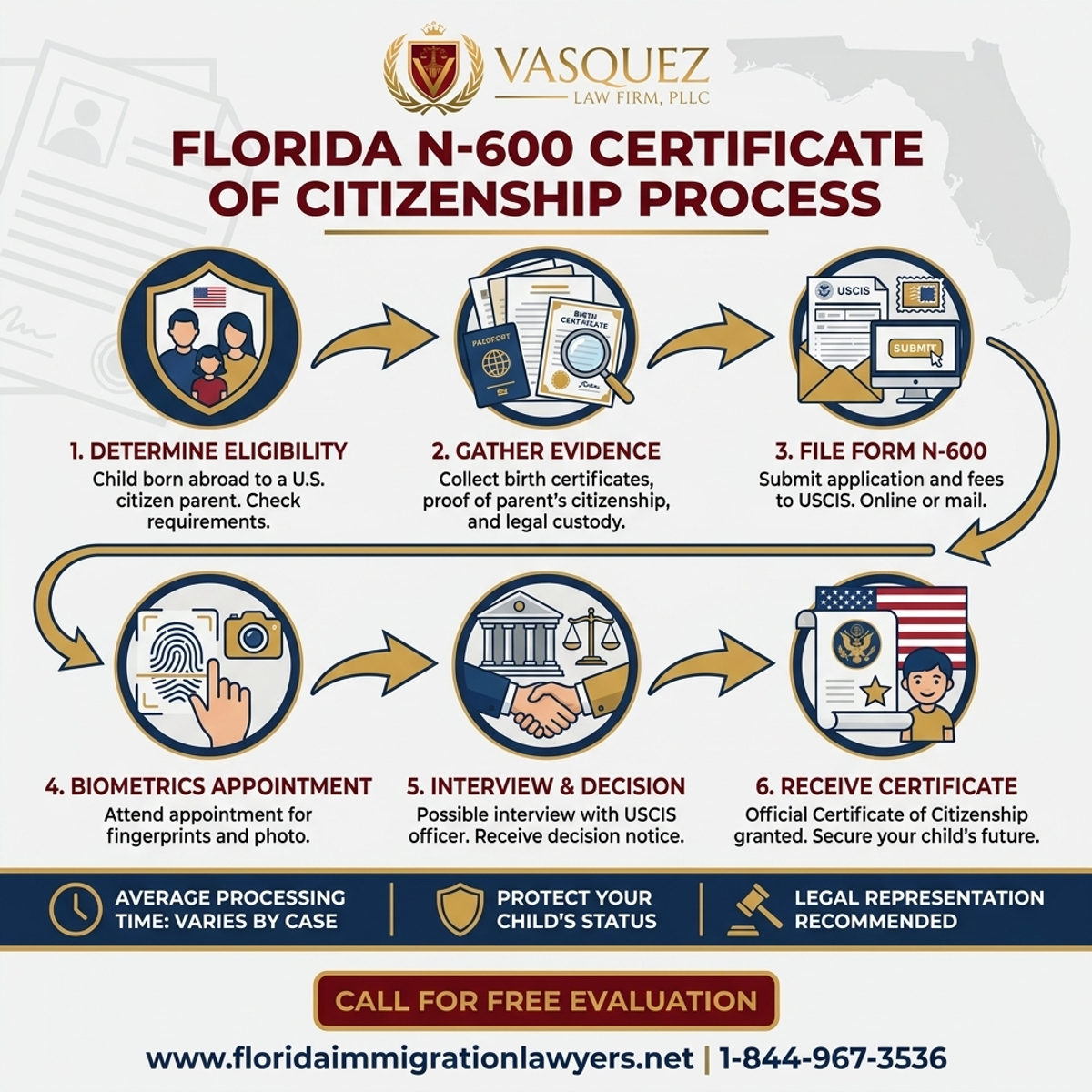
Step-by-Step Process — N-600 Certificate of Citizenship Florida Children
This process can take several months, and staying organized is crucial. Our family immigration attorneys at Florida Immigration Lawyers are here to guide you through each step, ensuring your application is complete, accurate, and submitted correctly, minimizing potential delays for your child's N-600 Certificate of Citizenship in Florida.
Essential Document Checklist for N-600 Applicants
A complete and accurate submission of supporting documents is critical for a successful N-600 application. Missing or incorrect documents are among the most common reasons for delays or denials. Below is a comprehensive checklist of documents typically required. Please remember that specific circumstances may require additional evidence, and all foreign language documents must be accompanied by a certified English translation.
- Child's Birth Certificate: Showing the child's birth name, date, and place, and parents' names.
- Proof of Child's Lawful Permanent Resident (LPR) Status: Copy of the child's Green Card (Form I-551).
- Proof of Parent's U.S. Citizenship:
- U.S. Birth Certificate (if born in the U.S.).
- Certificate of Naturalization (Form N-550 or N-570).
- Certificate of Citizenship (Form N-560 or N-561).
- Valid unexpired U.S. Passport.
- Proof of Parent-Child Relationship:
- Child's birth certificate listing the U.S. citizen parent(s).
- Marriage certificate(s) for the U.S. citizen parent(s) (if applicable).
- Divorce decrees or death certificates for prior marriages (if applicable).
- Adoption decree (if the child was adopted).
- Proof of Legal and Physical Custody (for INA 320 cases):
- If parents are married, marriage certificate is usually sufficient.
- If parents are separated or divorced, court orders granting sole or joint legal and physical custody to the U.S. citizen parent.
- School records, medical records, or other documents showing the child resides with the U.S. citizen parent.
- Proof of Residence in the United States (for INA 320 cases):
- School records, medical records, or utility bills showing the child's address in Florida.
- Rental agreements or mortgage statements.
- Photographs: Two identical passport-style photographs of the child.
- Previous Immigration Documents: Copies of any prior immigration forms or notices (e.g., I-130, I-485 approval notices).
- Certified English Translations: For any document not in English.
Compiling these documents can be overwhelming, especially when dealing with international records or complex family structures. Florida Immigration Lawyers has extensive experience in preparing thorough and accurate N-600 packages for clients across Florida, ensuring that all required evidence is included to support your child's claim to citizenship. We understand the specific requirements of the USCIS Jacksonville Field Office and other local processing centers, helping you avoid common pitfalls.
N-600 Processing Timelines and Cost Factors in 2026
Understanding the potential processing timelines and associated costs is crucial when preparing to file an N-600 application for your child. While USCIS strives for efficiency, processing times can vary significantly based on the service center's workload, the complexity of the case, and the completeness of the submitted application. Florida Immigration Lawyers helps manage expectations by providing insights into current trends and what you can anticipate.
Processing Expectations in Florida
As of 2026, N-600 processing times can range from several months to over a year. You can check the most current estimates directly on the USCIS Processing Times webpage by selecting Form N-600 and your specific service center or field office (e.g., the Jacksonville Field Office). Factors that can influence processing speed include:
- USCIS Workload: High volumes of applications can naturally extend processing times.
- Completeness of Application: Applications with missing documents or errors will likely be delayed or even rejected.
- Need for Interview: If an interview is required, it adds another step to the timeline.
- Responses to Requests for Evidence (RFEs): If USCIS requests additional information, your prompt and thorough response is critical.
After filing, you will receive a receipt notice (Form I-797C) within a few weeks. This notice contains a receipt number that you can use to track your case online. Following the biometrics appointment, the next significant update is usually the interview notice (if applicable) or the final decision. Our firm regularly monitors USCIS processing trends relevant to Florida residents to keep our clients informed.
Cost Factors and Fee Breakdown
The primary cost associated with the N-600 application is the USCIS filing fee. Please note that USCIS fees are subject to change, so always verify the current fee on the official USCIS website before submitting your application. As of our current understanding, the fee for Form N-600 is substantial. There is typically no separate biometrics fee for N-600 applicants, as it is included in the filing fee.
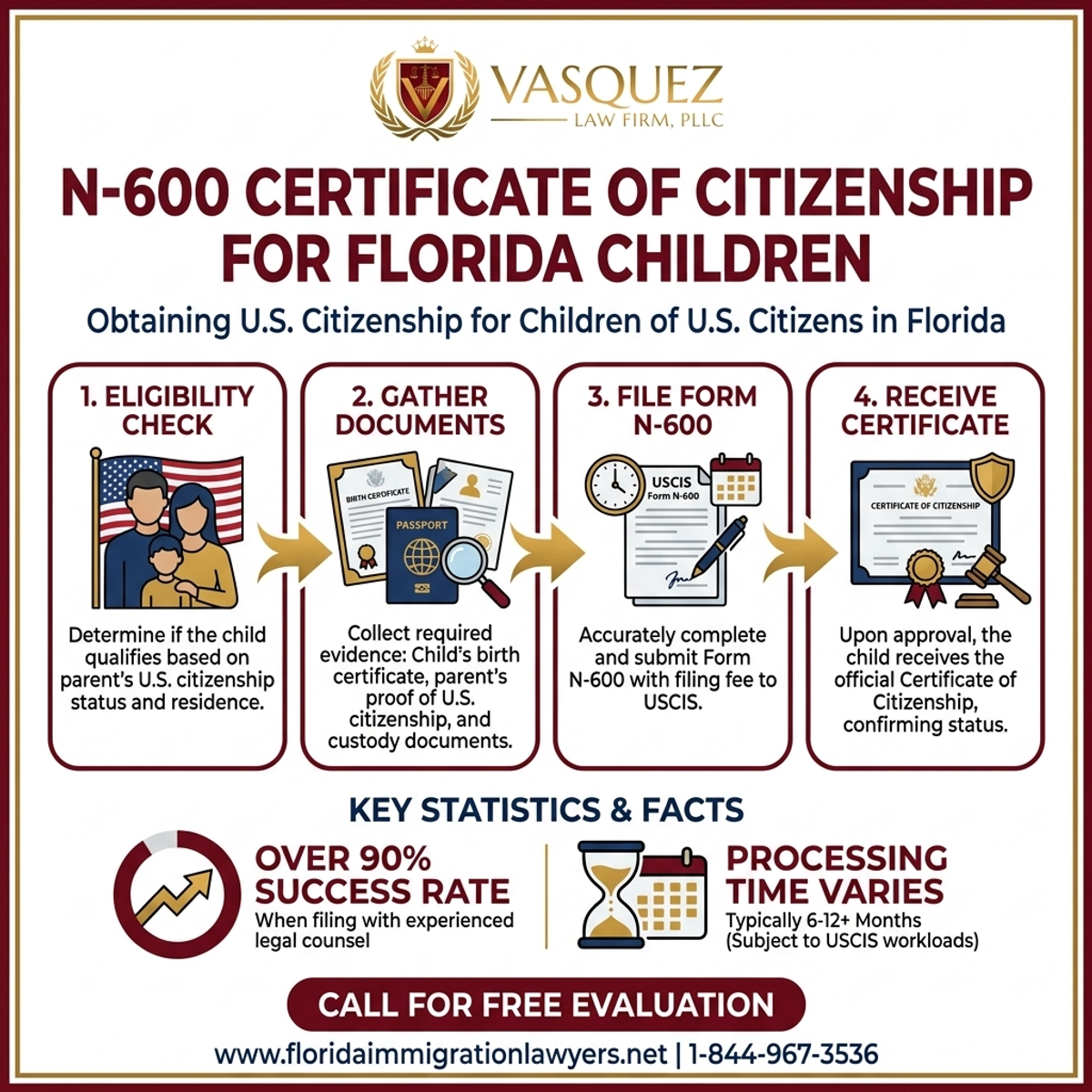
Key Statistics — N-600 Certificate of Citizenship Florida Children
Beyond the USCIS fee, other potential costs might include:
- Legal Fees: Hiring an experienced immigration attorney, like those at Florida Immigration Lawyers, to prepare and submit your application. While an additional cost, legal representation can significantly increase the likelihood of approval and reduce stress.
- Document Translation Fees: If any of your supporting documents are not in English, you will need certified translations, which incur separate costs.
- Photography Fees: For passport-style photos of the child.
- Travel Expenses: For attending biometrics appointments or interviews at USCIS offices in Florida.
Investing in legal assistance for your child's N-600 application is an investment in their future. It ensures that the application is meticulously prepared, all supporting documents are correctly presented, and any potential issues are addressed proactively. Do not hesitate to contact Florida Immigration Lawyers for a free consultation to discuss the costs and benefits of legal representation for your child's N-600 Certificate of Citizenship in Florida.
Do not navigate this process alone. Contact Florida Immigration Lawyers today to ensure your child's N-600 application is handled with the expertise and care it deserves. Our dedicated team is ready to assist you.
Common Mistakes to Avoid When Filing for an N-600 Certificate of Citizenship
The N-600 application, while seemingly straightforward for derived citizenship, is prone to common errors that can lead to significant delays or even denial. Avoiding these pitfalls is crucial for a smooth process. Florida Immigration Lawyers helps clients sidestep these issues with careful preparation and expert guidance.
- Incorrectly Determining Eligibility: Many families assume their child is eligible without thoroughly checking all conditions under INA 320 or 322. Forgetting the child must be a Legal Permanent Resident (LPR) and in the legal and physical custody of the U.S. citizen parent at the time citizenship derived is a frequent error. This can lead to an application for a child who is not yet a citizen.
- Missing or Incomplete Documentation: Failing to submit all required supporting documents, such as birth certificates, marriage licenses, or naturalization certificates, is a primary cause of Requests for Evidence (RFEs) and delays. USCIS needs clear proof for every claim.
- Inaccurate Information on Form N-600: Any discrepancies between the information provided on the N-600 form and supporting documents can raise red flags. Dates of entry, names, or addresses must be consistent across all submitted materials. Even small errors can lead to scrutiny.
- Not Providing Certified English Translations: All documents not in English must be accompanied by a complete and accurate English translation, certified by the translator. Submitting untranslated documents will result in rejection or RFE.
- Failure to Prove Legal and Physical Custody: For children whose parents are divorced or separated, providing insufficient evidence of the U.S. citizen parent's legal and physical custody can be a major hurdle. Court orders or detailed affidavits are often necessary.
- Incorrect Filing Fee or Payment Method: USCIS fees change periodically. Submitting an incorrect fee amount or using an unacceptable payment method will cause the application to be rejected and returned, wasting valuable time.
- Sending Original Documents: Unless specifically requested, never send original documents. Always submit clear, legible copies. USCIS may not return original documents, and losing them can create significant problems.
- Missing Biometrics Appointment: Failing to attend the scheduled biometrics appointment without proper rescheduling can lead to the denial of the application. These appointments are mandatory for identity verification.
- Not Responding to Requests for Evidence (RFEs): If USCIS sends an RFE, failing to respond within the given timeframe, or providing an incomplete response, will almost certainly lead to a denial.
- Lack of Professional Review: Attempting to navigate the complex N-600 process without legal counsel often results in overlooking critical details or misinterpreting legal requirements. An experienced attorney can identify potential issues before submission.
When to Call a Lawyer for Your N-600 Application
While the N-600 process might seem straightforward for some, there are many situations where the expertise of an immigration attorney is not just helpful, but essential. Navigating the complexities of immigration law, especially when a child's future is at stake, requires precision and a deep understanding of USCIS policies and the Immigration and Nationality Act. Florida Immigration Lawyers is here to provide that crucial support.
You should consider contacting an attorney if any of the following scenarios apply to your child's N-600 application:
- Complex Family Situations: This includes adoption cases, children born out of wedlock, stepchildren, or situations involving divorced or separated parents where custody is not clearly defined. These cases often require additional evidence and legal arguments to establish the parent-child relationship and custody.
- Previous Denials or RFEs: If your N-600 application was previously denied, or if you received a Request for Evidence (RFE) that you are unsure how to address, an attorney can review the reasons for the denial or RFE and help you strategize a new approach or appeal.
- Criminal History: If either the U.S. citizen parent or the child has any criminal history, even minor offenses, it can complicate the application. An attorney can assess the impact of such history and advise on potential waivers or mitigation strategies.
- Unclear Immigration History: If the child's or parent's immigration history is complex, has gaps, or involves any past violations, an attorney can help clarify the record and ensure all necessary information is presented correctly to USCIS.
- Concerns about Interviews: If you are nervous about the possibility of an interview at a USCIS field office in Florida (e.g., Jacksonville) or believe there are aspects of your case that might be questioned, an attorney can prepare you for the interview and even attend with you.
- Lost or Unavailable Documents: If crucial documents like birth certificates, marriage licenses, or naturalization certificates are lost or difficult to obtain, an attorney can guide you on acceptable secondary evidence or alternative proofs.
- Expedited Processing Needs: While N-600 applications are rarely expedited, if there is a compelling humanitarian reason, an attorney can help articulate and submit an expedited request.
Do not take chances with your child's citizenship. The experienced immigration attorneys at Florida Immigration Lawyers provide comprehensive legal services for N-600 applications, from initial eligibility assessment to preparing documents, responding to USCIS inquiries, and representing you at interviews. We serve families across Florida, including Jacksonville, Orlando, Tampa, and Miami, ensuring that your child's path to formal citizenship is as smooth and successful as possible. Your child's future is our priority.
About Florida Immigration Lawyers
Florida Immigration Lawyers is a leading immigration law firm dedicated to serving individuals and families across the entire state of Florida. With a deep understanding of U.S. immigration laws and policies, our experienced attorneys provide compassionate, effective, and results-driven legal representation. We specialize in a wide range of immigration matters, including family-based petitions, citizenship and naturalization, asylum, deportation defense, and business immigration. Our firm is committed to helping clients achieve their American dream by navigating the complex legal landscape with clarity and confidence.
We pride ourselves on our client-centered approach, offering personalized attention to each case. Our team understands the unique challenges faced by immigrant communities in Florida, from Jacksonville to Miami, and we are dedicated to providing accessible and high-quality legal services. We offer free consultations to discuss your specific needs and develop a tailored strategy. Available 24/7, Florida Immigration Lawyers is always here to provide expert guidance and support. Se Habla Español, ensuring that language is never a barrier to justice. Contact us today at 1-844-967-3536 or visit https://www.floridaimmigrationlawyers.net to learn how we can assist you and your family.
Sources and References
- U.S. Citizenship and Immigration Services (USCIS) - Form N-600
- U.S. Citizenship and Immigration Services (USCIS) - Check Case Processing Times
- Executive Office for Immigration Review (EOIR)
- 8 U.S.C. § 1431 - Immigration and Nationality Act (INA) Section 320 (Children born outside the United States and residing permanently in the United States; conditions for automatic citizenship)
- 8 U.S.C. § 1433 - Immigration and Nationality Act (INA) Section 322 (Children born outside the United States; naturalization on application of citizen parent)
- 8 CFR Part 320 - Children of Citizen Parents
- 8 CFR Part 322 - Child Residing Outside United States
- USCIS Policy Manual, Volume 12 - Citizenship and Naturalization, Part H - Children of U.S. Citizens
Related services: immigration practice areas, asylum protection.
This article provides general legal information and is not intended as legal advice. Every case is unique, and outcomes depend on specific facts and circumstances. Contact an attorney for advice about your particular situation. Immigration laws are subject to frequent change.
Securing your child's N-600 Certificate of Citizenship is a fundamental step towards their future. Do not navigate this crucial process without expert legal guidance. Florida Immigration Lawyers offers free consultations to help you understand your options and ensure a smooth, successful application. Call us today at 1-844-967-3536. Se Habla Espanol - Estamos aqui para ayudarle.
Do Not Navigate This Process Alone
Our experienced immigration attorneys are ready to fight for you. Get a free, confidential consultation today.
Se Habla Español
Frequently Asked Questions
Florida Immigration Lawyers
Immigration Attorney | Founder, Vasquez Law Firm
U.S. Air Force veteran and immigration attorney with thousands of cases resolved. J.D., NCCU School of Law. AILA member. Admitted to the 4th, 5th, and 11th Circuit Courts.
Available 24/7 - Free Evaluations
Related Legal Services
Our Florida immigration attorneys can help you with immigration practice areas, free immigration consultation and experienced immigration attorneys. Call today at 1-844-967-3536 for a free consultation.
Related Links
Related Topics
Free Legal Consultation
Discuss your case with our experienced attorneys. We're available 24/7.
Se Habla Español - Estamos aquí para ayudarle.
Related Articles
Expungement's Effect on Immigration in Florida | VLF Florida
Expungement can affect your immigration status in Florida. Learn how a sealed record influences immigration consequences and why consulting a lawyer is essential for navigating these complex issues.
Free Immigration Consultation: Legal Help in Florida
Navigating immigration in Fort Lauderdale can be complex. Our free consultation offers guidance on legal options and strategies. Contact Florida Immigration Lawyers for support today.
Citizenship Delay in Florida: What to Know | VLF Florida
Experiencing delays in your citizenship application in Florida? Learn about N-400 processing and USCIS backlog issues, and when to seek legal help. Call us for a free consultation.
Child Status Protection Act: Navigating CSPA in Florida
Learn how the Child Status Protection Act (CSPA) helps protect children's immigration status in Florida. This guide covers eligibility, documentation, timelines, and common mistakes. For personalized advice, call Florida Immigration Lawyers at 1-844-967-3536.