Understanding the I-864 Affidavit of Support in Florida
Learn about the I-864 Affidavit of Support, a critical step for sponsoring family members in Florida. This guide covers requirements, common mistakes, and when to seek legal counsel. Contact Florida Immigration Lawyers for expert assistance.

- It's legally binding for sponsors.
- Joint sponsors may be needed if income requirements aren't met.
- It's required for most family-based immigrants.
Introduction
For many immigrants in Florida, particularly in Naples and surrounding areas, the I-864 Affidavit of Support is a pivotal step in their journey. This document, required for most family-based immigrants, ensures that the immigrant will not become a public charge. In this post, we cover everything you need to know about the I-864, from requirements to common pitfalls. Call Florida Immigration Lawyers at 1-844-967-3536 for a free consultation to ensure your process is seamless.
The concept of a 'public charge' is central to U.S. immigration policy, aiming to ensure that new immigrants can support themselves financially and do not rely on government assistance. The I-864 serves as a robust guarantee from the sponsor to the U.S. government, affirming that they will provide financial backing to the sponsored immigrant. This commitment is not merely a formality; it carries significant legal weight and long-term implications for the sponsor.
Understanding the intricacies of the I-864 is vital to avoid delays or even denial of an immigration petition. From accurately calculating household income to gathering the correct supporting documents, each step demands meticulous attention. For residents of Florida navigating these complex requirements, especially in bustling communities like Naples, having expert legal guidance can make all the difference in achieving a successful outcome for their loved ones.
What is the I-864 Affidavit of Support?
The I-864 Affidavit of Support is a legally binding contract between a sponsor and the U.S. government. It confirms that the sponsor will financially support the immigrant, preventing them from becoming a public charge. This affidavit is typically required when sponsoring family members for a green card. In Florida, this process is crucial for ensuring a stable transition for immigrants into the U.S. economy.
This legally binding agreement means the sponsor is obligated to reimburse any federal, state, or local agency that provides means-tested public benefits to the sponsored immigrant. This obligation generally lasts until the immigrant becomes a U.S. citizen, has worked for 40 quarters (approximately 10 years) in the U.S., departs the U.S. permanently, or passes away. It's a serious commitment, and sponsors should fully understand the financial responsibilities they are undertaking.
The purpose of the I-864 extends beyond just financial assurance; it also acts as a safeguard against potential strain on public resources. By requiring a sponsor to demonstrate sufficient income or assets, the U.S. government ensures that immigrants have a support system in place as they integrate into American society. This is particularly important for family-based immigration, where the primary goal is family reunification while upholding fiscal responsibility.
Who Needs to Submit an I-864?
Generally, the I-864 is required for those sponsoring a relative for immigration. This includes U.S. citizens and lawful permanent residents sponsoring family members. In some cases, a joint sponsor might be necessary if the primary sponsor’s income doesn’t meet the requirements. Joint sponsors must also complete an I-864 and meet the same financial eligibility.
The primary sponsor must be at least 18 years old, a U.S. citizen or lawful permanent resident, and domiciled in the U.S. (meaning their principal residence is in the United States). They must also demonstrate income at or above 125% of the Federal Poverty Guidelines for their household size. For active duty military personnel sponsoring their spouse or child, the income requirement is slightly lower, at 100% of the Federal Poverty Guidelines.
A joint sponsor is an individual who agrees to accept legal responsibility for the sponsored immigrant along with the primary sponsor. This becomes necessary if the primary sponsor's income, even when combined with their household members' income or assets, falls short of the required threshold. A joint sponsor must independently meet all the same requirements as the primary sponsor, including age, domicile, citizenship/LPR status, and the 125% income threshold for their own household size. It's important to note that a joint sponsor cannot simply supplement the primary sponsor's income; they must be able to support the immigrant fully on their own.
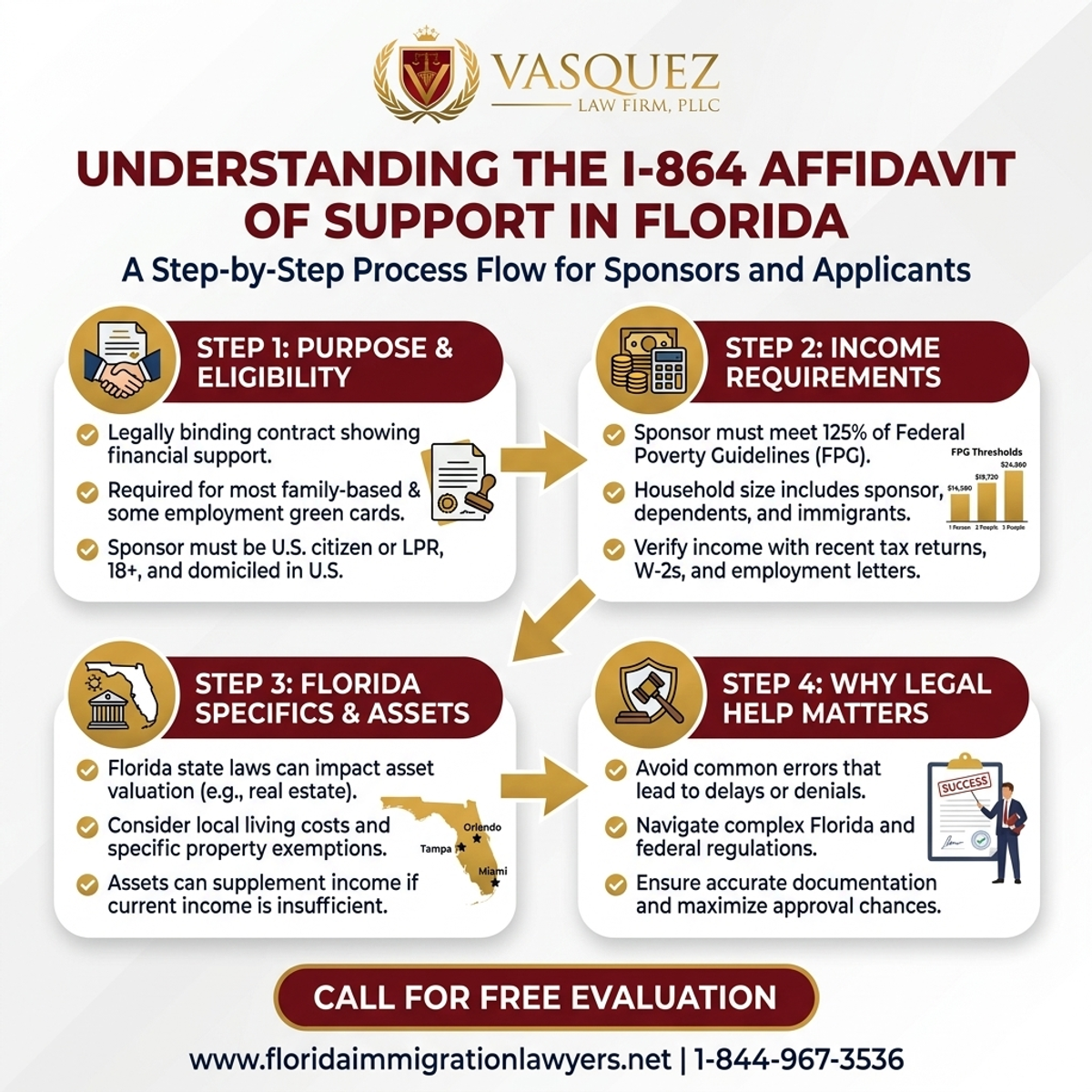
Step-by-Step Process — Understanding the I-864 Affidavit of Support in Florida
Step-by-Step Guide to Completing the I-864
- Gather financial documents: This includes tax returns, W-2s, and pay stubs.
- Complete the I-864 form: Provide accurate information about your income and household size.
- Submit additional documentation: This might include proof of citizenship or residency.
- Mail the completed form to USCIS: Follow instructions specific to your case number.
Completing these steps correctly is crucial. If you need assistance, don't hesitate to reach out to a qualified immigration attorney.
Step 1: Gather financial documents. This is perhaps the most critical initial step. You'll need your federal income tax returns for the most recent tax year. While USCIS generally only requires the most recent year, it's advisable to have the past three years available, as they may be requested. Along with tax returns, gather all W-2 forms for wage earners, 1099 forms for independent contractors, and recent pay stubs (typically for the last six months). If you are self-employed, you will need your tax returns with all schedules, including Schedule C or Schedule F, to demonstrate your business income. Ensure all documents are clear and legible.
Step 2: Complete the I-864 form accurately. The I-864 form itself is multi-page and requires detailed information about both the sponsor and the intending immigrant. Pay close attention to sections like Part 4, which asks for your household size. This calculation is crucial and includes yourself, the intending immigrant(s), your dependents, and anyone else you have previously sponsored on an I-864. An incorrect household size can lead to an inaccurate income requirement calculation, potentially causing delays. Always use the most current version of the form from the USCIS website.
Step 3: Submit additional documentation. Beyond financial records, you must include proof of your U.S. citizenship or lawful permanent residency, such as a copy of your birth certificate, U.S. passport, or green card. If you are relying on assets to meet the income requirements, you will need to provide documentation for those assets, such as bank statements, property deeds, or stock certificates. Ensure that all copies are clear and that you keep originals for your records. If any documents are not in English, they must be accompanied by a certified English translation.
Step 4: Mail the completed form to USCIS or the National Visa Center (NVC). The specific mailing address depends on whether the immigrant is applying for adjustment of status within the U.S. or through consular processing abroad. If it's consular processing, the I-864 and supporting documents are usually sent to the National Visa Center (NVC). For adjustment of status, it's typically filed with the I-485 application at a USCIS lockbox facility. Always refer to the specific instructions for your case to ensure proper filing. Missing a signature or sending it to the wrong address can result in rejection and significant delays.
Document Checklist for the I-864
- Form I-864
- Most recent tax return
- W-2 forms
- Pay stubs from recent months
- Proof of citizenship or residency
- Proof of relationship to the immigrant
Each item on this checklist is critical for a complete and successful I-864 submission. The Form I-864 itself must be the latest version, fully completed and signed. Your most recent federal income tax return, including all schedules, provides a comprehensive overview of your financial standing, demonstrating your ability to meet the income threshold. W-2 forms and recent pay stubs offer additional proof of current employment and income stability, corroborating the information on your tax returns.
Proof of citizenship or lawful permanent residency is required to establish your eligibility as a sponsor. This could be a copy of your U.S. birth certificate, passport, naturalization certificate, or green card. Finally, while not directly part of the I-864 package, proof of relationship to the immigrant (e.g., marriage certificate, birth certificate) is essential for the underlying immigration petition, ensuring the sponsored individual is indeed eligible for family-based immigration. Always organize these documents clearly and make copies for your records before submitting.
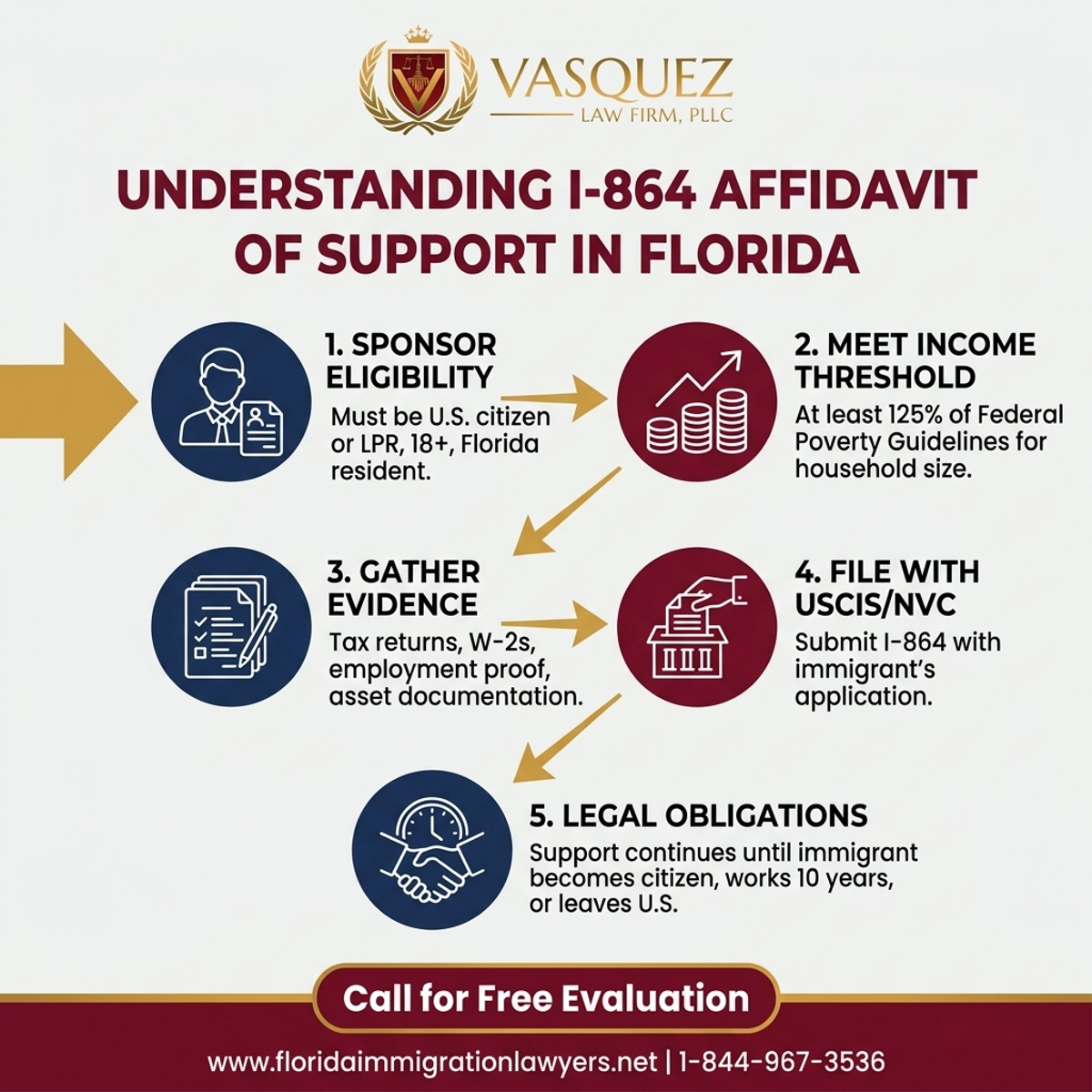
Key Statistics — Understanding the I-864 Affidavit of Support in Florida
Timeline and Processing Expectations
The processing time for the I-864 can vary. Generally, it takes a few months for USCIS to process the form. However, delays are possible, especially in high-demand areas like Florida. Recent court rulings have aimed to expedite processing times, but applicants should remain patient and ensure all documents are correctly submitted to avoid further delays.
Several factors can influence the processing timeline. The volume of applications at USCIS or the National Visa Center (NVC) plays a significant role, as does the completeness and accuracy of your submission. If your application lacks necessary documentation or contains errors, you will likely receive a Request for Evidence (RFE), which can add several weeks or even months to the overall processing time. Responding to an RFE promptly and thoroughly is crucial to keep your case moving forward.
For those undergoing consular processing, the I-864 is typically reviewed by the NVC before the immigrant's interview at a U.S. embassy or consulate abroad. The NVC's internal processing times can fluctuate, and applicants can often track their case status online. For adjustment of status cases filed within the U.S., the I-864 is reviewed as part of the overall I-485 application, and the processing time will align with the I-485 timeline for your specific USCIS field office. Staying informed and proactive, perhaps by consulting Florida Immigration Lawyers, can help manage expectations and address potential issues quickly.
Cost Factors and Fee Breakdown
There is no direct filing fee for the I-864. However, costs can arise from gathering necessary documents, such as obtaining certified copies of tax returns. Additionally, legal assistance may incur fees, but this can be invaluable in ensuring accuracy and compliance with immigration laws.
While USCIS does not charge a separate fee for filing Form I-864, applicants should budget for various indirect expenses. These can include fees for obtaining official government documents like birth certificates or marriage licenses, which might be necessary to prove relationships or sponsor eligibility. If any supporting documents are in a foreign language, certified translation services will incur costs, typically ranging from $20 to $50 per page. Notary public fees for certain affidavits can also add up.
Furthermore, if the sponsor relies on assets (like real estate or bank accounts) to meet the income threshold, they might need appraisals or official statements, which could involve fees. The most significant potential cost, though often a wise investment, is legal representation. An experienced immigration attorney from Florida Immigration Lawyers can help prepare the I-864, review supporting documents, and respond to RFEs, significantly reducing the risk of costly delays or denials. This expertise helps ensure the process is handled correctly the first time, saving time and potential future expenses.
Common Mistakes to Avoid
- Not meeting income requirements: Ensure your income is sufficient, or consider a joint sponsor.
- Incomplete forms: Double-check all sections of the I-864 are filled out.
- Lack of supporting documents: Include all necessary financial documents.
- Incorrect household size: Accurately count all dependents and household members.
- Using outdated forms: Always use the most current version of the I-864.
- Failure to sign: Unsigned forms will be rejected.
- Misunderstanding obligations: Sponsors are legally responsible for supporting the immigrant.
Each of these common mistakes can lead to significant delays or even denial of the immigration petition. For instance, not meeting income requirements is a frequent pitfall; sponsors must ensure their income is at least 125% of the Federal Poverty Guidelines for their household size. If not, exploring a qualified joint sponsor or demonstrating significant assets is crucial. Incomplete forms often result in a Request for Evidence (RFE) from USCIS, which prolongs the process. Take the time to review every field carefully.
Lack of supporting documents, such as missing tax returns, W-2s, or proof of identity, will inevitably lead to an RFE or rejection. Always refer to the official instructions and the document checklist provided by Florida Immigration Lawyers. An incorrect household size calculation can lead to an erroneous income threshold, making it seem like you don't meet the requirements when you actually do, or vice versa. Be meticulous in counting everyone who should be included.
Using outdated forms is a simple but common error; USCIS frequently updates its forms, so always download the latest version directly from their website. Failure to sign the I-864 form will result in immediate rejection, as an unsigned form holds no legal weight. Finally, misunderstanding the obligations means sponsors might not fully grasp the long-term financial and legal responsibilities they are undertaking, which can have serious repercussions for years to come. It’s essential to be fully aware of the commitment before signing.
When to Call a Lawyer
If you're unsure about any part of the I-864 process, consulting with an immigration attorney is crucial. Legal advice is particularly important if:
- Your income doesn't meet the requirements.
- You're unsure about document requirements.
- There are changes in your financial situation.
Beyond the situations listed, legal counsel becomes indispensable in more complex scenarios. For example, if you have a complicated financial history, multiple sources of income, or if your income fluctuates significantly year to year, an attorney can help present your financial stability in the best possible light. Similarly, if the immigrant has a history of receiving public benefits, or if there are any other potential public charge issues, an attorney can help navigate these complexities and prepare a robust case.
Working with an attorney also provides peace of mind. They can help you accurately calculate your household size, determine the correct income threshold, and identify if a joint sponsor is truly needed. If you're considering a joint sponsor, an attorney can guide both parties through their respective obligations and ensure all forms are correctly completed. Don't hesitate to reach out to Florida Immigration Lawyers at 1-844-967-3536 for a free consultation to assess your specific needs and ensure a smooth application process.
About Florida Immigration Lawyers
Florida Immigration Lawyers is dedicated to providing expert legal assistance for immigration matters throughout Florida. Our team offers personalized guidance to help navigate the complexities of immigration law. For assistance, call 1-844-967-3536 or visit our website. We're available 24/7 to help you achieve your immigration goals.
Sources and References
- U.S. Citizenship and Immigration Services (USCIS)
- Executive Office for Immigration Review (EOIR)
- 8 U.S.C. Chapter 12 - Immigration and Nationality Act
Related services: immigration practice areas, family immigration services, citizenship and naturalization, deportation defense.
This article provides general legal information and is not intended as legal advice. Every case is unique, and outcomes depend on specific facts and circumstances. Contact an attorney for advice about your particular situation.
For personalized assistance with your immigration journey, call Florida Immigration Lawyers at 1-844-967-3536 for a free consultation. Se Habla Español - Estamos aquí para ayudarle.
If you need legal assistance, learn more about Florida immigration legal team, or call us at 1-844-967-3536 for a free consultation.
Do Not Navigate This Process Alone
Our experienced immigration attorneys are ready to fight for you. Get a free, confidential consultation today.
Se Habla Español
Frequently Asked Questions
Florida Immigration Lawyers
Immigration Attorney | Founder, Vasquez Law Firm
U.S. Air Force veteran and immigration attorney with thousands of cases resolved. J.D., NCCU School of Law. AILA member. Admitted to the 4th, 5th, and 11th Circuit Courts.
Available 24/7 - Free Evaluations
Related Legal Services
Our Florida immigration attorneys can help you with immigration practice areas, free immigration consultation and experienced immigration attorneys. Call today at 1-844-967-3536 for a free consultation.
Related Links
Related Topics
Free Legal Consultation
Discuss your case with our experienced attorneys. We're available 24/7.
Se Habla Español - Estamos aquí para ayudarle.
Related Articles
Family Petition Immigration Lawyer Miami: Your Florida Guide
For families in Miami, Kissimmee, and across Florida, securing a family petition is often the first step towards reuniting with loved ones in the U.S. This process, which typically begins with filing Form I-130, Petition for Alien Relative, requires meticulous attention to detail and a thorough understanding of U.S. immigration law. From proving a legitimate family relationship to navigating extensive documentation and often lengthy processing times, the journey can be complex. An experienced family petition immigration lawyer can provide invaluable guidance, helping to avoid common pitfalls, respond to USCIS requests, and ensure a smooth application process. Florida Immigration Lawyers offers dedicated legal support to families statewide, helping them achieve their dreams of reunification.
Immigration Interview Preparation Florida: Your Guide
Preparing for your immigration interview in Florida is a pivotal step towards securing your future. This comprehensive guide provides essential tips, a detailed step-by-step preparation plan, and a crucial document checklist to ensure you are fully ready for your USCIS interview. Learn about common mistakes to avoid, understand processing timelines, and identify when legal assistance from experienced Florida immigration lawyers is vital. Whether you are in Hialeah, Miami, or Orlando, navigating your green card, naturalization, or asylum interview requires meticulous attention to detail and professional guidance. Florida Immigration Lawyers offers free consultations to help you prepare effectively and confidently.
DACA Renewal Florida 2026 Guide for Dreamers | VLF Florida
For DACA recipients in Florida, understanding the DACA renewal process for 2026 is vital. This comprehensive guide details eligibility, step-by-step procedures, essential documents, timelines, and costs. Learn how to file your Form I-821D and I-765, avoid common mistakes, and ensure continuous residence. We cover specific considerations for Dreamers in St. Petersburg and across Florida, emphasizing the importance of timely and accurate submissions to USCIS. Discover when legal assistance from Florida Immigration Lawyers can be crucial, especially for complex cases involving criminal history or travel outside the U.S. Get expert advice to protect your deferred action status and employment authorization.
DACA Renewal Florida 2026 Guide for Dreamers | VLF Florida
Learn how to renew your DACA in Florida for 2026. This guide provides essential steps, common pitfalls, and resources available to Dreamers in Hialeah and beyond. Call Florida Immigration Lawyers at 1-844-967-3536 for a free consultation.
