Family Petition Immigration Lawyer Miami: Your Florida Guide
For families in Miami, Kissimmee, and across Florida, securing a family petition is often the first step towards reuniting with loved ones in the U.S. This process, which typically begins with filing Form I-130, Petition for Alien Relative, requires meticulous attention to detail and a thorough understanding of U.S. immigration law. From proving a legitimate family relationship to navigating extensive documentation and often lengthy processing times, the journey can be complex. An experienced family petition immigration lawyer can provide invaluable guidance, helping to avoid common pitfalls, respond to USCIS requests, and ensure a smooth application process. Florida Immigration Lawyers offers dedicated legal support to families statewide, helping them achieve their dreams of reunification.

Securing a family petition, often initiated via Form I-130, Petition for Alien Relative, is a fundamental step for many individuals seeking to immigrate to the United States through a qualifying family relationship. This complex process involves demonstrating a legitimate familial bond, navigating extensive paperwork, meeting strict eligibility criteria, and often enduring lengthy processing times. For families in Miami, Kissimmee, and across Florida, having an experienced immigration lawyer is crucial to ensure all requirements are met, common pitfalls are avoided, and the application proceeds smoothly, ultimately helping families reunite.
- A family petition establishes a qualifying relationship for immigration.
- The process typically begins with Form I-130 filed with USCIS.
- Eligibility depends on the petitioner's status and the familial relationship.
- Expert legal guidance is vital to navigate complexities and avoid delays.
- Florida Immigration Lawyers helps families in Miami, Kissimmee, and statewide.
Navigating the intricate landscape of U.S. immigration law can feel like an overwhelming journey, especially when your family's future hangs in the balance. For many individuals and families in vibrant Florida communities like Miami and Kissimmee, the dream of reuniting with loved ones or starting a new life together in the United States begins with a family petition. This critical legal step, often involving the Form I-130, is the foundation for family-based immigration. Understanding each phase, from establishing eligibility to submitting comprehensive documentation, is paramount to a successful outcome.
At Florida Immigration Lawyers, we understand the profound importance of family reunification. Our dedicated team of experienced attorneys is committed to guiding you through every complexity of the family petition process, whether you are sponsoring a spouse, child, parent, or sibling. We serve clients throughout Florida, including those in Miami-Dade, Orange, and Osceola counties, providing personalized and compassionate legal support. Don't let the daunting paperwork and legal jargon deter you from your family's future. For expert assistance with your family petition or any immigration matter, call Florida Immigration Lawyers at 1-844-967-3536 for a free consultation today.
Understanding the Family Petition Process: Your Path to Reunification
The family petition process is the cornerstone of family-based immigration to the United States. It officially begins when a U.S. citizen or lawful permanent resident (LPR) files a Form I-130, Petition for Alien Relative, with U.S. Citizenship and Immigration Services (USCIS). This form serves to establish a legitimate qualifying relationship between the petitioner (the U.S. citizen or LPR) and the beneficiary (the family member seeking to immigrate). Without an approved I-130, the beneficiary generally cannot proceed with their application for a green card or immigrant visa. The categories of relationships are specifically defined by the Immigration and Nationality Act (INA), specifically INA §201 and INA §203(a), which outline immediate relatives and family-preference categories, respectively.
Immediate relatives include spouses of U.S. citizens, unmarried children under 21 of U.S. citizens, and parents of U.S. citizens (if the citizen is 21 or older). These categories are not subject to annual visa quotas, meaning there is no waiting list once the I-130 is approved and a visa becomes immediately available. In contrast, family-preference categories, such as unmarried adult children of U.S. citizens, spouses and children of LPRs, married children of U.S. citizens, and siblings of U.S. citizens, are subject to numerical limitations and often involve significant waiting periods. These waiting times can vary dramatically based on the beneficiary's country of origin and the specific preference category, sometimes spanning several years or even decades. Understanding your specific category is crucial for setting realistic expectations for the timeline of your case.
The process is more than just filling out a form; it requires meticulous attention to detail and a thorough understanding of immigration regulations. From collecting robust evidence of your relationship to ensuring all biographical information is consistent, every step matters. For families in Miami and Kissimmee, working with a knowledgeable family petition immigration lawyer can make a significant difference in preparing a strong and accurate petition, reducing the likelihood of Requests for Evidence (RFEs) or denials. Our firm helps you gather the necessary documentation and articulate your case effectively to USCIS.
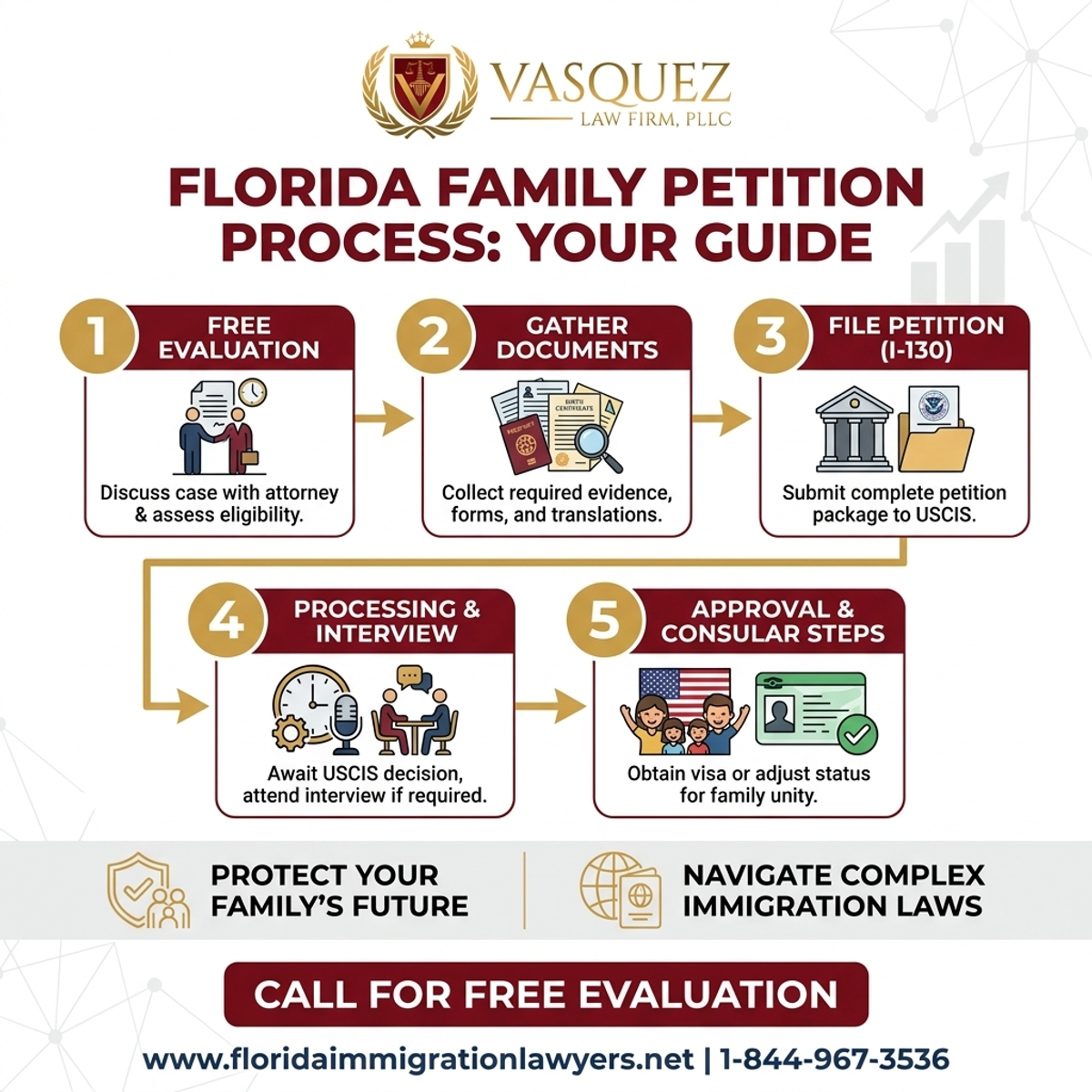
Step-by-Step Guide to Filing a Family Petition in Florida
Embarking on the family petition journey requires a structured approach. Here is a detailed step-by-step guide to help you understand the typical process, keeping in mind that each case has unique circumstances.
-
Determine Eligibility and Relationship Category: The first crucial step is to confirm that the petitioner (U.S. citizen or LPR) has a qualifying relationship with the beneficiary. This includes verifying the petitioner's status and the nature of the family tie (e.g., spouse, child, parent, sibling). This determination directly impacts whether the beneficiary falls into an immediate relative or a preference category, which in turn affects visa availability and waiting times. For instance, a U.S. citizen sponsoring a spouse will have a different timeline than an LPR sponsoring a married child. Consulting with a family petition immigration lawyer in Miami or Kissimmee can help you accurately assess your eligibility and choose the correct path.
-
Gather Required Documentation: Comprehensive and accurate documentation is critical for a successful petition. This includes proof of the petitioner's U.S. citizenship or LPR status, evidence of the qualifying relationship (e.g., marriage certificates, birth certificates, adoption decrees), and proof of termination of any prior marriages for both parties, if applicable. You will also need to collect evidence demonstrating the bona fides of your relationship, especially for spousal petitions, which might include joint bank accounts, shared utility bills, photographs, and affidavits from friends and family. Organizing these documents meticulously from the outset can prevent delays and RFEs from USCIS.
-
File Form I-130, Petition for Alien Relative: The petitioner files Form I-130 with USCIS, along with all supporting documentation and the required filing fee. The specific USCIS Lockbox facility or service center where you mail your petition depends on your place of residence and the type of petition. For Florida residents, this often means submitting to a Dallas or Chicago Lockbox. It is vital to ensure that the form is completed accurately and all questions are answered truthfully. Incomplete or incorrectly filed petitions are a common cause of delays or rejections. You can find detailed filing instructions and forms on the USCIS website.
-
USCIS Processing and Approval: After submission, USCIS will send a receipt notice (Form I-797C, Notice of Action). They will then review the petition, conduct background checks, and may request additional evidence (RFE) if information is missing or unclear. Once satisfied, USCIS will approve the I-130. The approval signifies that the familial relationship has been established for immigration purposes. If the beneficiary is already in the U.S. and eligible, they may be able to file for Adjustment of Status (Form I-485) concurrently or shortly after the I-130 approval, especially for immediate relatives. For those outside the U.S., the approved petition is forwarded to the National Visa Center (NVC).
-
National Visa Center (NVC) Processing (for beneficiaries abroad): If the beneficiary is outside the U.S., the approved I-130 is sent to the NVC. The NVC collects additional documents, including financial support forms (Form I-864, Affidavit of Support), civil documents, and visa application forms (DS-260). They ensure all required fees are paid and documents are submitted before scheduling an interview at a U.S. embassy or consulate in the beneficiary's home country. This stage is crucial for ensuring visa readiness and often involves extensive communication with the NVC. The NVC provides detailed instructions and checklists for this stage.
-
Immigrant Visa Interview (for beneficiaries abroad) or Adjustment of Status Interview (for beneficiaries in the U.S.): For beneficiaries abroad, the final step is an interview at a U.S. embassy or consulate. During the interview, a consular officer will review the application and supporting documents and determine if the beneficiary is eligible for an immigrant visa. For beneficiaries in the U.S. adjusting status, an interview will be scheduled at a local USCIS field office, such as the USCIS Hialeah Field Office or the Orlando Field Office, where an officer will review their application, conduct background checks, and make a final decision on their green card application. Preparation for these interviews is key, and a lawyer can help you anticipate questions and present your case confidently.
Essential Documents for Your Family Petition
A well-prepared family petition hinges on submitting a complete and accurate set of supporting documents. Missing or incorrect documents are among the most common reasons for delays or rejections. Here is a comprehensive checklist of documents typically required:
- Proof of Petitioner's U.S. Citizenship or Lawful Permanent Resident (LPR) Status:
- U.S. Birth Certificate (for citizens)
- U.S. Passport (for citizens)
- Certificate of Naturalization (Form N-550 or N-570) or Certificate of Citizenship (Form N-560 or N-561) (for citizens)
- Copy of Green Card (Form I-551, for LPRs)
- Proof of Qualifying Relationship:
- For Spouses: Marriage certificate, joint bank account statements, joint leases/mortgages, joint utility bills, photographs showing shared life, affidavits from people who know the couple.
- For Children: Birth certificate showing the petitioner as a parent, adoption decree (for adopted children).
- For Parents: Petitioner's birth certificate showing the beneficiary as a parent.
- For Siblings: Birth certificates of both petitioner and beneficiary, showing at least one common parent.
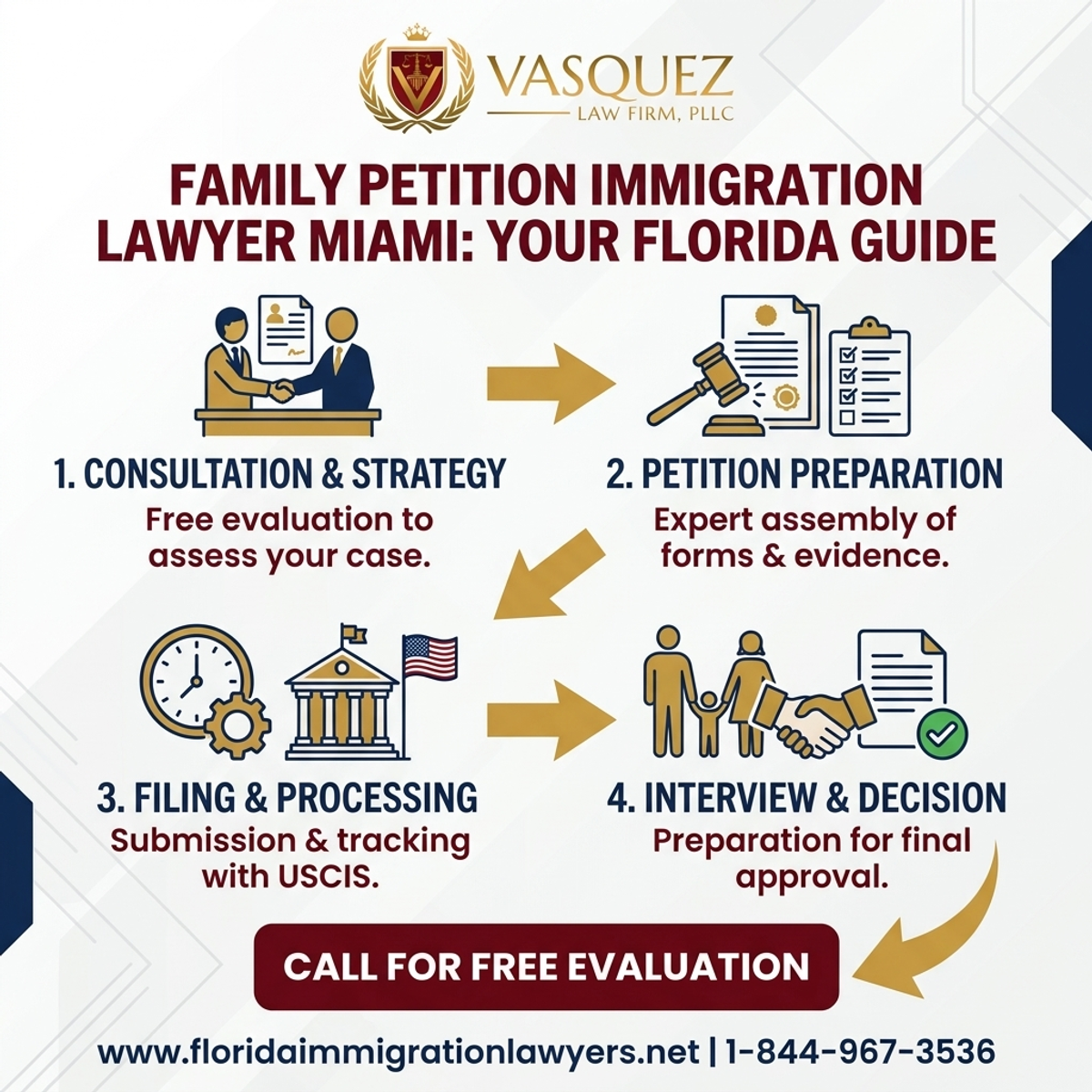
Step-by-Step Process — Family Petition Immigration Lawyer Miami: Your Florida Guide
- Proof of Termination of Prior Marriages (if applicable): Divorce decrees, annulment decrees, or death certificates for both petitioner and beneficiary, if they were previously married.
- Passport-Style Photographs: Typically two recent photos for both the petitioner and beneficiary, meeting USCIS specifications.
- Form I-130, Petition for Alien Relative: The accurately completed and signed form.
- Form I-130A, Supplemental Information for Spouse Beneficiary (if applicable): Required when petitioning for a spouse.
- G-325A, Biographic Information (if applicable): Although often replaced by I-130/I-130A, ensure you follow current USCIS guidelines.
- Form I-864, Affidavit of Support: Submitted later during NVC or Adjustment of Status processing, this form demonstrates the petitioner's financial ability to support the beneficiary.
- Medical Examination Report: Required for both consular processing and adjustment of status, completed by an authorized civil surgeon.
- Police Clearances/Criminal Records: Required for beneficiaries from certain countries and for those with past legal issues.
All documents submitted to USCIS must be in English or accompanied by a certified English translation. For residents of Florida, especially those in diverse areas like Miami and Kissimmee, ensuring that birth certificates, marriage licenses, and other vital records from foreign countries are properly translated and certified is a common but critical step. Our family petition immigration lawyer team ensures your documentation is impeccable, minimizing potential roadblocks.
Navigating Timelines and Processing Expectations in Florida
Understanding the potential timelines for a family petition is crucial for managing expectations and planning for your family's future. The processing time can vary significantly based on several factors: the specific relationship category, the country of origin of the beneficiary, the current workload of USCIS service centers, and whether the beneficiary is adjusting status within the U.S. or undergoing consular processing abroad. USCIS provides estimated processing times on its website, which are regularly updated and should be consulted as a general guide, but they are not guarantees.
For immediate relatives of U.S. citizens (spouses, unmarried children under 21, and parents), the I-130 petition typically takes 7-15 months for USCIS to process. Once approved, a visa number is immediately available. If the immediate relative is in the U.S. and eligible, they can often file Form I-485, Application to Register Permanent Residence or Adjust Status, concurrently with or soon after the I-130, leading to a green card within another 8-24 months after I-130 approval and interview. Interviews for adjustment of status for Florida residents often take place at USCIS field offices located in Hialeah (serving Miami-Dade County), Orlando, or Tampa. These local offices have varying backlogs, which can impact your overall waiting period.
For family preference categories, the process is considerably longer due to annual visa quotas. After I-130 approval, the beneficiary must wait for their priority date to become current according to the U.S. Department of State's Visa Bulletin. This wait can range from a few years to over two decades, depending on the category and country. For example, a sibling of a U.S. citizen from Mexico might face a wait exceeding 20 years. Once the priority date is current, the case moves to the National Visa Center (NVC) for further processing, which typically adds another 6-12 months before an interview can be scheduled at a U.S. embassy or consulate abroad. The NVC processing involves submitting all civil documents, financial forms, and visa application forms. The final step is the consular interview at a U.S. embassy, for which the State Department provides comprehensive guidance.
Throughout this entire process, RFEs or administrative processing delays can extend timelines. An experienced family petition immigration lawyer in Miami or Kissimmee can help monitor your case, respond promptly to USCIS requests, and provide realistic expectations based on current trends and your specific circumstances. Our firm stays updated on USCIS processing times and actively tracks cases to keep clients informed.
Do not navigate this complex process alone. The stakes are too high for your family's future. Contact Florida Immigration Lawyers today for expert guidance and dedicated representation. We are here to help you understand your options and achieve your immigration goals.
Cost Factors and Fee Breakdown for Family-Based Visas
Understanding the financial aspects of a family petition is essential for planning. The total cost involves several components, including government filing fees, medical examination fees, and potentially attorney fees. It's important to remember that government fees are subject to change and are non-refundable, regardless of the outcome of your application. USCIS fees are periodically updated, so always check the latest fee schedule on the official USCIS website before filing.
The primary government fee is for filing Form I-130, Petition for Alien Relative. If the beneficiary is adjusting status within the U.S., they will also pay fees for Form I-485, Application to Register Permanent Residence or Adjust Status, and potentially for Forms I-765 (Employment Authorization) and I-131 (Advance Parole) if filed concurrently. For beneficiaries undergoing consular processing abroad, there will be fees for the immigrant visa application (DS-260) and the Affidavit of Support (I-864) processing by the National Visa Center (NVC). Additionally, all beneficiaries must undergo a mandatory medical examination by a USCIS-approved civil surgeon or a panel physician abroad, the cost of which varies by provider but is typically a few hundred dollars and is paid directly to the physician.
Beyond government and medical fees, attorney fees are a significant consideration. While it is possible to file a family petition independently, the complexities of immigration law often make legal representation a wise investment. An experienced family petition immigration lawyer provides invaluable assistance in preparing a robust petition, gathering extensive documentation, responding to RFEs, and representing you during interviews. Attorney fees vary based on the complexity of the case, the scope of services provided, and the firm's experience. Many firms, including Florida Immigration Lawyers, offer flat-fee structures for family-based petitions, providing cost predictability for our clients in Miami, Kissimmee, and throughout Florida. These fees cover the time, expertise, and resources dedicated to ensuring your case is handled professionally and efficiently.
Key Statistics — Family Petition Immigration Lawyer Miami: Your Florida Guide
Consider the potential costs of delays or denials resulting from errors in your application. Such issues can lead to additional filing fees, lost time, and increased stress. Investing in legal counsel from the outset can often save you money and heartache in the long run by ensuring your petition is complete, accurate, and strategically presented. We encourage you to discuss all potential costs during your initial consultation so you can plan accordingly for this important journey.
The Role of a Family Petition Immigration Lawyer in Miami & Kissimmee
While the prospect of filing a family petition might seem straightforward on the surface, the reality is far more intricate. The U.S. immigration system is notoriously complex, with constantly evolving laws, regulations, and policies. This is where the expertise of a dedicated family petition immigration lawyer becomes not just beneficial, but often essential for a successful outcome. For families in diverse communities like Miami and Kissimmee, having local legal representation means having someone who understands both federal immigration law and the specific nuances of navigating the process within Florida's jurisdiction, including interactions with local USCIS field offices and immigration courts. Our attorneys are well-versed in 8 CFR Part 204, which governs petitions for alien relatives.
An immigration lawyer from Florida Immigration Lawyers provides comprehensive support from the very beginning. We start by thoroughly assessing your eligibility and determining the most appropriate immigration path for your family. This initial consultation helps identify potential challenges, such as past immigration violations, criminal history, or issues with prior marriages, which could complicate the petition. We then assist in meticulously preparing and organizing all required forms and supporting documents, ensuring accuracy and completeness. This includes drafting compelling affidavits, translating foreign documents, and ensuring all evidence meets USCIS standards. Our proactive approach aims to minimize the chances of Requests for Evidence (RFEs) or denials, which can significantly delay your case.
Beyond paperwork, our firm acts as your advocate and liaison with USCIS and the National Visa Center (NVC). We track your case progress, respond to any inquiries from immigration authorities, and keep you informed every step of the way. If an interview is required, whether at a USCIS field office in Orlando or Hialeah, or at a U.S. embassy abroad, we provide thorough preparation, helping you understand what to expect and how to present your case confidently. In situations where complications arise, such as a Notice of Intent to Deny (NOID) or an unfavorable decision, we are prepared to appeal or pursue other legal remedies. Our goal is to alleviate the stress of the immigration process, allowing you to focus on your family while we handle the legal complexities. We are here to serve families across Florida, from the bustling streets of Miami to the family-friendly neighborhoods of Kissimmee and beyond.
Common Mistakes to Avoid in Your Family Petition
Navigating the family petition process can be fraught with potential pitfalls. Avoiding these common mistakes can save you significant time, money, and stress:
-
Incomplete or Inaccurate Forms: Even minor errors or missing information on Form I-130 or other supporting documents can lead to Requests for Evidence (RFEs) or outright denial. Consequences: Significant delays, re-filing fees, and added stress.
-
Insufficient Proof of Relationship: Failing to provide robust evidence that your relationship is genuine, especially for spousal petitions, is a major red flag for USCIS. Consequences: RFEs, interview scrutiny, or denial based on suspected marriage fraud.
-
Not Disclosing All Marriages: Omitting information about prior marriages, even if terminated, can be seen as misrepresentation. Consequences: Allegations of fraud, denial of petition, and potential bars to future immigration benefits.
-
Failure to Meet Financial Requirements: The petitioner must demonstrate the ability to financially support the beneficiary (Form I-864, Affidavit of Support). Not meeting income guidelines or failing to provide sufficient evidence can halt the process. Consequences: Denial of the green card application, requiring a joint sponsor or proving sufficient assets.
-
Missing Deadlines or Ignoring RFEs: Failing to respond to USCIS Requests for Evidence (RFEs) or NVC inquiries by the specified deadline will lead to the abandonment or denial of your case. Consequences: Case closure, requiring a new petition and restarting the entire process.
-
Inadequate Translations: Any document not in English must be accompanied by a certified English translation. Submitting uncertified or poor-quality translations is unacceptable. Consequences: RFEs, delays, or rejection of documents.
-
Not Updating Address with USCIS: Moving without notifying USCIS via Form AR-11 can result in missing critical notices, interview appointments, or RFEs. Consequences: Missed appointments leading to case abandonment, significant delays, or denial.
-
Assuming All Family Members Qualify: Not all family relationships confer immigration benefits, and some have extremely long waiting lists. Misunderstanding eligibility can lead to filing an unapprovable petition. Consequences: Wasted time and money on an ineligible petition.
-
Entering the U.S. with Immigrant Intent on a Non-Immigrant Visa: For beneficiaries already in the U.S., entering on a tourist visa with the intent to adjust status immediately can be considered visa fraud. Consequences: Denial of adjustment of status and potential bar from future immigration.
-
Not Seeking Legal Counsel: Attempting to navigate the complex immigration system without professional guidance can lead to costly errors and missed opportunities. Consequences: Higher risk of denial, prolonged processing, and increased stress from avoidable mistakes.
When to Call a Family Petition Immigration Lawyer
While some family petition cases may seem straightforward, the reality is that complications can arise at any stage, making professional legal guidance invaluable. You should strongly consider contacting a family petition immigration lawyer from Florida Immigration Lawyers if you encounter any of the following scenarios or have specific concerns:
- Complex Family Situations: If you have step-relationships, adopted children, or previous marriages that involved immigration filings, these situations add layers of complexity that benefit from legal expertise.
- Past Immigration Issues: If either the petitioner or beneficiary has a history of visa overstays, prior deportations, criminal records, or other immigration violations, legal counsel is essential to assess eligibility and potential waivers.
- Received a Request for Evidence (RFE) or Notice of Intent to Deny (NOID): These notices from USCIS indicate that your application is deficient. A lawyer can help you understand the specific issues and formulate a comprehensive and timely response.
- Financial Sponsorship Concerns: If the petitioner does not meet the income requirements for the Affidavit of Support (Form I-864), a lawyer can advise on potential joint sponsors or how to present sufficient assets.
- Beneficiary is Overseas and Consular Processing is Required: Navigating the National Visa Center (NVC) and a U.S. embassy interview abroad can be confusing. A lawyer can prepare you for the interview and manage the NVC stage efficiently.
- Concerns about Interview Preparation: Whether it's an adjustment of status interview at a USCIS field office in Hialeah or a consular interview, a lawyer can conduct mock interviews and ensure you are fully prepared to answer questions confidently and accurately.
- Desire for Peace of Mind: Even in seemingly simple cases, the emotional and financial investment in an immigration petition is substantial. Hiring an attorney provides peace of mind, knowing your case is handled professionally and meticulously.
Florida Immigration Lawyers has extensive experience in all aspects of family-based immigration. Our team is dedicated to providing clear, effective legal strategies for families across Florida, including Kissimmee, Orlando, and Miami. We are here to ensure your journey to reunification is as smooth as possible.
About Florida Immigration Lawyers
Florida Immigration Lawyers is a leading immigration law firm dedicated to serving individuals and families throughout the Sunshine State. With a deep understanding of the complexities of U.S. immigration law, our experienced attorneys provide compassionate and effective legal representation across a wide range of immigration matters, including family petitions, asylum claims, deportation defense, citizenship applications, and business immigration solutions. We are committed to helping our clients achieve their American dreams, whether they are seeking to reunite with family, gain protection, or pursue new opportunities.
Our firm prides itself on personalized service, strategic advocacy, and a client-centered approach. We understand that every immigration journey is unique and often filled with challenges. That's why we offer comprehensive support, guiding you through every step of the legal process with clarity and dedication. Choosing Florida Immigration Lawyers means partnering with a team that is available 24/7, offers free consultations, and speaks both English and Spanish to ensure effective communication. We serve all of Florida, from Miami to Jacksonville, and are ready to be your trusted legal partner. Visit floridaimmigrationlawyers.net or call 1-844-967-3536 to learn how we can assist you.
Sources and References
- U.S. Citizenship and Immigration Services (USCIS)
- U.S. Department of State - National Visa Center (NVC) Processing
- Executive Office for Immigration Review (EOIR)
- 8 U.S.C. Chapter 12 - Immigration and Nationality Act (INA)
- INA Section 201 - Numerical limitations on total lawful permanent residents
- INA Section 203(a) - Preference immigrants
- 8 CFR Part 204 - Petitions for alien relatives, fiancés(ées), and orphans
Related services: family-based green cards, fiancé visa (K-1), marriage-based immigration.
This article provides general legal information and is not intended as legal advice. Every case is unique, and outcomes depend on specific facts and circumstances. Contact an attorney for advice about your particular situation.
Your family's future in the United States is too important to leave to chance. With the complexities of immigration law, expert legal guidance is invaluable. Let Florida Immigration Lawyers provide the support and representation you need to navigate the family petition process successfully. We are committed to helping you achieve your immigration goals with professionalism and care. Contact us today for a free consultation at 1-844-967-3536. Se Habla Espanol - Estamos aqui para ayudarle.
If you need legal assistance, learn more about speak with a family immigration lawyer, or call us at 1-844-967-3536 for a free consultation.
Do Not Navigate This Process Alone
Our experienced immigration attorneys are ready to fight for you. Get a free, confidential consultation today.
Se Habla Español
Frequently Asked Questions
Florida Immigration Lawyers
Immigration Attorney | Founder, Vasquez Law Firm
U.S. Air Force veteran and immigration attorney with thousands of cases resolved. J.D., NCCU School of Law. AILA member. Admitted to the 4th, 5th, and 11th Circuit Courts.
Available 24/7 - Free Evaluations
Related Legal Services
Our Florida immigration attorneys can help you with family immigration services, immigration practice areas and free immigration consultation. Call today at 1-844-967-3536 for a free consultation.
Related Links
Related Topics
Free Legal Consultation
Discuss your case with our experienced attorneys. We're available 24/7.
Se Habla Español - Estamos aquí para ayudarle.
Related Articles
Immigration Interview Preparation Florida: Your Guide
Preparing for your immigration interview in Florida is a pivotal step towards securing your future. This comprehensive guide provides essential tips, a detailed step-by-step preparation plan, and a crucial document checklist to ensure you are fully ready for your USCIS interview. Learn about common mistakes to avoid, understand processing timelines, and identify when legal assistance from experienced Florida immigration lawyers is vital. Whether you are in Hialeah, Miami, or Orlando, navigating your green card, naturalization, or asylum interview requires meticulous attention to detail and professional guidance. Florida Immigration Lawyers offers free consultations to help you prepare effectively and confidently.
DACA Renewal Florida 2026 Guide for Dreamers | VLF Florida
For DACA recipients in Florida, understanding the DACA renewal process for 2026 is vital. This comprehensive guide details eligibility, step-by-step procedures, essential documents, timelines, and costs. Learn how to file your Form I-821D and I-765, avoid common mistakes, and ensure continuous residence. We cover specific considerations for Dreamers in St. Petersburg and across Florida, emphasizing the importance of timely and accurate submissions to USCIS. Discover when legal assistance from Florida Immigration Lawyers can be crucial, especially for complex cases involving criminal history or travel outside the U.S. Get expert advice to protect your deferred action status and employment authorization.
DACA Renewal Florida 2026 Guide for Dreamers | VLF Florida
Learn how to renew your DACA in Florida for 2026. This guide provides essential steps, common pitfalls, and resources available to Dreamers in Hialeah and beyond. Call Florida Immigration Lawyers at 1-844-967-3536 for a free consultation.
Understanding the I-864 Affidavit of Support in Florida
Learn about the I-864 Affidavit of Support, a critical step for sponsoring family members in Florida. This guide covers requirements, common mistakes, and when to seek legal counsel. Contact Florida Immigration Lawyers for expert assistance.