F-1 Reinstatement Process for Florida Students | VLF Florida
Discover the F-1 reinstatement process for students in Florida. Learn how to regain your student visa status and continue your education. For personalized help, contact Florida Immigration Lawyers at 1-844-967-3536.

- Eligibility criteria must be met.
- Form I-539 is required.
- Timely application is essential.
Introduction
Imagine you are an international student at a university in Hollywood, Florida, and you suddenly realize you are out of status on your F-1 visa. This can be a daunting situation, but understanding the F-1 reinstatement process can help you get back on track. This article will cover the essential steps, timelines, and requirements for F-1 reinstatement. Call Florida Immigration Lawyers at 1-844-967-3536 for a free consultation to guide you through this process.
Falling out of F-1 status can be a source of immense stress and uncertainty for international students. It means losing the legal basis to remain in the U.S., potentially jeopardizing your academic journey and future career aspirations. The thought of having to interrupt your studies or even leave the country can be overwhelming, especially when you've invested so much time and effort into your education in Florida.
However, it's crucial to understand that losing your F-1 status doesn't automatically mean the end of your academic dreams in the U.S. The U.S. Citizenship and Immigration Services (USCIS) provides a pathway for eligible students to regain their lawful status through the F-1 reinstatement process. This article aims to demystify this critical procedure, offering a clear, step-by-step guide to help you navigate it successfully. For immediate and expert guidance, do not hesitate to call Florida Immigration Lawyers at 1-844-967-3536 for a free consultation.
Understanding F-1 Reinstatement
F-1 reinstatement allows students who have fallen out of status to regain their F-1 visa status. This is crucial for continuing education without having to leave the U.S. The primary requirement is to demonstrate that the violation of status was due to circumstances beyond your control, such as a medical emergency or a change in personal circumstances.
According to the USCIS, reinstatement is not guaranteed and requires a detailed explanation of the situation. Students must file Form I-539 and provide supporting documentation. It's important to consult with an immigration lawyer to strengthen your case.
The concept of "circumstances beyond your control" is central to a successful reinstatement application. This typically refers to unforeseen events that directly led to the status violation, such as severe illness requiring extended hospitalization, a sudden and debilitating family emergency requiring your full attention, or an administrative error made by your Designated School Official (DSO) or the university. It's important to differentiate these from situations that could have been avoided through reasonable diligence, like simply forgetting to register for classes or mismanaging your finances.
Failure to successfully reinstate your F-1 status can have severe long-term implications. Without a valid F-1 status, you lose the ability to legally study, work on campus, or apply for Optional Practical Training (OPT) or Curricular Practical Training (CPT). More critically, remaining in the U.S. without status accrues unlawful presence, which can lead to bars from re-entering the U.S. for several years. Therefore, understanding the nuances of this process and preparing a robust application is paramount. Consulting with an experienced immigration lawyer, like those at Florida Immigration Lawyers, can significantly strengthen your case by ensuring your explanation meets USCIS's stringent requirements.
Step-by-Step Guide to F-1 Reinstatement
The F-1 reinstatement process, while complex, becomes manageable when broken down into clear, actionable steps. Following this guide diligently will help you compile a comprehensive and compelling application for USCIS. Remember, precision and thoroughness are your allies in this journey.
- Review Eligibility: Make sure you meet the criteria for reinstatement, including not being out of status for more than five months, unless there are exceptional circumstances.
- Complete Form I-539: Prepare and submit Form I-539, Application to Extend/Change Nonimmigrant Status, along with the appropriate fee.
- Collect Documentation: Gather necessary supporting documents, such as your SEVIS I-20 form, a detailed letter explaining the reasons for your status violation, and financial support evidence.
- Submit Application: Send your application to the appropriate USCIS office. In Florida, the Miami USCIS office often handles these applications.
- Await Decision: Processing times can vary, but typically range from three to six months. Stay in touch with your DSO and monitor your case status on the USCIS website.
This initial step is critical. USCIS generally requires that you have not been out of status for more than five months at the time of filing your Form I-539. However, if your violation exceeds this period, you must provide a compelling explanation for the delay, demonstrating that exceptional circumstances prevented an earlier filing. Other key eligibility factors include maintaining an intent to pursue a full course of study, not having a record of repeated or willful violations of immigration regulations, and not engaging in unauthorized employment. Your Designated School Official (DSO) at your Florida institution can help you assess your initial eligibility.
Form I-539 is the cornerstone of your reinstatement application. It must be filled out accurately and completely. Pay close attention to all sections, ensuring that your personal details, educational history, and requested change of status are clearly articulated. Any discrepancies or omissions can lead to delays or even a denial. It's advisable to review the instructions provided by USCIS thoroughly and consider seeking assistance from Florida Immigration Lawyers to ensure every detail is correct before submission.
This is perhaps the most labor-intensive but crucial step. Beyond the SEVIS I-20 (endorsed for reinstatement by your DSO) and financial evidence demonstrating your ability to cover tuition and living expenses, your detailed letter of explanation is paramount. This letter should clearly and concisely outline the exact circumstances that led to your status violation, emphasizing that these were beyond your control. Provide supporting evidence for your claims, such as medical records, death certificates, official correspondence, or letters from your university. The more comprehensively you document your situation, the stronger your case will be.
Once all forms and supporting documents are meticulously prepared, assemble your application package. It's highly recommended to make a complete copy of everything for your records before mailing. Send your application via certified mail with a return receipt requested, or use a courier service that provides tracking. This ensures you have proof of submission and delivery. While the Miami USCIS office handles many cases in Florida, always verify the correct filing address on the USCIS website for Form I-539, as locations can change.
The waiting period can be anxious, but it's important to remain patient and proactive. During this time, you should continue to enroll in a full course of study, even though you are technically out of status. This demonstrates your continued intent to pursue your education. You cannot travel outside the U.S. while your application is pending, as this would be considered an abandonment of your application. Regularly check the USCIS website using your receipt number for updates. If USCIS issues a Request for Evidence (RFE), respond promptly and thoroughly with the requested information, ideally with legal assistance from Florida Immigration Lawyers.
By following these steps meticulously and seeking professional guidance when needed, you significantly enhance your chances of a successful F-1 reinstatement.
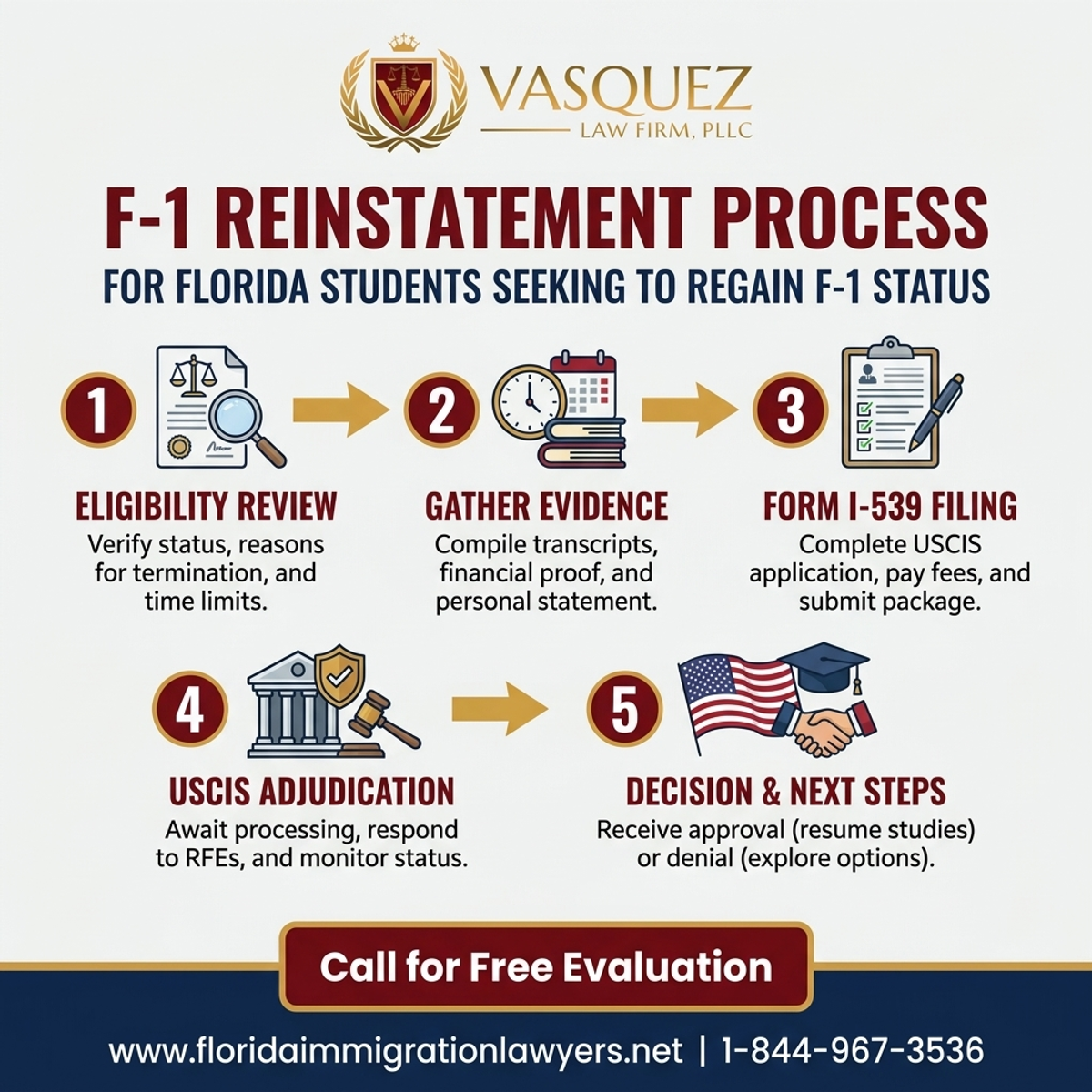
Step-by-Step Process — F-1 Reinstatement Process for Florida Students
Document Checklist for Reinstatement
A comprehensive document checklist is essential for ensuring your F-1 reinstatement application is complete and accurate. Missing even a single required document can lead to delays or a Request for Evidence (RFE), prolonging your out-of-status period.
- Completed Form I-539
- SEVIS I-20 form
- Letter of explanation
- Financial support documentation
- Copies of passport and visa
- Proof of current enrollment
Organizing these documents carefully and ensuring they are all up-to-date will streamline the review process for USCIS. When in doubt about any specific document, consulting with your DSO or an immigration attorney from Florida Immigration Lawyers is always recommended.
Timeline and Processing Expectations
The timeline for processing an F-1 reinstatement can vary. Generally, students should expect to wait between three to six months for a decision. During this time, it is crucial to maintain communication with your Designated School Official (DSO) and to keep track of any correspondence from USCIS.
Recent changes in immigration policy, such as those mentioned in news reports, could impact processing times. Staying informed on policy updates is essential for timely submission and response.
Several factors can influence the processing time for your F-1 reinstatement application. These include the overall workload at the specific USCIS service center handling your case, the complexity of your individual situation, and whether USCIS issues a Request for Evidence (RFE). An RFE can add several weeks or even months to the processing time, as you will need to gather and submit additional documentation. It is crucial to respond to any RFE promptly and comprehensively to avoid further delays or a potential denial.
While waiting for a decision, students should continue to maintain their full course of study and adhere to all F-1 student regulations, even if technically out of status. This demonstrates your commitment to your academic goals. It's also important to understand that you are generally not permitted to travel outside the U.S. while your reinstatement application is pending, as doing so is usually considered an abandonment of your application. Staying in constant communication with your DSO and regularly checking the USCIS online case status tool will help you stay informed throughout this period. For personalized updates or if you encounter unexpected delays, Florida Immigration Lawyers can assist in communicating with USCIS.
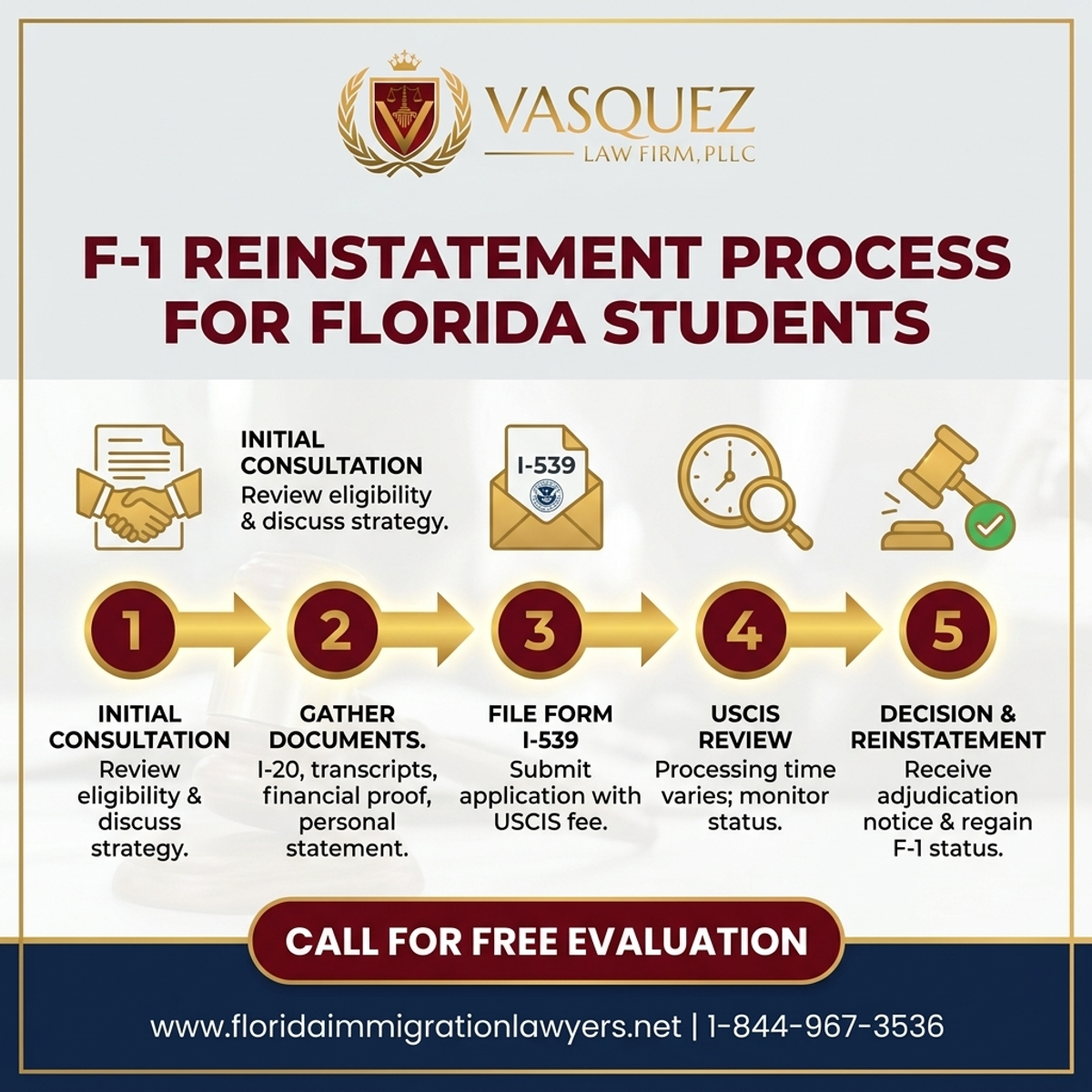
Key Statistics — F-1 Reinstatement Process for Florida Students
Cost Factors and Fee Breakdown
The cost of filing Form I-539 includes the application fee, which can change frequently, so always check the current fee on the USCIS website. Additional costs may include legal fees if you choose to hire an attorney, which can be advantageous in complex cases.
Do not navigate this process alone. Contact Florida Immigration Lawyers today at 1-844-967-3536 for assistance.
Beyond the base filing fee for Form I-539, which is subject to change by USCIS, students should budget for other potential expenses. These might include fees for obtaining certified copies of documents (like medical records), translation services if any documents are not in English, and postage costs for sending your application package. It's always wise to check the USCIS website for the most current fee schedule before preparing your payment to avoid rejection of your application due to an incorrect fee.
While hiring an immigration attorney adds to the overall cost, the investment can be invaluable, especially for complex cases or if you are unsure about any aspect of the application. An experienced lawyer from Florida Immigration Lawyers can help you prepare a strong, error-free application, craft a compelling letter of explanation, gather crucial supporting evidence, and represent you in communications with USCIS. This professional guidance can significantly increase your chances of a successful reinstatement and save you from potential costly mistakes or delays in the long run.
Common Mistakes to Avoid
- Missing the application deadline: Ensure you apply within five months of losing status.
- Incomplete documentation: Double-check that all required documents are included.
- Incorrect fee submission: Verify the latest application fee on the USCIS website.
- Not providing a detailed explanation: Clearly articulate the reasons for your status violation.
- Ignoring communication from USCIS: Regularly check your mail and email for updates.
- Not consulting with a DSO: They can provide invaluable support and guidance.
- Failing to demonstrate financial capability: Provide clear evidence of financial support.
Avoiding these common pitfalls is crucial for a smooth F-1 reinstatement process. Diligence, attention to detail, and proactive communication can make all the difference in successfully regaining your status. When in doubt, remember that Florida Immigration Lawyers are available at 1-844-967-3536 to provide expert advice and prevent these mistakes.
When to Call a Lawyer
If you are unsure about your eligibility for F-1 reinstatement or have a complicated case, it is wise to consult with an immigration attorney. Legal counsel can help you navigate the complexities of the application process, prepare your documentation, and represent you in communications with USCIS. Florida Immigration Lawyers offer comprehensive services to assist you in this critical process.
There are specific scenarios where legal counsel becomes not just advisable, but almost essential. For instance, if you have a prior history of immigration violations, if your out-of-status period exceeds the five-month guideline, or if the circumstances leading to your violation are particularly complex or require extensive documentation (e.g., severe medical conditions, criminal incidents, or administrative errors by multiple parties). In such cases, the nuanced understanding of immigration law that an attorney possesses can be the deciding factor in your case's outcome.
An immigration attorney acts as your advocate, ensuring your application is meticulously prepared and presented in the best possible light. They can help you anticipate potential challenges, craft a persuasive explanation, and respond effectively to any Requests for Evidence (RFEs) from USCIS. The peace of mind that comes with knowing your case is being handled by professionals allows you to focus on your studies while your legal team navigates the complexities. Florida Immigration Lawyers offers comprehensive services to assist you in this critical process, providing tailored strategies for your unique situation.
About Florida Immigration Lawyers
Florida Immigration Lawyers is a dedicated law firm serving all of Florida, including Hollywood and surrounding areas. We specialize in immigration cases such as F-1 reinstatement, asylum, deportation defense, and more. Our team is available 24/7 to provide free consultations. Contact us at 1-844-967-3536 or visit our website at floridaimmigrationlawyers.net.
Sources and References
- U.S. Citizenship and Immigration Services (USCIS)
- Executive Office for Immigration Review (EOIR)
- 8 U.S.C. Chapter 12 - Immigration and Nationality Act
Related services: immigration practice areas, family immigration services, citizenship and naturalization.
This article provides general legal information and is not intended as legal advice. Every case is unique, and outcomes depend on specific facts and circumstances. Contact an attorney for advice about your particular situation.
Call Florida Immigration Lawyers at 1-844-967-3536 for a free consultation. Se Habla Espanol - Estamos aqui para ayudarle.
If you need legal assistance, learn more about Florida immigration legal team, or call us at 1-844-967-3536 for a free consultation.
Do Not Navigate This Process Alone
Our experienced immigration attorneys are ready to fight for you. Get a free, confidential consultation today.
Se Habla Español
Frequently Asked Questions
Florida Immigration Lawyers
Immigration Attorney | Founder, Vasquez Law Firm
U.S. Air Force veteran and immigration attorney with thousands of cases resolved. J.D., NCCU School of Law. AILA member. Admitted to the 4th, 5th, and 11th Circuit Courts.
Available 24/7 - Free Evaluations
Related Legal Services
Our Florida immigration attorneys can help you with free immigration consultation, experienced immigration attorneys and business immigration. Call today at 1-844-967-3536 for a free consultation.
Related Links
Related Topics
Free Legal Consultation
Discuss your case with our experienced attorneys. We're available 24/7.
Se Habla Español - Estamos aquí para ayudarle.
Related Articles
Immigration Lawyer Tampa Bay Area: Your Florida Guide
For those in the Tampa Bay Area and across Florida, navigating immigration law is complex. An experienced immigration lawyer is crucial for family petitions, employment visas, deportation defense, and citizenship. This guide from Florida Immigration Lawyers covers essential services, step-by-step processes, required documents, timelines, and costs. We also highlight common mistakes and when to seek legal help, ensuring you are well-informed. With local expertise and a commitment to clients, our firm provides comprehensive support to achieve your immigration goals. Contact us for a free consultation and personalized guidance.
Family Petition Immigration Lawyer Miami: Your Florida Guide
For families in Miami, Kissimmee, and across Florida, securing a family petition is often the first step towards reuniting with loved ones in the U.S. This process, which typically begins with filing Form I-130, Petition for Alien Relative, requires meticulous attention to detail and a thorough understanding of U.S. immigration law. From proving a legitimate family relationship to navigating extensive documentation and often lengthy processing times, the journey can be complex. An experienced family petition immigration lawyer can provide invaluable guidance, helping to avoid common pitfalls, respond to USCIS requests, and ensure a smooth application process. Florida Immigration Lawyers offers dedicated legal support to families statewide, helping them achieve their dreams of reunification.
Immigration Interview Preparation Florida: Your Guide
Preparing for your immigration interview in Florida is a pivotal step towards securing your future. This comprehensive guide provides essential tips, a detailed step-by-step preparation plan, and a crucial document checklist to ensure you are fully ready for your USCIS interview. Learn about common mistakes to avoid, understand processing timelines, and identify when legal assistance from experienced Florida immigration lawyers is vital. Whether you are in Hialeah, Miami, or Orlando, navigating your green card, naturalization, or asylum interview requires meticulous attention to detail and professional guidance. Florida Immigration Lawyers offers free consultations to help you prepare effectively and confidently.
DACA Renewal Florida 2026 Guide for Dreamers | VLF Florida
For DACA recipients in Florida, understanding the DACA renewal process for 2026 is vital. This comprehensive guide details eligibility, step-by-step procedures, essential documents, timelines, and costs. Learn how to file your Form I-821D and I-765, avoid common mistakes, and ensure continuous residence. We cover specific considerations for Dreamers in St. Petersburg and across Florida, emphasizing the importance of timely and accurate submissions to USCIS. Discover when legal assistance from Florida Immigration Lawyers can be crucial, especially for complex cases involving criminal history or travel outside the U.S. Get expert advice to protect your deferred action status and employment authorization.