DACA Renewal Florida 2026 Guide for Dreamers | VLF Florida
Learn how to renew your DACA in Florida for 2026. This guide provides essential steps, common pitfalls, and resources available to Dreamers in Hialeah and beyond. Call Florida Immigration Lawyers at 1-844-967-3536 for a free consultation.

Renewing your DACA status in Florida for 2026 is crucial for maintaining your ability to live and work in the U.S. This guide provides essential steps, common pitfalls, and resources available to Dreamers in Hialeah and beyond.
- Ensure your renewal application is submitted on time.
- Gather necessary documentation meticulously.
- Understand recent legal changes affecting DACA.
Introduction
For many young immigrants in Florida, the Deferred Action for Childhood Arrivals (DACA) program is a lifeline. As a Dreamer living in Hialeah, Florida, ensuring your DACA status is current allows you to continue working legally and pursuing educational opportunities. This guide will walk you through the DACA renewal process for 2026, highlight common mistakes to avoid, and provide useful resources. Call Florida Immigration Lawyers at 1-844-967-3536 for a free consultation.
For thousands of young individuals across Florida, particularly within vibrant immigrant communities like Hialeah, DACA represents more than just a legal status; it's a foundation for building a future. It allows you to pursue higher education, secure stable employment, and contribute meaningfully to your community without the constant fear of deportation. The renewal process, while seemingly straightforward, requires meticulous attention to detail and an understanding of the evolving legal landscape.
This comprehensive guide is designed to empower you with the knowledge needed for a successful DACA renewal in 2026. We'll delve into each step, from initial eligibility checks to submitting your application, and provide critical insights into common pitfalls. Staying informed and prepared is your best defense against potential delays or denials. Remember, your future is worth protecting, and resources like Florida Immigration Lawyers are here to support you every step of the way.
Understanding DACA and Its Importance
DACA provides temporary protection from deportation and work authorization to eligible young immigrants brought to the United States as children. It has been a critical program for many in Florida, particularly in areas like Hialeah, which has a significant immigrant population. With recent legal challenges and changes, staying informed about your DACA status is more important than ever.
Beyond protection from deportation and work authorization, DACA recipients gain access to a range of opportunities that significantly improve their quality of life. This includes eligibility for a driver's license in Florida, which is crucial for daily commutes, accessing healthcare, and maintaining employment. It also opens doors to higher education, allowing Dreamers to pursue college degrees and vocational training that might otherwise be inaccessible. The stability DACA offers allows individuals to plan for their future, invest in their communities, and contribute to the economy without the constant shadow of uncertainty.
The program’s impact is particularly profound in communities like Hialeah, where a large portion of the population includes individuals who arrived in the U.S. as children. DACA has enabled these young people to integrate more fully into American society, fostering economic growth and cultural enrichment. However, the program's future has been subject to ongoing legal and political debates, underscoring the critical need for DACA recipients to remain vigilant, understand their rights, and ensure their status is always up-to-date.
Eligibility for DACA Renewal
To be eligible for DACA renewal, you must meet certain criteria, including having had DACA previously and maintaining a clean criminal record. Also, you must have lived in the U.S. continuously and not have left the country without advance parole.
To reiterate, continuous residence means you have maintained your primary home in the U.S. since June 15, 2007, up to the present. While brief, casual, and innocent departures from the U.S. are generally permissible, any travel outside the country without USCIS-approved advance parole can lead to serious complications and potentially render you ineligible for renewal. Regarding criminal records, USCIS scrutinizes any arrests or convictions. While minor traffic infractions might not pose a significant issue, any misdemeanor or felony conviction, or even multiple minor offenses, can jeopardize your renewal. It is imperative to disclose all interactions with law enforcement, even if charges were dropped or expunged, and to consult with an immigration attorney like those at Florida Immigration Lawyers if you have any doubts about your record.
Step-by-Step Guide to DACA Renewal
- Check Your Eligibility: Ensure that you have met all renewal requirements, including residence and educational criteria.
- Gather Necessary Documents: This includes your employment authorization card, previous DACA approval notices, and identity documents.
- Complete USCIS Forms: Fill out Form I-821D, Form I-765, and Form I-765WS. Make sure all information is accurate.
- Pay the Application Fee: Check the current fee schedule on the USCIS website.
- Submit Your Application: Send your completed forms and documents to the appropriate USCIS address for processing.
- Attend Biometrics Appointment: Once your application is received, you will be scheduled for a biometrics appointment. Attend this appointment as scheduled.
This initial self-assessment is vital. Beyond the basic requirements, consider any changes in your life since your last approval. Have you traveled internationally? Have you had any encounters with law enforcement, no matter how minor? Being honest and thorough at this stage can prevent significant issues later. If you're unsure about any aspect of your eligibility, especially concerning travel or legal history, it's always best to seek guidance from an experienced immigration lawyer.
A comprehensive collection of documents is the backbone of a strong application. For proof of continuous residence, examples include school transcripts, medical records, utility bills, rental agreements, employment records, and bank statements from the relevant periods. Ensure these documents clearly show your name and address. Organize them chronologically and make copies of everything you send to USCIS, keeping the originals for your records.
These forms are critical. Form I-821D is your actual request for DACA. Form I-765 is the Application for Employment Authorization, allowing you to work legally. Form I-765WS is the worksheet that supports your economic need for employment. Read all instructions carefully. Use black ink, write legibly, and answer every question truthfully. If a question doesn't apply to you, write "N/A" (not applicable) rather than leaving it blank. Inconsistencies or omissions can trigger Requests for Evidence (RFEs) or even denials.
As of my last update, the total fee for DACA renewal is typically $495, which covers the Form I-765 and the biometrics fee. However, USCIS fees are subject to change, so always verify the exact amount on the official USCIS website before submitting your application. Fee waivers for DACA renewals are extremely rare and generally not available, so plan accordingly. If you face financial hardship, explore options with non-profit organizations or consider saving up well in advance.
Once all forms are completed and documents gathered, assemble your package carefully. USCIS provides specific mailing addresses based on your location; for Florida residents, this typically goes to a USCIS Lockbox facility. Use a reliable mailing service that provides tracking, such as USPS Certified Mail with a return receipt, FedEx, or UPS. This provides proof of submission and delivery, which can be invaluable if any issues arise. Remember to keep a complete copy of your entire application package for your records.
The biometrics appointment is a mandatory step. You will receive an appointment notice (Form I-797C) with the date, time, and location of your appointment at an Application Support Center (ASC). During this appointment, USCIS will collect your fingerprints, photograph, and signature. This information is used for background checks and to verify your identity. Missing this appointment without rescheduling can significantly delay your application or even lead to denial. If you cannot attend, contact USCIS immediately to request a reschedule, providing a valid reason.
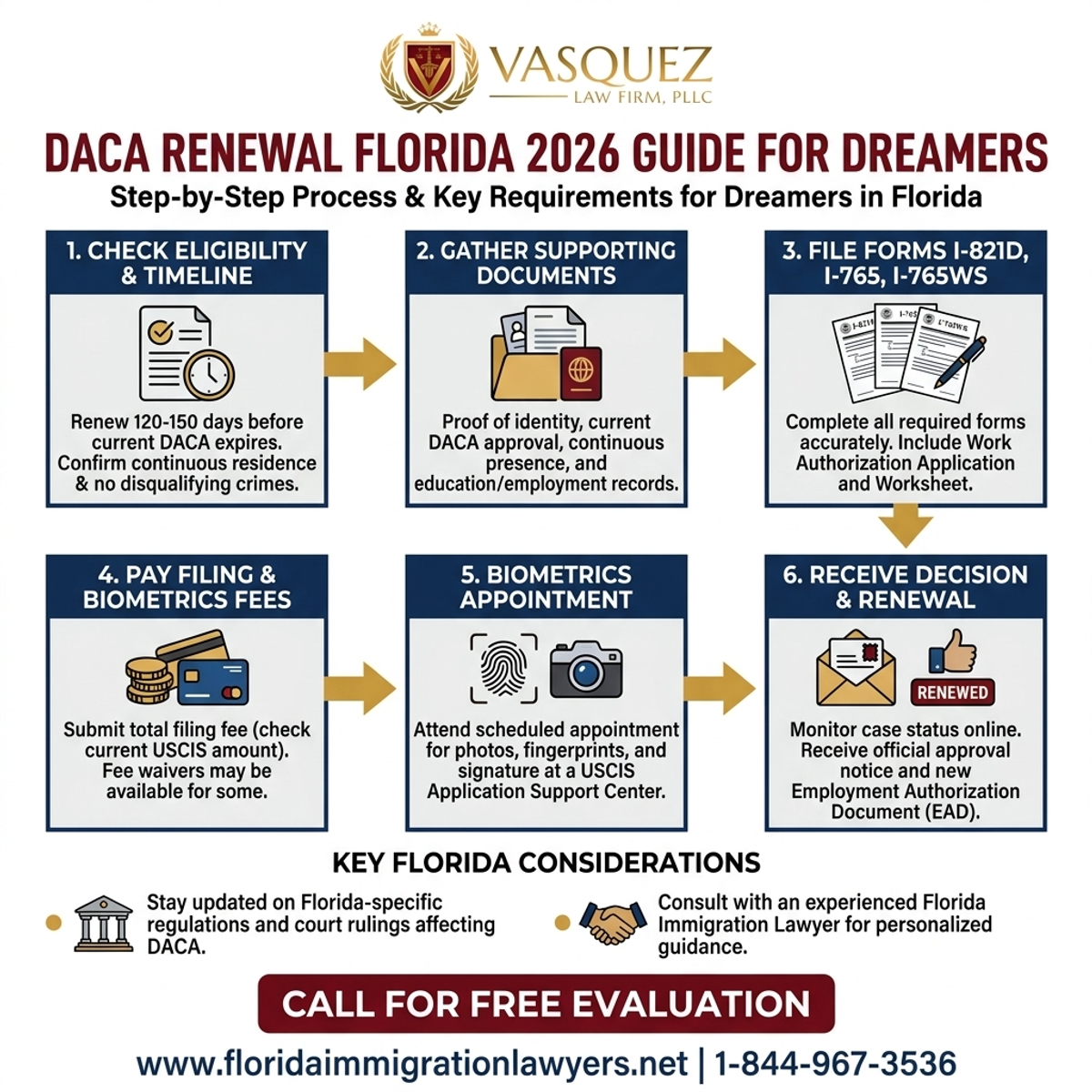
Step-by-Step Process — DACA Renewal Florida 2026 Guide for Dreamers
Document Checklist for DACA Renewal
- Previous DACA approval notice
- Employment Authorization Card
- Proof of identity (passport, birth certificate)
- Proof of continuous residence in the U.S.
- Any legal documents related to past criminal charges or arrests
A thorough checklist ensures no critical item is overlooked. For your previous DACA approval notice (Form I-797), having this readily available confirms your prior status. Your Employment Authorization Card (EAD) serves as proof of your current work authorization. For proof of identity, a valid passport from your country of origin or a birth certificate with a government-issued photo ID are strong options.
When demonstrating continuous residence, think broadly. Beyond school and medical records, consider tax returns, leases, affidavits from friends or family, and even dated photographs with verifiable locations. The goal is to paint a clear picture of your presence in the U.S. during the required periods. Finally, for any legal documents related to past criminal charges or arrests, gather all disposition records, court orders, and police reports, even if the charges were dismissed. Transparency is key, and it’s always advisable to review these with Florida Immigration Lawyers to understand their potential impact on your renewal.
Timeline and Processing Expectations
Typically, the DACA renewal process takes 120 to 150 days from submission to approval. However, delays can occur due to high application volumes or incomplete submissions. Stay proactive by checking your application's status online and responding promptly to any USCIS requests.
While the 120-150 day processing window is a general guideline, actual times can fluctuate significantly. Factors such as the volume of applications USCIS is receiving, policy changes, and the completeness of your submission can all influence the timeline. It is highly recommended to submit your renewal application approximately 150 days (5 months) before your current DACA and EAD expire. This proactive approach helps prevent any lapse in your work authorization and protection from deportation.
To stay on top of your application, utilize the USCIS online case status tracker. You'll need the receipt number provided on your Form I-797C, the official notice of action. Sign up for email and text updates to receive notifications on your case's progress. If you receive a Request for Evidence (RFE), respond promptly and thoroughly. Delays in responding, or incomplete responses, will inevitably prolong the processing time. If your application is pending beyond the typical processing time, or if your EAD is about to expire and you haven't received an update, consider contacting Florida Immigration Lawyers for assistance in inquiring with USCIS.
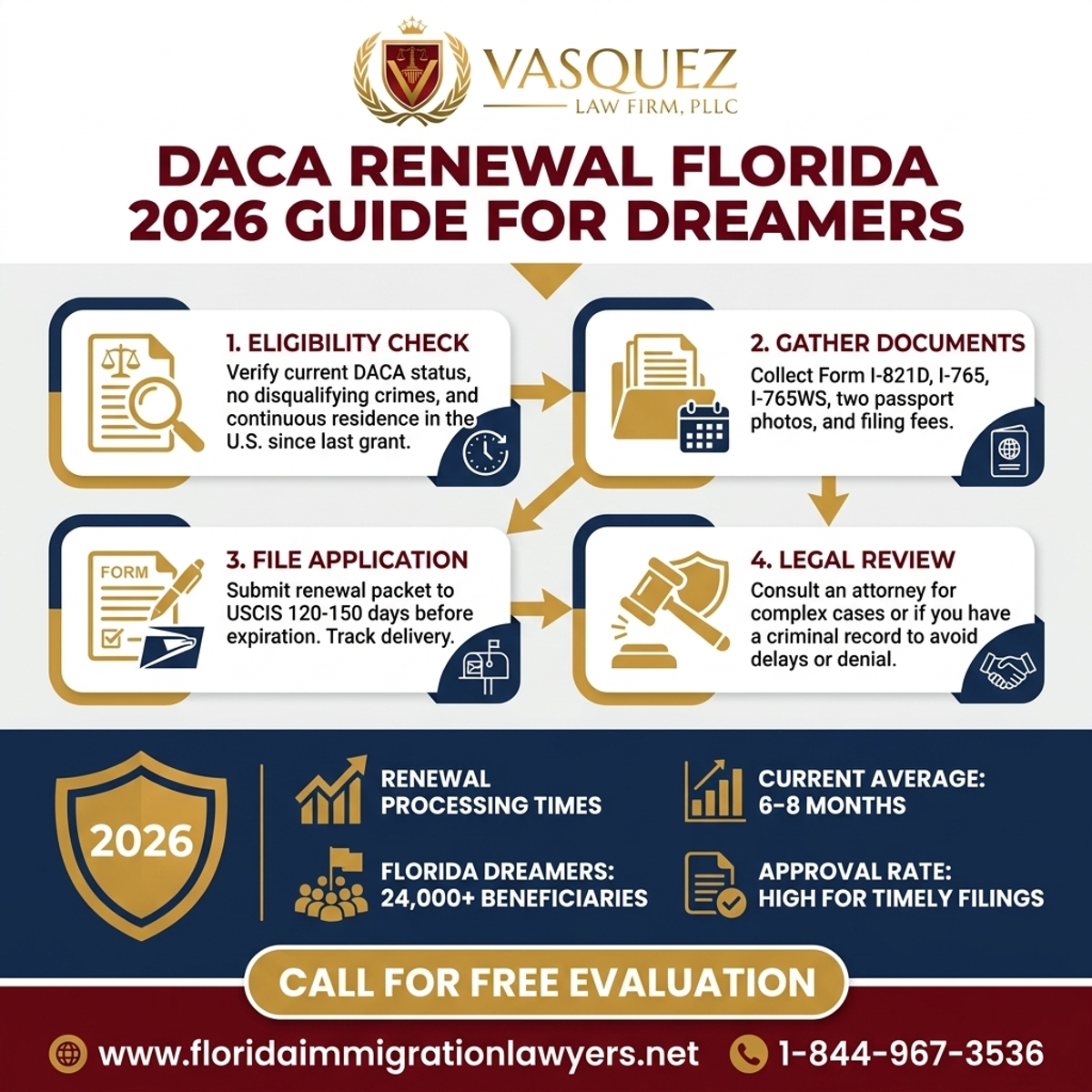
Key Statistics — DACA Renewal Florida 2026 Guide for Dreamers
Cost Factors and Fee Breakdown
Renewing your DACA involves several costs. While the primary fee is for the application itself, additional costs may include legal fees if you choose to seek professional assistance. It is crucial to check the USCIS website for the most current fee information.
Understanding the financial commitment for DACA renewal is crucial for proper planning. The total fee typically includes the Form I-765 (Application for Employment Authorization) fee and the biometrics services fee. As of current guidelines, these are combined for a total of $495. It's important to remember that these fees are non-refundable, regardless of the outcome of your application.
While the application fee is the primary expense, you should also budget for other potential costs. These might include fees for obtaining necessary documents (e.g., birth certificates, school transcripts), mailing costs (especially if using certified mail), and, most importantly, legal fees if you opt for professional assistance. Consulting with an experienced immigration attorney from Florida Immigration Lawyers can provide invaluable peace of mind, ensuring your application is accurate and complete, potentially saving you from costly errors or delays down the line. Many non-profit organizations also offer low-cost or free assistance with DACA renewals, so research local resources if financial constraints are a concern.
Do not navigate this process alone. Contact Florida Immigration Lawyers today.
Frequently Asked Questions (FAQs) About DACA Renewal
Q: What happens if my DACA expires before I submit my renewal application?A: If your DACA expires before you file your renewal, USCIS generally allows you to submit a renewal application if it has been less than one year since your DACA expired. However, during this lapse, you will not have work authorization or protection from deportation. It's crucial to avoid this gap by filing well in advance, ideally 120-150 days before expiration, to maintain continuous status. If you find yourself in this situation, consult Florida Immigration Lawyers immediately.Q: Can I travel outside the U.S. if I have DACA?A: Traveling outside the U.S. with DACA requires approved advance parole (Form I-131) from USCIS. Leaving the country without this document can result in your DACA being automatically terminated and may make you inadmissible upon your return, effectively barring you from re-entry. Advance parole is typically granted for humanitarian, educational, or employment purposes. Always seek legal advice from Florida Immigration Lawyers before planning any international travel to ensure you understand the risks and requirements.Q: What if I have a minor criminal offense on my record since my last DACA approval?A: Any criminal offense, even a minor one, can impact your DACA renewal eligibility. USCIS reviews all arrests and convictions. While minor traffic violations might not pose a significant problem, misdemeanors or felonies can lead to denial. It is absolutely critical to disclose all incidents and provide certified court dispositions. Do not assume an offense is too minor to mention. Contact Florida Immigration Lawyers at 1-844-967-3536 for an assessment of your specific situation to understand the potential implications and how best to proceed.Q: Is there any financial assistance available for DACA renewal fees?A: While USCIS does not typically offer fee waivers for DACA renewals, some non-profit organizations and community groups provide financial assistance or scholarships to help Dreamers cover the application costs. It's worth researching local and national organizations that support immigrant communities. Plan ahead to save for the $495 fee, as it is a mandatory part of the renewal process. Early planning can alleviate financial stress and ensure timely submission of your application.Q: How can I check the status of my DACA renewal application?A: You can check the status of your DACA renewal application online using the USCIS Case Status Online tool. You will need the 13-character receipt number from the Form I-797C Notice of Action that USCIS sent you after receiving your application. This tool provides real-time updates on your case. You can also sign up for email and text message notifications. If your case is outside normal processing times, or you have concerns, contacting Florida Immigration Lawyers can help in escalating inquiries with USCIS.Common Mistakes to Avoid
- Missing Application Deadlines: Late submissions can lead to a lapse in protection and work authorization.
- Incomplete Forms: Ensure all sections are filled out accurately to avoid delays.
- Insufficient Documentation: Lack of proper documentation can result in application denial.
- Ignoring Legal Advice: Consulting with an experienced lawyer can prevent costly errors.
- Not Checking Application Status: Regularly check your status to ensure timely processing.
- Traveling Without Advance Parole: Leaving the U.S. without advance parole can jeopardize your status.
- Not Updating Address with USCIS: Failure to update your address can lead to missed communications.
- Overlooking Criminal Records: Not addressing past charges can result in denial.
Submitting your application too late is perhaps the most critical error. USCIS recommends filing 120 to 150 days before your current DACA and EAD expire. If your DACA lapses, you lose your work authorization and protection from deportation, potentially facing job loss and increased vulnerability.
Even a single unanswered question or an inconsistent date can lead to an RFE or outright denial. Double-check every field, ensuring all information matches previous applications and supporting documents.
Failing to provide clear proof of continuous residence or identity can halt your application. Always provide copies, not originals, unless specifically requested, and ensure all documents are legible and relevant.
Attempting to navigate complex immigration law without professional guidance, especially if you have a complicated case, is a significant risk. An attorney can spot issues you might miss and provide strategic advice.
Regularly monitoring your application status online helps you anticipate next steps, such as biometrics appointments, and allows you to respond quickly to any USCIS requests.
This is a grave mistake. Leaving the U.S. without an approved Form I-131 (Application for Travel Document) for advance parole can be considered self-deportation and will likely lead to your DACA being revoked and potential inadmissibility upon return.
USCIS communicates vital information via mail. If your address changes and you don't update it promptly with USCIS, you could miss crucial notices, including RFEs or appointment letters, leading to delays or denial.
Any interaction with law enforcement, even if charges were dropped or expunged, must be disclosed. Failing to do so can be seen as misrepresentation and lead to denial, and potentially more severe immigration consequences. Always consult with Florida Immigration Lawyers if you have any criminal history.
When to Call a Lawyer
If you're facing issues like criminal charges, complex family situations, or you simply want to ensure your application is flawless, legal help is crucial. Florida Immigration Lawyers can guide you through this process and help avoid common errors that could jeopardize your status. Our experts are ready to assist you with all your immigration needs.
While some DACA renewals are straightforward, many situations warrant the expertise of an immigration attorney. If you've had any arrests or convictions, even minor ones, since your last DACA approval, a lawyer can assess the impact and advise on the best course of action. Similarly, if you've traveled outside the U.S. without advance parole, or if you've had a significant break in your continuous residence, legal counsel is essential to determine your continued eligibility.
Other complex situations include changes in marital status, name changes, or if you've ever been placed in deportation proceedings. Even if your case seems simple, an attorney can offer peace of mind by thoroughly reviewing your application, ensuring all forms are correctly filled out, and all necessary documentation is included. Proactive legal consultation with Florida Immigration Lawyers can prevent potential complications, save time, and protect your DACA status. Don't hesitate to call 1-844-967-3536 for a free consultation to discuss your unique circumstances.
About Florida Immigration Lawyers
Florida Immigration Lawyers is dedicated to providing expert legal assistance to immigrants across Florida. With a team of experienced attorneys, we offer services ranging from DACA renewals to deportation defense and family immigration. Our bilingual team is available 24/7 to ensure you receive the support you need. Contact us at 1-844-967-3536 or visit our website for a free consultation.
Our firm understands the profound impact immigration laws have on individuals and families. We are committed to providing compassionate, effective, and personalized legal representation to the diverse immigrant communities throughout Florida. Our team of highly skilled attorneys stays abreast of the latest developments in immigration law, ensuring our clients receive the most current and strategic advice possible.
Beyond DACA renewals, we offer a full spectrum of immigration services, including family-based petitions, adjustment of status, naturalization, and robust deportation defense. We pride ourselves on our client-centered approach, making sure you feel informed and supported at every stage of your legal journey. With our bilingual staff available 24/7, we strive to remove language barriers and ensure that everyone has access to the legal assistance they need. Your future in the U.S. is our priority.
Sources and References
- U.S. Citizenship and Immigration Services (USCIS)
- Executive Office for Immigration Review (EOIR)
- 8 U.S.C. Chapter 12 - Immigration and Nationality Act
Related services: immigration practice areas, family immigration services, citizenship and naturalization.
This article provides general legal information and is not intended as legal advice. Every case is unique, and outcomes depend on specific facts and circumstances. Contact an attorney for advice about your particular situation.
Call Florida Immigration Lawyers at 1-844-967-3536 for a free consultation. Se Habla Espanol - Estamos aqui para ayudarle.
If you need legal assistance, learn more about immigration lawyers in Florida, or call us at 1-844-967-3536 for a free consultation.
Do Not Navigate This Process Alone
Our experienced immigration attorneys are ready to fight for you. Get a free, confidential consultation today.
Se Habla Español
Frequently Asked Questions
Florida Immigration Lawyers
Immigration Attorney | Founder, Vasquez Law Firm
U.S. Air Force veteran and immigration attorney with thousands of cases resolved. J.D., NCCU School of Law. AILA member. Admitted to the 4th, 5th, and 11th Circuit Courts.
Available 24/7 - Free Evaluations
Related Legal Services
Our Florida immigration attorneys can help you with free immigration consultation, experienced immigration attorneys and business immigration. Call today at 1-844-967-3536 for a free consultation.
Related Links
Related Topics
Free Legal Consultation
Discuss your case with our experienced attorneys. We're available 24/7.
Se Habla Español - Estamos aquí para ayudarle.
Related Articles
Family Petition Immigration Lawyer Miami: Your Florida Guide
For families in Miami, Kissimmee, and across Florida, securing a family petition is often the first step towards reuniting with loved ones in the U.S. This process, which typically begins with filing Form I-130, Petition for Alien Relative, requires meticulous attention to detail and a thorough understanding of U.S. immigration law. From proving a legitimate family relationship to navigating extensive documentation and often lengthy processing times, the journey can be complex. An experienced family petition immigration lawyer can provide invaluable guidance, helping to avoid common pitfalls, respond to USCIS requests, and ensure a smooth application process. Florida Immigration Lawyers offers dedicated legal support to families statewide, helping them achieve their dreams of reunification.
Immigration Interview Preparation Florida: Your Guide
Preparing for your immigration interview in Florida is a pivotal step towards securing your future. This comprehensive guide provides essential tips, a detailed step-by-step preparation plan, and a crucial document checklist to ensure you are fully ready for your USCIS interview. Learn about common mistakes to avoid, understand processing timelines, and identify when legal assistance from experienced Florida immigration lawyers is vital. Whether you are in Hialeah, Miami, or Orlando, navigating your green card, naturalization, or asylum interview requires meticulous attention to detail and professional guidance. Florida Immigration Lawyers offers free consultations to help you prepare effectively and confidently.
DACA Renewal Florida 2026 Guide for Dreamers | VLF Florida
For DACA recipients in Florida, understanding the DACA renewal process for 2026 is vital. This comprehensive guide details eligibility, step-by-step procedures, essential documents, timelines, and costs. Learn how to file your Form I-821D and I-765, avoid common mistakes, and ensure continuous residence. We cover specific considerations for Dreamers in St. Petersburg and across Florida, emphasizing the importance of timely and accurate submissions to USCIS. Discover when legal assistance from Florida Immigration Lawyers can be crucial, especially for complex cases involving criminal history or travel outside the U.S. Get expert advice to protect your deferred action status and employment authorization.
Understanding the I-864 Affidavit of Support in Florida
Learn about the I-864 Affidavit of Support, a critical step for sponsoring family members in Florida. This guide covers requirements, common mistakes, and when to seek legal counsel. Contact Florida Immigration Lawyers for expert assistance.
