DACA Renewal Florida 2026 Guide for Dreamers | VLF Florida
For DACA recipients in Florida, understanding the DACA renewal process for 2026 is vital. This comprehensive guide details eligibility, step-by-step procedures, essential documents, timelines, and costs. Learn how to file your Form I-821D and I-765, avoid common mistakes, and ensure continuous residence. We cover specific considerations for Dreamers in St. Petersburg and across Florida, emphasizing the importance of timely and accurate submissions to USCIS. Discover when legal assistance from Florida Immigration Lawyers can be crucial, especially for complex cases involving criminal history or travel outside the U.S. Get expert advice to protect your deferred action status and employment authorization.

Quick Answer: DACA Renewal Florida 2026
To renew your Deferred Action for Childhood Arrivals (DACA) status in Florida for 2026, you must file Form I-821D (Consideration of Deferred Action for Childhood Arrivals), Form I-765 (Application for Employment Authorization), and Form I-765 Worksheet (Form I-765WS) with USCIS. It is crucial to submit these forms within 120 to 150 days before your current DACA and Employment Authorization Document (EAD) expire. This proactive approach helps avoid gaps in employment authorization and protected status. Florida Dreamers should pay close attention to all filing instructions and gather necessary supporting documents, including proof of continuous residence and any new criminal history information, to ensure a successful renewal application.
- File 120-150 days before expiration.
- Submit Forms I-821D, I-765, and I-765WS.
- Include all required supporting documents.
- Seek legal advice for complex cases or questions.
- Maintain continuous residence in the U.S.
Navigating the complex landscape of U.S. immigration law can be daunting, especially when your future and stability depend on it. For thousands of young individuals across Florida, the Deferred Action for Childhood Arrivals (DACA) program provides a crucial lifeline, offering protection from deportation and the ability to work legally. As we look towards 2026, understanding the precise requirements and procedures for DACA renewal Florida is more important than ever for Dreamers in St. Petersburg, Tampa, Orlando, Miami, and throughout the Sunshine State.
Many DACA recipients face anxiety about their status, particularly with ongoing legal challenges and policy shifts. This comprehensive guide aims to demystify the DACA renewal Florida process for 2026, providing clear, actionable information to help you prepare your application effectively. We will cover everything from eligibility criteria and required documents to timelines, costs, and common pitfalls to avoid. Our goal is to empower you with the knowledge needed to maintain your deferred action status and continue building your life in Florida.
The stakes are high, and even minor errors can lead to significant delays or even denial. Ensuring your application is complete and accurate is paramount. At Florida Immigration Lawyers, we understand the unique challenges faced by Dreamers and are dedicated to providing expert legal guidance. Do not risk your future by attempting to navigate this intricate process alone. For personalized assistance with your DACA renewal or any immigration matter, call Florida Immigration Lawyers at 1-844-967-3536 for a free consultation. Your journey towards continued stability begins with informed action.
Understanding DACA Renewal Florida 2026: Eligibility and Context
The Deferred Action for Childhood Arrivals (DACA) program, established in 2012, offers temporary relief from deportation and work authorization to eligible undocumented immigrants who came to the United States as children. While new DACA applications are generally not being accepted due to court orders, renewals remain available. For Dreamers in Florida, understanding the current legal context and eligibility for DACA renewal Florida in 2026 is critical to maintaining their status. The program's future is often subject to legal challenges, making it essential to stay informed about any policy updates from USCIS.
To be eligible for DACA renewal, you must meet several key criteria. Primarily, you must have continuously resided in the United States since the date you submitted your most recent DACA request that was approved. This means you cannot have left the U.S. without advance parole since your last DACA approval. Additionally, you must not have been convicted of a felony, a significant misdemeanor, or three or more other misdemeanors, and must not pose a threat to national security or public safety. These criteria are strictly enforced, and any changes to your criminal record since your last approval could jeopardize your renewal. It's important to remember that DACA does not grant lawful permanent resident status or a path to citizenship; it provides temporary deferred action.
The state of Florida is home to a significant population of DACA recipients, many of whom contribute substantially to our communities and economy. From the vibrant urban centers like St. Petersburg and Miami to agricultural areas, Dreamers are an integral part of Florida's fabric. The legal landscape surrounding DACA can be volatile, with court decisions frequently impacting its scope. For instance, recent federal court rulings have reaffirmed the ability to process renewals while generally prohibiting new initial applications. Staying informed about these judicial developments is paramount, and a qualified immigration attorney can provide clarity on how these changes might affect your specific situation. This ongoing legal uncertainty underscores the importance of timely and accurate renewal applications.
Eligibility for DACA renewal also requires you to still meet the initial DACA guidelines regarding age, education, and physical presence in the U.S. at the time of your initial application. While these specific initial criteria are not re-evaluated for renewal, USCIS will confirm that you continue to meet the ongoing requirements. Any discrepancies or new information that arises since your last approval must be carefully addressed. For comprehensive information on DACA, refer to the official USCIS DACA page. If you have questions about your eligibility or current immigration status, consider consulting with an attorney specializing in immigration law.
Step-by-Step DACA Renewal Florida Process for 2026
Renewing your DACA status in Florida for 2026 requires careful adherence to USCIS procedures. Following these steps systematically can significantly increase your chances of a successful and timely renewal. The process involves multiple forms and meticulous documentation, making precision crucial. Missing a step or providing incomplete information can lead to delays or even a denial of your application, which could have severe consequences for your ability to work and remain in the U.S. legally.
-
Determine Your Renewal Window:
USCIS recommends filing your DACA renewal application between 120 and 150 days before your current DACA and Employment Authorization Document (EAD) expire. Filing too early (more than 150 days) might result in rejection, while filing too late (less than 120 days) significantly increases the risk of your DACA expiring before a decision is made, leading to a gap in your work authorization and protection from removal. Mark your calendar clearly with these dates to ensure timely submission.
-
Gather Required Forms:
You will need to complete and submit three forms:
- Form I-821D, Consideration of Deferred Action for Childhood Arrivals: This is the primary form for requesting deferred action.
- Form I-765, Application for Employment Authorization: This form requests your work permit.
- Form I-765 Worksheet (Form I-765WS): This worksheet helps determine if you need to submit additional information for the I-765.
Ensure you are using the most current versions of these forms, available on the USCIS website. Outdated forms will be rejected. Carefully read all instructions for each form to understand what information is required for each section.
-
Collect Supporting Documents:
Assemble all necessary supporting documentation. This typically includes copies of your previous DACA approval notice, your current EAD card, and documents proving your continuous residence in the U.S. since your last DACA approval. If you have traveled abroad with advance parole, include copies of your advance parole document and passport stamps. Any new criminal history information, even minor incidents, must be disclosed and documented. Failure to disclose can lead to severe penalties. For a detailed list, refer to the next section.
-
Prepare Your Application Packet:
Organize your forms and supporting documents neatly. It is advisable to make a copy of the entire application packet for your records before mailing it. Use paper clips or binder clips to keep documents together; avoid staples that might hinder processing. Include a cover letter listing the contents of your submission. Double-check that all fields are filled out accurately and completely, and that all signatures are present where required.
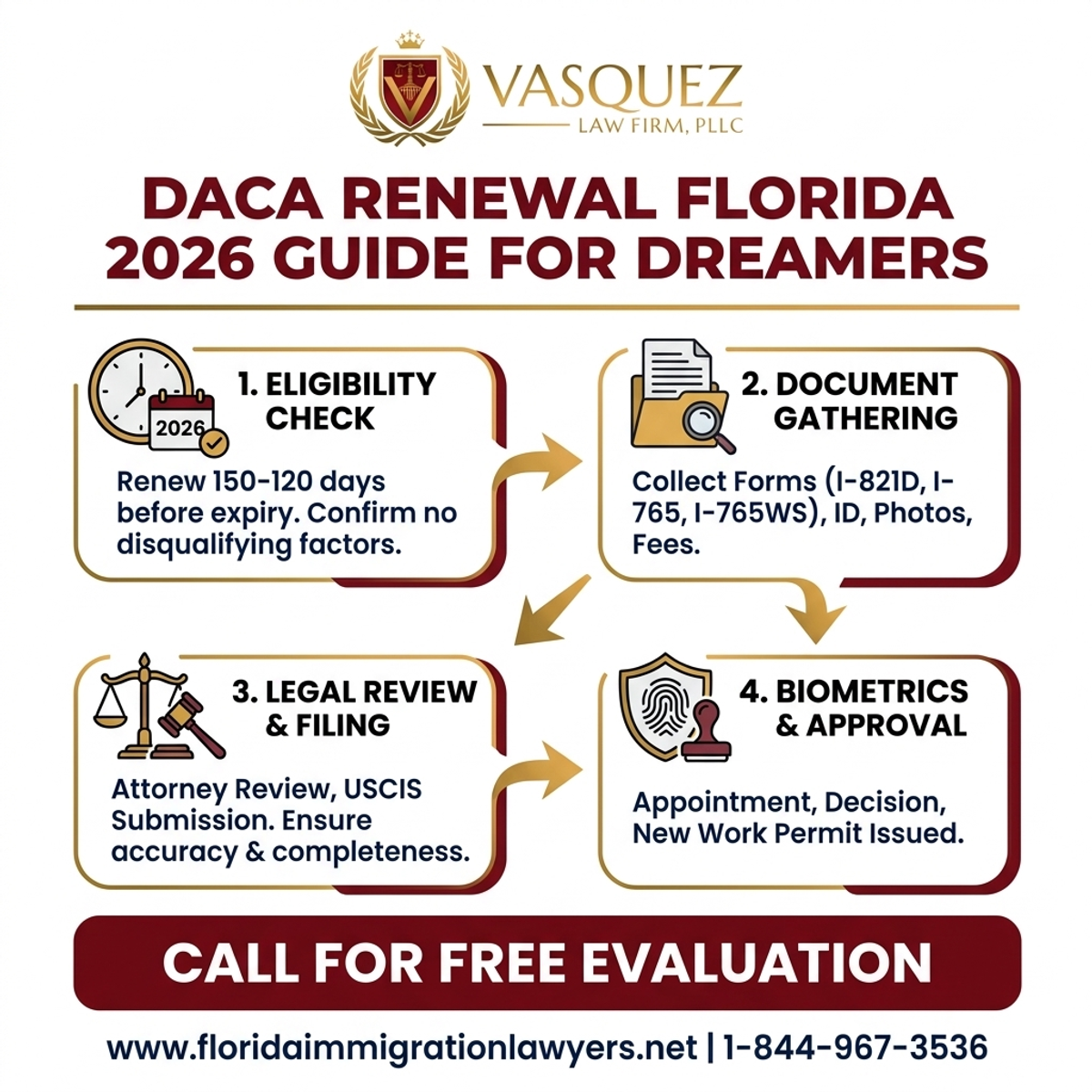
Step-by-Step Process — DACA Renewal Florida 2026 Guide for Dreamers
-
Pay the Filing Fees:
The DACA renewal application requires a specific filing fee, which includes the biometric services fee. Always verify the current fee amounts on the USCIS website, as they are subject to change. Payment can typically be made by money order, personal check, cashier's check, or by credit card using Form G-1450, Authorization for Credit Card Transactions. Fee waivers are rarely granted for DACA renewals, so plan to pay the full amount. Incorrect fee amounts will cause your application to be rejected.
-
Mail Your Application:
Send your completed application packet to the correct USCIS lockbox facility. The specific mailing address depends on the state you reside in and the type of application. For Florida residents, you will typically mail your application to a USCIS lockbox in Chicago. Always confirm the correct mailing address on the USCIS website before sending. Use a mailing service that provides tracking and delivery confirmation, such as USPS Certified Mail, FedEx, or UPS. This provides proof of submission and peace of mind.
-
Attend Biometrics Appointment (If Required):
After USCIS receives your application, you will receive a receipt notice. In some cases, you may also receive a notice to attend a biometrics appointment at an Application Support Center (ASC). This appointment is for capturing your fingerprints, photograph, and signature. It is mandatory to attend this appointment, as failure to do so can lead to a denial of your application. Be sure to bring the appointment notice and a valid photo ID.
-
Monitor Your Case Status:
You can track the status of your DACA renewal application online using the receipt number provided by USCIS. Visit the USCIS Case Status Online tool for updates. Be prepared for processing times to vary. If you do not receive a decision within the typical processing timeframe, you may inquire with USCIS. Maintain copies of all correspondence from USCIS.
Essential Document Checklist for DACA Renewal
A complete and accurate submission of documents is critical for a smooth DACA renewal Florida process. Missing or incorrect documents are among the most common reasons for delays or rejections. Before mailing your application, use this checklist to ensure every required item is included. Remember, copies are generally acceptable, but keep your originals safe.
- Most Recent DACA Approval Notice (Form I-797): A copy of the approval notice from your previous DACA grant. This serves as proof of your past deferred action status.
- Current Employment Authorization Document (EAD Card): A clear photocopy of the front and back of your valid EAD card.
- Proof of Identity: A copy of a government-issued photo identification, such as your passport, national identity card from your country of origin, or state ID.
- Proof of Continuous Residence: Documentation showing you have continuously resided in the U.S. since your last DACA approval. Examples include:
- School transcripts or report cards from Florida schools.
- Employment records, pay stubs, or W-2 forms from Florida employers.
- Bank statements, utility bills, or credit card statements addressed to you in Florida.
- Medical records or insurance statements.
- Lease agreements or rent receipts.
- Affidavits from individuals who can attest to your presence.
- Advance Parole Documents (if applicable): If you traveled outside the U.S. with advance parole since your last DACA approval, include copies of your Form I-131 approval notice and entry/exit stamps in your passport.
- Criminal History Records (if applicable): If you have any new arrests, charges, or convictions since your last DACA approval, you must provide certified court dispositions and police reports. Even minor infractions should be disclosed.
- Form I-821D, Consideration of Deferred Action for Childhood Arrivals: Completed and signed.
- Form I-765, Application for Employment Authorization: Completed and signed.
- Form I-765 Worksheet (Form I-765WS): Completed.
- Payment for Filing Fees: Check, money order, or Form G-1450 for credit card payment, made payable to "U.S. Department of Homeland Security" for the correct amount.
- Passport-Style Photographs: Two identical, unmounted, passport-style color photographs taken within 30 days of filing. Write your name and A-number lightly on the back of each photo.
DACA Renewal Timelines and Processing Expectations
Understanding the typical timelines for DACA renewal Florida is crucial for managing expectations and avoiding gaps in your status. While USCIS aims for efficiency, processing times can fluctuate based on application volume, staffing levels, and policy changes. Generally, DACA renewals are processed within 3 to 5 months from the date USCIS receives your application. However, it is always wise to plan for potential delays and submit your application well within the recommended window of 120 to 150 days before expiration.
Once you mail your application, here's a general timeline of what to expect:
- Within 1-2 weeks: You should receive a receipt notice (Form I-797C) from USCIS, confirming they have received your application. This notice will contain your receipt number, which you can use to track your case online.
- Within 3-8 weeks: If required, you may receive a biometrics appointment notice. This appointment will typically be scheduled at a local Application Support Center (ASC) in Florida, such as those in Orlando, Tampa, or Miami.
- Within 3-5 months: USCIS will review your application. During this period, they may issue a Request for Evidence (RFE) if they need additional information or clarification. Responding to an RFE promptly and thoroughly is essential to avoid delays or denial.
- Upon Approval: If your DACA renewal is approved, you will receive an approval notice (Form I-797) and your new Employment Authorization Document (EAD card) by mail. This EAD card will typically be valid for two years.

Key Statistics — DACA Renewal Florida 2026 Guide for Dreamers
It is important to note that these are estimated times. Some cases may be processed faster, while others may take longer. Monitoring your case status online and keeping all correspondence from USCIS is highly recommended. If your current DACA and EAD are nearing expiration and you have not received a decision, you may be able to contact USCIS customer service for an inquiry, but this should be done cautiously and only after the typical processing times have passed. Planning ahead and submitting a complete application minimizes stress and potential disruptions to your life.
Cost Factors and Fee Breakdown for DACA Renewal
The financial aspect of DACA renewal Florida is an important consideration for many Dreamers. The fees associated with the application are set by USCIS and are subject to change. It is crucial to always verify the current fee amounts directly on the USCIS website before submitting your application. As of the most recent updates, the total fee for a DACA renewal application typically includes two main components:
- Form I-765, Application for Employment Authorization Fee: This fee covers the processing of your work permit application.
- Biometric Services Fee: This fee covers the cost of your fingerprinting, photograph, and signature collection at an Application Support Center.
These two fees are usually combined into a single payment. USCIS does not generally grant fee waivers for DACA renewal applications, making it essential to budget for the full amount. While the specific amounts can vary, they represent a significant financial commitment for many families. Incorrect payment amounts or unpayable checks are common reasons for application rejection, so double-check the figures and ensure funds are available.
In addition to the USCIS filing fees, Dreamers in Florida should also consider other potential costs associated with the renewal process:
- Legal Fees: While not mandatory, hiring an experienced immigration attorney can significantly improve the accuracy and completeness of your application, especially for complex cases or if you have a criminal history. Legal fees vary depending on the firm and the complexity of your case, but many offer free initial consultations to discuss your options.
- Document Gathering Costs: You might incur small fees for obtaining certified court records, birth certificates, or other official documents if you don't already have them.
- Photography Costs: Passport-style photos typically cost a small amount at pharmacies or photo studios.
- Mailing Costs: Using certified mail with tracking and delivery confirmation incurs a small postal fee, but provides invaluable peace of mind and proof of mailing.
Planning for these expenses in advance can help alleviate financial stress. Many community organizations in Florida offer assistance with DACA renewal applications, sometimes including financial aid or low-cost services. Researching these resources in your local area, such as St. Petersburg, Tampa, or Miami, could be beneficial. However, always ensure that any non-attorney assistance is reputable and supervised by qualified legal professionals. Investing in a properly prepared application is an investment in your future stability.
Do not navigate this complex process alone. The nuances of immigration law, combined with the critical importance of a successful DACA renewal, make professional legal guidance invaluable. Contact Florida Immigration Lawyers today for expert assistance tailored to your specific situation. We are here to help you secure your future.
Common Mistakes to Avoid in DACA Renewal
Renewing your DACA status is a critical process, and even minor missteps can lead to significant delays or outright denial. Being aware of common mistakes can help you prepare a strong and accurate application for DACA renewal Florida in 2026. Avoid these pitfalls to protect your deferred action status and employment authorization.
-
Filing Outside the Recommended Window: Submitting your application too early (more than 150 days before expiration) can lead to rejection, while filing too late (less than 120 days) risks having your DACA and EAD expire before a decision is made. This creates a gap in your ability to work and protection from deportation, which can have serious consequences for employment and driving privileges in Florida.
-
Using Outdated Forms: USCIS frequently updates its forms. Using an old version of Form I-821D, I-765, or I-765WS will result in your application being rejected. Always download the latest forms directly from the USCIS website before preparing your packet.
-
Incomplete or Inaccurate Information: Failing to fill out every required field, providing inconsistent answers, or making typographical errors can trigger Requests for Evidence (RFEs) or even lead to denial. Double-check all personal information, dates, and addresses. Ensure your name is consistently spelled across all documents.
-
Insufficient Supporting Documentation: Not including all necessary supporting documents, such as proof of continuous residence or copies of previous approval notices, is a common reason for delays. Ensure every item on the checklist is included and clearly labeled. If a document is in a foreign language, it must be accompanied by a certified English translation.
-
Failure to Disclose Criminal History: Any arrests, charges, or convictions, no matter how minor, since your last DACA approval must be disclosed. Failing to do so is considered misrepresentation and can lead to immediate denial and potentially severe immigration consequences, including referral to EOIR for removal proceedings. Always provide certified court dispositions.
-
Incorrect Filing Fees: Submitting the wrong fee amount or using an expired check will cause your application to be rejected. Verify the exact current fees on the USCIS website. Ensure checks or money orders are correctly made out to "U.S. Department of Homeland Security" and signed.
-
Not Keeping Copies of Your Application: Always make a complete copy of your entire application packet, including all forms and supporting documents, before mailing it. This serves as your record and is invaluable if USCIS requests additional information or if your original application is lost.
-
Lapsing in Continuous Residence: DACA requires continuous residence in the U.S. If you left the U.S. without advance parole since your last DACA approval, you may have broken your continuous residence and become ineligible for renewal. This is a critical eligibility requirement.
-
Ignoring USCIS Communications: Failing to respond to an RFE or a biometrics appointment notice can lead to the denial of your application. Read all correspondence from USCIS promptly and respond within the specified deadlines. Missing an appointment can lead to denial.
When to Call a DACA Renewal Lawyer in Florida
While some DACA recipients successfully navigate the renewal process on their own, there are many situations where the expertise of an experienced immigration attorney is not just helpful, but absolutely essential. For Dreamers in St. Petersburg, Tampa, and across Florida, understanding when to seek legal counsel can make a significant difference in the outcome of your DACA renewal Florida application. Florida Immigration Lawyers are here to provide the guidance you need.
You should strongly consider contacting an attorney if any of the following apply to your situation:
- Criminal History: If you have any arrests, charges, or convictions (even minor ones) since your last DACA approval, an attorney can assess the impact on your eligibility and help you gather the necessary court documents and present your case effectively. Certain offenses can make you ineligible for DACA.
- Travel Outside the U.S. Without Advance Parole: If you left the U.S. without a valid advance parole document since your last DACA approval, your continuous residence may have been broken, potentially making you ineligible. An attorney can help determine your eligibility and explore other options.
- Previous DACA Denial or Complex History: If your previous DACA application was denied, or if you have a complex immigration history (e.g., prior removal proceedings, voluntary departure, or other immigration violations), legal counsel is vital to address these issues and strengthen your renewal application. This is particularly important to avoid deportation defense scenarios.
- Uncertainty About Continuous Residence: If you have gaps in your documentation proving continuous residence in Florida or are unsure how to demonstrate it, an attorney can help you compile compelling evidence.
- Identity or Age Discrepancies: Any discrepancies in your birth date or identity documents can complicate your application. An attorney can help you resolve these issues and provide necessary explanations to USCIS.
- Receiving a Request for Evidence (RFE): If USCIS sends you an RFE, it means they need more information. An attorney can help you understand what is being requested and formulate a comprehensive and timely response, ensuring all specific requirements are met.
- Concerns About Asylum or Other Relief: If you are also exploring other forms of immigration relief, such as asylum, or if you have concerns about potential removal proceedings, an attorney can provide holistic advice on how DACA renewal fits into your broader immigration strategy.
Do not wait until you receive a denial or an RFE to seek help. Proactive legal consultation can prevent problems before they arise. Florida Immigration Lawyers have extensive experience assisting Dreamers throughout Florida, including those in St. Petersburg, with their DACA renewals. We are committed to protecting your rights and securing your future. Our team can help you navigate the complexities of USCIS regulations and ensure your application is as strong as possible.
About Florida Immigration Lawyers
Florida Immigration Lawyers is a premier immigration law firm dedicated to serving individuals and families across the entire state of Florida. With a deep understanding of U.S. immigration law and a compassionate approach, we provide comprehensive legal services to immigrants navigating complex legal processes. Our firm is committed to protecting the rights and securing the futures of our clients, from family immigration to business immigration matters.
Our experienced attorneys specialize in a wide range of immigration services, including DACA renewals, citizenship applications, deportation defense, asylum claims, visa petitions, and green card applications. We pride ourselves on offering personalized attention and strategic legal solutions tailored to each client's unique circumstances. We understand the challenges and anxieties that come with immigration issues and strive to provide clear communication, unwavering support, and effective representation.
Why choose Florida Immigration Lawyers? We offer free consultations to assess your case, are available 24/7 to address your urgent concerns, and have a proven track record of success. Our bilingual team ensures that language is never a barrier to receiving quality legal assistance. Whether you are in St. Petersburg, Miami, Orlando, or anywhere else in Florida, our dedicated attorneys are here to advocate for you. Visit our website at www.floridaimmigrationlawyers.net or call us at 1-844-967-3536 to schedule your free consultation today.
Sources and References
- U.S. Citizenship and Immigration Services (USCIS)
- USCIS - Deferred Action for Childhood Arrivals (DACA)
- USCIS - Filing Fees
- Executive Office for Immigration Review (EOIR)
- Immigration and Nationality Act (INA) Section 235 (8 U.S.C. § 1225) - Inspection by Immigration Officers; Expedited Removal of Inadmissible Arriving Aliens; Referral for Hearing
- 8 Code of Federal Regulations (CFR) Part 274a - Control of Employment of Aliens
- USCIS Policy Manual, Volume 1, Part A, Chapter 3 - Discretionary Decisions
Related services: immigration practice areas, free immigration consultation.
This article provides general legal information and is not intended as legal advice. Every case is unique, and outcomes depend on specific facts and circumstances. Contact an attorney for advice about your particular situation.
Your DACA status is too important to leave to chance. The process of DACA renewal Florida requires precision, up-to-date knowledge, and often, the strategic insight of an experienced legal professional. Don't risk delays or denial by navigating the complexities alone. Secure your future and maintain your ability to live and work in Florida by getting the expert legal support you deserve.
Contact Florida Immigration Lawyers today for a free, confidential consultation. Call us at 1-844-967-3536. Se Habla Español - Estamos aqui para ayudarle.
Do Not Navigate This Process Alone
Our experienced immigration attorneys are ready to fight for you. Get a free, confidential consultation today.
Se Habla Español
Frequently Asked Questions
Florida Immigration Lawyers
Immigration Attorney | Founder, Vasquez Law Firm
U.S. Air Force veteran and immigration attorney with thousands of cases resolved. J.D., NCCU School of Law. AILA member. Admitted to the 4th, 5th, and 11th Circuit Courts.
Available 24/7 - Free Evaluations
Related Legal Services
Our Florida immigration attorneys can help you with deportation defense, citizenship and naturalization and family immigration services. Call today at 1-844-967-3536 for a free consultation.
Related Links
Related Topics
Free Legal Consultation
Discuss your case with our experienced attorneys. We're available 24/7.
Se Habla Español - Estamos aquí para ayudarle.
Related Articles
DACA Renewal Florida 2026 Guide for Dreamers | VLF Florida
Learn how to renew your DACA in Florida for 2026. This guide provides essential steps, common pitfalls, and resources available to Dreamers in Hialeah and beyond. Call Florida Immigration Lawyers at 1-844-967-3536 for a free consultation.
Understanding the I-864 Affidavit of Support in Florida
Learn about the I-864 Affidavit of Support, a critical step for sponsoring family members in Florida. This guide covers requirements, common mistakes, and when to seek legal counsel. Contact Florida Immigration Lawyers for expert assistance.
Find an Immigration Lawyer in Hialeah, Florida | VLF Florida
Finding the right immigration lawyer in Hialeah, Florida, is crucial for navigating complex immigration processes. With a growing Hispanic community, Hialeah offers access to experienced Spanish-speaking lawyers who can assist with visas, asylum applications, and deportation defense.
Immigration Lawyer Miami: Expert Florida Services for You
Navigating immigration law in Miami, Florida, is exceptionally complex. An experienced immigration lawyer in Miami is vital for anyone seeking family visas, employment-based green cards, asylum, or facing deportation. This comprehensive guide from Florida Immigration Lawyers explores the essential services our Miami attorneys provide, including family-based immigration, deportation defense, and naturalization. We outline the step-by-step process, crucial document checklists, and factors influencing timelines and costs. Learn about common mistakes to avoid and understand when professional legal counsel is indispensable. Contact us for a free consultation to ensure your immigration journey is handled with expertise and care.